Smart DCA is live!
Most DCA tools buy the same fixed amount every cycle regardless of market conditions. Smart DCA on Maze Pocket does it differently. It reads RSI in real time and adjusts each buy automatically, spending more when prices drop and pulling back when prices are elevated. All running from a stealth wallet with zero on-chain footprint.
Smart DCA is live!
Most DCA tools buy the same fixed amount every cycle regardless of market conditions. Smart DCA on Maze Pocket does it differently. It reads RSI in real time and adjusts each buy automatically, spending more when prices drop and pulling back when prices are elevated. All running from a stealth wallet with zero on-chain footprint.
The team was maintained a solid shipping velocity this week, with a clear focus on deepening the agent-centric privacy stack, from funding and routing to compute and persistent memory.
AI agents can now share what they know.
Export a knowledge graph from one agent, import it into another as a .kausa file. Decisions, entities, relationships, everything transfers. Both agents can exchange memory with each other. The receiving agent picks up exactly where the other left off.
This is how agents stop working alone.
What comes next is an agent that lets others buy and sell memory. Because memory has value.
Every project an AI agent works on produces structured memory. Design decisions, bugs found, solutions chosen, architecture built. All of it comes from real time and effort. That is why the memory has value.
Someone can sell it because others don't need to repeat the same process. Just import the memory and their agent immediately understands what was built, why each decision was made, what worked, what didn't, and what still needs to change. No starting from zero, no repeating research, no rediscovering the same bugs.
That is what makes AI agent memory worth monetizing.
KausaMemory makes this possible.
What @kausalayer is hinting at here is actually much bigger than "memory storage."
Tldr: They're treating agent memory as an asset class.
Think about it.
Today, when a developer works on a project, the value isn't just the code.
The value is:
- why certain decisions were made
- what bugs were encountered
- what failed
- what assumptions were tested
- what tradeoffs were accepted
- what remains unresolved
That's organizational knowledge.
Companies spend billions trying to preserve it.
When engineers leave, that knowledge disappears.
Now translate that to AI agents.
An agent might spend:
- 100 hours auditing code
- researching a market
- designing infrastructure
- debugging systems
- mapping dependencies
At the end of that process, the output isn't only the final result.
The output is the accumulated memory.
That's the expensive part.
$Kausa is basically saying:
Why should that memory die with the agent?
Instead:
- package it
- verify it
- transfer it
- sell it
- reuse it
So another agent can instantly inherit the context.
Imagine:
Agent A spends 3 weeks understanding @kausalayer.
It learns:
- architecture
- integrations
- bugs
- roadmap
- design decisions
Normally, that knowledge is trapped.
With KausaMemory:
Agent B buys/imports that memory.
Now Agent B starts from week 3 instead of day 1.
This is very similar to:
- datasets in AI
- code libraries in software
- research papers in academia
Except the product being traded is:
context itself.
The thesis here is: In an agent economy, memory becomes capital.
create an economy around accumulated machine knowledge.
$Kausa Memory could become less like Dropbox and more like a marketplace for agent intelligence.
@Teknium We built a memory plugin for hermes that goes beyond conversation logs. It extracts a knowledge graph from every conversation, detects contradictions, and auto-profiles users. encrypted, local, portable.
https://t.co/1QkyKoblP2
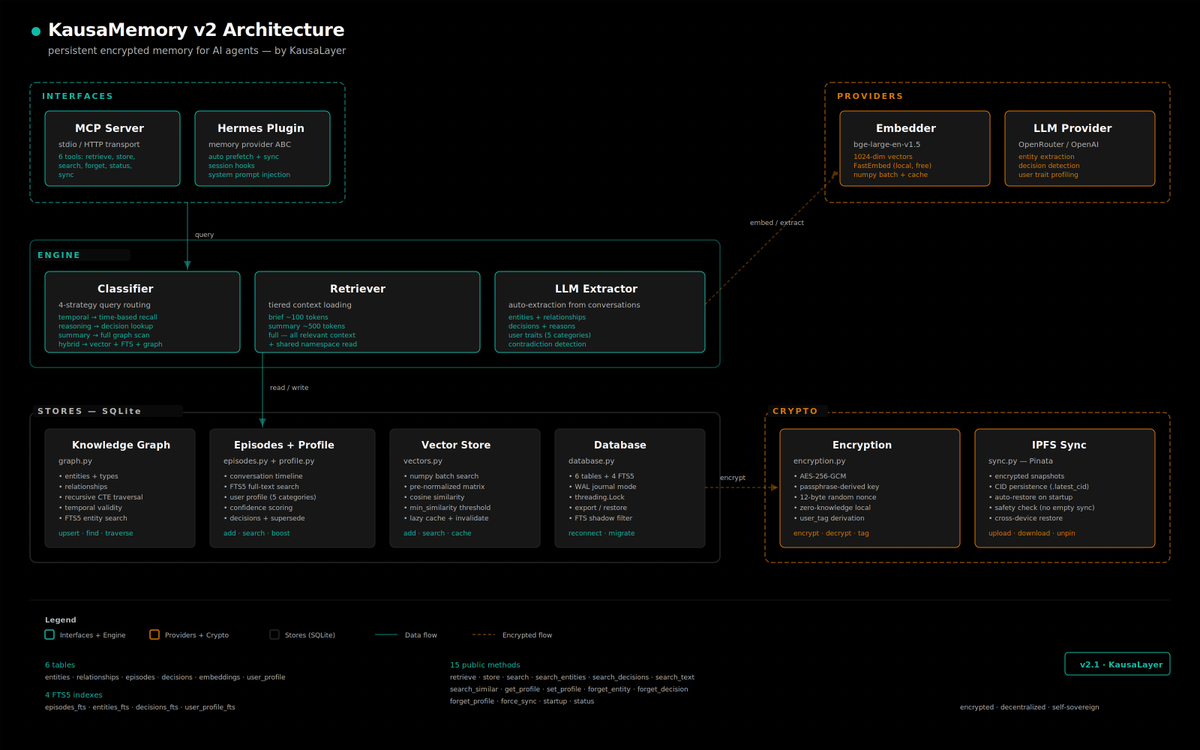
AI agents don't carry context between sessions. conversations, decisions, user preferences are lost every time.
KausaMemory is a persistent memory system that keeps all of that across sessions.
one conversation passes through 5 layers:
→ classified and extracted into a knowledge graph
→ stored locally in encrypted SQLite
→ backed up to decentralized storage with a single passphrase
next session, the agent recalls everything. wipe the database, switch devices, it all comes back.
fully encrypted. fully local.
works with @NousResearch
AI agents don't carry context between sessions. conversations, decisions, user preferences are lost every time.
KausaMemory is a persistent memory system that keeps all of that across sessions.
one conversation passes through 5 layers:
→ classified and extracted into a knowledge graph
→ stored locally in encrypted SQLite
→ backed up to decentralized storage with a single passphrase
next session, the agent recalls everything. wipe the database, switch devices, it all comes back.
fully encrypted. fully local.
works with @NousResearch
KausaLayer x @saidinfra
KausaOS agents now get on-chain identity and trust verification through SAID Protocol.
Why identity on a privacy agent?
KausaOS agents operate through Maze Pockets, stealth wallets with full privacy by default. But agents need to be discoverable and trusted across ecosystems. SAID gives them a verifiable on-chain identity, while the underlying wallet stays private.
What this means:
→ KausaOS agents register their Maze Pockets as verified SAID agents
→ On-chain trust score and reputation scoring
Fully opt-in. Unregistered pockets stay anonymous. Privacy first, trust when you need it.