Aviation needs trust. Blockchain was built for it.
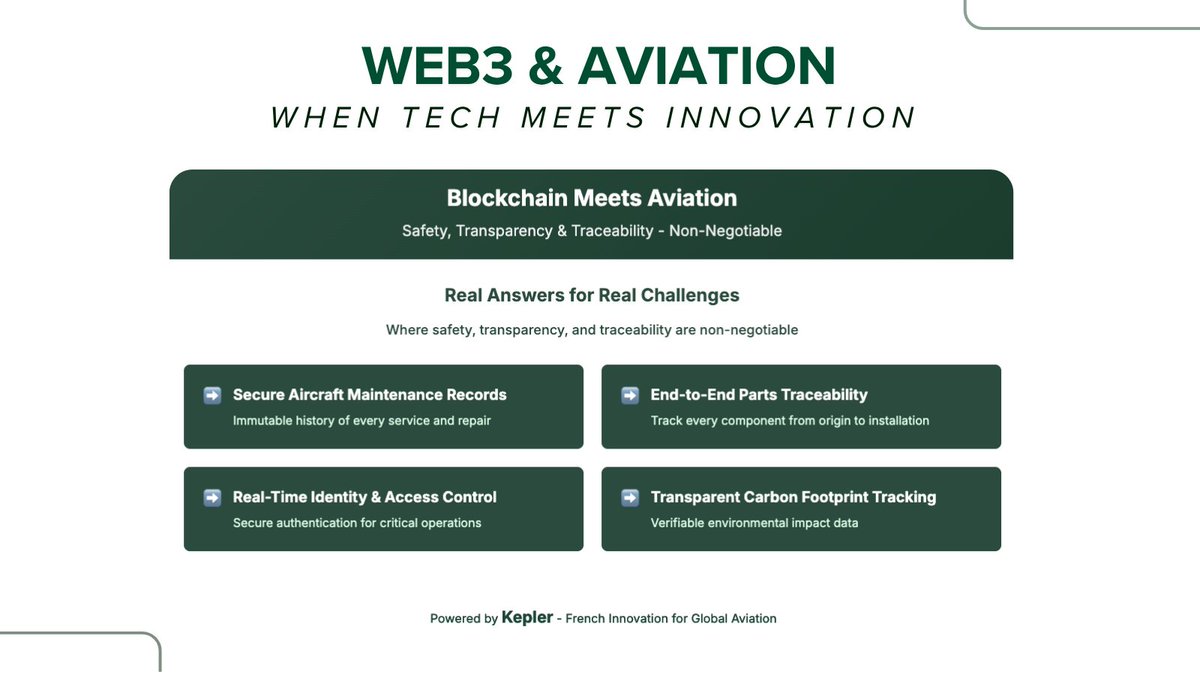
In an industry where safety, transparency, and traceability are non-negotiable, blockchain brings real answers:
➡️ Secure aircraft maintenance records
➡️ End-to-end traceability of parts
➡️ Real-time identity & access control
➡️ Transparent carbon footprint tracking
At Kepler, we’re building tools that connect aviation to the power of Web3 for a safer, greener, and more efficient sky.
Let me tell you a story I keep hearing from training orgs.
A flight school issues a type rating. Five years later, the pilot leaves for
another airline. That airline's HR team needs to verify the certificate is
real.
What happens today:
→ An email to the original school
→ A delay of a few days
→ A manual check from someone who may or may not still work there
→ A reply with an attached PDF that technically proves nothing
→ A decision based on "it looks legitimate"
What happens with AeroCert:
→ Drop the original file into our verification page
→ We re-compute the hash
→ We check the chain
→ Match or no match, in 3 seconds
Same outcome. A thousand times less friction. And — this is the part most
people miss — the result is audit-proof. If the airline ever has to justify
why they trusted that certificate, they have cryptographic evidence, not a
screenshot.
That's the unglamorous reason design partners actually adopt AeroCert.
"We've never had a counterfeit parts problem."
Every MRO that eventually got burned once said this.
Here's the uncomfortable truth: the question isn't whether fakes exist in your
supply chain. The question is whether you'd be able to prove they don't —
today, in under an hour, to a regulator asking about a specific serial number.
Most MROs can't answer that question without a scramble. Spreadsheet lookups.
Vendor emails. Archived PDFs on a file server three IT migrations old.
AeroCert changes the shape of that conversation.
→ Every incoming document gets a hash check in 3 seconds
→ Every outgoing work order gets anchored as you issue it
→ Every record you've ever produced stays verifiable, even if your vendor goes
bankrupt tomorrow
The best protection against a counterfeit parts scandal isn't hoping it
doesn't happen.
It's being the one organization in the chain that can prove, instantly, that
it didn't come from you.
Most "digital records" in aviation today are just databases with nicer user
interfaces.
That's not a nitpick. It's the entire problem.
A database can be:
→ Rewritten by an admin
→ Subpoenaed by a court
→ Corrupted by a hack
→ Wiped by a disgruntled employee
→ Lost in a migration
→ Decommissioned when the company shuts down
None of these scenarios are hypothetical. All of them have happened.
The FAA has been clear for years that airworthiness records must be
tamper-evident, a word that means something very specific. It means: even the issuer shouldn't be able to silently alter the record after the fact.
A database can't meet that bar. A cryptographic anchor on a public ledger can.
That's the difference between "we stored it digitally" and "we built it to
last." AeroCert is designed for the second one.
Here's something most outsiders don't realize about aviation parts.
The global market is worth roughly $100 billion a year. Engines, blades,
avionics, landing gear, thousands of line-replaceable units moving across
continents every single day.
And almost all of it — all of it — runs on scanned PDFs for proof of
authenticity.
→ The parts dealer trusts the sender
→ The MRO trusts the parts dealer
→ The airline trusts the MRO
→ The passenger trusts the airline
That's not a supply chain. That's an honor system with wings.
And it's exactly how the AOG Technics scandal happened. Nobody at any layer of
that chain had a way to verify the original document. So the fakes slipped
through every step.
AeroCert doesn't ask you to trust harder.
It removes the need for trust in the first place.
A question I've been asked a lot recently:
"Why would aviation, the most regulated industry on earth, actually need
blockchain?"
It's a fair question. The answer isn't "because blockchain." The answer is
that aviation already has every property that makes anchoring certificates the
right architectural choice:
→ The certificates already exist — Form 1s, type ratings, logs, inspections.
We're not adding paperwork.
→ The supply chain is distributed — OEMs, MROs, regulators, operators all
touch the same documents, and none of them fully trust each other by default.
→ The stakes are life-threatening, not financial — a fake handbag is a
consumer problem, a fake turbine blade is a crash waiting to happen.
→ An aircraft flies for 30 years — records have to survive decades,
bankruptcies, acquisitions, and server migrations.
Every one of these is a reason a neutral, shared, tamper-evident ledger beats
a centralized database.
Introducing AeroCert.
We built it because the aviation industry has spent decades perfecting
engines, airframes, and flight procedures — while leaving the paperwork that
backs all of it stuck in the 1990s.
Here's what AeroCert does, in plain language:
→ You upload any aviation certificate, document, or data payload
→ We compute a unique cryptographic fingerprint of that file
→ That fingerprint gets anchored on-chain, with a timestamp and the issuer's
identity
→ From that moment on, anyone can verify the document in under 3 seconds
No more phone calls to OEMs. No more leap-of-faith PDFs. No more "we'll get
back to you next week."
✔︎ EASA- and FAA-aligned
✔︎ ISO 27001 architecture
✔︎ AES-256 encryption
✔︎ Public verification endpoint
✔︎ Open API for integrations
Most people think the aviation industry's biggest trust problem is on the
tarmac.
It's not. It's in the filing cabinet.
Every day, millions of decisions in this industry are backed by a single
artifact: a certificate. An EASA Form 1. An FAA 8130-3. A training record. A
maintenance log.
All of them, in 2026, still live as PDFs you can scan, edit, and forward.
→ A parts dealer in one country trusts a document issued in another
→ An MRO inherits that trust when they install the part
→ The airline inherits it again when the aircraft takes off
→ And nobody in that chain has a way to verify the original in seconds
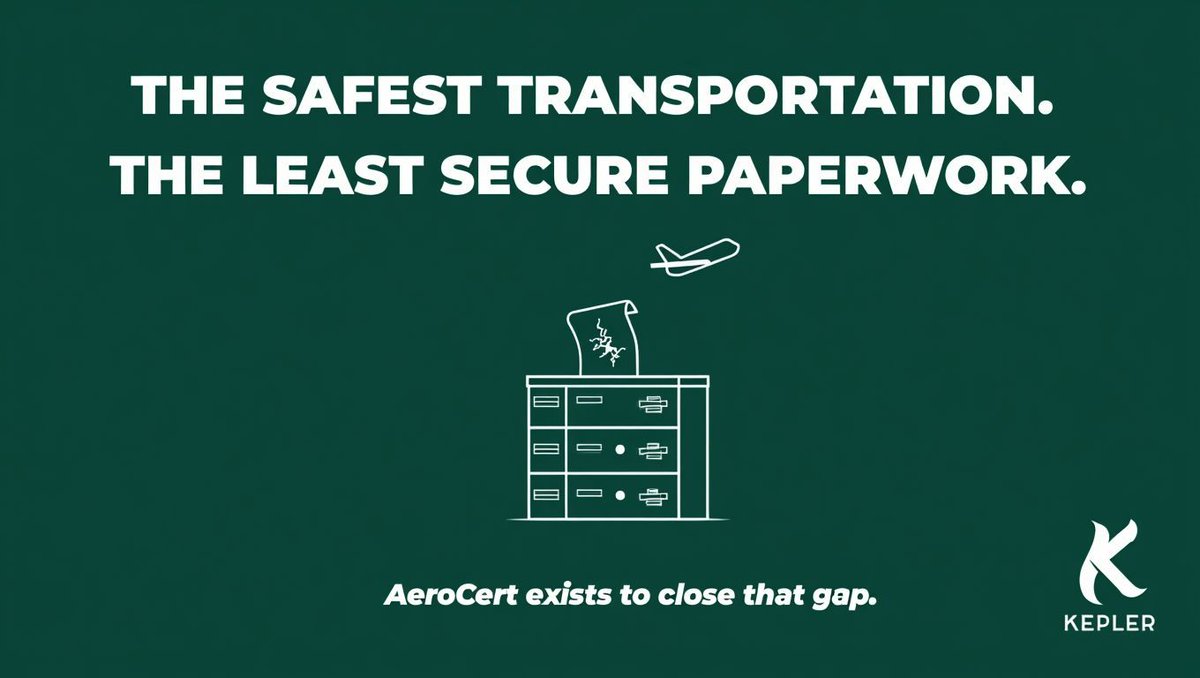
The safest form of transportation in history is backed by the least secure
paperwork in the world.
AeroCert exists to close that gap.
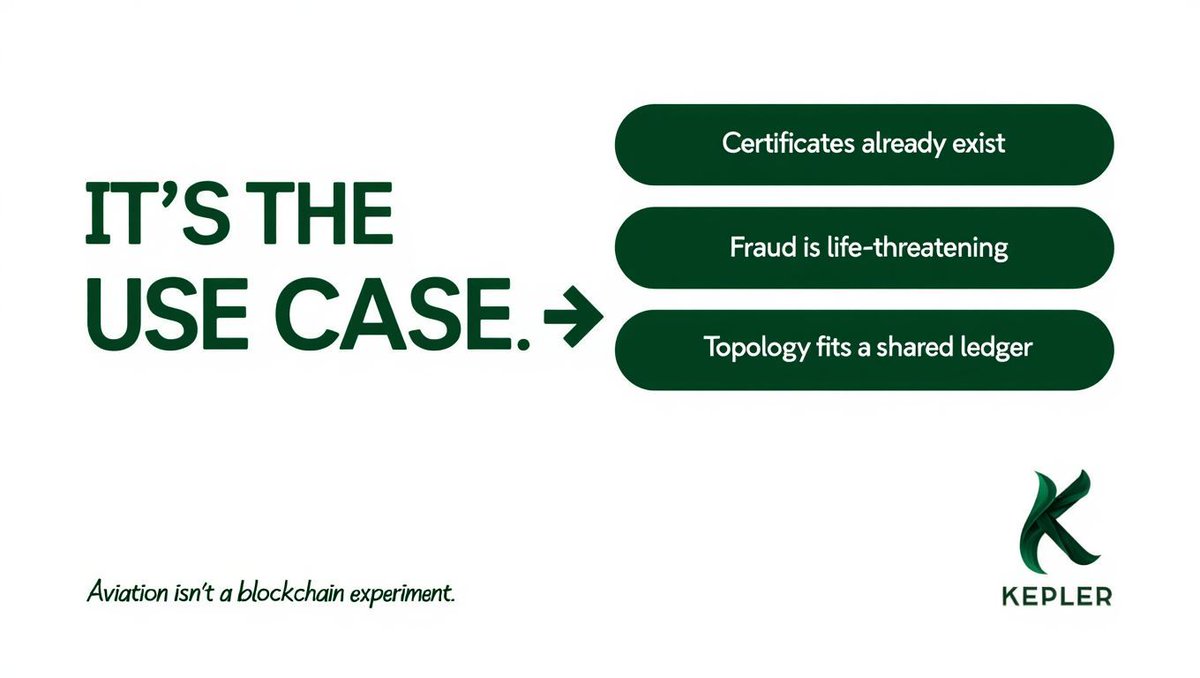
Three reasons aviation is the right industry for blockchain-anchored
certificates — and why most other industries are the wrong one.
→ The certificates already exist. We're not adding paperwork.
→ The cost of fraud is life-threatening, not financial.
→ No single authority owns the chain — the topology already fits a shared
ledger.
Aviation isn't a blockchain experiment. It's the use case 🔧
An aircraft flies for 30 years. Its certification records have to be
verifiable for 30 years.
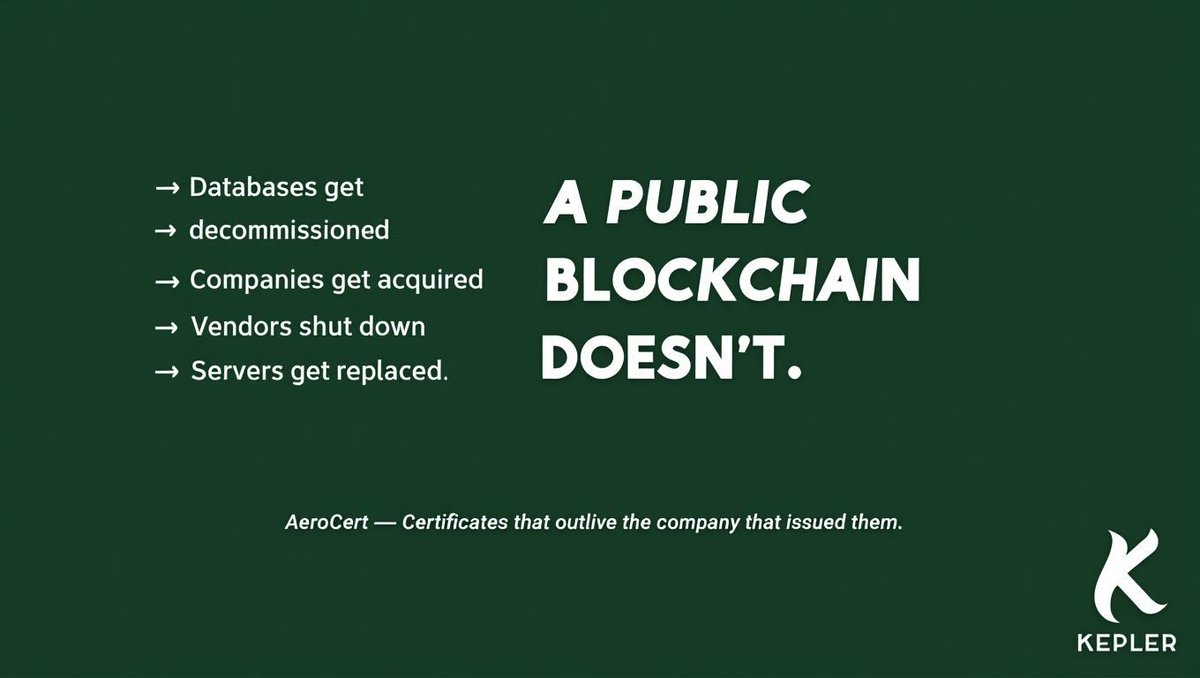
→ Databases get decommissioned.
→ Companies get acquired.
→ Vendors pivot or shut down.
→ Servers get replaced.
A public blockchain doesn't.
That's why AeroCert anchors. It's the only way a certificate can outlive the
company that issued it.
Every counterfeit aviation part in circulation today passed a document check.
📃The document was the problem.
No one in the supply chain had a way to verify a Form 1 or 8130-3 in real
time. So everyone defaulted to trusting the sender.
Trust in the sender is how fakes get on aircraft.
Trust in the math is how we stop them.
Aviation is evolving.
Operations are becoming smarter.
Aircraft are becoming more connected.
Regulations are becoming more complex.
But the digital infrastructure behind many critical processes is still catching up.
Kepler Aviation exists to accelerate that evolution.
We design and engineer next-generation digital infrastructure for the aviation industry — built with precision, scalability, and long-term resilience in mind.
Our aim is simple:
Make aviation systems clearer.
Stronger.
More trustworthy.
More future-ready.
To achieve that, we leverage some of the most advanced engineering processes available today:
→ AI-assisted development workflows
→ modern scalable architectures
→ security-by-design principles
→ API-first systems
→ blockchain-backed verification models
→ compliance-aware engineering
We combine deep technical rigor with a forward-looking mindset.
Because aviation does not need more tools.
It needs better foundations.
We work with organizations across the aviation ecosystem:
Things AeroCert anchors today:
▎ ✔︎ Training certificates
▎ ✔︎ Maintenance records
▎ ✔︎ Airworthiness documents
▎ ✔︎ Battery Digital Product Passports
▎ ✔︎ Inspection reports
▎ ✔︎ Parts traceability records
One platform. One verification layer. One source of truth.
Let’s clear something up.
Blockchain is useless in most industries.
But in aviation?
It solves something very specific:
→ independent verification
→ tamper resistance
→ cross-border trust
→ decentralized audit capability
Aviation is international by nature.
Aircraft don’t stay in one country.
Certificates shouldn’t depend on one server either.
AeroCert isn’t trying to “put aviation on-chain”.
It anchors verification layers on-chain.
Subtle difference.
Massive impact.
If you want infrastructure thinking instead of crypto buzz:
👉 https://t.co/iyUczQQGXm
Training companies are one of the most underestimated pillars in aviation.
They certify pilots.
They certify technicians.
They certify safety staff.
And yet their digital tools often:
❌ don’t reflect their authority
❌ don’t protect their credibility
❌ don’t scale internationally
❌ don’t secure their certificates
MBA Clarity changes that dynamic.
It gives training organizations:
→ structured catalog management
→ session tracking
→ student lifecycle monitoring
→ automated certificate issuance
→ blockchain anchoring via AeroCert
Your certification becomes:
Not just a document.
But a digitally provable credential.
And that changes reputation dynamics.
We don’t build “platforms”.
We build leverage.
Explore the ecosystem:
👉 https://t.co/iyUczQQGXm
Airport handlers move thousands of people and aircraft every single day.
And yet…
Their certification systems often look like:
→ shared folders
→ scanned PDFs
→ manual Excel tracking
→ email confirmations
→ “can you resend that document?”
In an industry where safety is everything.
That gap is wild.
With AeroCert + structured certification logic, we’re building:
✔️ instant verification
✔️ immutable training history
✔️ clean role-based validation
✔️ digital audit trails
Not for hype.
For operational clarity.
Airport operations shouldn’t slow down because of paperwork friction.
If you’re an airport handler or training company —
you’ll want to look at what we’re building.
👉 https://t.co/iyUczQQGXm
Serious industry.
Serious standards.
But we still laugh a lot.
And that matters.
Because building in aviation is demanding.
You deal with compliance.
You deal with traceability.
You deal with “what if something fails?”
If the team can’t enjoy working together,
that pressure becomes heavy fast.
What I’ve learned:
Strong teams are not the loudest.
They’re the most stable.
Calm.
Focused.
Comfortable challenging each other.
That’s the energy in this room.
Aviation platforms will never stay small.
Not because they want to.
Because they must scale:
🔹 more users
🔹 more trainings
🔹 more certificates
🔹 more queries
🔹 more integrations
🔹 more compliance checkpoints
That means:
→ predictable architecture
→ performance targets
→ reliability SLAs
→ observable systems
→ graceful error handling
We build with that in mind because aviation doesn’t pause for short-term fixes.
See the long-term vision:
👉 https://t.co/iyUczQQGXm
Today many aviation systems require:
❌ manual checks
❌ phone calls
❌ PDF hunting
❌ version confusion
That’s expensive.
AeroCert enables:
✅ QR-code based verification
✅ independent third-party checks
✅ immutable history you don’t have to trust blindly
✅ instant certainty at the point of need
Verification shouldn’t require a training session.
It should be effortless.
That’s what we’re building.
👉 https://t.co/iyUczQQGXm
Let’s be honest.
Most people hear “blockchain” and think buzzword.
But in AeroCert, blockchain is just the last mile of a bigger story:
➡️ a reliable workflow
➡️ controlled validation states
➡️ unchangeable history
➡️ audit-friendly structure
Blockchain doesn’t replace the system.
It anchors trust.
If you build your internal logic poorly and then anchor it on-chain…
You just anchor garbage on-chain.
AeroCert starts with strong backend logic, then adds verification.
Not the other way around.
If you want to explore the real approach we’re building for aviation:
👉 https://t.co/iyUczQQGXm