Excited to share that our paper "1000 Layer Networks for Self-Supervised RL: Scaling Depth Can Enable New Goal-Reaching Capabilities" has won the Best Paper Award at NeurIPS '25!
Hope to see you all in San Diego :)
1/ While most RL methods use shallow MLPs (~2–5 layers), we show that scaling up to 1000-layers for contrastive RL (CRL) can significantly boost performance, ranging from doubling performance to 50x on a diverse suite of robotic tasks.
Webpage+Paper+Code: https://t.co/43xwfJEIjh
In Astra, we made significant progress on subjective domains like design aesthetics and knowledge work. It’s been a blast developing new methods for training on non-verifiable domains. Excited for this line of work and what’s coming next. Go try out Astra when you can! :)
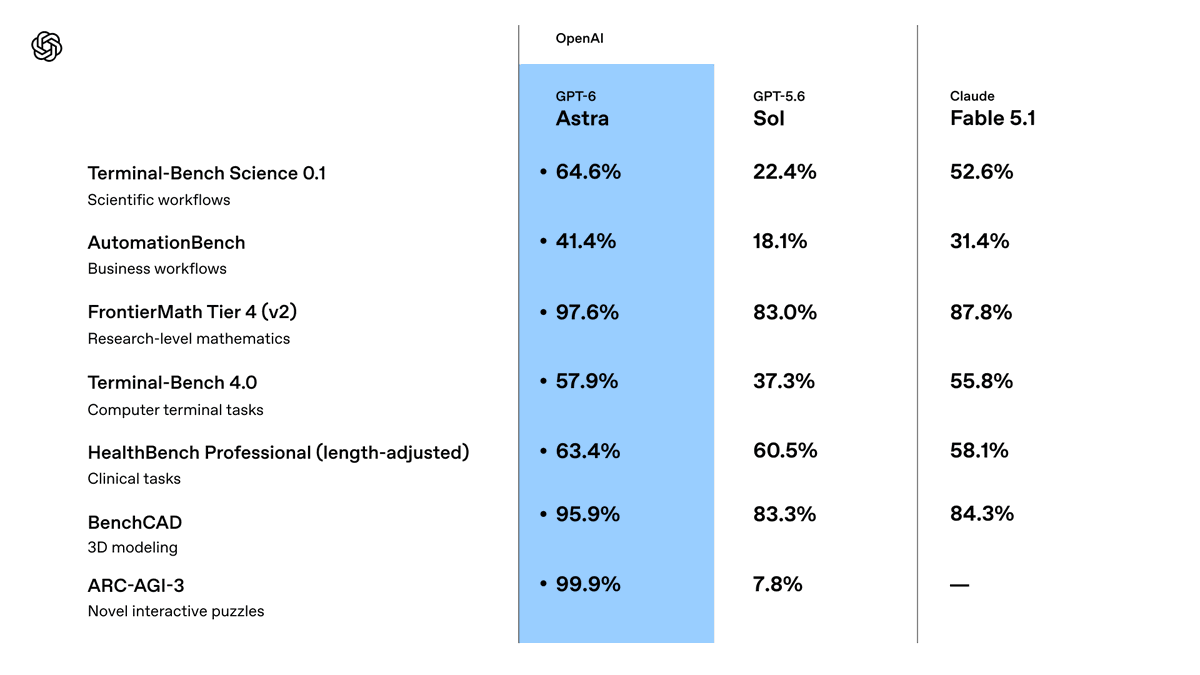
GPT-6 Astra is state-of-the-art on FrontierMath Tier 4, ARC-AGI 3, and TerminalBench-4.0.
GPT‑6 Astra is also a major advance for scientific discovery, with state-of-the-art performance on Terminal-Bench Science 0.1 and HealthBench Pro.
An internal version of Astra, @OpenAI’s next major model family, solved 10 major open problems in mathematics, quantum complexity, and theoretical computer science.
We believe it will be a major step for scientific reasoning. https://t.co/iP6cyheZ7i
Introducing GPT-5.5
A new class of intelligence for real work and powering agents, built to understand complex goals, use tools, check its work, and carry more tasks through to completion. It marks a new way of getting computer work done.
Now available in ChatGPT and Codex.
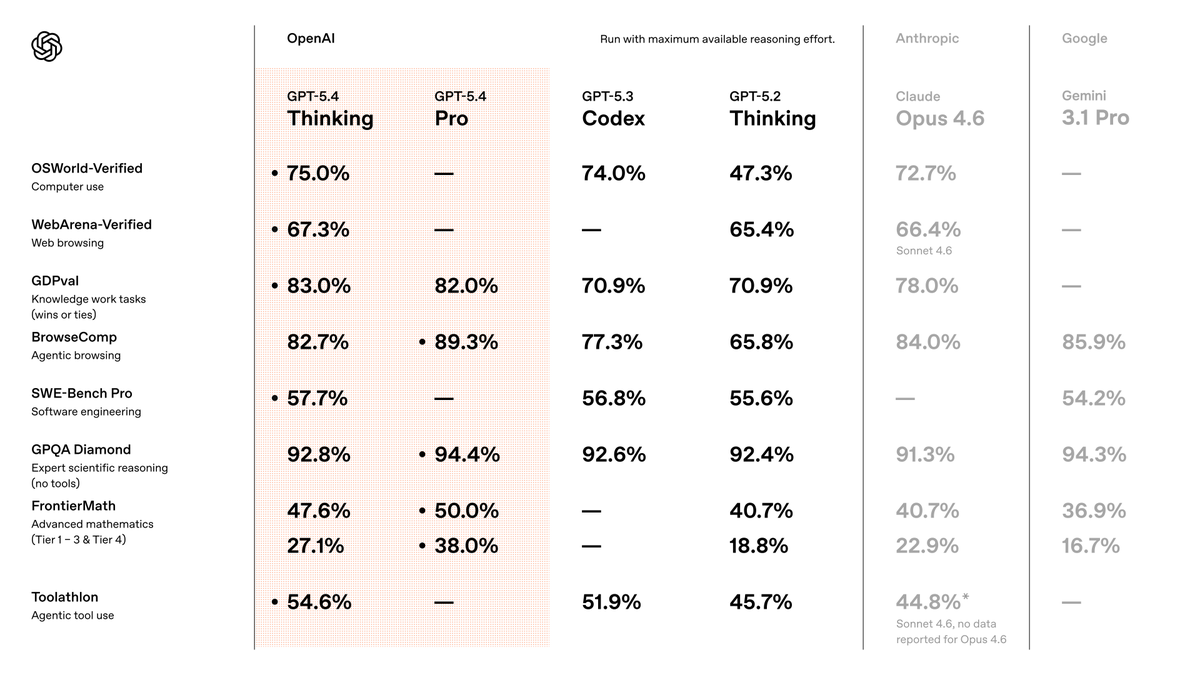
GPT-5.4 Thinking and GPT-5.4 Pro are rolling out now in ChatGPT.
GPT-5.4 is also now available in the API and Codex.
GPT-5.4 brings our advances in reasoning, coding, and agentic workflows into one frontier model.
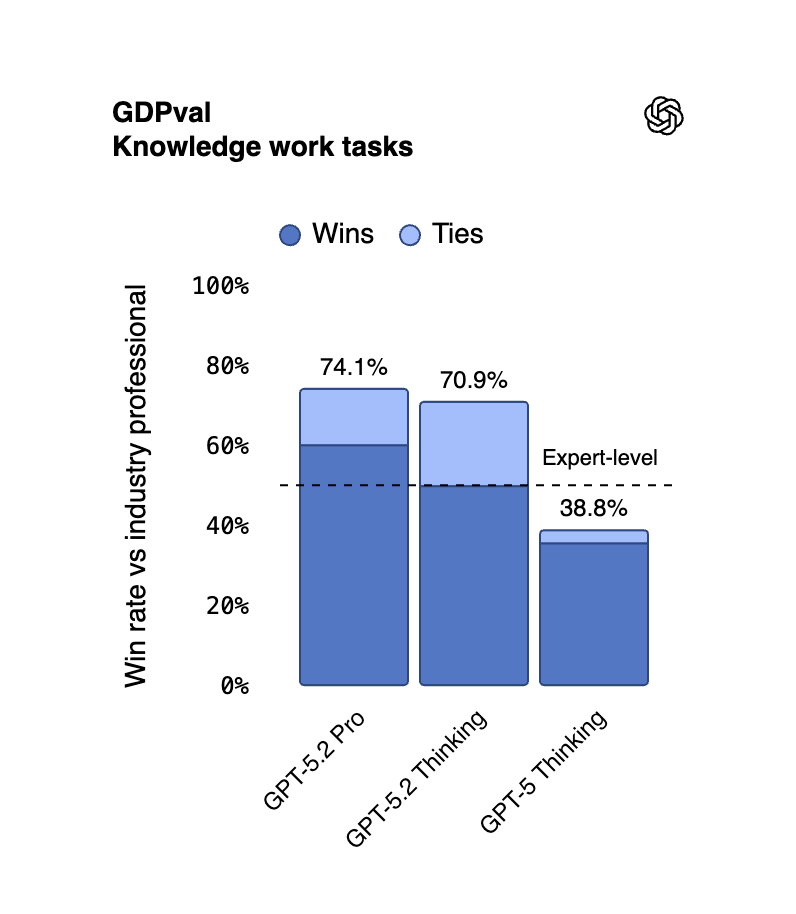
On GDPval, an eval measuring well-specified knowledge work tasks across 44 occupations, GPT-5.2 Thinking is our first model that performs at a human expert level.
These tasks include making presentations, spreadsheets, and other artifacts.
Happy to share that our work “1000 Layer Networks for Self-Supervised RL: Scaling Depth Can Enable New Goal-Reaching Capabilities” was accepted to #NeurIPS2025 as an Oral Presentation!
Grateful to my amazing collaborators @IJ_Apps@m_bortkiewicz@ben_eysenbach 🥳
1/ While most RL methods use shallow MLPs (~2–5 layers), we show that scaling up to 1000-layers for contrastive RL (CRL) can significantly boost performance, ranging from doubling performance to 50x on a diverse suite of robotic tasks.
Webpage+Paper+Code: https://t.co/43xwfJEIjh
@rasbt Great stuff @rasbt! What's the literature behind the design decision of LN both before and after the attn/FFNs (vs. pre-LN only)? Also, thoughts on adding variable-length batched inference? Would you (A) left-pad + modify mask, or (B) right-pad + gather per-sequence "last index"?
@nrehiew_ This might be a dumb question, but can Claude Code be used on a remote server (like a university computing cluster) that doesn't have npm installed and where I lack installation permissions, rather than running it locally?