You can now bring your own key (BYOK) to Kilo Gateway across 20 providers.
That means you can use your own API keys or coding subscriptions across Kilo, with advanced usage analytics, cost tracking, and access across the full Kilo product suite.
0% markup. You get billed directly by your provider.
Here’s how to set it up:
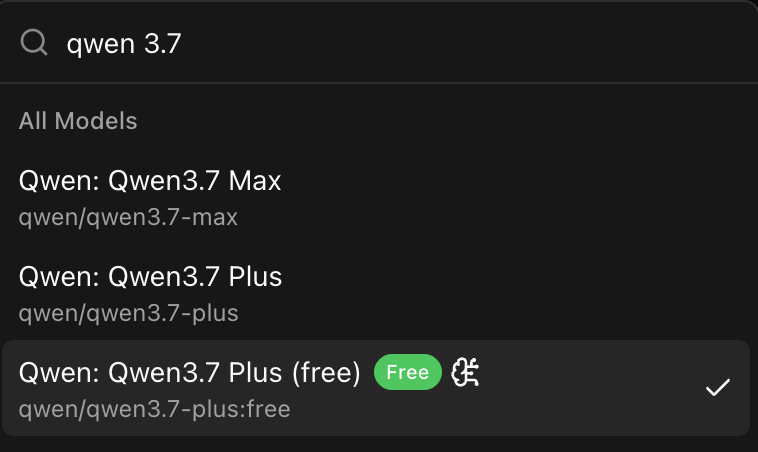
Qwen 3.7 Plus is free in Kilo for a limited time!
@Alibaba_Qwen's new multimodal agent model reads screens, navigates GUIs, generates code from visual references, and works across GUI and CLI. 1M token context.
It's free for a couple more days. Try it now.
@StepFun_ai Step 3.7 Flash is where I'd point people to first this week. 👇
198B sparse MoE, ~11B active per token — so you get big-model reasoning at a speed that actually holds up at long context. 256K window, selectable reasoning tiers, Apache 2.0.
And it’s free in @kilocode
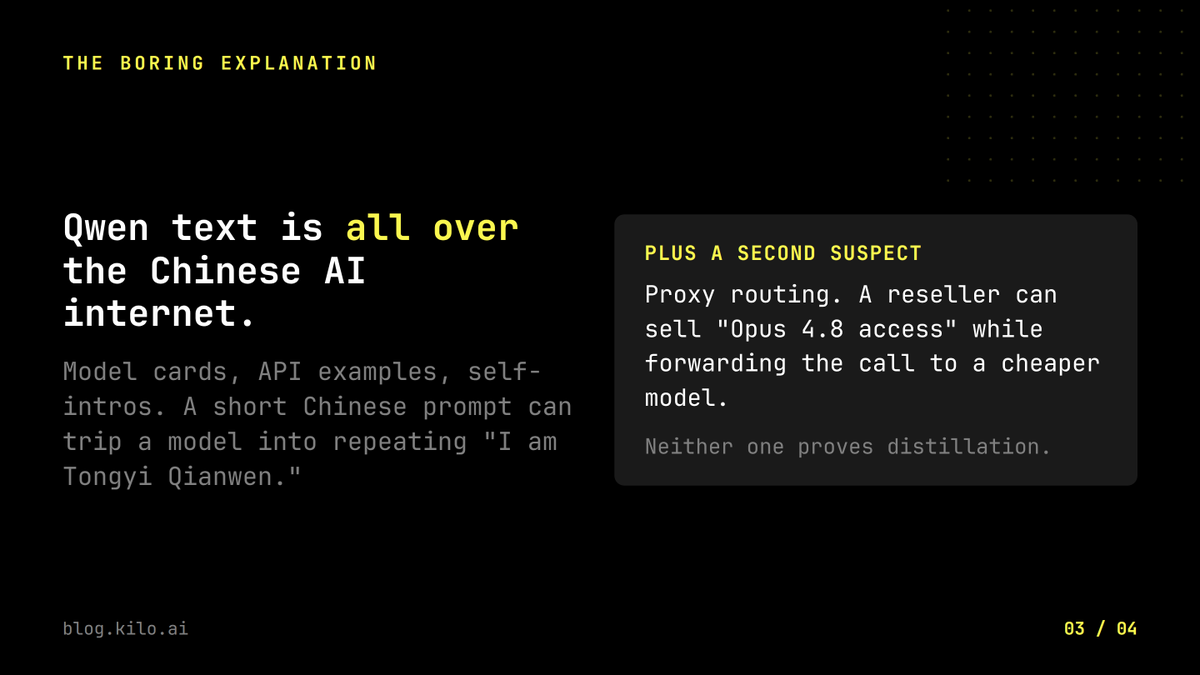
The real lesson for anyone building on these models: never trust a model's self-report for identity or routing. Ask "who made you" and you're testing the training data, not the deployment. Verify at the API layer, not by asking nicely.
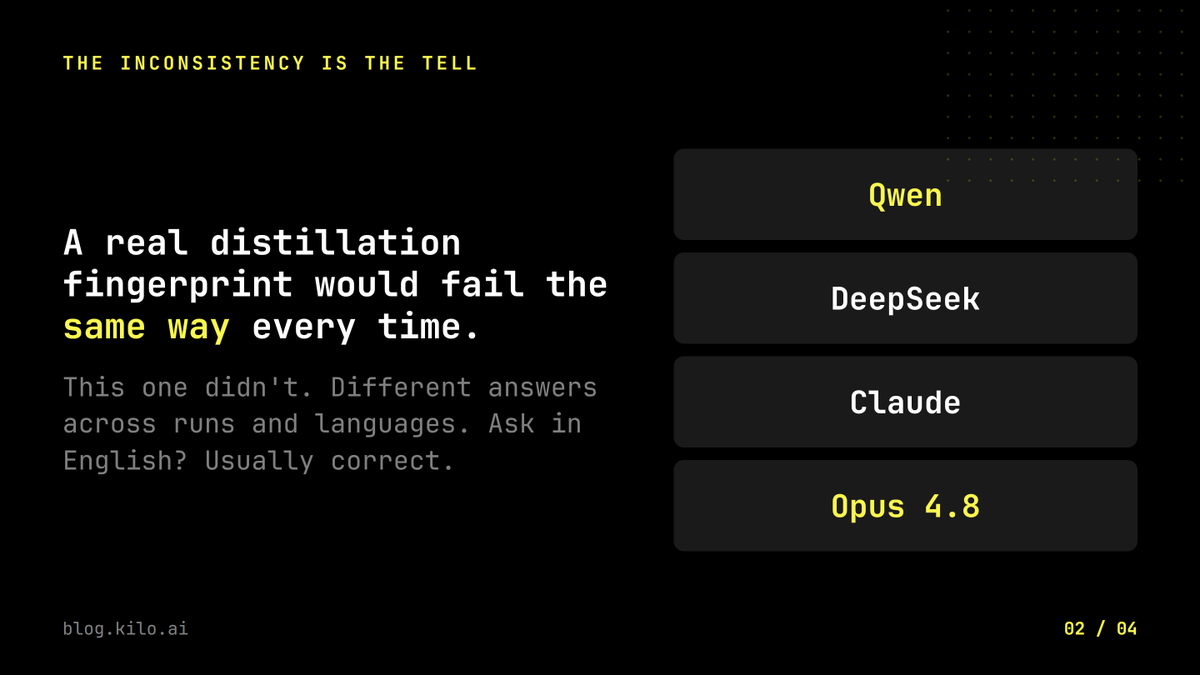
Someone asked Claude Opus 4.8 "what model are you?" in Chinese. It said "I'm Qwen."
The internet decided Anthropic distilled Alibaba's model. Then it said DeepSeek. Then Claude. Then Opus 4.8.
A real distillation fingerprint fails the same way every time. This one didn't.
https://t.co/JUaBY5ZlfJ
@schardofglass Yes and yes. You can add your ChatGPT/Codex subscription as a provider, and it works across the full suite including KiloClaw. Set it up here! https://t.co/NuRRG6I4ZG
You can now bring your own key (BYOK) to Kilo Gateway across 20 providers.
That means you can use your own API keys or coding subscriptions across Kilo, with advanced usage analytics, cost tracking, and access across the full Kilo product suite.
0% markup. You get billed directly by your provider.
Here’s how to set it up:
@morganlinton@IntlOptions@EnoReyes Love hearing this, Morgan! Take all the time you need to dig in. If anything comes up while you're testing, we're around and happy to help.
@Tommy_Burma Hey Tommy, sorry for the trouble! We can't pull up account or billing details here on X. Can you email [email protected] with this same info (workspace name + the email on your account) and the team will look into the duplicate charges and sort out a refund? Thanks!
** Five frontier models, 15 planted bugs, one prompt. **
The model that found the hardest bug in the set, a three-file state mutation chain, did it at roughly a third of the cost per catch of anything close to it.
That was Grok Build 0.1! Full breakdown and cost math from @coldopn here 👇
@TimJayas The more interesting answer is probably neither. Different models tend to excel at different parts of the workflow, which is why many developers are moving toward multi-model setups instead of picking a single favorite.
@TimJayas The more interesting answer is probably neither.
Different models tend to excel at different parts of the workflow, which is why many developers are moving toward multi-model setups instead of picking a single favorite.
@TTrimoreau Could developers? Sure. Would they want to? Probably not.
Software development has always adopted better tools, and AI is proving to be one of the most useful yet.
@mandylu One of the strangest parts of AI right now. We're getting better at building these systems faster than we're getting at fully explaining them.
The screenshot version of AI engineering is 100 agents in 100 tabs.
The real version is 2 or 3 you actually steer, because of one rule almost nobody talks about:
** if a human can't review the output in one sitting, the task was too big. **
We learned that the expensive way, across 40 trillion tokens. https://t.co/t7d1ESBVN6
Your coding agent is going to get ripped out. The question is whether your workflow has the core strength to survive it.
* Roo Code: archived.
* Antigravity: bait and switched into a chatbot overnight.
Both in the same week.
Build something that doesn't fold the second a vendor pivots. https://t.co/3gegMDWDjV