Advisor to startups. Freelancer. @LeadershipData founder. Global Speaker. Top B2B influencer & social promoter of Data Science AI ML. PhD Astrophysics @Caltech
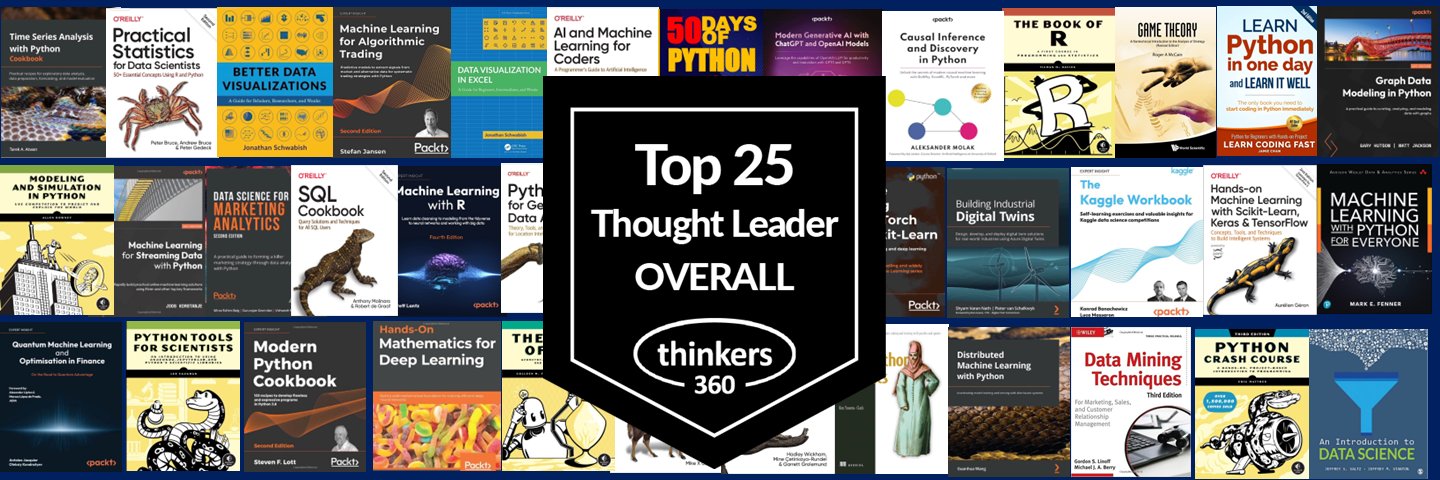
Incredible limited-time offer from @PacktPublishing on their Agentic AI (and beyond) new and best-selling books — DISCOUNTED now @ 20-30% OFF.
See this catalog of choices: https://t.co/xttyz4BdEn via @PacktDataML
Have you noticed how so many Bitcoin $BTC maxis adorn their skyrocketing projections with the phrase “if the pattern repeats”?
Well, we already know that the patterns are not repeating.
I have low confidence in predicting extremely volatile time series. It could go up ⬆️ or down⬇️ or chop horizontally🔄. How’s that for a projection?
This very practical math book is for anyone who wants to develop their powers to think mathematically, especially anyone who has always wondered what lies at the core of mathematics.
"Thinking Mathematically" at https://t.co/wU5qiYiu1i
"How to Build and Fine‐Tune a Small Language Model: A Step-by-Step Guide for Beginners, Researchers, and Non-Programmers"
Available at https://t.co/msIjZw2arK
Build your own AI—without a PhD, expensive hardware, or industry-level resources. Whether you’re a beginner, a student, a scientist, or a domain expert, this book shows you how to create, train, fine-tune, and deploy Small Language Models (SLMs) that truly understand your field.
Differential geometry is a mathematical discipline that studies smooth manifolds, using techniques of vector calculus, linear algebra & multilinear algebra. It was used by Einstein in his development of General Relativity: https://t.co/S3F8M1SBa7
Book: https://t.co/wrgK1xLkHj
"Solving Mathematical Problems: A Personal Perspective," by Terence Tao
╰┈➤https://t.co/jsZApXcdbO
Amazon summary: "Authored by the leading name in mathematics, this engaging and clearly presented text leads the reader through the various tactics involved in solving mathematical problems at the Mathematical Olympiad level. Covering number theory, algebra, analysis, Euclidean geometry, and analytic geometry, Solving Mathematical Problems includes numerous exercises and model solutions throughout. Assuming only a basic level of mathematics, the text is ideal for students of 14 years and above in pure mathematics."
Supercomputing for AI — Foundations, Architectures, and Scaling Deep Learning. [804-page masterpiece]
Get it: https://t.co/FlEIvi2UMN
Git it: https://t.co/zzPNSHrTAx
2nd Edition at https://t.co/AnWbwkheUN
Graph Machine Learning — the latest advancements in graph data to build robust machine learning algorithms.
𝓚𝓮𝔂 𝓕𝓮𝓪𝓽𝓾𝓻𝓮𝓼:
🟠Master new graph ML techniques through updated examples using PyTorch Geometric and Deep Graph Library (DGL)
🔵Explore GML frameworks and their main characteristics
🟠Leverage LLMs for machine learning on graphs and learn about temporal learning
Hacking and Security: The Comprehensive Guide to Ethical Hacking, Penetration Testing, and Cybersecurity
Get it at https://t.co/q2YPp33Cji
[99% 4- and 5-star reviews. 1141 pages]
@betraidx No, the book is not about ML distance metrics. It is just an interesting (and massive) encyclopedia of the many numerous and diverse ways that humans across the world measure distances.
Regarding messy data, see this:
https://t.co/XXMoBqM2RZ
If your data is a mess, then (to prepare for machine learning and other analysis & inference methods) you need to spend a lot of time doing a lot of data profiling, data typing, data transformations (e.g., scaling, zero-centering, normalizations, adjusting for different units, one-hot encoding), feature engineering, etc.
That's one of the greatest ways to build data literacy -- getting to know your data up close and personal, thoroughly and completely. I like to describe "Data Profiling" as "Having your first date with your data." See:
https://t.co/bs1K3aKCFh
9 Distance Metrics used in Data Science and Machine Learning (advantages & pitfalls): https://t.co/xSsnRagUGT
——
#ML#Statistics#Mathematics#DataScientist
——
➕See 730+ page book "Encyclopedia of Distances" (3rd edition): https://t.co/nenQhGcR4d
If your data is a mess, then (to prepare for machine learning and other analysis & inference methods) you need to spend a lot of time doing a lot of data profiling, data typing, data transformations (e.g., scaling, zero-centering, normalizations, adjusting for different units, one-hot encoding), feature engineering, etc.
That's one of the greatest ways to build data literacy -- getting to know your data up close and personal, thoroughly and completely. I like to describe "Data Profiling" as "Having your first date with your data." See:
https://t.co/bs1K3aKCFh
I don’t understand how someone creates an interesting graphic or meme, and then doesn’t proofread the one sentence that they write before posting it. This is not a simple isolated example. I am noticing similar misspellings in other posts recently much more frequently than ever. Has our education system really failed this badly?
If you find other examples, please share them here. 😎








![KirkDBorne's tweet photo. Introduction to Time Series Analysis and Forecasting [2nd edition] (from the Wiley Series in Probability and Statistics): https://t.co/Ai7mv6dYjJ https://t.co/jGEeT8SpM0](https://pbs.twimg.com/media/HN7H-SvXYAAW1FK.jpg)


![KirkDBorne's tweet photo. Supercomputing for AI — Foundations, Architectures, and Scaling Deep Learning. [804-page masterpiece]
Get it: https://t.co/FlEIvi2UMN
Git it: https://t.co/zzPNSHrTAx https://t.co/PpkjkoGPTK](https://pbs.twimg.com/media/HN4kGXdX0AAM4oq.jpg)


![KirkDBorne's tweet photo. Hacking and Security: The Comprehensive Guide to Ethical Hacking, Penetration Testing, and Cybersecurity
Get it at https://t.co/q2YPp33Cji
[99% 4- and 5-star reviews. 1141 pages] https://t.co/vmyAE4lPtS](https://pbs.twimg.com/media/HN4jH7UWAAAtScT.jpg)


