When they tell you what they will do, believe them.
The goal for democrats is to apply the income tax to everyone. But they’ll never substantially lower other taxes, they’ll just create more reckless spending.
How do we know that? Well, that’s exactly what they are doing now after the largest regressive tax increases in state history.
Six months after the IPO, the RSUs vest. That isn't a stock sale. It's wages, all in one year.
Washington doesn't tax the decade it took to earn them. It taxes the year they show up.
Vote YES on I-645.
WA voters have already rejected an income tax in 1934, 1936, 1938, 1942, 1944, 1970, 1973, 1975, 1982, and 2010.
This year vote YES to repeal the income tax, disguised as a "millionaires tax."
If you don’t know which side to believe regarding the “Millionaires Income Tax” just take a look at the basic facts. I think the one thing everyone can agree on is that this tax is unpopular and politically risky.
First, the tax will generate around 2%-2.5% of current budget. Would they take on this risk and controversy for a 2% revenue increase? Or, would they take on this risk to get the proverbial “camels nose in the tent” and eventually generate a much larger percentage of the budget? When you look at population, average incomes, ages, population growth etc it becomes very clear: The only way to generate a significant percentage of the budget, enough to make all this controversy and career risk worth it, is to tax everyone. Not close to enough +million earners to matter. And there are less every day (because of the tax). Full disclosure, I will be impacted by this tax in two ways. I’ll pay it on a portion of my income and it will make our charitable giving no longer fully tax deductible. I don’t want to pay it. Regardless, everything I’ve said here is 100% fact
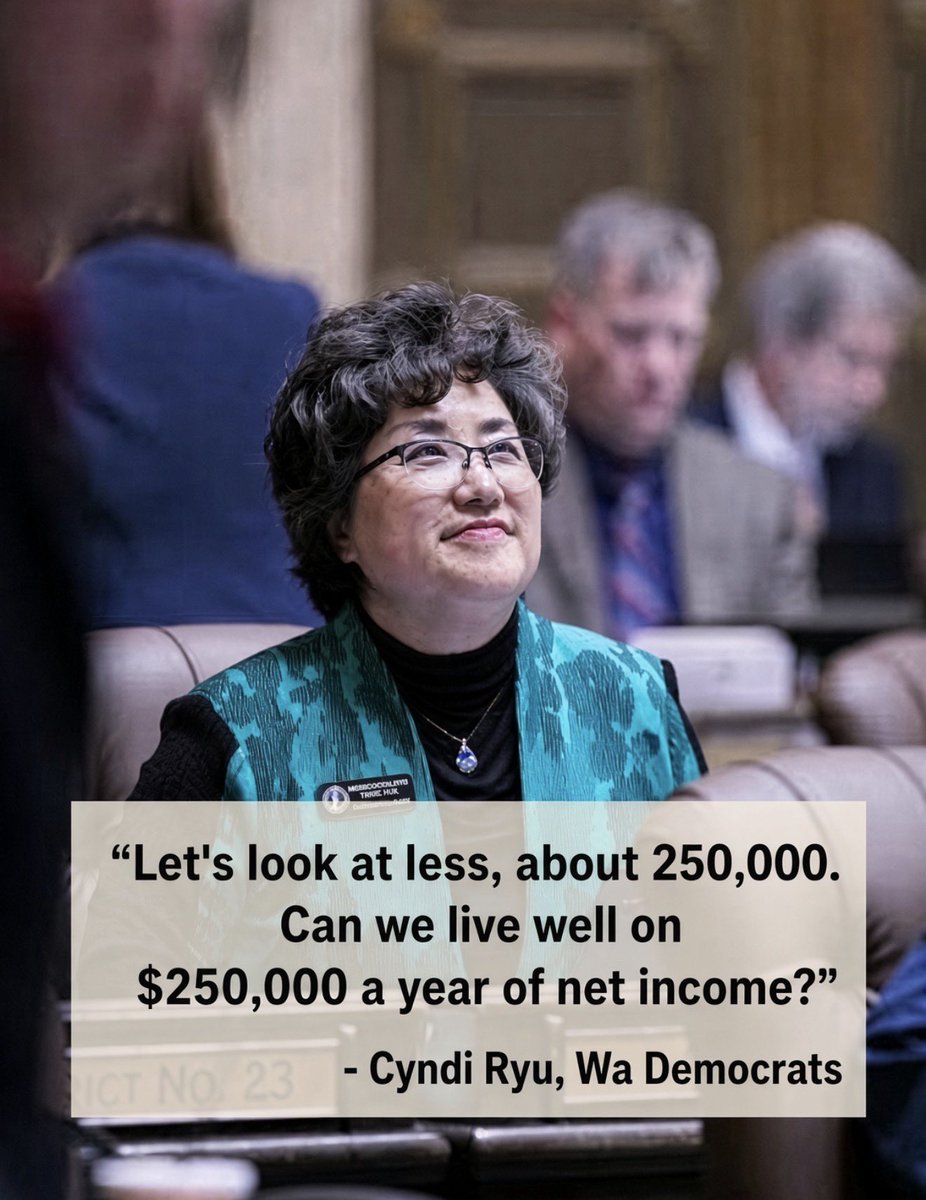
NEW: Democratic Rep Cindy Ryu admits her party plans to lower the threshold on the income tax from millionaires to everyone in WA state & that she wants to tax companies more
She told KUOW, "Let's look at less, about 250,000. Can we live well on$250,000 a year of net income?"
Made with Claude Opus 5.5.
The fearmongering about AI always makes us forget that NOTHING WENT FOOM, as was always predicted.
Send this to your doomer friend who has a very high P(Doom).
Accelerate.
Robert, you can’t be this daft. How many pensioners in the country make over $1 million a year? Maybe 2 or 3 in the state? You think they’re going after that bag?? OR, and I know this sounds crazy, they’re planning on rolling it out to everybody. Critical thinking is extinct
Diane Morgan, writer, actor, and director best known as Philomena Cunk, is bringing the hard-hitting questions to #Assemble26LDN on October 14.
Register here: https://t.co/wtVwEetVNj
📣 Chainguard is officially a CVE Numbering Authority 📣
Frontier AI models are finding latent bugs in widely used open source software that scanners and years of expert review couldn't detect.
The Common Vulnerabilities and Exposures (CVE®) Program has authorized Chainguard to assign CVEs for vulnerabilities processed through Athena, our coalition to protect open source from AI attacks. That means organizations and open source maintainers can more easily assess their exposure, reduce false positives, and take action on the fixes coming out of Athena.
Learn more: https://t.co/EP0mRXsI77
The marriage penalty isn’t the only disastrous flaw in Washington State’s incoming 9.9% income tax (SB 6346). The legislation is drafted so poorly that it creates an absurd tax cliff—triggering an effective marginal tax rate of over 1,300% on people who realize just a tiny amount of taxable capital gains.
While modeling WA’s 9.9% tax on income over $1M (scheduled for 2028), a bizarre edge case emerged in how the new income tax interacts with Washington’s existing capital gains excise tax.
Here is the breakdown:
The Background
The Existing Capital Gains Tax (RCW 82.87):
0% on the first ~$278k of long-term capital gains (standard deduction, indexed for inflation).
7% on gains above ~$278k up to $1M.
9.9% on gains above $1M.
The Incoming Income Tax (SB 6346):
9.9% on Washington taxable income exceeding $1M (derived from federal AGI).
To prevent double-taxing capital gains, the bill establishes an adjustment mechanism in Section 302:
Sec. 302(1): First, you deduct all long-term capital gains from your federal AGI.
Sec. 302(3): Then, you add back the WA-taxed gain plus the standard deduction (~$278k) to fold capital gains back into your Washington base income.
The Statutory Glitch:
The critical drafting flaw lies in the final sentence of Section 302(3):
"This subsection (3) applies only to taxpayers owing tax under chapter 82.87 RCW for that taxable year."
Because the add-back only triggers if you actually owe capital gains tax, it creates two wildly divergent outcomes for high earners:
Gain under ~$278k: You owe $0 under RCW 82.87. Because you owe no capital gains tax, Sec. 302(3) does not apply. Your capital gains were stripped out in Sec. 302(1) and never added back. Your capital gains completely escape the 9.9% income tax.
Gain $1 over ~$278k: You now owe capital gains tax under RCW 82.87. Suddenly, Sec. 302(3) triggers. The statute forces you to add back the taxable gain plus the entire ~$278k standard deduction. The whole gain is thrown back into your income tax base.
The Math: A $27,600 Penalty for Making $2,000 More
Consider a single filer earning $1.2M in W-2 wages (using the ~$278k deduction threshold):
Scenario A: $277,000 Long-Term Gain
Capital Gains Tax (RCW 82.87): $0 (under the deduction)
Sec. 302(3) Add-Back: Does not apply.
Income Tax Base: $1,200,000 (gains remain fully excluded)
Taxable Income over $1M: $200,000
9.9% WA Income Tax: $19,800
Total WA Tax: $19,800
Scenario B: $279,000 Long-Term Gain (Just $2,000 more)
Capital Gains Tax (RCW 82.87): 7% on $1,000 = $70
Sec. 302(3) Add-Back: Triggers because $70 of tax is owed. The full $279,000 is added back into base income.
Income Tax Base: $1,479,000
Taxable Income over $1M: $479,000
9.9% WA Income Tax: $47,421
Total WA Tax: $47,491
The Takeaway
By realizing an extra $2,000 in capital gains, this taxpayer’s total state tax liability jumps by $27,691 ($70 in capital gains tax + $27,621 in new income tax).
That is an effective marginal tax rate of 1,384% on that $2,000.
This cliff affects anyone whose other income (wages, business income, RSUs) already puts them over $1M—such as dual-income tech households or startup employees experiencing a liquidity event. Crossing the capital gains exemption line by even a single dollar unexpectedly exposes the first ~$278,000 of previously exempt gains to a 9.9% tax penalty.
Whether this was an intentional trap or simply careless drafting, it underscores how poorly structured this legislation really is.
In Spokane, government is making fire victims pay for crackpipes and heroin needles for homeless drug addicts, but they refuse to waive demolition fees for fire victims, forcing them to pay for permits to clear their own burned out properties. Don't let communists run anything.
Stopppp, we're blushing ☺️
@G2dotcom's Fall 2026 reports are in, and Chainguard was recognized in SEVEN different categories. We'll leave it to our customers to tell you why 👇
Had dinner with a tier 1 VC in NYC and we were chatting about Bending Spoons and he goes "The Bending Spoons guys are PE guys, they value businesses on EBITDA. In VC we value businesses on VIBEITDA, so its quite different"
(posted with permission)
"With Chainguard Libraries, I'm looking forward to being able to sleep at night and not have to worry about the ongoing malware supply chain attacks." — Kevin Fuller, CISO at @PropioLS
Propio trusts Chainguard to prevent AI-driven supply chain attacks (and deliver better sleep 💤). Here's their story: https://t.co/0EAPbVizN8