“Adaptation in clinical trials facilitates accommodation of the unknown in trial design with methodological rigor, often resulting in improved efficiency.” A Designing Clinical Trials article discusses the benefits and challenges of adaptive designs for clinical trials for kidney diseases like calciphylaxis. https://t.co/LmxJPPJ3RE
REGISTER: https://t.co/FLOT8dt0DY
Join an expert panel as they present key updates from ERA 2024 including updates on diabetic kidney disease & discuss the impacts for patient care in Australia.
Host: @KrishRathika
Panel: @brendonneuen, @jardine_meg, Dr Brendan Smyth
@ANZSN
Today we're proud to share that ANZSN has collaborated with the International Society of Nephrology to co-fund 4 'sister renal centres.' This initiative is part of our commitment to extend our focus to the Asia Pacific region.
https://t.co/34fDRDX23p
#worldkidneyday2024
ANZSN acknowledges Waitangi Day on Feb 6. It is now 184 yrs since the Crown & iwi signed Te Tiriti o Waitangi in 1840. As with the Uluru Statement of the Heart, we are reminded about what these documents mean as guidance for clinical care & research.
https://t.co/xbKMtA4lYi
The President's Update was sent to members yesterday afternoon. It comes with our thanks to the ANZSN Councillors, Committee leaders & volunteers, all our members & fellow organisations. We wish you the very best for the Festive Season.
"The issue of dialysate sodium concentration selection is one of many examples in health care where practice arises from arbitrary decisions." This Perspective examines the impact of observational reports on practice https://t.co/rCHZfoBiUG
@jardine_meg@KrishRathika
Clinical Guidelines and systematic reviews can’t keep up with the exponential growth in medical and scientific literature.
It is estimated that 4,000 (75 trials) health-related journal articles are published daily, and on average it takes 17 years for health research to be translated into clinical practice.
Considerable time, effort and resources are needed to develop and update guidelines and systematic reviews using the current rigorous processes.
The results of our systematic prioritisation mapping process found a lot of duplication of guidelines and systematic reviews.
A prioritisation process is essential to ensure that limited resources aren’t wasted.
Please do our #chronickidneydisease survey here:
https://t.co/H36PWFYxsb
For more information, please refer to the patient information sheet on the CARI Guidelines website: https://t.co/O7CzrB0jFn
Our systematic prioritisation mapping process has highlighted many areas of #peritonealdialysis that need updated clinical guidance. A prioritised list is urgently needed to make the best use of our limited resources and to make our research more impactful.
To participate, please click this link for round one:
https://t.co/H36PWFYxsb
We found 13 related Clinical Practice Guidelines. About 50% are out of date and have not been updated for >5 years. We identified 49 Cochrane systematic reviews, of which 40% were published after the linked guidelines. In addition, there are many instances of duplication of guidelines and systematic reviews.
We identified 62 intervention questions and grouped them into 7 broad topics. We need your help to rank these topics in the first round of our surveys.
In the second and third rounds, we will focus on the highest-ranked broad topics from the first round and rank the intervention questions linked to them.
For more information, please refer to the patient information sheet on the CARI Guidelines website: https://t.co/O7CzrB0jFn
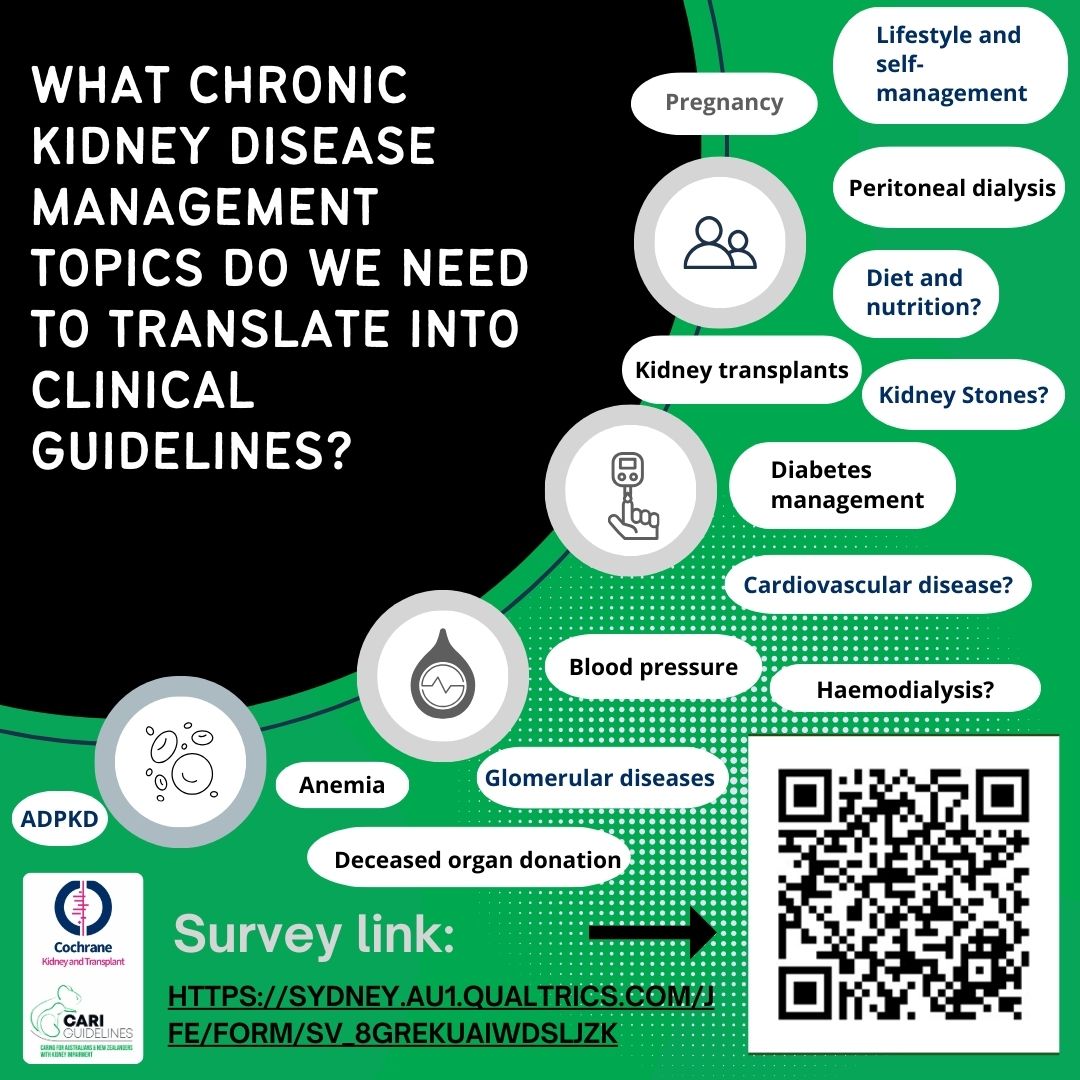
Attention health professionals and individuals with #ChronicKidneyDisease
We need your help to rank broad Chronic Kidney Disease topics via a 3-round Delphi survey. This will determine the kidney health communities' priorities for updating evidence.
To determine the topics, all relevant CKD Clinical Practice Guidelines were systematically mapped to Cochrane systematic reviews and clinical trials. This process identified 10 broad topics for #ChronicKidneyDisease, 7 topics for #Peritonealdialysis, 9 for #haemodialysis, and 9 for #kidneytransplant to be ranked in round 1 of the survey.
To participate, click this link for round one:
https://t.co/H36PWFYxsb
Rounds 2-3 will drill down into more specific research questions and inform the updating of our guidelines.
Your participation in this survey is crucial to help us improve the quality of care for individuals with chronic kidney disease and ensure the judicious use of limited resources.
For more information, please refer to the patient information sheet on the CARI Guidelines website: https://t.co/O7CzrB0jFn
A timely reminder from WA about how important dialysis units are in remote Australia to ensure people can remain on Country while receiving the life-saving care they need.
https://t.co/YOHmeZZbfs