When we had to make a decision:
Do we make the product simple, but limit what users can do?
Or do we take the harder path and build something more powerful, even if it takes a bit more time to understand at first?
With Chirp, we chose the second path.
We decided not to sacrifice functionality just to ship something quick but basic. Instead, we focused on building a platform that gives users the freedom to do almost anything across IoT, automation, connectivity, data, and real-world device management.
Yes, Chirp might feel complex when you first start using it.
But once you understand what is possible, the platform opens up in a completely different way.
You can connect devices, create automations, work with real-world data, build workflows, manage infrastructure, and start turning IoT into something practical, useful, and scalable.
While crypto has been going through its usual up and down cycles, we stayed focused on the core.
We kept building.
We kept expanding the functionality.
We kept improving the foundation.
And today, Chirp has become one of the largest IoT platforms in the space by depth of functionality.
The best part is that we are not done yet.
Now that the functionality is in place, our next major focus is making the platform easier, smoother, and more accessible for everyone. We already have something in the works that will help with exactly that.
More big updates are coming.
In the meantime, check out the Chirp platform, start automating, and see what is possible when IoT is not limited by narrow use cases.
The world of IoT is truly unbelievable.
Just be careful. Once you start exploring what you can build, it might pull you in.
#IoT #Depin #IndustrialIoT #chirpdewi
Qubitcoin team is finalising the development of Superdense Consensus. Learn here what is this revolutionary technology about 👇
$QTC
https://t.co/2hLSasGCJe
qPoW - the architecture powering Qubitcoin.
The workflow combines:
* SHA3 hashing
* parametrized quantum circuits
* quantum sampling
* classical verification
The first prototype was benchmarked both on IBM quantum hardware (ibmq_quito) and classical simulators.
It later became one of the foundations behind Qubitcoin’s qPoW architecture.
Figure from the original research paper
“Quantum Proof of Work with Parametrized Quantum Circuits“ by @MYShalaginov & @MikeDubrovsky.
Mikhail and Yudong recently had a great discussion with Fred Chong, one of the world’s leading voices in quantum computer architecture.
Quantum computing is still largely a field shaped by physicists, which makes Fred’s perspective especially valuable, coming from computer architecture and supercomputing.
They drilled into the challenges of building the full stack required for fault-tolerant quantum computing: compilers, error correction, verification, scheduling, and hardware/software co-design, and debated where NISQ-era approaches may still provide value, particularly for optimization problems with limited datasets such as biomarker discovery and cancer treatment prediction.
For the Qubitcoin community, this direction is highly aligned with what we have been building:
In addition to our VQA-based component already being part of qPoW, for the last few months, we have been heavily focused on integrating tasks directly relevant to fault-tolerant quantum algorithms and the future quantum software stack.
The long-term goal is not just to make a quantum-aware blockchain, but to help create computational infrastructure naturally connected to the emerging fault-tolerant quantum ecosystem.
Supra is no longer just a blockchain project.
We are becoming a blockchain and AI organisation. @supraosai is at the centre of that. 🤖
What this actually means:
→ The L1 is the trust layer. Consensus, settlement, verifiable execution.
→ SupraOS is the agent layer. Where autonomous software actually works.
→ Together: rails for AI that can be trusted to act, not just to talk.
We have spent months working toward this shift. This is where we are headed.
Supra is no longer just a blockchain project
We’re becoming a blockchain and AI organization and SupraOS is at the center of it all
You don’t just secure your own data
You fully own and run your own AI Organization locally
Private agents. Departments. Collective intelligence
Tamper evident audit trails via Supra L1
Alpha just dropped. First access is live for Supra DeFi founders and our community right now
The foundation we’ve been building for years is finally shipping at the pace this new era demands
Watch what’s shipping → https://t.co/RKknCMPWqR
What will you build with your own AI org?
We recently spoke with @CraigGidney, a leading expert in quantum algorithms at @GoogleQuantumAI.
With Google calling for post-quantum cryptography by 2029, quantum progress is advancing faster than expected. Craig made several recent estimates on a quantum computer breaking RSA-2048 could take 1M noisy qubits and 1 week.
Our takeaway from speaking with Craig: the bottleneck isn’t qubits, it’s arithmetic. Modular multiplication is costly due to heavy T-gate use. He is primarily focused on making algorithms practical via magic-state distillation and scalable factories.
A pleasure speaking with Craig, humble and a one-of-a-kind expert pushing quantum algorithms forward.
Our Tech team is adjusting Qubitcoin to the needs of making quantum algorithms practical.
Mit der Vision Chain startet Bitpanda eine regulierte Blockchain-Umgebung, um tokenisierte Vermögenswerte in den Mainstream zu bringen. Jetzt mehr lesen👇 https://t.co/INEJW8vV8I
Today's SUP is with @toonswapsupra !
As discussed, we're an hour earlier today:
2pm UTC.
So take note! ⏰
@JamesBondsama will be getting the latest with Mr Toonswap himself, with a live walkthrough of how the dApp is looking. 🔥
See you there!
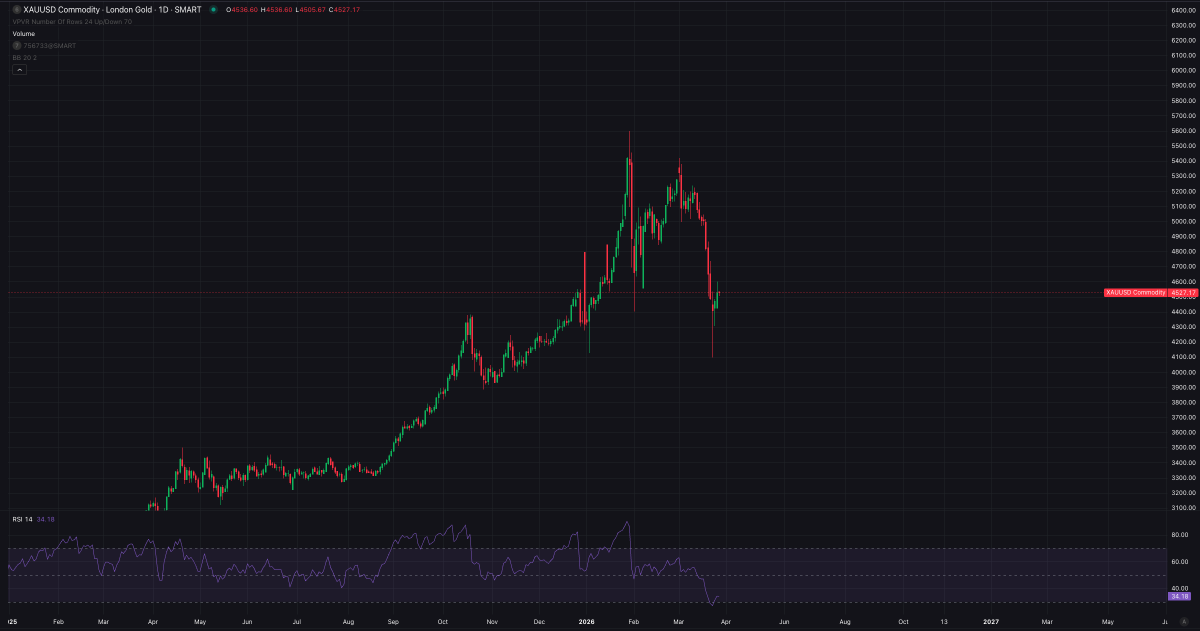
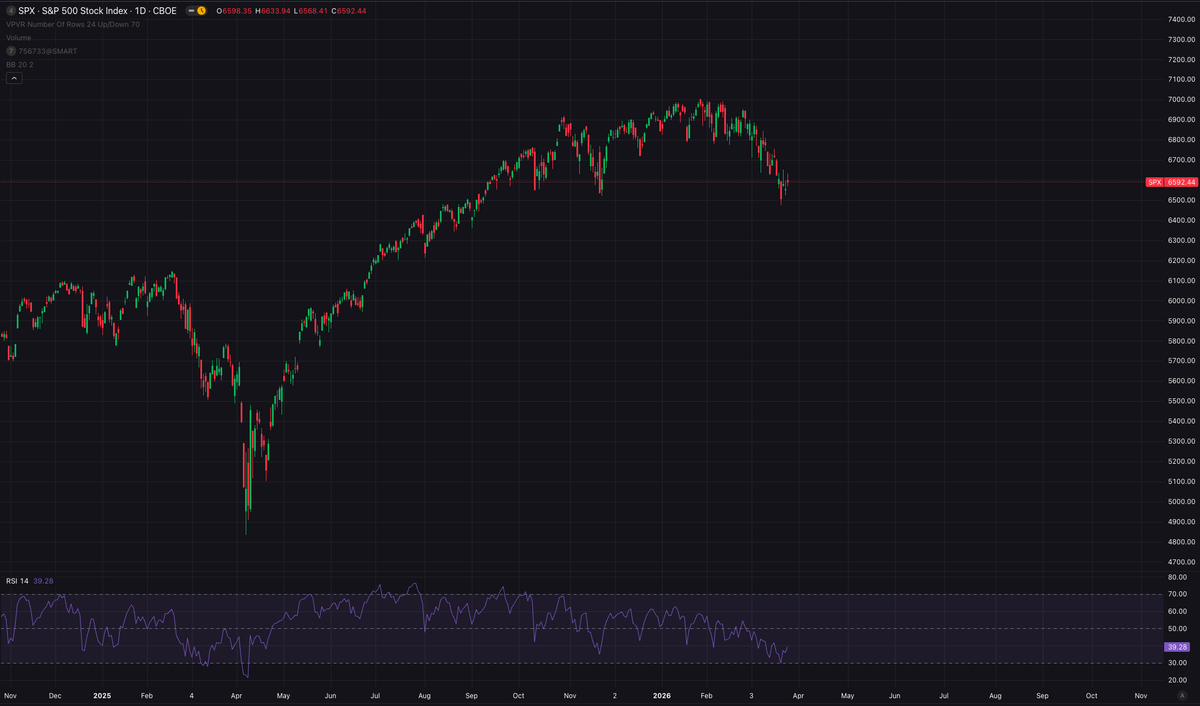
Hope is driving the markets - The American system is loosing confidence.
Equities, commodities, and crypto rebounded after President Trump declared victory over Iran following their ceasefire proposal.
Iran, however, has denied the proposal put forward by the U.S. and its allies, showing no signs of backing down.
As of now, markets appear to be betting on a Trump-led resolution.
The U.S. has proposed the following:
- No nuclear enrichment
- Dismantling of nuclear facilities
- Limited missile production
- No support for proxy groups
- U.S. control over the Strait of Hormuz
In contrast, Iran demands:
- Reparations for damages incurred
- A guarantee of no future attacks
- Removal of sanctions
- No U.S. military bases in the region
- The right to charge fees for passage through the Strait of Hormuz - similar to how Egypt charges for the Suez Canal
Still, a war of information persists. The most likely scenario remains a temporary ceasefire, enabling further negotiations.
If such a deal materializes, markets are likely to rally - shifting toward risk-on sentiment, selling oil, and buying equities, commodities, and crypto.
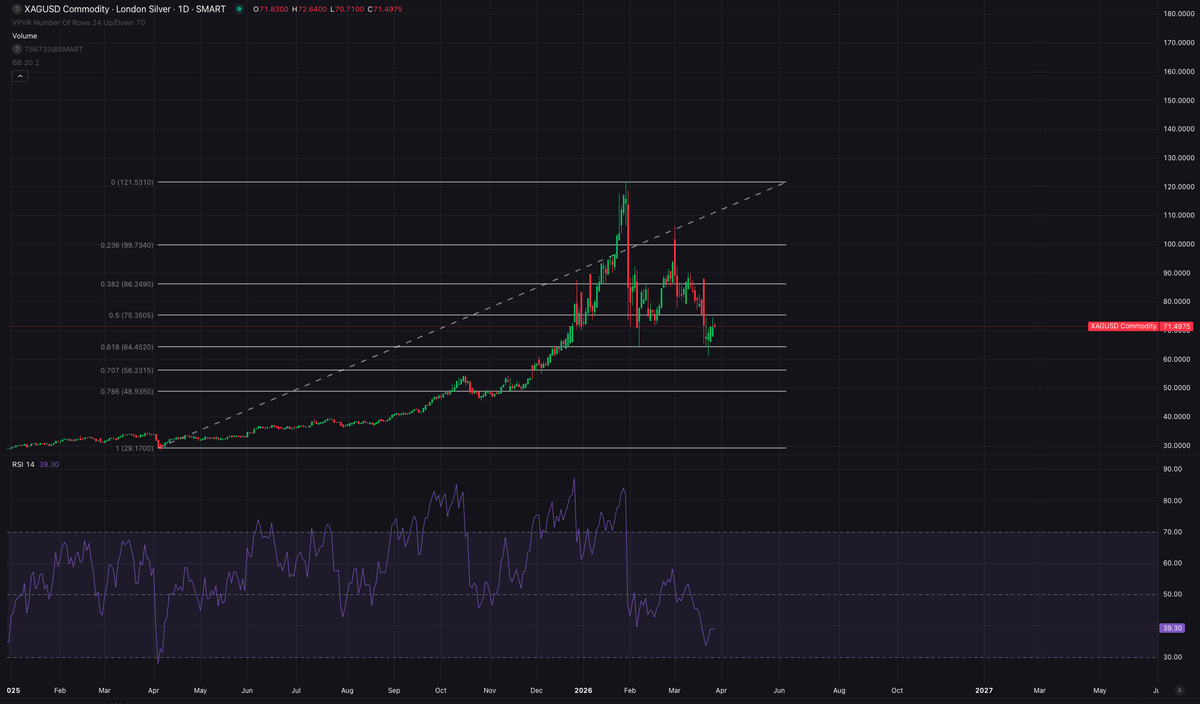
Conversely, if Iran rejects the proposal and hostilities continue, markets could plunge further into support zones.
Silver, in particular, could retrace to $56 in the worst-case scenario.
On the risk front, yesterday’s U.S. $69 billion 2-year Treasury note auction delivered a strong warning: demand was shockingly weak for such a short-duration instrument.
- High yield: 3.936% (When-Issued: 3.918%)
- Bid-to-cover ratio: 2.44
- Indirect bids (foreign central banks): 59.4%
- Direct bids (domestic investors): 16.5%
All three metrics are at historic lows. A bid-to-cover ratio below 2.5 indicates weak demand, while the low share of indirect and direct bids signals declining confidence in U.S. debt by both domestic and international buyers - the very opposite of what the U.S. aimed to achieve ahead of this geopolitical escalation.
Additionally, the $1.8 trillion private credit market is unraveling. Major funds like Blackstone and others are facing record redemption requests, as investors grow concerned about AI-driven disruption in the SaaS sector.
This confluence of geopolitical tension, weakening Treasury demand, and a collapsing private credit market suggests a fragile financial system.
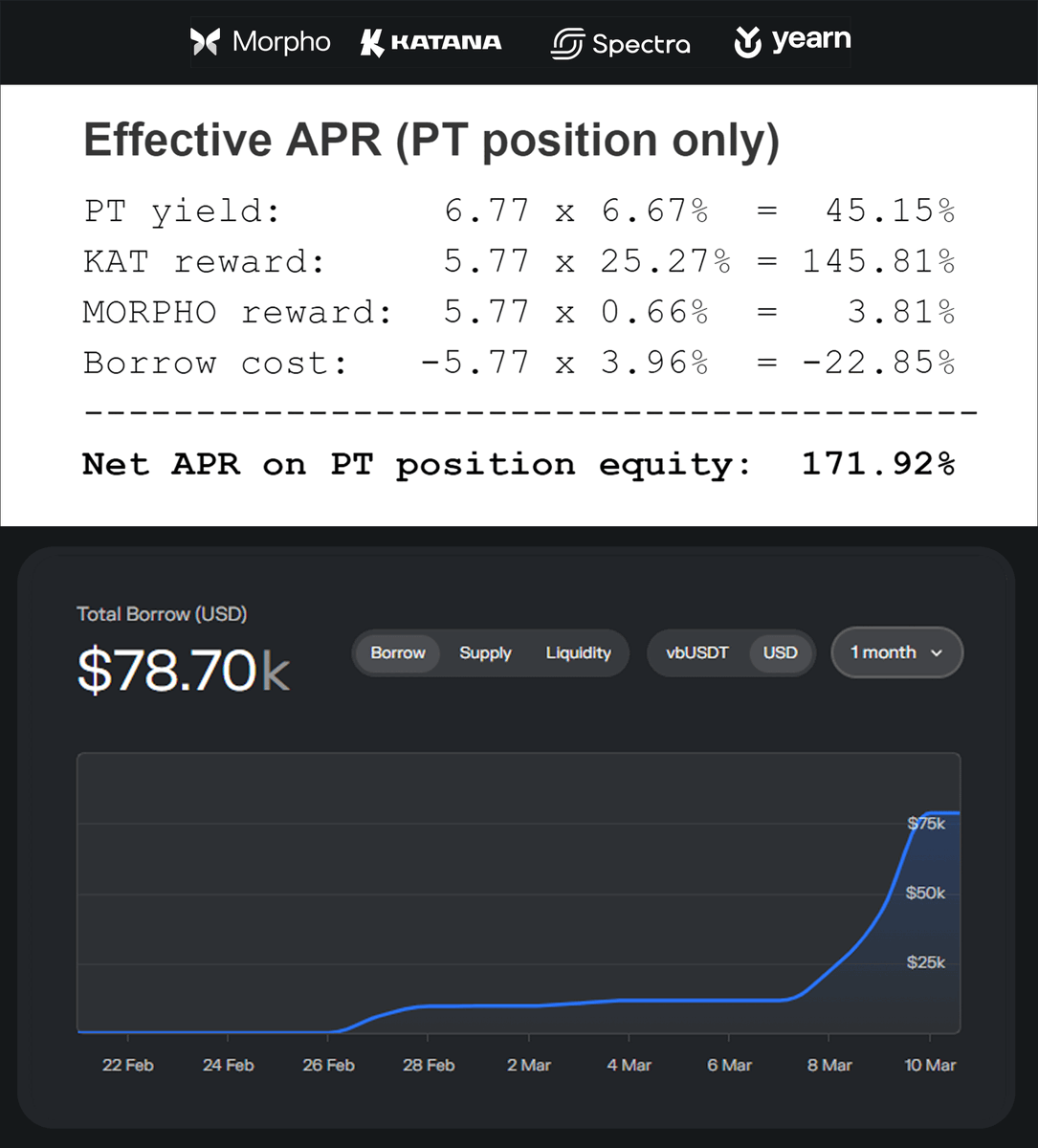
The PT looping play on @katana morpho is gaining traction as vbUSDT borrowers are now getting paid to borrow.
I've scanned the top loopers leveraging @spectra_finance to see what they're doing and how to get the 3-digit rate.
details, ingredients & links ↓
While we focus on quantum simulation and research, we still closely follow how base-layer cryptography evolves.
These kinds of protocol-layer shifts are what our founder, @MYShalaginov, will be discussing this April at MIT Bitcoin Expo, hosted by @MITBitcoinClub, alongside researchers, industry leaders, and policymakers. Ethereum’s post-quantum roadmap will also be part of that discussion.
We would be glad to see you join the conversation!
https://t.co/zWJoQbjpEz
The world's largest sovereign wealth fund just placed a $243 million bet on the quantum future.
Norway's Norges Bank has disclosed substantial positions across the industry, allocating $200 million to IonQ, $39 million to Rigetti Computing, and $4 million to D-Wave Quantum.
This marks a maturing of the market structure. While quantum stocks have largely been the province of retail investors and passive flows, the entry of a $2 trillion institutional heavyweight brings a different tier of validation.
The split across companies is the most telling detail. By diversifying across hardware modalities, the fund is betting that different technical approaches will find success in different applications. It is a tacit acknowledgment that the industry is likely big enough for multiple architectures to thrive.
For a sector that lives and dies by deep R&D, the arrival of patient, long-term capital signals that the commercial timeline is coming into focus
#QuantumComputing
Honored to have @MYShalaginov representing Qubitcoin at #MITBitcoinExpo2026 // @MITBitcoinClub
Thoughtful dialogue around quantum computing and Bitcoin’s future security is more important than ever.