Ein Schritt in die richtige Richtung seitens deutscher Medien. Aber noch ein weiter, weiter Weg. Das Thema garbage in garbage out findet auch beim Thema Russland statt. Und auch solchen, die zensiert sind und die man gar nicht erwähnen darf. Ein weiter Weg....
This is extraordinarily rare.
In fact, according to a key figure in the German business community (who is a dear friend of mine), it's unprecedented.
An op-ed, two pages, centerpiece, in Germany’s most important economic newspaper (the Handelsblatt) that begs the German establishment to stop looking at China via the prism of propaganda. And it's by their Shanghai bureau chief - not some outside contributor.
The title is "The China debate cannot continue like this!" and the article makes the case that it's suicidal, from a German and European standpoint, to keep reducing China to false caricatures rather than facts.
In effect it's rubbish in, rubbish out: if you tell people lies about China - whichever direction they go (anti or pro) - then obviously the policies that come out will be rubbish, designed for a mirage of a country that exists only in people's imagination.
Needless to say, this is absolutely music to my ears because it's literally the main point I've been making in my advocacy around China for now almost 10 years. Some are finally seeing the light...
I also believe, as I argued in my article "Are Western media turning China-friendly?" last year (https://t.co/Xg1hoSRtNy) that this type of coverage was bound to happen, and there will be more and more of it.
Why? For a very simple structural reason: China is now too powerful to coerce. The West, and Europe in particular, just don't have the leverage anymore. Which means that if you tell China to do something and they don't want to, they just won't do it. Period.
In this situation, incapable of coercing, your only remaining choice is... convincing. And what do you need if you want to convince someone? Well, you need to understand them: understand how they think, how they behave, what drives them, what they actually want.
In other words: the moment coercion stops being an option, not only does propaganda stop being useful, it begins to be actively harmful as genuine understand becomes a strategic necessity. Reality is finally becoming profitable again.
Which means, if you're a journalist reading this and you're peddling some of your usual lies, describing China as some sort of cartoonish dictatorial dystopia that's simultaneously on the verge of collapse yet a "threat" to the whole world (in short, if you write on China for The Economist or the FT), be on notice: the real threat to your country isn't China. It's you.
This is extraordinarily rare.
In fact, according to a key figure in the German business community (who is a dear friend of mine), it's unprecedented.
An op-ed, two pages, centerpiece, in Germany’s most important economic newspaper (the Handelsblatt) that begs the German establishment to stop looking at China via the prism of propaganda. And it's by their Shanghai bureau chief - not some outside contributor.
The title is "The China debate cannot continue like this!" and the article makes the case that it's suicidal, from a German and European standpoint, to keep reducing China to false caricatures rather than facts.
In effect it's rubbish in, rubbish out: if you tell people lies about China - whichever direction they go (anti or pro) - then obviously the policies that come out will be rubbish, designed for a mirage of a country that exists only in people's imagination.
Needless to say, this is absolutely music to my ears because it's literally the main point I've been making in my advocacy around China for now almost 10 years. Some are finally seeing the light...
I also believe, as I argued in my article "Are Western media turning China-friendly?" last year (https://t.co/Xg1hoSRtNy) that this type of coverage was bound to happen, and there will be more and more of it.
Why? For a very simple structural reason: China is now too powerful to coerce. The West, and Europe in particular, just don't have the leverage anymore. Which means that if you tell China to do something and they don't want to, they just won't do it. Period.
In this situation, incapable of coercing, your only remaining choice is... convincing. And what do you need if you want to convince someone? Well, you need to understand them: understand how they think, how they behave, what drives them, what they actually want.
In other words: the moment coercion stops being an option, not only does propaganda stop being useful, it begins to be actively harmful as genuine understand becomes a strategic necessity. Reality is finally becoming profitable again.
Which means, if you're a journalist reading this and you're peddling some of your usual lies, describing China as some sort of cartoonish dictatorial dystopia that's simultaneously on the verge of collapse yet a "threat" to the whole world (in short, if you write on China for The Economist or the FT), be on notice: the real threat to your country isn't China. It's you.
@Ross__Hendricks look at a fact, there was a president with dementia, which was for about two years a conspiracy theory. thats the level we are at. add to that, that we fight wars in name of democrcy. it's mocking the electorat. hard to imagine a bigger insult than that. so, yes, anything goes.
@EvaVlaar@goddek One frequently overlooked item: crime correlates with wealth. Wealth correlates with education. Well, to lift people out of poverty and darkness might be a good idea. Maybe ai will be able to help. Universal respect. Curious on social science on that correlations and causations.
"Historically, direct warfare between China and Japan was actually quite rare before the late 19th century. Because they are separated by the East China Sea, their early conflicts were almost entirely proxy wars fought on the Korean peninsula." (AI prompted on history). Korean proxy wars also were rare.
@RnaudBertrand@nuanced_nl Aweking Richard is one choice to see what - some - chinese think. He takes chines content and translates and comments it for his audience
I found the section about China and it's neighbour's inaccurate. Over the last 2000 thousands years things have been comperarively peaceful and wars infrequent. Arrival of Europeans and Americans stirred things up. Whether that will continue or the countries will go back to their previous a war each about 400 years only is not clear to me. I hope the latter (China Korea and China Japan)
@RnaudBertrand I read a few books on Taiwan and in the first couple of decades or so, objectively the kmt treated the population worse than the Japanese did. That including a massacre and degraded industry, smaller share of participating in wealth creation for local elites.
@jojjeols@grok, please provide economic data for Taiwan vs china mainland. GDP per capita ppp. Gini coefficient. and respective trends, how are things evolving?
@tlarson95425@AngelicaOung@kajakallas@Natsecjeff I guess they actually destabilize the middle east since 5000years plus... "Determining the age of Iran depends on how you define a "nation." Because Iran is one of the world's few "civilization-states," its age can range from 45 years to over 5,000 years."
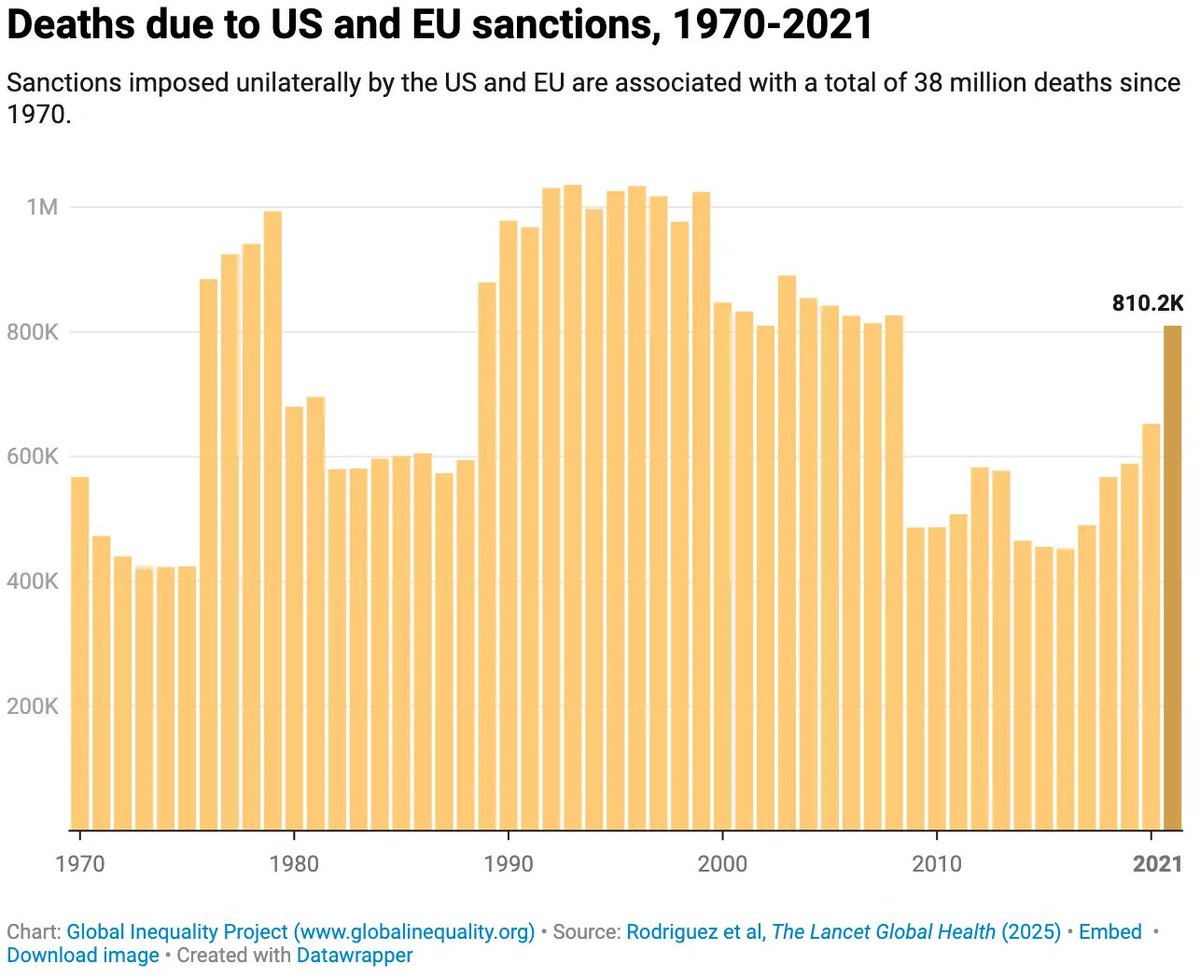
The Lancet recently published a study which found that sanctions from the US have caused 38 million deaths since 1970. The average death toll ranges from 400,000 to over 1 million per year.