Great to work with such a wonderful team on this important work. @UFNursing continues to lead the way! Super collaborative effort with @UFhealth.
https://t.co/rLZfbuwzUn
Remember we were just lucky COVID19 vaccines worked for older adults; they were excluded from trials! Including older adults in trials is ethically and scientifically necessary.
2 millenia & counting. Hippocrates knew #delirium was a medical emergency.
Why is it still so often missed, misdiagnosed, or undertreated?
What are the barriers?
What are the solutions?
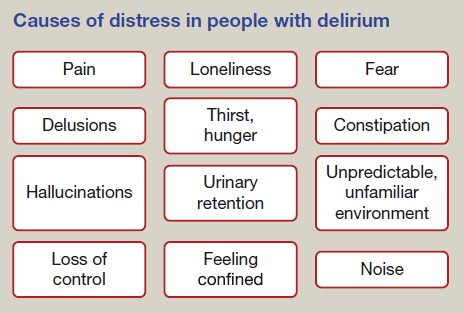
Haloperidol is a very poor treatment for urinary retention.
When a person looks agitated, systematically check for direct causes of distress.
#delirium
#Delirium treatment is much more complex: treat the cause(s) - usually more than 1, optimise physiology (e.g. hydrate), detect & treat distress, prevent complications (e.g. falls, pressure sores, aspiration), communicate with family, rehabilitate, etc.
#meded
2 millenia & counting. Hippocrates knew #delirium was a medical emergency.
Why is it still so often missed, misdiagnosed, or undertreated?
What are the barriers?
What are the solutions?
Noting that a patient is "confused" just isn't enough.
Don't assume any cognitive impairment is dementia - it may be delirium.
A brief conversation with the family can provide critical information.
#Delirium
ℹ A family told me recently: "He was sharp as a tack on Monday. By Wednesday he didn't know my name."
This is not dementia. Dementia does not appear in 48 hours.
This speed of change in mental status is 𝐭𝐡𝐞 𝐬𝐢𝐠𝐧𝐚𝐭𝐮𝐫𝐞 𝐨𝐟 #𝐝𝐞𝐥𝐢𝐫𝐢𝐮𝐦: acute onset. Hours to days.
I've seen delirium misdiagnosed as "progression of dementia" hundreds of times. The rationale is superficially reasonable - patient is old, patient has memory problems, therefore patient has dementia. This misdiagnosis is not the fault of staff - it emanates from a lack of attention to delirium in undergraduate and postgraduate training. But this common mix-up in clinical practise is serious and consequential.
Dementia progresses over months and years. If the change happened this week, something else is happening NOW. Something medical. Something usually reversible.
Every acute cognitive change in an older person deserves investigation. Infection. Medication change. Pain. Dehydration. Constipation. Hypoxia. Etc.
↳ 𝐖𝐡𝐞𝐧 𝐟𝐚𝐦𝐢𝐥𝐢𝐞𝐬 𝐭𝐞𝐥𝐥 𝐲𝐨𝐮 "𝐬𝐨𝐦𝐞𝐭𝐡𝐢𝐧𝐠'𝐬 𝐝𝐢𝐟𝐟𝐞𝐫𝐞𝐧𝐭," 𝐰𝐡𝐚𝐭 𝐢𝐬 𝐲𝐨𝐮𝐫 𝐧𝐞𝐱𝐭 𝐬𝐭𝐞𝐩?
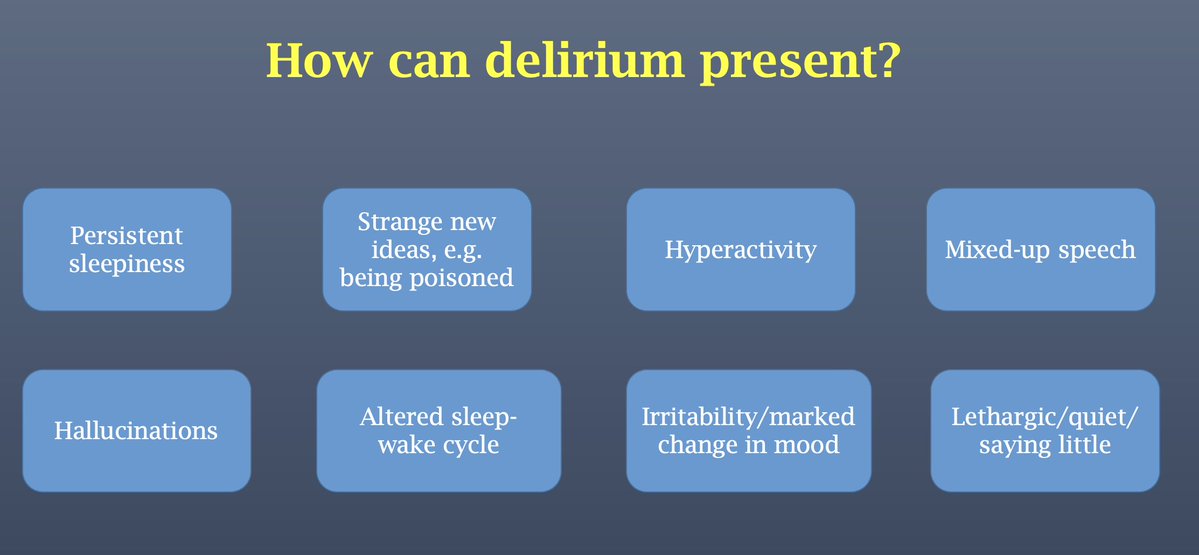
Delirium can present in several ways.
The key concept is change from baseline in hours/days.
This distinguishes delirium from dementia.
#delirium#dementia#patientsafety#4Ms
Famillies know the patient best.
"This isn't like her normal self" is a sign of #delirium.
👍 Staff: take this observation seriously & assess for delirium with a tool like the 4AT.
@Brown_SPH This is such sad news! Jim was a mentor and a friend. His opinions were always sought out. He was always there to write a letter of recommendation or support for me in advancing my career. I will miss him dearly. The world of Geriatric Medicine will miss him and his wisdom.
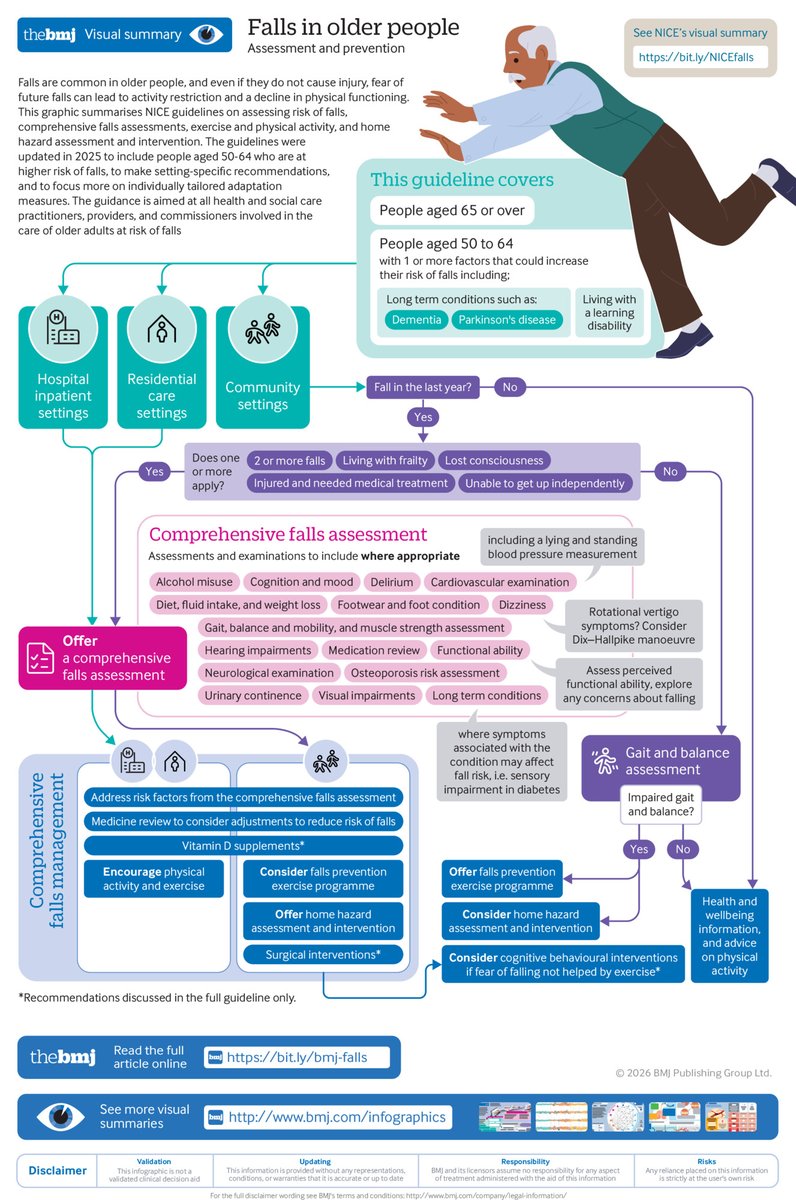
Falls are common in older people, and fall related injuries are a substantial cause of morbidity and mortality.
How should doctors assess the risk of falls? A summary of NICE guidelines, including a #BMJInfographic
https://t.co/s3P7sATuvU
"It wasn't until a geriatrician reviewed my mother's medications that we found the cause of her sudden confusion. A new sleeping pill... Within two days of stopping it, she was back to her old self."
#delirium
There's been a significant shift in evidence-based delirium care.
Historically, antipsychotics were used routinely in delirium.
Like the same thought process that somebody has a bacterial infection and they get an antibiotic. Or somebody has pain and they get an analgesic.
The assumption was that they would calm the patient and speed recovery.
⛔ That assumption is wrong ⛔
↧↧↧↧↧↧↧↧↧↧↧↧↧↧↧↧↧↧↧↧↧↧↧↧
The current evidence, including recent guidelines from the American Psychiatric Association (2025), is clear: antipsychotics do not accelerate recovery from delirium, do not improve delirium outcomes, and routine use is not recommended.
Antipsychotics should only be considered when de-escalation and environmental approaches have been attempted, the underlying causes have been identified and addressed, and the patient's disturbance is causing significant distress or safety risk. Even then, use should be time-limited and regularly reviewed.
The evidence suggests that most delirious patients improve with removal of harmful medications, treatment of underlying causes, and environmental modifications. Not with addition of antipsychotics.
This is a move toward more skilful, technical, professional, 𝐞𝐯𝐢𝐝𝐞𝐧𝐜𝐞-𝐛𝐚𝐬𝐞𝐝 prescribing & away from routine chemical restraint performed as if it is a good treatment.
#acuteconfusion #drugs #delirium #hospitalcare
Honored to work with this talented team highlighting the potential for using AI to improve care of our older veterans! Giving the best care to this most deserving group of heroes is great!
Check out this fascinating article by @jmirpub! https://t.co/vvn6GlLFoV
Family experience of delirium:
My mother is 79. Sharp. Reads the newspaper every day. Does the cryptic crossword in pen.
One day after her hip fracture repair, she told me the nurses were stealing her clothes. She said there were children hiding under the bed. She grabbed my wrist and whispered that we needed to leave before "they" came back.
I knew this wasn't her. I'd read about delirium after a friend's father went through something similar. So I spoke to the doctor and said: "There's something wrong with my mother - she's behaving strangely - not the same as her usual self at all."
The response: "She's just a bit confused after the anaesthetic. It's normal to see this."
But she stayed confused and actually she got worse. The next morning when we visited the nurses told me that she had pulled out her drip. When we were with her she was barely making sense and at one point tried to climb over the bed rails. She seemed really frightened but couldn't say why.
I again spoke to a doctor.
The doctor listened carefully then went to see my mother. He did a brief assessment involving asking her some questions. He had a look at her records and spoke to the nurses.
He told me that he thought my mother had something called delirium. I knew the word but didn't know that this was a medical condition.
The doctor examined her found that she likely had a chest infection and also had a full bladder but she was not able to pass urine - I was told this was called 'acute retention'.
The doctor started antibiotics and a urinary catheter was inserted.
She immediately became less agitated though remained confused. She had a more peaceful night and by the next morning was much more like herself.
🦴🦴🦴🦴🦴🦴🦴🦴🦴🦴🦴🦴🦴🦴🦴🦴🦴
Learning point:
↳ If a family member tells you their person "isn't right" - that is essential clinical information. It very often means delirium.
Have you ever had a family member make the diagnosis of delirium for you?
#hipfracture #surgery #elderlycare