2/2
To Salomon's "This freedom in asceticism is the last and ultimate opportunity for human self-realization in disintegrating periods" and similar passages in his 1939 Tocqueville piece, Strauss writes:
"But what does 'a natural world' mean? I find that you make too great a concession to sociology or romanticism by orienting yourself towards a somewhat healthy period in contrast to our sick period. I am inclined to believe that all periods as periods are sick, which does not mean that one period is not more tolerable than another. For example, Victorian England was more tolerable than post-war Europe. But was it therefore better in every respect? Wasn't the possibility of seeing the actual questions more seriously endangered by the Victorian pseudo-solution than by the uncertainty leading to the borders of barbarism during the 20s and 30s of this 20th century? In short: the natural world to which we must return cannot be any period of the past (or the future); because the human things are necessarily imperfect, always and everywhere. The advantage of the past (a very specific past) over the present consists only in that modern philosophers have taken from us the possibility of understanding the natural world, while certain pre-modern philosophers made a serious and partly even successful attempt to understand the natural world—this world, whose sun shines no less brightly for us than for Homer, as we immediately notice when we renounce philosophical terminology and call things by their names."
Strauss to Albert Salomon (Jan '40), in response to the Salomon's Oct '39 Tocqueville piece
Strauss comments on only a couple of sentences in Salomon's article. Re: "The demonry of nature in the ancient and medieval world is supplanted by the demonry of social institutions to which man is bowing as before a catastrophe of nature" and another similar passage, Strauss writes:
"--The replacement of the natural world with a world created by men that has been carried out by modern philosophy. I also believe that this is so. It is, as it seems to me, the actual meaning of modern idealism and the concept of art as creation that essentially belongs to it (in contrast to the older notion of art as an imitation of nature). From which the unavoidable consequence is that one must first return to a natural world before one can even begin to ask: all presently possible answers are necessarily halfheartednesses"
The third Salomon sentence on which Strauss comments is "This freedom in asceticism is the last and ultimate opportunity for human self-realization in disintegrating periods"
1/2
Exciting: transcripts of Leo Strauss's final seminar on Hobbes are being published in April. Whether or not any editor commissions it, I'll be writing an essay about Strauss's engagement with CB McPherson's rival interpretation of Hobbes
https://t.co/2xOYoZZLX6
I don't think it made out much more than 4%. When you train and give it context, that jumps to 75% or so. Anyway, here is the "ground truth": "...on the philosophers the duty to be kings than the duty to keep inns or to peddle. The Athenian drives home his immediately pertinent lesson by contrasting what an honest if inexperienced man would expect if he suddenly came across an inn in a deserted and remote region in the mountains, with the sad truth. He would expect that a lover of human beings had decided to give unselfish help to [struck: tired] tired and hungry wayfarers exposed to winter’s cold or summer’s heat; but when leaving he will find himself treated like a captive enemy who is fleeced for the highest possible ransom. — I must now think of the end of this lecture since I must now think of the ending of the Laws. The last great theme of the work is the νυκτε-..."
@alexpriou Interesting Claude found the original glossary, but didn't correct some of its guesses in that light. It has a higher % of correct transcription than it it currently does with LS whose writing in pen is easier -- let it try this? @realJohnCohen
Shilo Brooks of the Bush Center in conversation with Rafe Major on great books and self-government.
https://t.co/74MnIaTUU5
Strauss: “Is our present concern with liberal education and our present expectation from such liberal education not due to the void created by the decay of religious education? Is such liberal education meant to perform the function formerly performed by religious education? Can liberal education perform that function?”
A remarkable correspondence between Paul Kraus (extraordinarily gifted scholar of Arabic philosophy & science) and Leo Strauss (the preeminent 20th-c. political philosopher) — with the coolest cover (for a scholarly book):
https://t.co/j0zy5LERUX
Kudos to editors, @ls_foundation
On “august lice-catching”
Plato's Sophist 227a–b (Benardete translation)
“Eleatic Stranger: They certainly have, Theaetetus. But, as a matter of fact, the pursuit of their speeches does not at all care either less or more for the art of bath-sponging than for the drinking-of-drugs, regardless of whether the purification they do benefits us a lot or a little. For this pursuit, for the sake of the acquisition of mind, tries to understand the kinship and the lack of kinship of all arts, and with this in mind honors all of them on an equal basis. It does not believe that in terms of similarity the others are more laughable than the other ones, and it does not hold that the one who shows an art of hunting through the art of generalship is any the more august [σεμνότερον] than the one who does it through the art of lice-killing, but it does hold him to be for the most part more vain.”
When considering this passage in class, Christopher Bruell referred to this Churchill story:
“In addition to heavy doses of square bashing and target practice, Churchill also demanded improvements in the battalion’s sanitary and catering arrangements. 'We are here to make war – on lice,' he told his officers before launching into a lengthy lecture on the life cycle of the louse and its impact on warfare ancient and modern.” https://t.co/rilGEzVK2n
Kudos @ClaremontInst@ls_foundation for publishing newfound Leo Strauss-Frank Meyer correspondence. I've long thought some ambitious scholar needs to put all of Strauss's correspondence (in English translation!) into one volume. Incredibly insightful and direct. https://t.co/iO7Dk2483Q
Which of the following six are you counting as the second article he published in SR?
"The Spirit of Sparta or the Taste of Xenophon," 6:4 (November 1939), 502–536
"Persecution and the Art of Writing," 8:4 (November 1941), 488–504
"On Classical Political Philosophy," 12:1 (February 1945), 98–117
"On a New Interpretation of Plato's Political Philosophy," 13:3 (September 1946), 326–367
"The Origin of the Idea of Natural Right," 19:1 (March 1952), 23–60
"Kurt Riezler, 1882–1955," 23:1 (Spring 1956), 3–34
The 1936 movie The Petrified Forest
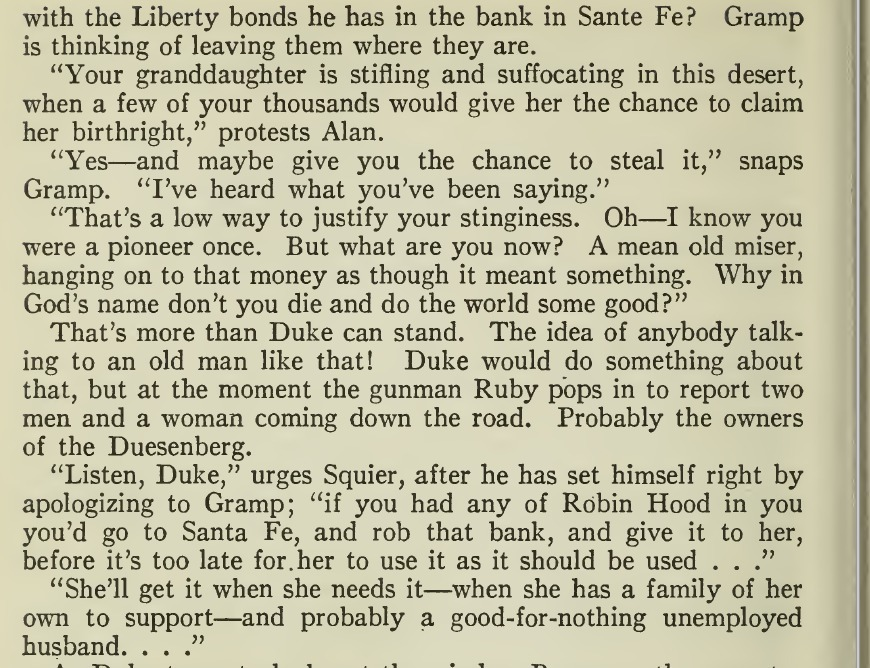
“That's more than Duke can stand” – Strauss's example of a gangster's weakness for justice (student notes, Montesquieu course, 1954)
“When I was a student, Bacon had a very bad press, and the verdict of Harvey, that he philosophizes like a Lord Chancellor, was regarded as the last word about Bacon. Then later I began to read Bacon, and for the first time I was absolutely surprised how wrong this view which I had imbued in school was in the face of this enormous fertility and genius, imagination, which Bacon manifestly shows when you begin to read him” (Strauss, Grotius seminar, autumn 1964, Chicago)
In his piece on Plato’s Laches, Seth Benardete quotes Sophocles’ Ajax (Ajax responding to his father as quoted by prophet Calchas): “even a nobody would acquire superiority with the help of the gods” (θεοῖς μὲν κἄν ὁ μηδὲν ὤν ὁμοῦ, κράτος κατακτήσαιτ᾽, Ajax 767). Benardete adds: “‘nobodies’ are ἄνθρωποι (human beings), and they need gods; ἄνδρες (men) do not.” He then cites 1 Corinthians 1:28 (after “the wisdom of the world” has been contrasted with the wisdom of God): καὶ τὰ ἀγενῆ τοῦ κόσμου καὶ τὰ ἐξουθενημένα ἐξελέξατο ὁ θεός, τὰ μὴ ὄντα, ἵνα τὰ ὄντα καταργήσῃ/“God chose the base things of the world and the despised things–and the things that are not–in order to nullify [render inactive] the things that are.” So that there is no boasting before God (1:29).
Kirk Emmert (under Strauss' supervision) on Churchill “Let us learn our lessons. Never, never, never believe any war will be smooth and easy, or that anyone who embarks on that strange voyage can measure the tides and hurricanes he will encounter. The Statesman who yields to war fever must realise that once the signal is given, he is no longer the master of policy but the slave of unforeseeable and uncontrollable events. Antiquated War Offices, weak, incompetent or arrogant Commanders, untrustworthy allies, hostile neutrals, malignant Fortune, ugly surprises, awful miscalculations – all take their seat at the Council Board on the morrow of a declaration of war. Always remember, however sure you are that you can easily win, that there would not be a war if the other man did not think he also had a chance” (A Roving Commission, 1930)
Seth Benardete on Odysseus' tears.
Demodocus' 1st song (8.74ff.): quarrel of Odysseus & Achilles. O. covers his head, 8.83–92; "for he was ashamed of weeping before the Phaeacians" (8.86).
"but we do not know why O. weeps"
yet: "O's tears, then, would be at the sheer waste of his life"; "the conflict itself was drained of its justice"; "to have been nothing else than to be the subject of song"; "The Phaeacians are the sole beneficiaries of ten years of fighting"
"He is famous no doubt; but the price is higher than he could have expected"; "It is as if his momentary wish in the face of the storm to have died for nothing had been the truth of the war"
2nd song (8.266–366): Ares & Aphrodite. No tears from O.
D's 3rd song (8.499ff.), requested by O. (8.493–95): the wooden horse. "O. shed piteous tears" (8.523–31).
"H. goes out of his way not to tell us the reason for O. tears"; "He replaces the reason or reasons with a simile"
Yet: "The hollowness of past and future right, when they are measured against all he has lost, makes him experience the equivalent of Andromache's fate"
"O's tears, then, could equally be for his vindication of Menelaus' legal right and rejection of Paris's 'natural' claim to Helen"
"He has beaten everything and everyone, but for what?"; "resounding 'No!'" / "Yes!" (to Troy's destruction)
Re: both songs 1 & 3: "why did O. weep at D's two songs" = "why did O. choose mortality" = "What was the good he found in the bad?"
Strauss exam questions on Spinoza
When Stanley Rosen was taking his doctoral examination at Chicago in 1955, Yves Simon set three questions for him (Rosen's dissertation was on Spinoza):
1) The problem of creation in Spinoza. Should the philosophy of Spinoza be described, with no qualification, as pantheistic?
2) Major evidences of Spinoza's influence on
modern philosophy.
3)The problem of free choice in the philosophy
of Spinoza.
Blanckenhagen wrote to Strauss (who was in Switzerland) asking for three additional questions as neither B. nor Otto von Simson felt competent to come up with them. Strauss suggested:
4) What is the relation of Spinoza's doctrine of providence to Maimonides'. State both the points of agreement and the points of difference. State the reasons why Sp. partly agrees and partly differs from M.
5) The traditional definition of substance is "ens per se." Sp. says: quod per se est et per se concipitur. Why does he make this change? ["a being which is by itself and is understood by itself"]
6) Sp. identifies natural right with natural might. How does he arrive from this premise to his liberal-democratic conclusion?