Verifiable computation for AI, defense & enterprise.
Halo: coordination engine for autonomous systems.
DeepProve: prove every AI inference.
@LagrangeFndn $LA
A drone swarm is only a swarm until the network breaks.
After that, it's just a lot of drones flying alone.
Everyone's racing to build more autonomous systems. Almost no one's building the engine that keeps them working as one.
Today that changes. Introducing Halo, the coordination engine for autonomous systems.
250 years ago, a country bet on a then-radical idea: don't put all the power in one place. Distribute it, check it, and the whole thing holds even when parts fail. That's still the bet we build on today.
It's the idea behind everything we make, from verifying every AI inference to autonomy with no single point of failure. Independence, by design.
Happy Fourth, everyone.
How do you keep a swarm a swarm while the network is falling apart?
Our chief scientist, Charalampos Papamanthou, broke down what's actually happening inside Halo. Short version:
4/ Decisions on three clocks: full consensus when there's time, neighborhood coordination when the swarm splits, and reflex in milliseconds when something is immediate.
Everybody wants to talk about how many drones you can build.
Nobody talks about what happens when half the swarm can't reach each other mid-mission. Comms jammed, GPS gone, the network in pieces.
That's the actual problem. That's what Halo is for.
Real missions don't sit still. Conditions shift, drones drop, and a hole opens in your coverage.
Watch Halo catch it and rebalance the swarm on its own. Roles reshuffled, coverage closed, no one touching a controller.
The mission changes. The system adapts. The swarm doesn't break.
1 of 4 short films. The next three show what coordination makes possible once a swarm can survive contact with the real world.
See how Halo works → https://t.co/OeXFnGox8j
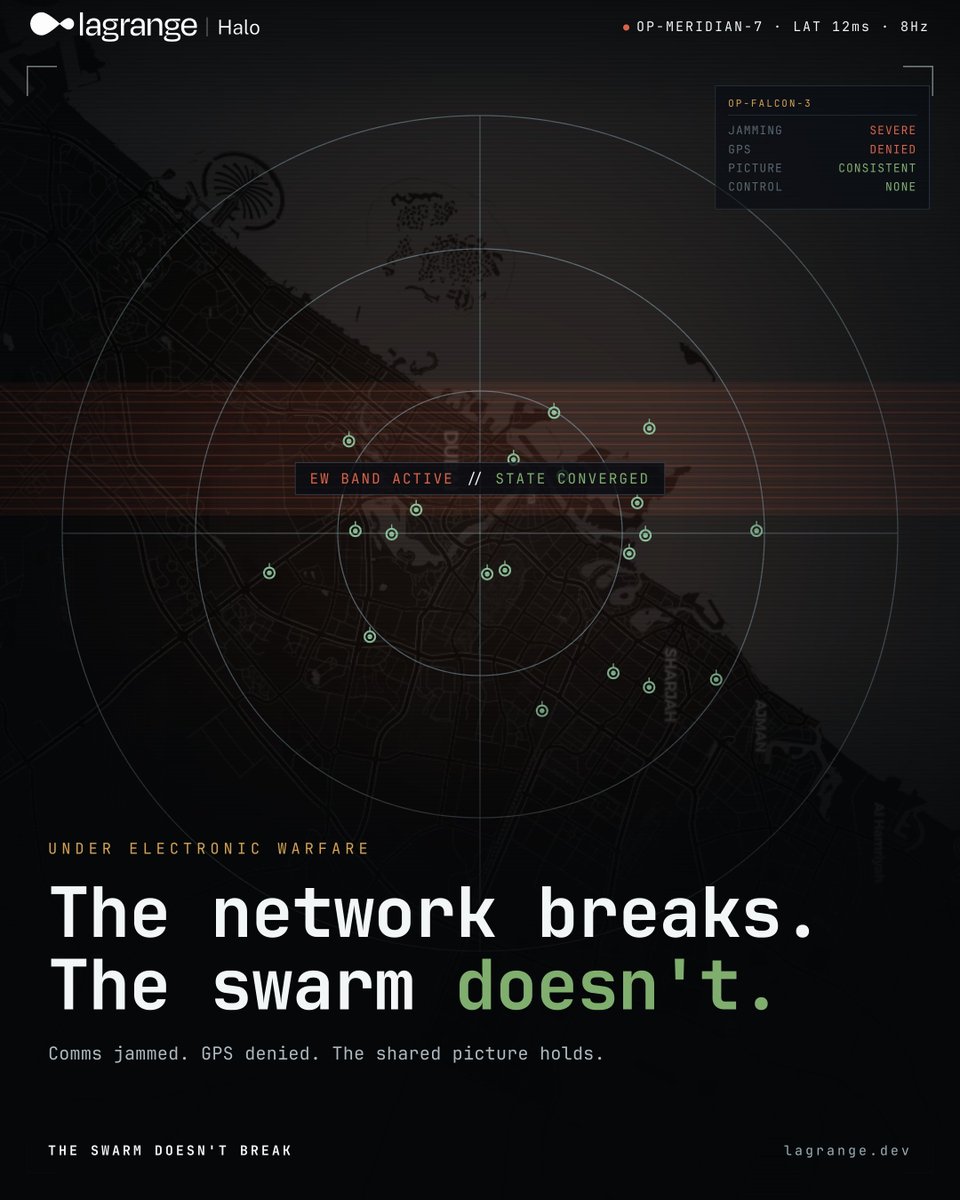
This is a drone swarm in the conditions that break everything else: nodes dropping offline, comms jammed, GPS denied.
With Halo, the swarm doesn't break.
Halo keeps every drone on the same shared picture, reassigns the work the instant one drops, and reconfigures the swarm in real time. No operator in the loop. No central controller to target.
Halo, the coordination engine for autonomous systems.
Halo is the coordination engine for autonomous systems. Built for the densest jamming on earth.
One shared picture. No central control.
See Halo in action → https://t.co/OeXFnGox8j
Comms jammed. GPS denied. For most drone swarms, the shared picture should fall apart.
Halo keeps every drone in agreement straight through the kind of electronic warfare that breaks everything else.
Built for the teams fielding autonomy: defense primes, drone OEMs, robotics and autonomy teams, and program offices.
See how Halo works → https://t.co/OeXFnGox8j
A drone swarm is only a swarm until the network breaks.
After that, it's just a lot of drones flying alone.
Everyone's racing to build more autonomous systems. Almost no one's building the engine that keeps them working as one.
Today that changes. Introducing Halo, the coordination engine for autonomous systems.
When comms are jammed, GPS is denied, and drones are dropping offline, Halo keeps the swarm in agreement.
Every node holds the same picture.
Failure is caught without false alarms.
Roles reassigned the instant one drops.
The system reconfigures itself in real time.
No central controller. No single point of failure.
It drops into the autonomy stack you already run - edge, ground station, or hybrid.
Live today.
The swarm doesn't break.
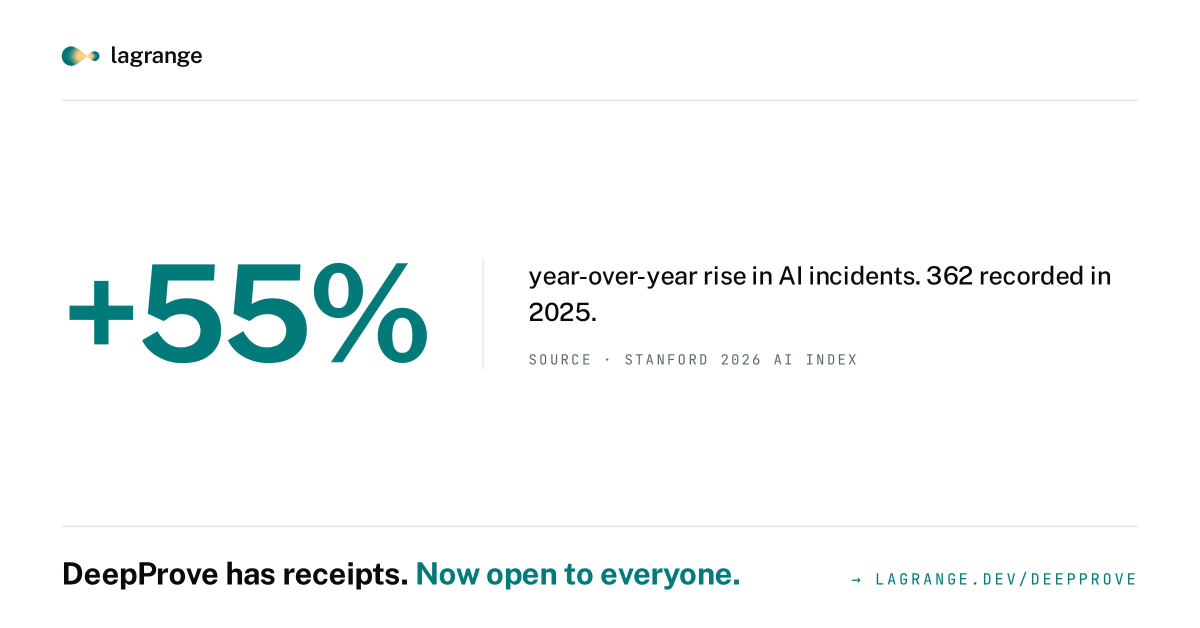
AI incidents hit a record high last year. up 55%.
model transparency fell for the first time. down 18pts.
(Stanford AI Index 2026)
more AI. more harm. less disclosure.
"trust me bro" is not an incident report.
would you ship an AI decision you can't prove?