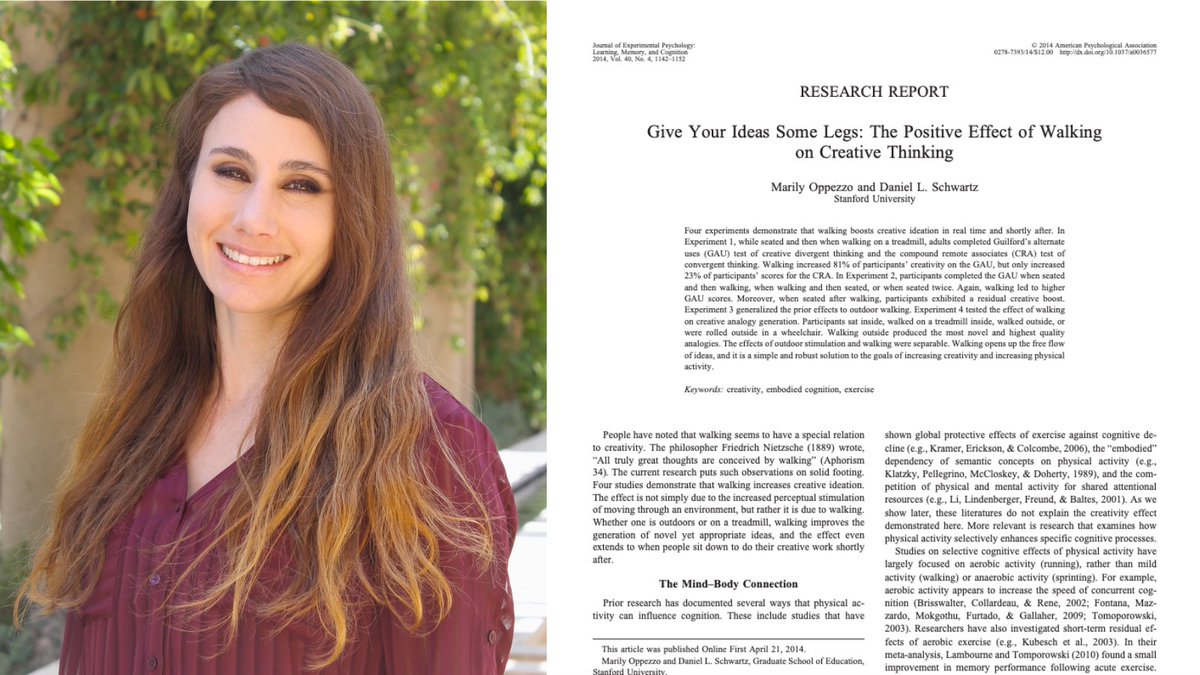
A Stanford psychologist spent 4 years proving that the simple act of walking generates 60% more creative ideas than sitting, and the experiment she designed to kill every alternative explanation is one of the most decisive findings in modern psychology.
Her name is Marily Oppezzo.
She got the idea for the study while walking with her advisor at Stanford to discuss her thesis topic, and the paper she eventually published in the Journal of Experimental Psychology in 2014 is sharp enough that it should have ended the seated meeting on the day it came out.
She ran 4 experiments on 176 people. Same person tested twice. Once sitting, once walking. The creativity tasks were the standard ones psychologists have used for decades to measure how good a brain is at generating novel useful ideas.
The result was almost too clean to publish.
81% of participants in the first experiment produced more creative ideas while walking than while sitting. In the second experiment, 88%. In the third, 100%. Every single person walked into a more creative version of themselves.
On average, people generated 60% more novel useful ideas the moment their legs started moving.
The skeptical question is the obvious one. Maybe it was the fresh air. Maybe it was the scenery passing by. Maybe it was the change of environment doing the work, not the walking itself.
Oppezzo killed every one of those explanations with one experimental decision.
She put people on a treadmill facing a blank wall. No scenery. No fresh air. No environmental change. Just legs moving in place while staring at white drywall. The 60% boost held.
Then she ran the experiment that closed the case completely. She took participants outside in two conditions. Half of them walked through a Stanford courtyard. The other half were pushed through the exact same courtyard in a wheelchair. Same outdoor stimulation. Same scenery passing at the same speed. The only difference was whether the legs were moving.
The walkers produced dramatically more novel high-quality ideas than the wheelchair group. The outdoors did almost nothing on its own. The walking did everything.
This is the part of the study that hit hardest when I read it the first time.
She also tested the opposite kind of thinking. Convergent thinking. The kind where there is one right answer and you have to narrow down to it.
Word puzzles where 3 words share a hidden fourth word that connects them. The seated participants did slightly better on these. Walkers got slightly worse.
Walking is not a general intelligence enhancer. It does one specific thing. It opens up the divergent search inside your brain. The part that generates options. The part that produces unexpected connections. The part that takes a problem and finds five ways into it instead of one.
When you need to converge on the single right answer, sit down. When you need to find the answer in the first place, get up.
The mechanism is now well understood. Walking selectively activates what neuroscientists call the default mode network, the system inside your brain that runs when you are not consciously focused on anything. The DMN is where mind-wandering happens. Where memories cross-reference each other. Where ideas that have been sitting in separate folders inside your head finally bump into each other.
When you sit at a desk and force yourself to concentrate, you suppress the DMN. When you walk at a natural pace, the executive part of your brain gets just busy enough handling the walking that the DMN comes online and starts doing the work that focus was blocking.
The most useful finding in the entire paper is the one almost nobody quotes.
The boost did not turn off the moment people stopped walking. Participants who walked first and then sat back down stayed elevated. Their next round of seated creativity work was still significantly better than people who had been sitting the whole time. The rest lingered for at least several minutes after the legs stopped moving.
You do not need to do creative work while walking. You need to walk before the creative work. The brain holds the state.
The history of this is the part that should haunt anyone who still does meetings in chairs.
Charles Darwin built a gravel loop behind his house in Kent called the Sandwalk and walked it 3 times a day for the rest of his life. The theory of evolution was developed one lap at a time on that path.
Nietzsche walked up to 10 hours a day during the years he wrote his most important books and openly said the work was conceived on his feet.
Beethoven composed for the morning and walked for 5 hours every afternoon with a pencil in his pocket for when something landed.
Kahneman said the best thinking of his Nobel Prize-winning career happened on leisurely walks with Amos Tversky. Steve Jobs refused to take important conversations sitting down. He held them on foot.
Every one of them was using the system Oppezzo would not measure until 2014. They just did not know what to call it.
The question worth sitting with is the one almost nobody asks.
Every meeting you have ever attended sitting around a table was a meeting held at a fraction of the brain power that was actually available to the people in the room. Every brainstorm that got stuck inside a conference room. Every problem you tried to solve at a desk and gave up on. Every idea you could not quite get to.
The intervention is the easiest one in modern science. No supplement. No app. No subscription. No training program. Just a pair of legs and 15 minutes.
The Stanford lab proved it. The philosophers knew it. The neuroscience explains it.
And almost everyone reading this is still trying to think their way out of problems sitting completely still.
Rita Moreno is one of just three people to win an Emmy for The Muppets, the other two: Bernadette Peters and Peter Sellers. The comedy timing during her performance of "Fever" while Animal attempts to railroad her is incredible. It was also done in one take
"Dat my kinda woman!"
"HEROES" ON BING CHRISTMAS SHOW 1977
“For ever and ever...”
Back in 2016 we posted the then oft overlooked performance of "Heroes" recorded for Bing Crosby's 1977 Merrie Olde Christmas TV Special. Notable for the wonderfully bizarre, but nevertheless beautiful David Bowie and Bing Crosby duet of Peace On Earth/Little Drummer Boy, the broadcast also contained aforementioned video of "Heroes".
In the promo film, Bowie sings one of the most heartfelt and emotional performances of "Heroes" he ever delivered. The vocal was sung over a backing track, with some not so subtle phasing and echo effects on his voice that may well have been added after the event.
Looking amazing, he sings close up straight to camera while he also performs several set mime pieces superimposed along with the main performance.
Along with a little help from Particledots on the audio, @NachosVideos produced a new version without Bing's spoken introduction encroaching on the performance.
The show was filmed in Elstree just outside London in the UK on September 11th, 1977. Originally broadcast in the US by CBS on the 30th of November 1977, the UK had to wait another month to see exactly what the fuss was being reported in the music weeklies, when the show was finally aired there on Christmas Eve 1977.
FOOTNOTE: The shot of a shirtless Bowie was one of several stills taken during this "Heroes" filming session, though he didn't appear like this in the actual broadcast.
#BowieBing #BowieHeroes #NachoBowie
Vanilla Fudge’s 1968 rendition of ‘Keep Me Hanging On’ on The Ed Sullivan Show is a sight to behold. They cover The Supremes in costumes that look like they came straight from Austin Powers, but the drama and showmanship capture the '60s vibe. And Carmine Appice on drums—wow!
Tearfully celebrating the life and music of Supertramp’s Rick Davies.
A generational talent, he wrote “Bloody Well Right,” one of the most iconic songs of the decade.
Sending condolences and gratitude to his family. #RIP ❤️🎹
@bearmccreary Gone Hollywood…
“I've had enough of walking from place to place
I've yet to come across a friendly face
And now the words sound familiar, as you slam the door
You're not what we're looking for”
“If we only had time, only had time for you”
@DameEvelyn Any chance of roll on a large, upside down cymbal, placed on a timpani while you gliss up and down on the timpani pedal - a la George Crumb?
Asking for a friend. 😉
Origins of 'While My Guitar Gently Weeps',
"The Eastern concept is that whatever happens is all meant to be ... every little item that's going down has a purpose. "While My Guitar Gently Weeps" was a simple study based on that theory ... I picked up a book at random, opened it, saw "gently weeps", then laid the book down again and started the song."
Says the legendary George Harrison about the song.
Harrison wrote "While My Guitar Gently Weeps" after his return from India, where the Beatles had been studying Transcendental Meditation under Maharishi Mahesh Yogi during the spring of 1968.
The visit had allowed Harrison to re-engage with the guitar as his primary instrument, after focusing on the Indian sitar for the previous two years, and also marked the start of a prolific period for him as a songwriter. Inspiration for the song came to him when he was visiting his parents in Warrington, Cheshire, and he began reading the I Ching, or "The Book of Changes".
As Harrison put it, "[the book] seemed to me to be based on the Eastern concept that everything is relative to everything else, as opposed to the Western view that things are merely coincidental."
Embracing this idea of relativism, he committed to writing a song based on the first words he saw upon opening a book, which happened to be "gently weeps". Harrison continued to work on the lyrics after this initial writing session.
During a ride from Surrey into London, Harrison asked Clapton to play guitar on the track. Clapton, who recognised Harrison's talent as a songwriter, and considered that his abilities had long been held back by Lennon and McCartney, was nevertheless reluctant to participate; he later recalled that his initial response was: "I can't do that. Nobody ever plays on Beatles records."
Harrison convinced him, and Clapton's lead guitar part, played on Harrison's Gibson Les Paul electric guitar "Lucy" (a recent gift from Clapton), was overdubbed that evening.
Recalling the session in his 2007 autobiography, Clapton says that, while Lennon and McCartney were "fairly non-committal", he thought the track "sounded fantastic", adding: "I knew George was happy, because he listened to it over and over in the control room."
Peter Frampton and Eric Clapton performing 'While My Guitar Gently Weeps' live at Crossroads, in 2019.
In 1983, Mel Brooks and Anne Bancroft appeared on a British variety show and sang Sweet Georgia Brown.
In Polish.
Happy Birthday 98th birthday to an absolute legend.
I just cancelled my Adobe licence after many years as a customer.
The new terms give Adobe "worldwide royalty-free licence to reproduce, display, distribute" or do whatever they want with any content I produce using their software.
This is beyond insane. No creator in their right mind can accept this .
You pay a huge monthly subscription and they want to own your content and your entire business as well.
Going to have to learn some new tools.