$ICP is the only blockchain where entire apps — frontend, backend, storage, and AI — run 100% on-chain.
🔧 How it’s possible:
• Smart contracts store gigabytes
• Runs real logic (WebAssembly)
• Horizontally scales with subnets
🌍 Why it matters:
• No AWS, no bridges, no middlemen
• Fully decentralized, tamper-proof
• Enables real on-chain AI + dApps
ICP isn’t just Web3 — it’s a full-stack Crypto Cloud. The future is already running.
#ICP #CryptoCloud #OnChainAI #Web3 #DecentralizedApps #Blockchain #AI
$CLOUD
@realclownicp@cryptocloudsicp https://t.co/f7pTE3UmTt
@elna_deai $ELNA
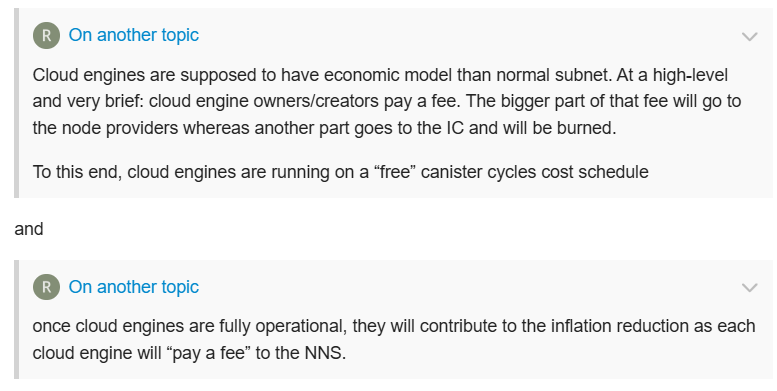
Value proposition of Cloud Engines⬇️
Even if $ICP captures just 0.1% of a projected $2T market by 2030, that would still represent $2B in annual revenue.
Someone got Wordpress running 100% from the Internet Computer! Not as easy as it sounds, as it's designed to run on traditional tech, not frontier serverless cloud, so big shout out to ICP community member @miadey 🔥
https://t.co/OB6LYKbIaO
AI deleting production data again 👀
Motoko, the frontier backend language for agents from Caffeine, prevents this:
1) Orthogonal persistence unifies data and logic.
2) On software updates, if migration logic results in data loss, the update is rejected, and agent tries again.
Does anyone else feel like exploits and hacks have exploded lately, especially in crypto?
🧵👇
Every day it’s another bridge hack, frontend compromise, exploit, or funds drained.
It feels like the frog in boiling water. Everyone treats it as normal because it happens so often, but to me it looks like a bubble popping in slow motion right in front of us.
I think a lot of this space may collapse, and yes, ICP’s price could get dragged down too because it’s still associated with crypto broadly.
But when the dust settles, real utility will matter.
This feels eerily similar to the dot-com bubble.
Back then people thought being a dot-com made something valuable.
Now, people think just being a blockchain does.
Then the bubble exposed what wasn’t useful, and much of it washed out.
But the real infrastructure and real utility rose from that, because the internet itself was useful when leveraged in meaningful ways.
That’s how I see the Internet Computer Protocol, leveraging blockchain technology in an actually meaningful way. Real utility.
Utility is THE narrative. Always has been.
$ICP $CLOUD ∞ ☁️
https://t.co/nqDRj45GqA
Utility is the narrative.
It’s the only thing that survives.
The dot-com bubble didn’t kill the internet. It killed bad ideas built around it.
The useful infrastructure remained.
Same with every major tech wave.
Hype fades.
Utility compounds.
$ICP $CLOUD ∞ ☁️
@MarioNawfal This is why people use caffeine AI for their apps, which builds apps on a frontier cloud made for agents. Data loss is impossible there because of enhanced orthogonal persistence
@caffeineai
I think people make a category error when they analyze the Internet Computer Protocol like just another cryptocurrency.
They look at the chart and compare it to other coins.
But that may be the wrong lens.
ICP isn’t simply a token with a narrow transactional use case.
It’s trying to build and power infrastructure: compute, storage, applications, AI services, and a new model for hosting on the web.
That’s a product.
Something developers, enterprises, governments, and builders could potentially use because it solves real problems.
That should be analyzed more like infrastructure or software than like a pure speculative asset.
The real question is not:
Will this coin be adopted?
It’s:
Will this infrastructure be used?
Big difference.
If the answer is yes, the token is the exposure layer.
$ICP $CLOUD ∞ ☁️
If your “new stack” needs 50+ moving parts to function, maybe the stack is the problem.
Real innovation should reduce dependencies, attack surface, and complexity.
Not recreate legacy finance with more middleware.
This is why a unified model like ICP matters.
$ICP $CLOUD ∞ ☁️
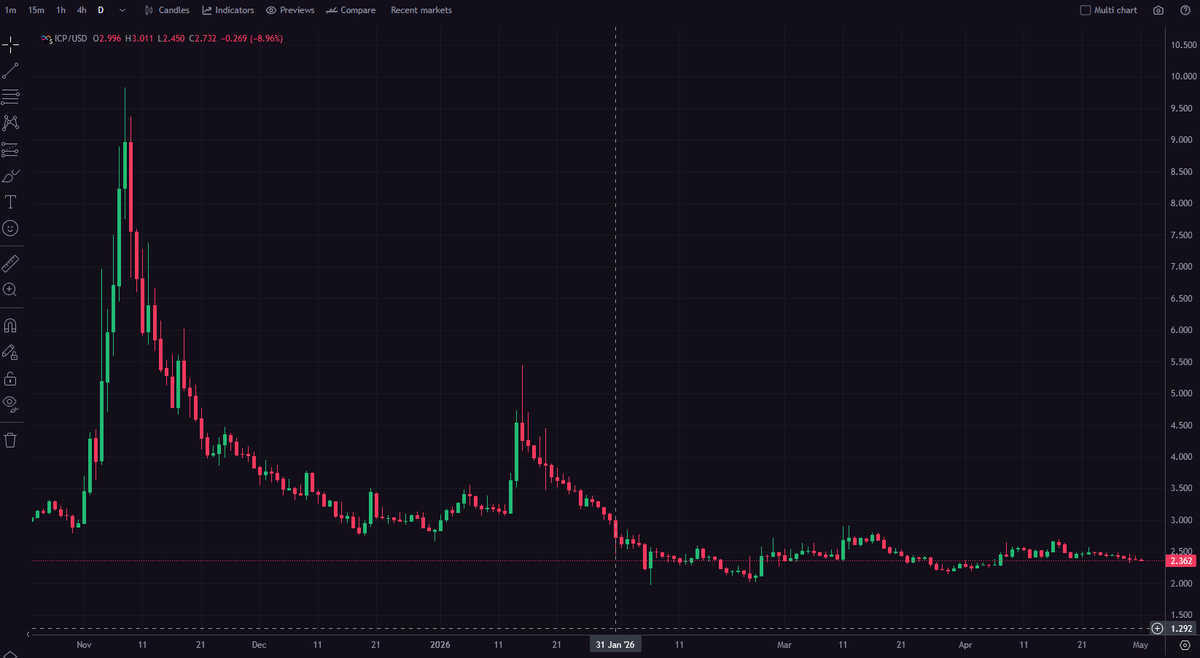
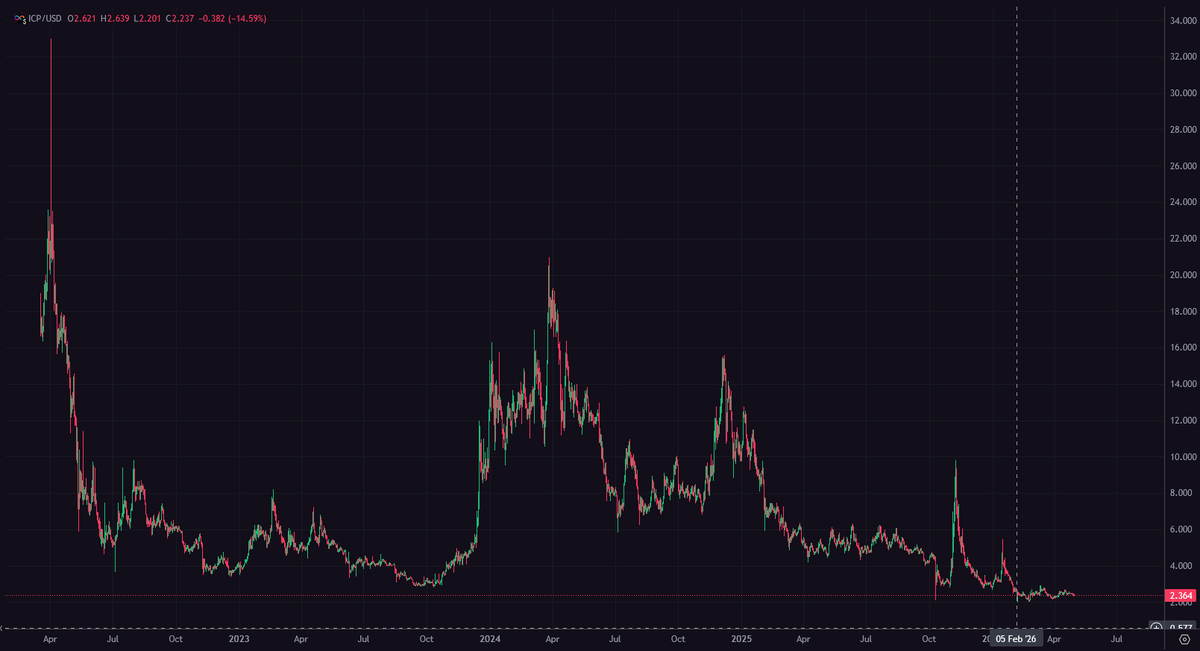
internet-computer:native has been sitting in a tight range for months now.
Roughly ~$2 to ~$3, just going sideways.
If you zoom out, this is actually one of the longest periods of real consolidation ICP has ever had.
That kind of compression usually doesn’t last forever.
Not financial advice, (DYOR) but structurally this is the most “calm” and controlled ICP has looked in a long time.
Now pair that with what the Internet Computer Protocol actually is:
- Full stack on-chain (frontend, backend, logic, data)
- Apps served directly from the chain (HTTP)
- On-chain AI execution
- No oracles (HTTP outcalls built-in)
- No Web2 dependencies
- Reduces cloud networking complexities
- Massively reduces attack surfaces
- Real apps, not just token movement
- True native cross-chain
Plus @caffeineai making it possible for anyone to build directly on the network.
This is what Web3 was supposed to be. A truly decentralized, full-stack cloud.
No other chain combines all of this in one stack
If you understand the tech, this kind of price behavior starts to look a little more interesting.
internet-computer:native $CLOUD ∞ ☁️
Wild that an account with 101k+ followers still has zero awareness of what’s actually being built.
101k+ followers and still thinking Web3 = trading, memes, and scams.
They are literally describing what already exists.
Apps people can use daily, no crypto UX, no wallets, no friction, just normal products running on-chain.
That’s exactly what the Internet Computer Protocol is doing right now and has been.
You can build entire apps and websites on it where users don’t even know it’s running on blockchain.
And with tools like @caffeineai, anyone can build apps on-chain.
This space isn’t lacking solutions, it’s just not paying attention.
$ICP $CLOUD ∞ ☁️
@zoetoshi
🔴IT'S 2026, AND EVERYTHING IS A SCAM
Real technical solutions will put TONS OF PEOPLE OUT OF A JOB. We are watching the final stages of a scam economy.
A Cloud Foundation Production ☁️♾
$ICP $CLOUD ☁️📽️
Everything is going according to the plan for $ICP.
When I interviewed the Founder of the Swiss Subnet, he shared the timeline for the Pakistani Cloud Engines/Subnet. I shared the timeline on X/YT/OC.
Guess what, we are exactly within the mentioned timeline (3-6 months after the agreement has been signed).
Please understand that DFINITY and the guys at the Swiss Subnet are working very hard to make this happen. This is the product of years of PR and lobbying. It is not a fluke.
I did mention that DFINITY is talking with Governments & Institutions (Dom confirmed). I think people struggle to understand the amount of times it takes to struck a deal and set this up. This is a big effort. The results will be proportional to the effort.
As mentioned, everything has been built for a reason.
I will share the timeline/value proposition/what to expect next on YT. Stay tuned!
Another bridge, more millions gone. Maybe it’s time to stop wrapping everything with more layers of abstraction and bridges.
ICP full-stack on-chain apps with ZERO bridges looking real smart right now.
$ICP $CLOUD ∞ ☁️
Cybersecurity & cloud networking professionals, genuine question:
Why do I almost never see discussion around the Internet Computer Protocol in your circles?
From my understanding, it seems like it changes the architecture pretty significantly in a more unified, less complex way.
Instead of stitching together a typical cloud stack (frontend, APIs, databases, auth, networking, firewalls, etc. across multiple services), you can run full-stack apps inside "canisters" on a single network, ICP, where components talk internally.
That seems like it could:
– reduce exposed endpoints
– reduce inter-service networking complexity
– reduce certain attack surfaces (especially between services)
– remove a lot of common misconfigurations that lead to breaches
Less complexity. Fewer attack surfaces, right?
At the same time:
– no traditional cloud perimeter
– different trust model
– different security assumptions
So I’m trying to sanity check my thinking.
A few things I’d really like input on:
– Does consolidating app + backend + data into a unified environment actually reduce attack surface in a meaningful way?
– How would you threat-model something like this compared to a typical AWS/GCP setup?
– Does reducing a lot of external networking between services lower real-world breach risk?
– Or does it just trade traditional cloud security controls for a different set of risks?
I get why most people tune out anything labeled “blockchain”, the space is full of hype and noise.
But this feels more like an infrastructure / architecture question than a crypto one.
Curious if I’m missing something or if this is just flying under the radar.
@NetworkChuck@cybersec@all_secured