In 1187, one of history's most contested cities changed hands again.
Sultan Salah ad-Din (Saladin) recaptured Jerusalem after nearly 90 years of Crusader rule, following his decisive victory at the Battle of Hattin.
When Crusader forces captured Jerusalem in 1099, thousands of Muslims and Jews were massacred. After Salah ad-Din's victory, many civilians were instead allowed to ransom themselves, others were released, and Christian holy sites were preserved.
His conduct surprised many contemporaries and helped shape his reputation far beyond the Islamic world.
Lesson From History:
How you treat people after victory often defines your legacy more than the victory itself.
Zhuangzi’s idea was more radical than simply “be different.” He argued that constantly proving your usefulness can make you a tool for other people’s ambitions, while the “useless” tree survives precisely because nobody can exploit it.
Lesson From History: Don’t measure your worth only by how useful you are to others. Protect some of your time, energy, and life for yourself.
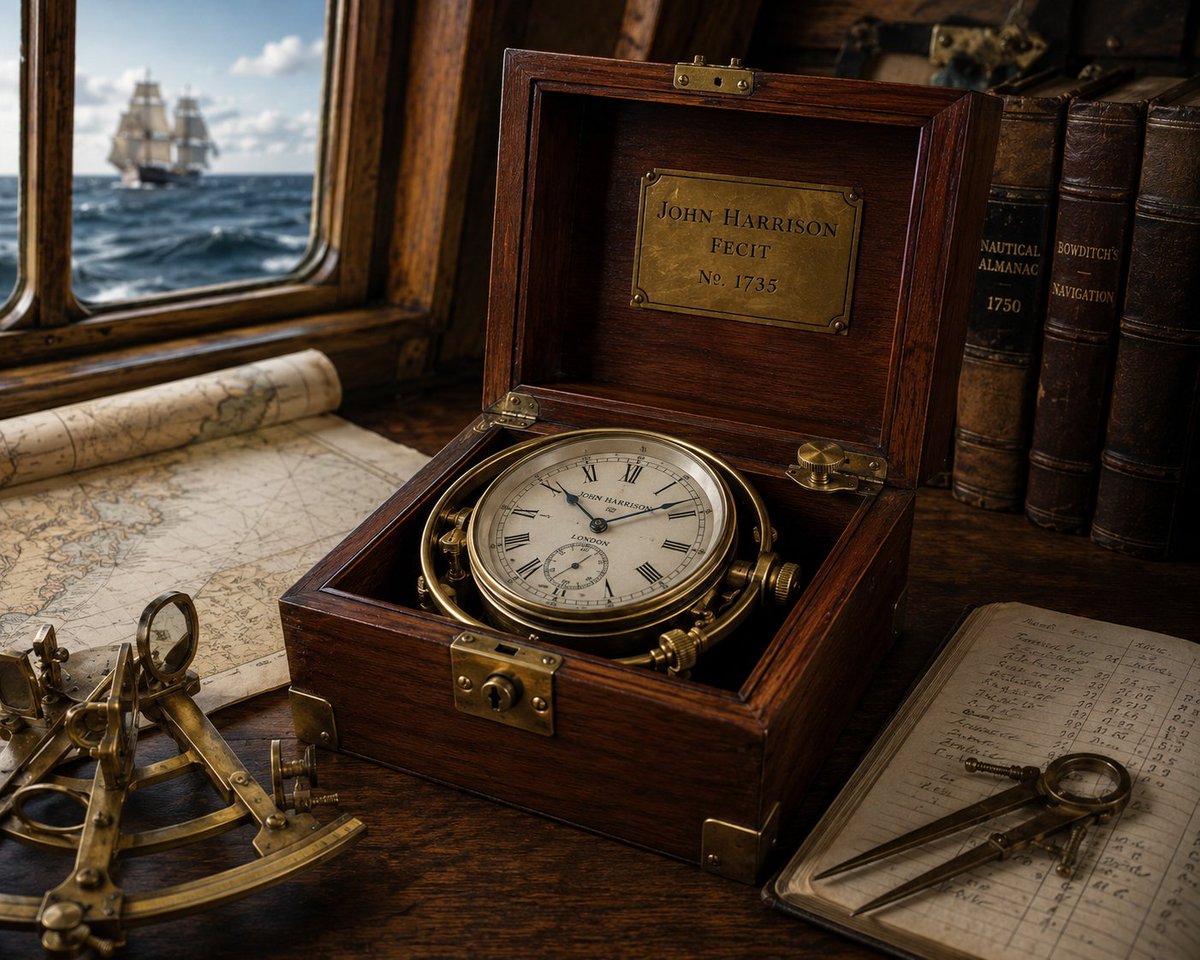
For decades, ships could calculate their latitude, but not their longitude.
In the early 1700s, determining a ship's east-west position at sea was one of navigation's greatest unsolved problems. Countless vessels were lost because sailors couldn't accurately calculate their longitude, even when they knew exactly where they were north or south.
In 1714, the British Parliament offered the Longitude Prize, one of history's largest scientific rewards, to anyone who could solve the problem.
The breakthrough came not from a famous astronomer, but from John Harrison, a self-taught carpenter and clockmaker. After decades of work, he developed a marine chronometer accurate enough to keep precise time at sea, allowing sailors to calculate longitude with remarkable precision.
His invention revolutionized navigation, reduced shipwrecks, and transformed global trade and exploration.
Lesson From History:
Don't dismiss your ideas because you're not the recognised expert. Sometimes a fresh perspective solves problems that specialists have struggled with for years.
An expedition to cross Antarctica became one of history's greatest survival stories instead.
In 1914, Ernest Shackleton set out to cross Antarctica, but his ship, Endurance, became trapped and crushed by sea ice before the journey could begin. Stranded in one of the harshest environments on Earth, Shackleton led his crew across drifting ice and through dangerous seas in search of rescue.
Nearly two years after leaving home, every member of the expedition survived.
Today, the expedition is widely studied as one of history's greatest examples of leadership under extreme pressure.
Lesson From History:
When your original goal becomes impossible, don't keep chasing it out of pride. Adjust your priorities and focus on achieving the best outcome that's still possible.
The concern wasn't completely unfounded. Modern education still limits calculator use in many early maths classes because students first need to develop number sense and mental arithmetic.
Lesson From History: Don't let convenience stop you from building real understanding. Master the basics before relying on shortcuts.
Ken Aston didn't invent yellow and red cards during the match. The idea came later when a London traffic light inspired him to create universal signals that every player could understand, regardless of language.
Lesson From History: When you face a recurring problem, don't just solve it once—create a system that prevents it from happening again.
For centuries, ships had to sail around an entire continent to travel between the Atlantic and Pacific Oceans.
Completed in 1914, the Panama Canal transformed global trade by cutting a route through the Isthmus of Panama. Before its construction, ships travelling between the east and west coasts of the Americas had to sail around Cape Horn, adding thousands of kilometres to their journey.
Building the canal required overcoming dense jungle, landslides, and deadly diseases such as malaria and yellow fever. Advances in engineering and public health eventually made one of history's greatest infrastructure projects possible.
More than a century later, the canal remains one of the world's busiest trade routes.
Lesson From History:
Before working harder, ask yourself if you're solving the problem in the smartest way. Sometimes changing the route is more valuable than moving faster.
The duel was the result of years of political rivalry, not a single argument. Hamilton and Burr had clashed repeatedly, and after Burr lost the 1804 New York governor's race, he demanded satisfaction over remarks Hamilton had allegedly made about his character. Although dueling was illegal in New York, they crossed the Hudson to New Jersey, where enforcement was weaker. Hamilton died the next day, while Burr's political career never recovered.
Lesson From History: A single emotional decision can undo a lifetime of achievement.
When London's Underground opened in 1863, it allowed thousands of commuters to travel into the city center without adding more horse-drawn traffic to already overcrowded streets. Its success inspired cities such as Budapest (1896), Paris (1900), New York (1904), and Berlin (1902) to build their own metro systems, permanently changing how modern cities expanded.
Lesson From History: Sometimes the best solution isn't expanding what already exists—it's finding an entirely new way forward.
During World War II, the Alaska–Siberia (ALSIB) air route carried nearly 8,000 American aircraft to the Soviet Union under the Lend-Lease program. What later became one of the Cold War's most symbolic frontiers had, only a few years earlier, served as a vital corridor for cooperation against Nazi Germany.
Lesson From History: Never assume today's reality is permanent. The world can change faster than you expect.
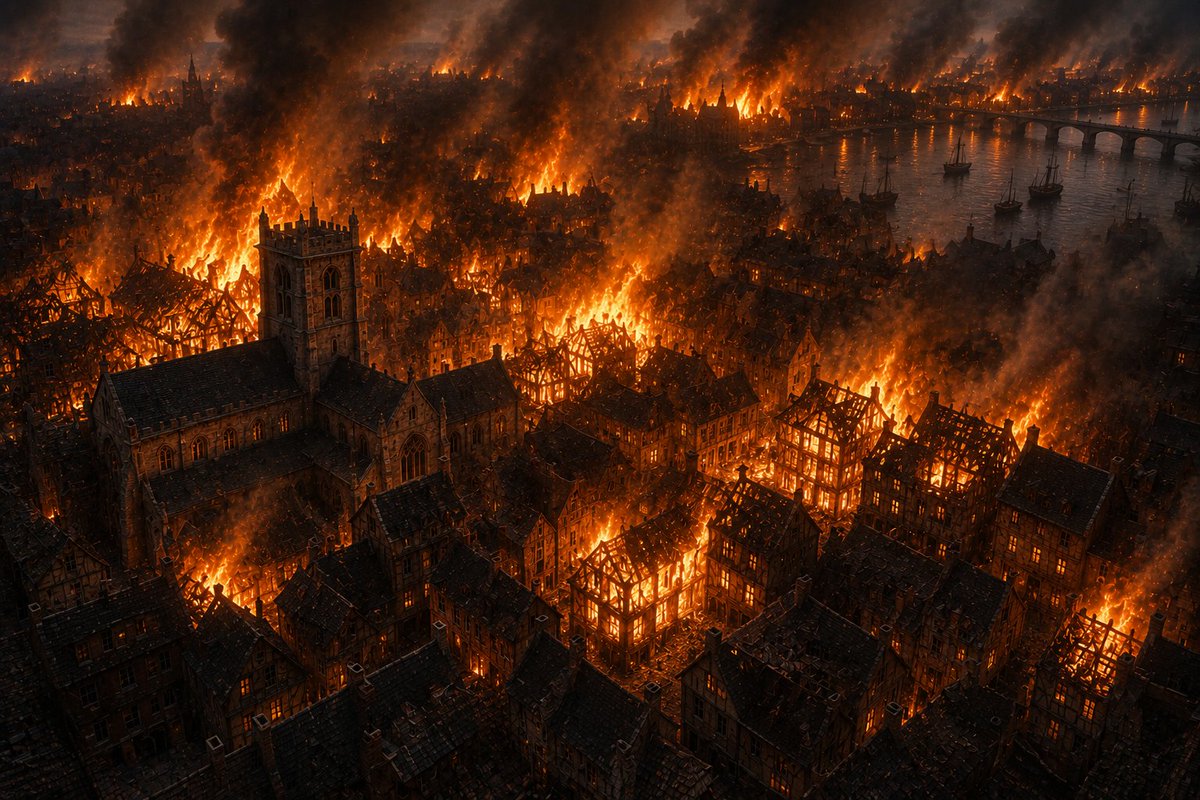
A fire that started in a bakery destroyed most of medieval London.
In the early hours of 2 September 1666, a fire broke out in Thomas Farriner's bakery on Pudding Lane. Strong winds, wooden buildings, and narrow streets allowed the flames to spread rapidly through the city.
Over four days, more than 13,000 houses, St Paul's Cathedral, and dozens of churches were destroyed. Although thousands lost their homes, the disaster also transformed London. New building regulations required brick and stone construction, streets were widened, and the city became far more resistant to future fires.
One of London's greatest disasters ultimately reshaped it for the better.
Lesson From History:
When something fails, don't focus only on fixing it. Improve the system so the same failure is less likely to happen again.
Nikola Tesla didn't just invent remarkable technologies—he helped create the electrical system that powers the modern world. His work on alternating current made it possible to transmit electricity efficiently over long distances, bringing reliable power to cities and millions of homes.
Lesson From History: Build things that solve real problems, and their impact can outlive you.
This 2,700-year-old Assyrian winged deity, known as a Lamassu, was buried for centuries before being rediscovered in Iraq in 2023. These monumental statues once stood at the entrances of Assyrian palaces, symbolizing strength, wisdom, and protection.
Lesson From History: Great things aren't always lost—they're often just waiting to be rediscovered.
A treaty that many considered disappointing became one of the most important turning points in Islamic history.
In 628 CE, the Prophet Muhammad ﷺ and approximately 1,400 companions travelled to Makkah intending to perform Umrah. They were stopped outside the city, and after lengthy negotiations, a peace treaty was signed with Quraysh.
Several terms appeared unfavorable to the Muslims, causing disappointment among many companions. Yet the agreement brought stability, allowing travel, dialogue, and peaceful interaction between tribes. During the following two years, Islam spread more rapidly than during years of conflict, and Makkah was later entered peacefully.
Historians regard the Treaty of Hudaybiyyah as one of the defining diplomatic successes of early Islamic history.
Lesson From History:
Don't judge every decision by its immediate outcome. Some of your best decisions will only reveal their value months—or even years—later.
Rome's trade with India brought extraordinary goods—but also a growing trade deficit. As Roman demand for luxury imports exceeded the value of its exports, increasing amounts of gold and silver flowed east, worrying leaders like Pliny the Elder nearly 2,000 years ago.
Lesson From History: A strong economy—and a strong life—can't rely on consuming more than it produces.
@Rainmaker1973 The theatre's remarkable preservation is no accident. Greek engineers carefully selected the location, materials, and design to create a structure that could withstand both time and constant use.
Lesson From History: Quality takes longer to build, but it lasts much longer.
A safety test carried out during the night became the world's worst nuclear accident.
On 26 April 1986, engineers at Reactor No. 4 of the Chernobyl Nuclear Power Plant began a planned safety test. A combination of operator mistakes and serious reactor design flaws caused an uncontrolled power surge, leading to explosions that destroyed the reactor.
Radioactive material spread across large parts of Europe. Entire towns were evacuated, hundreds of thousands of people were relocated, and a vast exclusion zone remains around the site today.
Investigations after the disaster led to major changes in nuclear safety procedures around the world.
Lesson From History:
Never ignore small risks simply because nothing has gone wrong before. Many disasters happen after people become comfortable taking the same shortcut repeatedly
Jamsetji Tata didn't just build a successful business—he designed it to create value long after he was gone. By placing much of the company's ownership into charitable trusts, he ensured that commercial success would continue funding education, healthcare, and scientific research for generations.
Lesson From History: Build systems that continue doing good even when you're no longer there. (Regardless of the size of the system).
Henry Ford didn't just revolutionize manufacturing with the assembly line—he standardized how work was done. By documenting every process, he reduced errors, improved consistency, and made it easier to train thousands of employees as production scaled.
Lesson From History: If success depends on one person's memory, your system isn't finished. Document your processes.
Alexander's greatest achievement wasn't simply the size of his empire—it was how quickly he built it. In just over a decade, his campaigns reshaped the political and cultural landscape from Greece to India, influencing trade, language, and civilization for centuries.
Lesson From History: Don't measure your potential by your age. Measure it by how you use your time.
Vasco da Gama's voyage did more than reach India—it permanently changed global trade. By opening a direct sea route between Europe and Asia, it reduced reliance on overland trade routes and reshaped commerce for centuries.
Lesson From History: Don't just work harder. Look for a better route.