LIP-106 is raised to allocate 20,000,000 LIKE to extend the deposit incentive for a year. Voting period will last for 7 days till 2026.06.23 1035 GMT+8.
https://t.co/LXryVaUj3J
Perfection is a direction, not a destination. Ship first, then improve it with your users—from my column to @3ookcom’s Cantonese AI narration to staying to mend an imperfect society.
https://t.co/kBShM08Ikq
The last LikeCoin community meeting (in this format) is happening in an hour.
- 2026.05.04 (Mon) 18:30 UTC+8
- https://t.co/mxhAoYUyZB
Starting next month, it will transform into a podcast. Stay tuned.
LIP-103 "Extension of Deposit Incentives for LikeCoin" was passed with 100% For (4.6m votes). Tech SubDAO will upgrade the deposit contract to reflect the change after lunar new year.
https://t.co/t2DJskg1WY
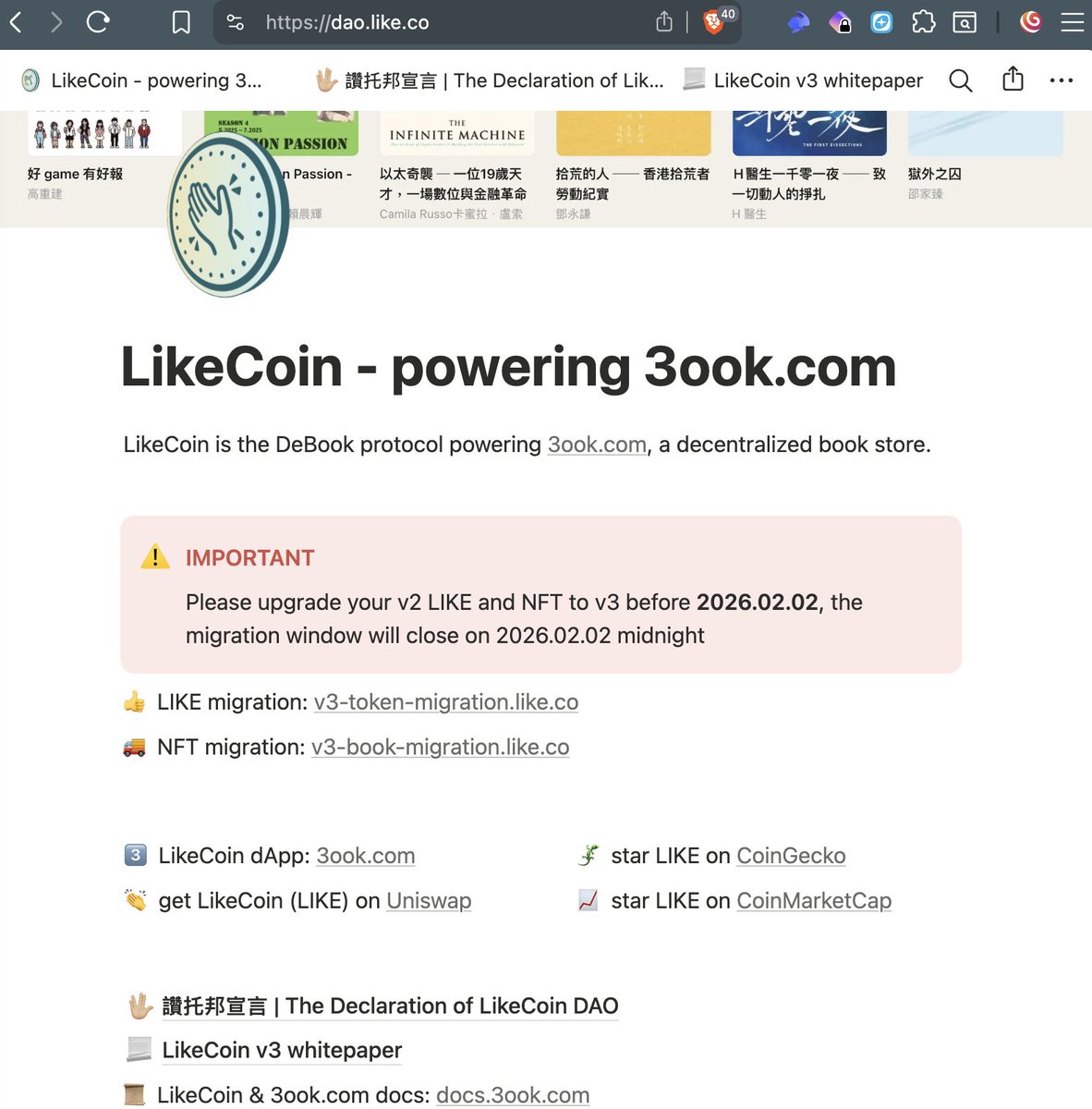
Final Call: The deadline of LikeCoin v3 migration will be 2026.02.02 2359 GMT +8. LikeCoin v2 holders are encouraged to upgrade their tokens to v3 to stay in the ecosystem.
https://t.co/pWos6iQoF3
@DerarTweb3@ckxpress just submitted a proposal to provide a final 30-day window for LikeCoin v1 holders to migrate their tokens directly to v3. If the proposal is passed by the community, there will be 30 days to migrate LikeCoin v1
https://t.co/r7IbkAqzaH
How I would do creator coins
We've seen about 10 years of people trying to do content incentivization in crypto, from early-stage platforms like Bihu and Steemit, to BitClout in 2021, to Zora, to tipping features inside of decentralized social, and more. So far, I think we have not been very successful, and I think this is because the problem is fundamentally hard.
First, my view of what the problem is. A major difference between doing "creator incentives" in the 00s vs doing them today, is that in the 00s, a primary problem was having not enough content at all. In the 20s, there's plenty of content, AI can generate an entire metaverse full of it for like $10. The problem is quality. And so your goal is not *incentivizing content*, it's *surfacing good content*.
Personally, I think that the most successful example of creator incentives we've seen is Substack. To see why, take a look at the top 10:
https://t.co/duaCaGNYXp
https://t.co/y1F9Td0Y52
https://t.co/xEMt8pIK74
Now, you may disagree with many of these authors. But I have no doubt that:
1. They are on the whole high quality, and contribute positively to the discussion
2. They are mostly people who would not have been elevated without Substack's presence
So Substack is genuinely surfacing high quality and pluralism.
Now, we can compare to creator coin projects. I don't want to pick on a single one, because I think there's a failure mode of the entire category.
For example:
Top Zora creator coins: https://t.co/238cqf2bX1
BitClout: https://t.co/0jVmotkpFw
Basically, the top 10 are people who already have very high social status, and who are often impressive but primarily for reasons other than the content they create.
At the core, Substack is a simple subscription service: you pay $N per month, and you get to see the person's articles. But a big part of Substack's success is that they did not just set the mechanism and forget. Their launch process was very hands-on, deliberately seeding the platform with high-quality creators, based on a very particular vision of what kind of high-quality intellectual environment they wanted to foster, including giving selected people revenue guarantees.
So now, let's get to one idea that I think could work (of course, coming up with new ideas is inherently a more speculative project than criticizing existing ones, and more prone to error).
Create a DAO, that is *not* token-based. Instead, the inspiration should be Protocol Guild: there are N members, and they can (anonymously) vote new members in and out. If N gets above ~200, consider auto-splitting it.
Importantly, do _not_ try to make the DAO universal or even industry-wide. Instead, embrace the opinionatedness. Be okay with having a dominant type of content (long-form writing, music, short-form video, long-form video, fiction, educational...), and be okay with having a dominant style (eg. country or region of origin, political viewpoint, if within crypto which projects you're most friendly to...). Hand-pick the initial membership set, in order to maximize its alignment with the desired style.
The goal is to have a group that is larger than one creator and can accumulate a public brand and collectively bargain to seek revenue opportunities, but at the same time small enough that internal governance is tractable.
Now, here is where the tokens come in. In general, one of my hypotheses this decade is that a large portion of effective governance mechanisms will all have the form factor of "large number of people and bots participating in a prediction market, with the output oracle being a diverse set of people optimized for mission alignment and capture resistance". In this case, what we do is: anyone can become a creator and create a creator coin, and then, if they get admitted to a creator DAO, a portion of their proceeds from the DAO are used to burn their creator coins.
This way, the token speculators are NOT participating in a recursive-speculation attention game backed only by itself. Instead, they are specifically being predictors of what new creators the high-value creator DAOs will be willing to accept. At the same time, they also provide a valuable service to the creator DAOs: they are helping surface promising creators for the DAOs to choose from.
So the ultimate decider of who rises and falls is not speculators, but high-value content creators (we make the assumption that good creators are also good judges of quality, which seems often true). Individual speculators can stay in the game and thrive to the extent that they do a good job of predicting the creator DAOs' actions.
Centralization strikes again. Despite our long-standing legitimacy since 2018, https://t.co/bCBleYaRNe is being unreasonably flagged unsafe by @NotionHQ with zero transparency. This is exactly why we build in Web3. We are sorry for the friction caused; we'll migrate our site soon
Ethereum itself must pass the walkaway test.
Ethereum is meant to be a home for trustless and trust-minimized applications, whether in finance, governance or elsewhere. It must support applications that are more like tools - the hammer that once you buy it's yours - than like services that lose all functionality once the vendor loses interest in maintaining them (or worse, gets hacked or becomes value-extractive). Even when applications do have functionality that depends on a vendor, Ethereum can help reduce those dependencies as much as possible, and protect the user as much as possible in those cases where the dependencies fail.
But building such applications is not possible on a base layer which itself depends on ongoing updates from a vendor in order to continue being usable - even if that "vendor" is the all core devs process. Ethereum the blockchain must have the traits that we strive for in Ethereum's applications. Hence, Ethereum itself must pass the walkaway test.
This means that Ethereum must get to a place where we _can ossify if we want to_. We do not have to stop making changes to the protocol, but we must get to a place where Ethereum's value proposition does not strictly depend on any features that are not in the protocol already.
This includes the following:
* Full quantum-resistance. We should resist the trap of saying "let's delay quantum-resistance until the last possible moment in the name of ekeing out more efficiencies for a while longer". Individual users have that right, but the protocol should not. Being able to say "Ethereum's protocol, as it stands today, is cryptographically safe for a hundred years" is something we should strive to get to as soon as possible, and insist on as a point of pride.
* An architecture that can expand to sufficient scalability. The protocol needs to have the properties that allow it to expand to many thousands of TPS over time, most notably ZK-EVM validation and data sampling through PeerDAS. Ideally, we get to a point where further scaling is done through "parameter only" changes - and ideally _those_ changes are not BPO-style forks, but rather are made with the same validator voting mechanism we use for the gas limit.
* A state architecture that can last decades. This means deciding, and implementing, whatever form of partial statelessness and state expiry will let us feel comfortable letting Ethereum run with thousands of TPS for decades, without breaking sync or hard disk or I/O requirements. It also means future-proofing the tree and storage types to work well with this long-term environment.
* An account model that is general-purpose (this is "full account abstraction": move away from enshrined ECDSA for signature validation)
* A gas schedule that we are confident is free of DoS vulnerabilities, both for execution and for ZK-proving
* A PoS economic model that, with all we have learned over the past half decade of proof of stake in Ethereum and full decade beyond, we are confident can last and remain decentralized for decades, and supports the usefulness of ETH as trustless collateral (eg. in governance-minimized ETH-backed stablecoins)
* A block building model that we are confident will resist centralization pressure and guarantee censorship resistance even in unknown future environments
Ideally, we do the hard work over the next few years, to get to a point where in the future almost all future innovation can happen through client optimization, and get reflected in the protocol through parameter changes. Every year, we should tick off at least one of these boxes, and ideally multiple. Do the right thing once, based on knowledge of what is truly the right thing (and not compromise halfway fixes), and maximize Ethereum's technological and social robustness for the long term.
Ethereum goes hard.
This is the gwei.
In accordance to LIP-102, https://t.co/jPZQeW8K0Q
guardians of the 2/3 tech subdao vault have been upgraded to wancat.eth, arttseng.eth and ckxpress.eth
https://t.co/p6mP0jjL0o
Now that ZKEVMs are at alpha stage (production-quality performance, remaining work is safety) and PeerDAS is live on mainnet, it's time to talk more about what this combination means for Ethereum.
These are not minor improvements; they are shifting Ethereum into being a fundamentally new and more powerful kind of decentralized network.
To see why, let's look at the two major types of p2p network so far:
BitTorrent (2000): huge total bandwidth, highly decentralized, no consensus
Bitcoin (2009): highly decentralized, consensus, but low bandwidth - because it’s not “distributed” in the sense of work being split up, it’s *replicated*
Now, Ethereum with PeerDAS (2025) and ZK-EVMs (expect small portions of the network using it in 2026), we get: decentralized, consensus and high bandwidth
The trilemma has been solved - not on paper, but with live running code, of which one half (data availability sampling) is *on mainnet today*, and the other half (ZK-EVMs) is *production-quality on performance today* - safety is what remains.
This was a 10-year journey (see the first commit of my original post on DAS here: https://t.co/Fa0jKFgObW , and ZK-EVM attempts started in ~2020), but it's finally here.
Over the next ~4 years, expect to see the full extent of this vision roll out:
* In 2026, large non-ZKEVM-dependent gas limit increases due to BALs and ePBS, and we'll see the first opportunities to run a ZKEVM node
* In 2026-28, gas repricings, changes to state structure, exec payload going into blobs, and other adjustments to make higher gas limits safe
* In 2027-30, large further gas limit increases, as ZKEVM becomes the primary way to validate blocks on the network
A third piece of this is distributed block building.
A long-term ideal holy grail is to get to a future where the full block is *never* constituted in one single place. This will not be necessary for a long time, but IMO it is worth striving for us at least have the capability to do that.
Even before that point, we want the meaningful authority in block building to be as distributed as possible. This can be done either in-protocol (eg. maybe we figure out how to expand FOCIL to make it a primary channel for txs), or out-of-protocol with distributed builder marketplaces. This reduces risk of centralized interference with real-time transaction inclusion, AND it creates a better environment for geographical fairness.
Onward.