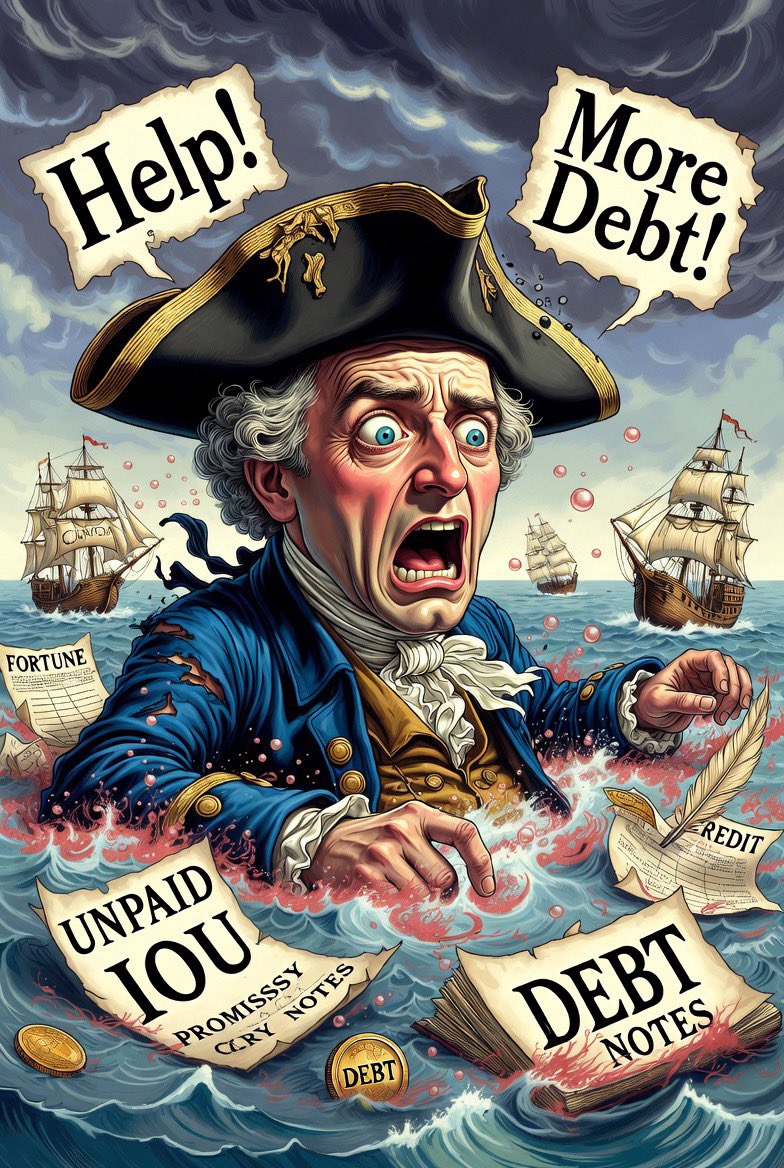
Thomas Jefferson’s warning on America’s banking system still hits hard in 2026:
He fiercely opposed the National Bank as unconstitutional — a monopoly of power not delegated to the federal government. He feared it would favor speculators and the wealthy over farmers and citizens, concentrating economic control in too few hands.
In 1816, Jefferson wrote: “I sincerely believe that banking establishments are more dangerous than standing armies; and that the principle of spending money to be paid by posterity under the name of funding, is but swindling futurity on a large scale.”
He saw banks as a “blot” on the Constitution that would corrupt morals, inflate and deflate fortunes at will, and erode liberty itself.
Here we are today— still debating the very financial power structures Jefferson tried to constrain.
Was he right? Or was Hamilton’s vision inevitable?
Share if you think we should revisit the Founders’ actual principles on money and power. 🇺🇸
What’s your take?
@Malc_OE@cindergirl1@gregmushen@bennyjohnson You’re a fucking idiot. Give me one country that’s not on conquered land. The natives here conquered it from three previous tribes before we were here too.
Present day blacks have killed more white people than slave owners ever killed blacks. Only 1.4% of Americans even owned slaves and of that percentage over 3500 were black slave owners. So your ancestors and brothers aren’t any better and I’m sure if many could have their way they would have whites in chains.
Welfare is destroying the nuclear family by incentivizing fathers to leave the home.
Consider a single mother of 3 earning $28,000. Without EITC, she can qualify for roughly $9,000–$27,000+ in annual federal supports: SNAP ($4k–$8k+ in food aid), Child Tax Credit (up to $6k), full Medicaid/CHIP coverage, WIC, possible TANF cash aid, and more.
Now add a father earning $40k. Household income jumps to ~$68k. Combined benefits often drop sharply to $4,000–$12,000 or less due to eligibility phase-outs (“benefit cliffs”). SNAP and TANF largely disappear, adult Medicaid coverage ends in many states, and tax credits shrink.
Result: The family’s total resources can be higher when the father is absent — even though two incomes should logically improve stability. This creates a financial disincentive for cohabitation or marriage, sometimes called the “welfare marriage penalty.”
These rules are designed to help low-income single parents, not to break up families. Yet the steep cliffs highlight how complex, income-tested programs can unintentionally distort decisions. Economists across perspectives have noted this effect for decades.
Children in intact families show lower rates of delinquency, depression, substance use, and incarceration (boys especially sensitive to father absence).
Debt can be crushing. You’ve seen all of the statistics.
The first step if you find yourself in a hole is to stop digging.
Nobody is going to come along and fix things for you, you need to take action and the sooner you do the sooner you will find peace.
Create a budget, and allocate your funds to the snowball strategy or the avalanche strategy.