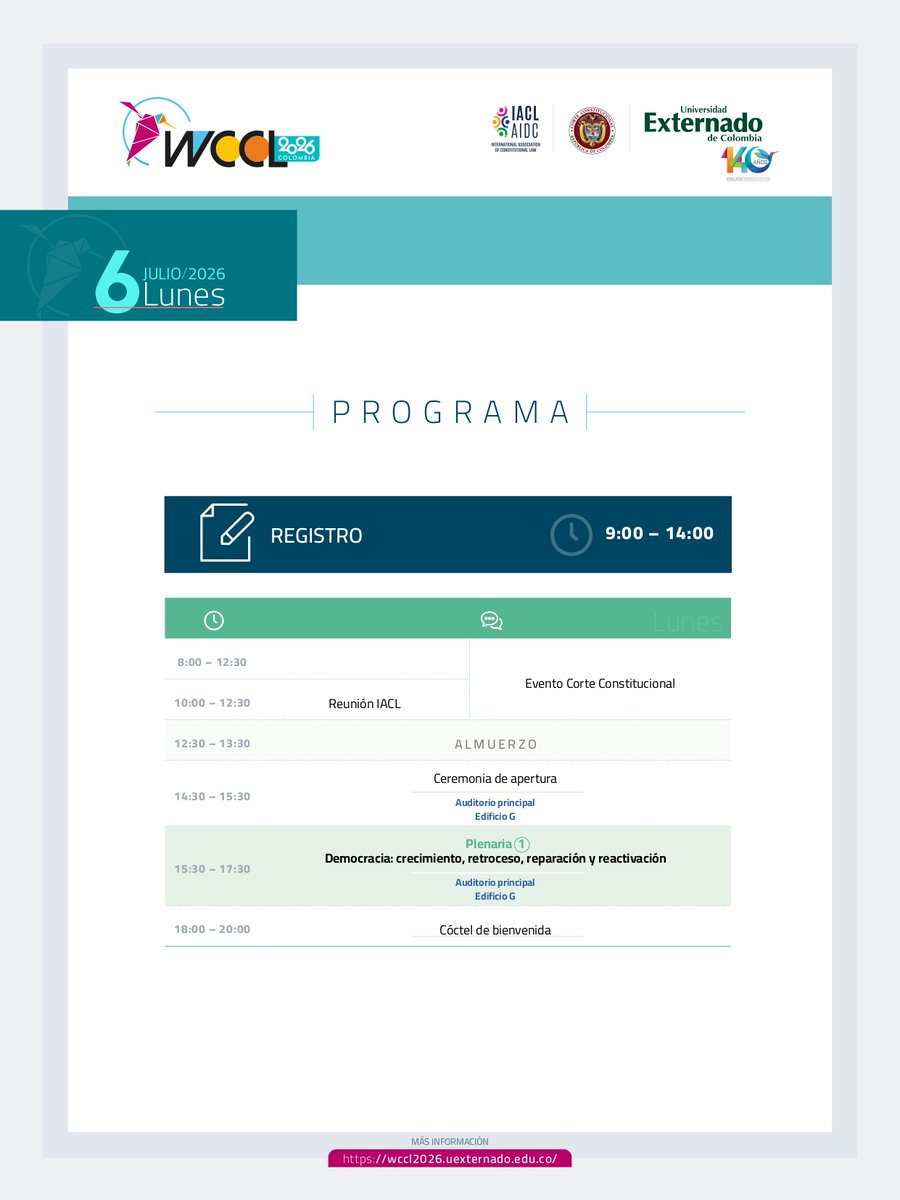
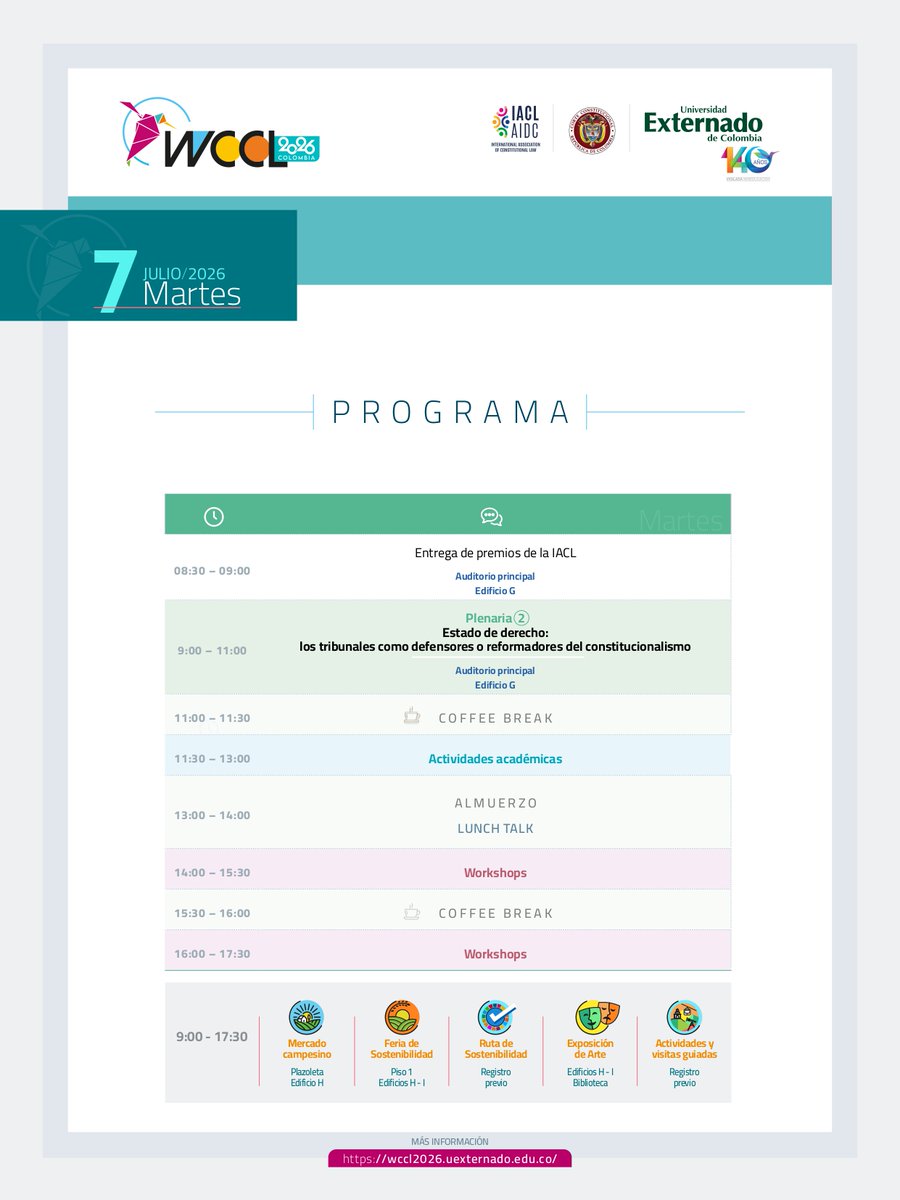
A esta hora se desarrolla la plenaria ‘Estado de derecho: tribunales como defensores o reformadores del constitucionalismo’. 👩⚖️👨⚖️
Un espacio académico donde se analiza el papel de los tribunales en los sistemas democráticos a nivel mundial. ⚖️📜
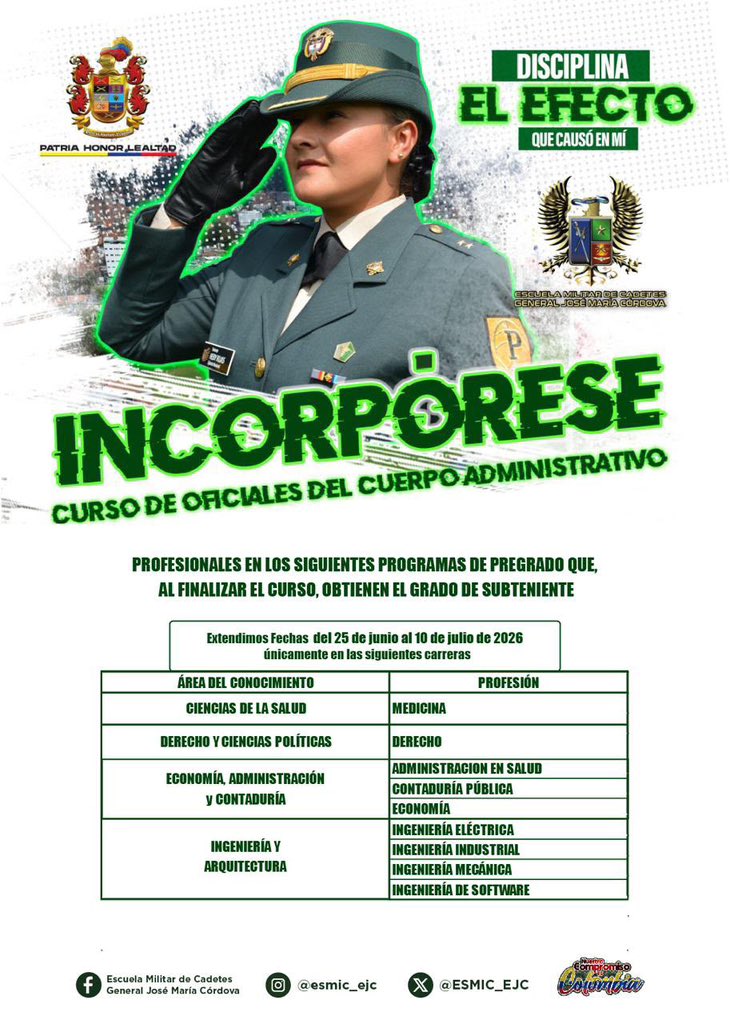
✅Derecho
✅Administración en Salud
✅Contaduría Pública
✅Economía
✅Ingeniería Eléctrica
✅Ingeniería Industrial
✅Ingeniería Mecánica
✅Ingeniería de Software
#IncorpóreseAlEjército como oficial del Cuerpo Administrativo.
@ESMIC_EJC
Elon Musk literally sat down for a 45-minute talk with Y Combinator that explains how to build world-changing companies better than any business school on earth. This is the advice he gave a room full of young founders:
1. Don't try to build something great. Try to build something useful.
Everyone obsesses over greatness. Musk says that's the wrong target. "I didn't originally think I would build something great. I wanted to try to build something useful. I didn't think I would build anything particularly great. Seemed unlikely, but I wanted to at least try." Aim for useful first. Greatness, if it comes, is a byproduct.
2. When you can't get in the front door, build your own door.
Before Musk started his first company, he tried to get a job at Netscape. "I sent my resume into Netscape and nobody responded. I tried hanging out in the lobby to see if I could bump into someone, but I was too shy to talk to anyone. So I'm like, this is ridiculous, I'll just write software myself." He didn't set out to be a founder. He became one because no one would hire him.
3. He slept in the office and showered at the YMCA.
The origin of his first company was not glamorous. "We couldn't even afford a place to stay. The office was 500 bucks a month, so we just slept in the office and showered at the YMCA." He couldn't afford proper internet either, so he drilled a hole through the office floor and ran a cable to the internet provider downstairs. That was the founder of the future richest man on earth.
4. Keep the chips on the table.
When Musk sold his first company, he received a $20 million cheque. His bank balance went from $10,000 to $20 million overnight. Most people would have stopped. He put almost all of it straight back into his next company. "I kept the chips on the table." He did the same thing decades later, over and over. He hates money sitting idle. Money is fuel for the next mission.
5. Start with the mission, then work backwards to make it a business.
Musk didn't start SpaceX to make money. He went on the NASA website to find out when humans were going to Mars, and there was no plan. So he decided to build one. "There had been no prior example of a rocket startup succeeding. A small chance of success is better than no chance of success." The mission came first. The business model came later.
6. He started SpaceX expecting to fail.
He is brutally honest about the odds. "SpaceX started in mid-2002 expecting to fail. Probably 90% chance of failing. When recruiting people, I said, we're probably going to die, but small chance we might not die." The first three launches failed. The fourth one worked with no money left. "If the fourth launch hadn't worked, it would have been curtains. We made it by the skin of our teeth."
7. Break every problem down to physics.
This is the core of how Musk thinks. "First principles means break things down to the fundamental elements that are most likely to be true, then reason up from there, as opposed to reasoning by analogy." His example is rockets. Everyone priced them based on what old rockets cost. Musk asked what a rocket is actually made of, priced the raw metals, and found the materials were only 1-2% of the historical price. The rest was inefficiency he could attack.
8. When told something takes 24 months, break it down and do it in six.
Last year xAI needed a giant computer to train its AI. Suppliers said it would take 18 to 24 months. "It's like, well, we need to get that done in six months or we won't be competitive." So he broke it into parts. Needed a building, so he found an old factory. Needed power, so he rented generators. Needed cooling, so he rented a quarter of America's mobile cooling capacity. He slept in the data centre and ran cabling himself. It got done.
9. Watch your ego-to-ability ratio.
Musk's single sharpest piece of advice for young founders is about staying honest with yourself. "A major failure mode is when your ego-to-ability ratio gets too high. Then you break the feedback loop to reality." Keep the ego small, internalise responsibility for everything, and stay ruthlessly connected to what's actually true. "You want to close the loop on reality hard. That's a super big deal."
10. Chase work, not glory.
His closing philosophy ties it all together. "It's so hard to be useful. The area under the curve of total utility is how useful you've been to your fellow human beings times how many people. If you aspire to do true work, your probability of success is much higher. Don't aspire to glory, aspire to work."
He was ridiculed for years. The press called him "internet guy attempting to build a rocket company." He agreed it sounded absurd. He did it anyway, because a small chance of doing something useful beat no chance at all.
Here's the thing though....
Musk became the most followed founder alive because everything he does happens in public. The launches, the failures, the talks like this one. The companies made him powerful. The personal brand made his every word travel around the world before he finishes saying it.
We build massive distribution and grow personal brands on X and beyond without our clients lifting a finger.
If you're a founder or VC looking for that kind of exposure, book a call below.
We average 1.5M views a week.
https://t.co/UoXuYlkBQq
#TBT | Los primeros pasos de una historia académica, en esta fotografía fue registrado el Curso de Ascenso de Teniente a Capitán No. 30 de Pilotaje, con el que entró en funcionamiento el Instituto Militar Aeronáutico en el año de 1960. A través de estos procesos fue fortalecida la formación profesional de los Oficiales de la #FuerzaAeroespacial🇨🇴, consolidando las bases de una tradición académica que hoy continúa en la Escuela de Postgrados de la FAC.
#EPFAC
#AdAstra🚀
Dear followers,
Please see this interview with Goldman Sachs on AI and jobs.
How Will AI Impact the Labor Market? | Goldman Sachs https://t.co/yoN7o7wbwL
Agradezco al procurador general de la Nación #GregorioEljach por sumarse a la invitación al Congreso Mundial de Derecho Constitucional 2026, que realizaremos del 6 al 10 de julio en el @UExternado. Será un honor recibir a quienes participarán en este gran encuentro académico.
En el marco de las operaciones ofensivas, tras combates contra integrantes del grupo armado organizado) ELN, frente Luis José Solano en zona rural del municipio de Morales, #Bolívar, nuestras tropas del @COL_EJERCITO neutralizaron a alias Bola Ocho, señalado cabecilla de la Red de Apoyo al Terrorismo de esta estructura criminal, presuntamente vinculado a múltiples acciones terroristas ejecutadas mediante drones y artefactos explosivos contra la Fuerza Pública en Bolívar, Cesar y otras regiones del país.
Durante esta acción se incautaron armas, municiones, explosivos, equipos de comunicación y más de 7 millones de pesos en efectivo., afectando significativamente las capacidades criminales, financieras y de coordinación de acciones terroristas de este GAO en esta zona del país.
#ContundenciaOperacional
#TodosSomosColombia
#SeguridadYDemocracia2026
“Loop engineering” is a hot buzzphrase after mentions of it by Boris Cherny (Claude Code’s creator) and Peter Steinberger (OpenClaw's creator) went viral on social media. Loops are now a key part of how we get AI agents to iterate at length to build software. In this letter, I’d like to share my 3 key loops, shown in the image below, for building 0-to-1 products. These loops guide not just how I build software, but also how I decide what software to build.
Agentic coding loop: Given a product specification and optionally a set of evals (that is, a dataset against which to measure performance), we can have an AI agent write code, test its work, and keep iterating until the code is bug-free and meets its specification. This idea of closing the loop took off around the end of last year, and it has been a game changer in enabling coding agents to work longer productively without human intervention. For example, over the weekend, I was building an app for my daughter to practice typing, and my coding agent could easily work for around an hour, using a web browser to check what it had built multiple times before getting back to me, without needing my intervention.
The engineering loop executes quickly. Every few minutes, the coding agent might build and test a new version of the software. I hear frequently from developers who are finding new ways to engineer more effective engineering loops. This is an active area of invention!
Developer feedback loop: In this loop, a developer examines the current product and steers the coding agent to improve it. Last year, a lot of developers (including me) were acting as the QA (quality assurance) function for our coding agents, manually finding bugs and then asking the agent to fix them. But with coding agents much more able to test their own code, the amount of time we need to spend on this function has decreased significantly. This allows us to make higher-level product decisions, such as what key features to offer, where the UI needs improvement, and so on.
The developer-feedback loop operates over time intervals between tens of minutes and hours — that's how frequently a developer might review a product and give feedback. In the case of the typing app, I changed my mind a few times about the visual design, what cat costumes she can unlock as she learns (she loves cats), and the user flow for a grown-up to log in and steer the child's learning experience.
When a developer has a clear vision for what to build, it is still a lot of work to translate that vision into a specification for a coding agent to implement. Further, after the developer has seen an implementation, they might update (or perhaps clarify) the spec to steer it toward what they want. If you find that the system repeatedly runs into certain problems, building a set of evals for the agent becomes useful.
AI-native teams are increasingly using AI to help shape product direction, for example, automating the gathering and analysis of usage data, summarizing written and verbal customer feedback, or carrying out competitive analysis. However, for pretty much all the products I’m involved in, I see humans as having a significant context advantage over current AI systems — we know a lot more than the AI system about the users and the context the product has to operate in — and thus humans play a critical role. Many people describe this human contribution as “taste,” but I prefer to think of it as humans having a context advantage, since that gives us a clearer path to helping AI systems get better. This also speaks to why this step can’t be automated: So long as the human knows something the AI does not, human-in-the-loop is needed to to inject that knowledge into the system.
External feedback loop: This includes a wide range of tactics like asking a few friends for feedback, launching to alpha testers, or putting the code into production with A/B testing. These tactics are usually slow, rarely taking less than hours and sometimes taking days or even weeks. This data informs the developer vision, which in turn continues to drive the detailed product spec, which in turn drives the coding agent.
With coding agents speeding up software development, more engineers are starting to play a partial product management role. For many engineers who are growing into this role, the hardest part is shaping the product vision and striking a balance between building (bridging the gap between vision and spec) and getting user feedback to evolve the vision. It is important to do both!
I will write more about how to do this in future posts, but for now, I find it encouraging that engineers are playing an expanded role (just as product managers and designers now do more engineering).
[Original text: The Batch]
@UExternado se convertirá, del 6 al 10 de julio, en el epicentro jurídico global, al recibir a los constitucionalistas más importantes del mundo en el Congreso Mundial de Derecho Constitucional 2026. Será un honor abrir nuestras puertas a esta conversación.
🇨🇴🤝🇻🇪 #ContigoVenezuela | El equipo USAR COL-1, máxima capacidad nacional de búsqueda y rescate, ya se encuentra en camino hacia #Venezuela para apoyar las labores de atención de la emergencia que enfrenta el país hermano.
Esta misión humanitaria, coordinada por la Unidad Nacional para la Gestión del Riesgo de Desastres (@UNGRD), reúne a 63 especialistas y 4 binomios caninos altamente entrenados: Rojo, Candy, Dasta y Tamy, quienes estarán brindando su experiencia y capacidades.
Con el apoyo de la @FuerzaAereaCol, fueron transportadas 12 toneladas de equipos especializados y ayudas para fortalecer las labores de búsqueda y rescate.
El Ejército Nacional de #Colombia, junto con las entidades operativas del Sistema Nacional de Gestión del Riesgo de Desastres (@SNGRDColombia), reafirma su compromiso con la cooperación, la solidaridad y la protección de la vida, llevando esperanza a quienes más lo necesitan.
#EjércitoEnElMundo
#SoldadoEsServicioSocial
Parabenizo o povo colombiano pelo processo democrático e soberano, expresso por sua vontade nas urnas, da escolha de seu novo presidente Abelardo de la Espriella nas eleições do último domingo. A amizade entre o Brasil e a Colômbia, que transcende ideologias, é fundamental para a superação de desafios comuns como a preservação da Amazônia, o enfrentamento da pobreza e o combate ao crime organizado. Que sigamos trabalhando juntos em benefício dos nossos povos.
Liderado por el @BancoMundial y la Asociación de Mujeres de la Energía, Wenergy conecta a mujeres que dan sus primeros pasos en el sector, que ofrece acceso a empleos de calidad, con profesionales que ya han recorrido ese camino. Conoce más sobre este programa de mentoreo
Los actos de la naturaleza se responden con actos de humanidad y solidaridad. Venezuela nos requiere hoy mas que nunca.
Destaco la respuesta de los líderes de la región y el envio de rescatistas y ayuda humanitaria.
Venezuela es pais fundador y sede de @AgendaCAF por ello estamos creando un “fondo para la reconstrucción” e invitamos a sector privado y gobiernos a hacer sus aportes, que junto con los nuestros, harán parte de la respuesta efectiva a este momento.
¿Puede una Constitución ayudar a proteger el medio ambiente? ¿Cómo deben responder nuestras instituciones a desafíos de sostenibilidad? Estas son algunas de las preguntas que estarán en el centro del Congreso Mundial de Derecho Constitucional 2026.
El debate constitucional global se traslada a Bogotá: ¡Bienvenidas(as) al WCCL 2026! 🇨🇴🏛️
Nuestro rector Hernando Parra Nieto, extiende una calurosa invitación a participar en el espacio académico más importante de orden mundial en cuanto a Derecho Constitucional. ⚖️
Bajo el lema "Constitucionalismo Sostenible: Respuestas para un mundo en cambio", este Congreso será el espacio idóneo para debatir los desafíos más apremiantes de nuestra era. 🌿📖
Conoce toda la programación aquí 👉 https://t.co/nhXZcgyIYD
🛰️ Con el Objetivo 5 de la Política Pública de Gestión del Espectro 2026-2029, Colombia avanza en el fortalecimiento de sus capacidades para promover servicios satelitales, ampliar el acceso a Internet e impulsar la innovación en todo el territorio.
El talento no tiene fronteras ni códigos postales. 🌍✨ Por primera vez, Mujeres Rompiendo Barreras abre su modalidad virtual sincrónica para que fortalezcas tu liderazgo sin importar en qué región estés.
Dirigido a estudiantes y egresadas de la @UExternado. ¡Tu voz cuenta desde cualquier lugar! 🚀👩💼
Postúlate aquí: https://t.co/LWZijxhffh 🔗
Me sumo a la invitación del alcalde @CarlosFGalan para que @Bogota, Colombia y el mundo nos acompañen en el Congreso Mundial de Derecho Constitucional. Será un honor recibir a quienes trabajan todos los días por la defensa de la democracia, los derechos y las instituciones.







![AndrewYNg's tweet photo. “Loop engineering” is a hot buzzphrase after mentions of it by Boris Cherny (Claude Code’s creator) and Peter Steinberger (OpenClaw's creator) went viral on social media. Loops are now a key part of how we get AI agents to iterate at length to build software. In this letter, I’d like to share my 3 key loops, shown in the image below, for building 0-to-1 products. These loops guide not just how I build software, but also how I decide what software to build.
Agentic coding loop: Given a product specification and optionally a set of evals (that is, a dataset against which to measure performance), we can have an AI agent write code, test its work, and keep iterating until the code is bug-free and meets its specification. This idea of closing the loop took off around the end of last year, and it has been a game changer in enabling coding agents to work longer productively without human intervention. For example, over the weekend, I was building an app for my daughter to practice typing, and my coding agent could easily work for around an hour, using a web browser to check what it had built multiple times before getting back to me, without needing my intervention.
The engineering loop executes quickly. Every few minutes, the coding agent might build and test a new version of the software. I hear frequently from developers who are finding new ways to engineer more effective engineering loops. This is an active area of invention!
Developer feedback loop: In this loop, a developer examines the current product and steers the coding agent to improve it. Last year, a lot of developers (including me) were acting as the QA (quality assurance) function for our coding agents, manually finding bugs and then asking the agent to fix them. But with coding agents much more able to test their own code, the amount of time we need to spend on this function has decreased significantly. This allows us to make higher-level product decisions, such as what key features to offer, where the UI needs improvement, and so on.
The developer-feedback loop operates over time intervals between tens of minutes and hours — that's how frequently a developer might review a product and give feedback. In the case of the typing app, I changed my mind a few times about the visual design, what cat costumes she can unlock as she learns (she loves cats), and the user flow for a grown-up to log in and steer the child's learning experience.
When a developer has a clear vision for what to build, it is still a lot of work to translate that vision into a specification for a coding agent to implement. Further, after the developer has seen an implementation, they might update (or perhaps clarify) the spec to steer it toward what they want. If you find that the system repeatedly runs into certain problems, building a set of evals for the agent becomes useful.
AI-native teams are increasingly using AI to help shape product direction, for example, automating the gathering and analysis of usage data, summarizing written and verbal customer feedback, or carrying out competitive analysis. However, for pretty much all the products I’m involved in, I see humans as having a significant context advantage over current AI systems — we know a lot more than the AI system about the users and the context the product has to operate in — and thus humans play a critical role. Many people describe this human contribution as “taste,” but I prefer to think of it as humans having a context advantage, since that gives us a clearer path to helping AI systems get better. This also speaks to why this step can’t be automated: So long as the human knows something the AI does not, human-in-the-loop is needed to to inject that knowledge into the system.
External feedback loop: This includes a wide range of tactics like asking a few friends for feedback, launching to alpha testers, or putting the code into production with A/B testing. These tactics are usually slow, rarely taking less than hours and sometimes taking days or even weeks. This data informs the developer vision, which in turn continues to drive the detailed product spec, which in turn drives the coding agent.
With coding agents speeding up software development, more engineers are starting to play a partial product management role. For many engineers who are growing into this role, the hardest part is shaping the product vision and striking a balance between building (bridging the gap between vision and spec) and getting user feedback to evolve the vision. It is important to do both!
I will write more about how to do this in future posts, but for now, I find it encouraging that engineers are playing an expanded role (just as product managers and designers now do more engineering).
[Original text: The Batch]](https://pbs.twimg.com/media/HMEtxp3bsAARJdi.jpg)