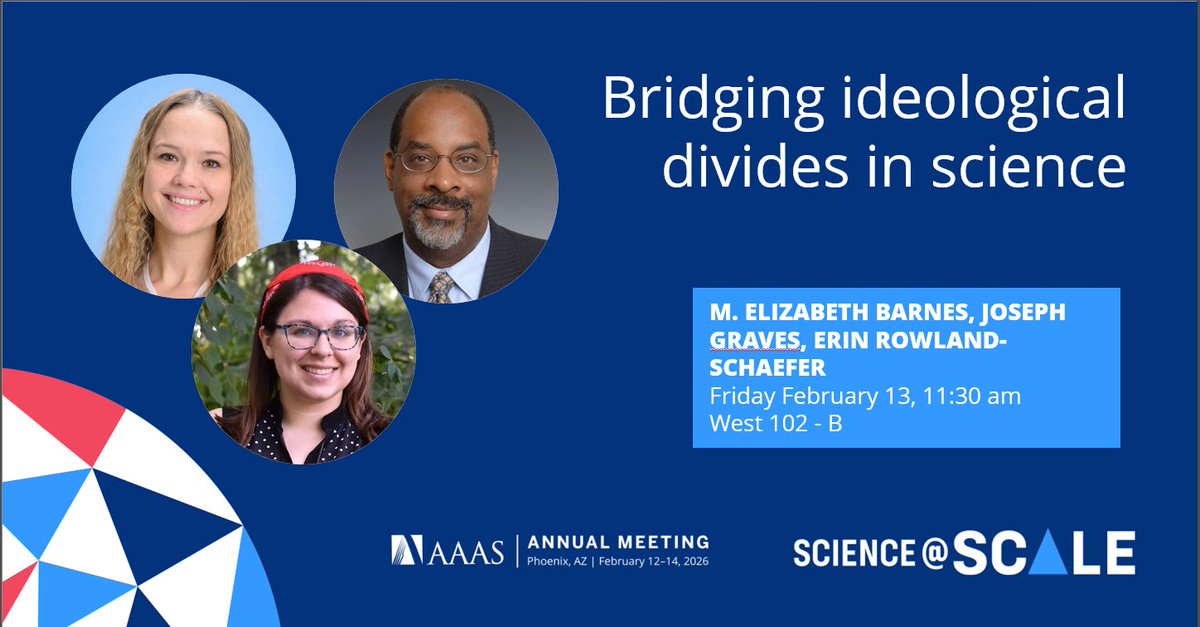
At the #AAASmeeting, Sudip Parikh & Michael Crow emphasized the need for science communication that builds trust & strengthens relationships.
That’s exactly the challenge we’re tackling tomorrow in our session: “Bridging Ideological Divides About Science.” I hope you join us.
At the #AAASmeeting, Sudip Parikh & Michael Crow emphasized the need for science communication that builds trust & strengthens relationships.
That’s exactly the challenge we’re tackling tomorrow in our session: “Bridging Ideological Divides About Science.” I hope you join us.
A new chapter begins for CBE—Life Sciences Education!
Editor-in-Chief Miriam Segura introduces new sections, faster publication formats, and new Senior Editors shaping the field.
Read more ➡️ https://t.co/3vH27M614X
The Science Communication Education Research Network is excited to launch our second talk series! Our first talk will be from Dr. Liz Bailey on integrating indigenous ways of knowing into science communication. Free to all! See flier for registration details.
Another nail in the astrology coffin:
152 astrologers did no better than random chance at guessing people’s charts from detailed info about them. Astrologers helped design the test, and "experts" failed at the same rate as novices.
Horoscopes may be fun, but they ain't real.
New LSE study from @lizard_barnacle (MTSU) finds biology undergrads often discuss climate change but lack confidence in proposing solutions. Most avoid talking with skeptics—pointing to the need for more training in science communication. https://t.co/OAUBSCKDbg #ASCB
LSE study from @lizard_barnacle (MTSU) provides the first randomized controlled evidence that conflict-reducing practices in evolution education lower conflict, boost compatibility with religion, & increase acceptance of human evolution. 🔗 https://t.co/wO5iRG7l7k #ASCB
True failure is not falling short of our goals. It's failing to pursue our most meaningful goals.
In the moment, it feels risky to take a chance. In hindsight, our biggest mistakes are the chances we didn't take.
Inaction is a recipe for regret. Action is fuel for growth.
Are you a grad student, postdoc, staff, or faculty curious about science education research? Get your feet wet with this free online series AND if you come to 4 sessions, you get a free membership in SABER, an international biology education research society. Please share!
In our new study examining over 6700 undergraduate biology students in over 55 courses, we found that emphasizing compatibility between religion and evolution and giving students autonomy over their decision to accept evolution leads to more acceptance. https://t.co/Bd5UQylGXS
In our new study examining over 6700 undergraduate biology students in over 55 courses, we found that emphasizing compatibility between religion and evolution and giving students autonomy over their decision to accept evolution leads to more acceptance. https://t.co/Bd5UQylGXS
Thanks to @brownell_sara for her partnership on this project and @Rahmi_QA for her leadership as first author. Additonally, thank you to @bayedws@asummersill2 and @Hayley_Dunlop for being rock star research assistants. And @PLOSONE for publishing the study!
These results, in conjunction with a long line of studies over the last decade, indicate that having these discussions and being more open and understanding of student viewpoints may increase evolution acceptance faster.