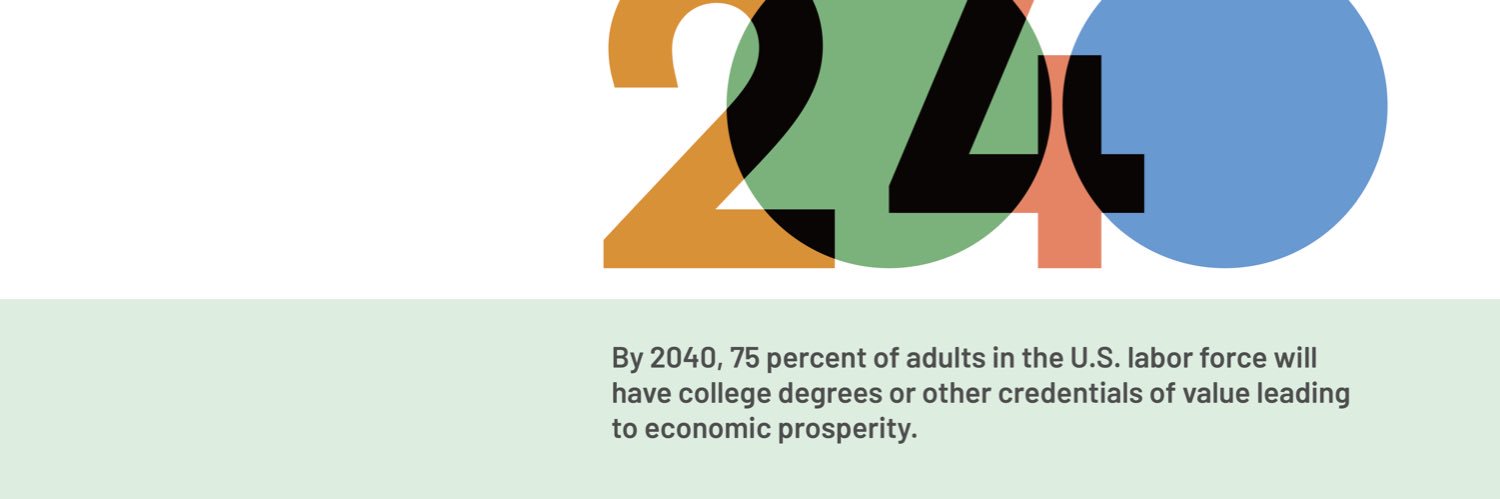
We’re a private foundation committed to increasing the share of adults in the U.S. labor force with degrees or other credentials of value to 75 percent by 2040.
“The future of work is not something happening to HBCUs. It’s something HBCUs can help lead,” Jasmine Haywood said at the ESSENCE Festival of Culture. As the future of work continues to evolve, they’re positioned to shape what comes next, open doors, and expand opportunities.
The cost of college has become a defining public issue, not just a personal finance one.
Will limiting borrowing force colleges to rein in prices, or only make college less accessible for some? https://t.co/dZbau3KdOr
Lumina's Jasmine Haywood, Ph.D., will moderate a discussion at the Global Black Economic Forum during the ESSENCE Festival of Culture exploring how HBCUs, employers, and cross-sector partnerships can create stronger pathways to economic opportunity.
https://t.co/2vmOncT8Pn
Interest and ambition are already there, but what's often standing in the way are the realities of everyday life. We need more flexible, affordable pathways to connect opportunity and demand.
https://t.co/tbllSfMsoF
If we miss the people behind the stats, it's easy to overlook the systems that made finishing college difficult in the first place. What can we change so that fewer students have to choose between education and life? Meet Aaron, Alina, Dupree, and Sylvie: https://t.co/pOQ7joh9Ht
Educators matter even more as AI changes how students learn. What happens when AI supports learning instead of replacing it?
"All of us—including tech providers, educators, and philanthropy—can play an active role in shaping what's next for students."
https://t.co/YRsrTrNV4U
According to a survey by @Gallup and @LuminaFound, only 1 in 4 adults believe most people can access a quality, affordable education. We're here to change that. We are online, tuition-free, and teach in-demand skills with personalized support. Learn more: https://t.co/U2eWHBYM5O
Postsecondary ed is still one of the most powerful drivers of economic mobility - but only when it leads to meaningful opportunity. SBE is bringing together @LuminaFound, @HCMStrat & @MDHigherEdComm on June 16 at 10AM ET to talk about how to get it right. https://t.co/XFvDpRlgua
The conversation about liberal arts often gets stuck on semantics. "Both words, 'liberal' and 'arts,' are a turnoff to many people, and when you put them together, it just doesn't sound appealing to many Americans," @jamiemerisotis writes in @Forbes. More: https://t.co/y2QPBLORi3
If colleges are creating AI degrees solely to chase demand, students will be left sorting through a crowded marketplace of promises. Yet will these programs lead to credentials of value and fulfilling careers?
https://t.co/b260IOzM2L
There’s a lot of energy right now around workforce training, short-term credentials, and creating more pathways to good jobs, but are we making sure people have the basic math and literacy skills they need to succeed once they get there?
https://t.co/djyrEu2iYr
Even students at institutions with strong placement rates and hands-on programs are still uneasy about what comes next, so the idea of "is college worth it?" isn't just a perception issue.
What needs to change so opportunity isn't left to chance?
https://t.co/l0euVpdWM5
Preparing students for the future means more than giving them access to new technology. Students need hands-on experience with these tools while developing the critical thinking skills that technology can't replace.
https://t.co/PaD6v1ZnVW
In Pope Leo XIV's new encyclical on AI and human dignity, @jamiemerisotis sees a challenge to rethink progress. If AI is reshaping work, then education and workforce systems need to help people adapt, contribute, and thrive—not compete—with machines. https://t.co/UV9oZNdRCw
"Here is the part that actually matters for the rest of your life: The degree you just earned is worth a lot more than the headlines suggest." In @USATODAY, Lumina's Courtney Brown pushes back on the idea that graduates are entering a broken job market: https://t.co/YTjGsEtvzd
What does the future of education look like in an era defined by AI, workplace disruption and changing attitudes about the value of a college degree? On this episode of the Business & Beyond #podcast, I sit down with @LuminaFound CEO Jamie Merisotis to explore the seismic shifts reshaping higher education, workforce development and the global economy. LISTEN: https://t.co/9CQcrcJoAQ @IIB #podcast @HigherEdIN@chronicle
"A degree is supposed to be an investment in your future, not a mortgage on it." That parting shot hits hard at the absurdity of placing the onus of affordability on students and their individual choices around school choice, loan amounts, or budgeting. https://t.co/u1BLBhTilb
Among adults without a college degree, only 25% believe most people can access a “quality, affordable education,” a new joint study by @LuminaFound and @Gallup shows. https://t.co/JvDN1n084P