We thank @WSJ for sharing Lungpacer’s 15-year journey from personal loss to innovation. We believe AeroPace, our innovative catheter-based neurostimulation device, will make a real difference for patients on prolonged ventilation. https://t.co/tI8RCJvc8T
For respiratory therapists, any new ICU therapy needs to fit the workflow.
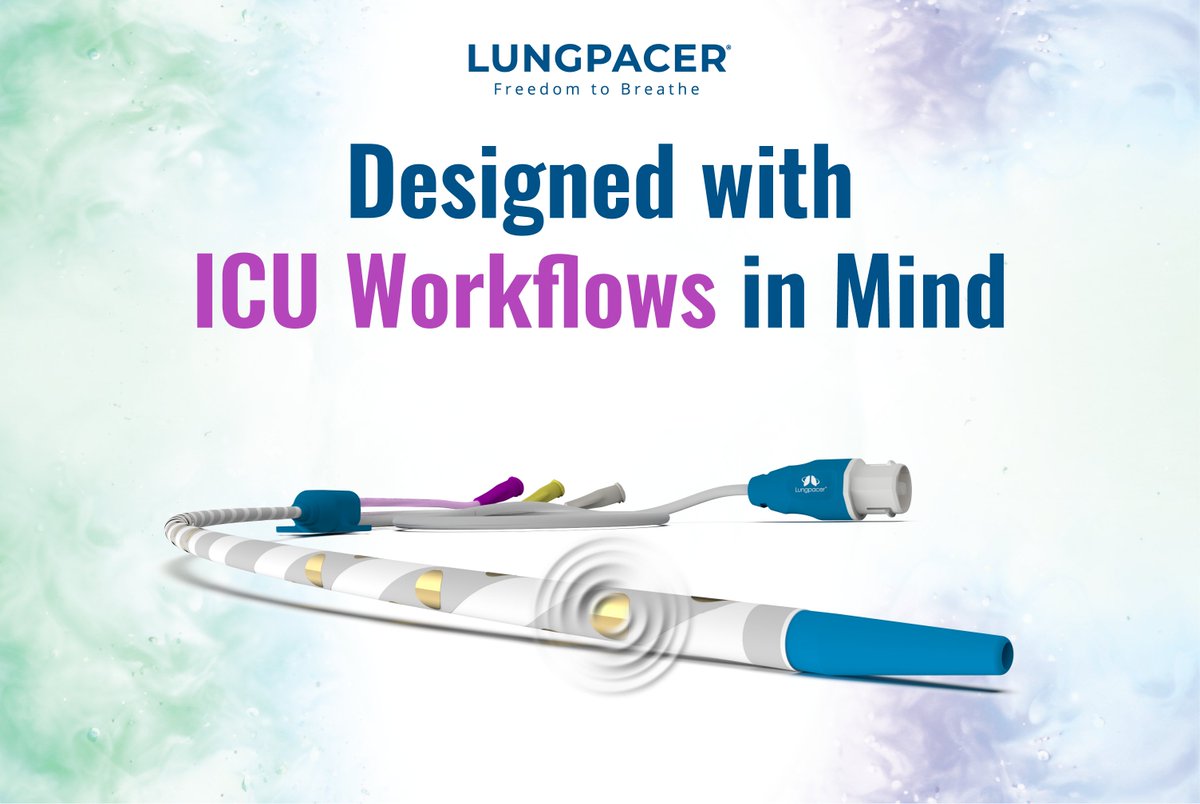
AeroPace was designed with ICU workflows in mind. The temporary, transvenous AeroPace Neurostimulation Catheter uses a familiar CVC access technique, with Therapy delivered twice daily.
RTs managing daily liberation protocols can use AeroPace as a powerful new part of their existing approach to ventilator weaning.
Learn more about how AeroPace works at https://t.co/sYSxU69SQ3
#AeroPace #Lungpacer #VentilatorLiberation #RespiratoryTherapy #ICU #CriticalCare
AeroPace is FDA-approved for improved weaning success in patients on mechanical ventilation ≥96 hrs and who have not weaned. Not for use in patients with implantable electronic devices. ISI: https://t.co/bw51BLlwtd
Phrenic nerve stimulation may assist with more than just diaphragm strength.
The STIMULUS study found that continual phrenic nerve stimulation improved cardiac output during mechanical ventilation and reduced pulmonary vascular resistance. This investigational finding adds to a growing body of evidence connecting diaphragm activation to positive hemodynamic effects in critically ill patients.
View the results of the STIMULUS trial (NCT05465083) at https://t.co/0kJr6lac2X
#AeroPace #Lungpacer #VentilatorLiberation #STIMULUS #ClinicalResearch #CriticalCare
⚠️ CAUTION: AeroNova is an investigational device. Limited by United States law to investigational use. Exclusively for clinical investigations. To be used by qualified investigators only.
New CPT III codes for transvenous diaphragm neurostimulation take effect July 2026.
These new codes provide an additional reimbursement pathway for AeroPace — complementing the existing CMS New Technology Add-on Payment (NTAP) of up to $23,650 per qualified patient, which helps hospitals adopt new, breakthrough technologies like AeroPace.
For hospitals and value analysis committees evaluating AeroPace, the arrival of dedicated CPT coding is a meaningful step in establishing a long-term reimbursement framework.
#AeroPace #Lungpacer #VentilatorLiberation #CPTCodes #HealthcareReimbursement #NTAP
AeroPace is FDA-approved for improved weaning success in patients on mechanical ventilation ≥96 hours and who have not weaned. Not for use in patients with implantable electronic devices. ISI: https://t.co/3xJ5qMci26
Respiratory therapists see ventilator-induced diaphragm dysfunction every day.
A patient looks ready to wean on paper — oxygenation is adequate, sedation is reduced — but spontaneous breathing trials keep failing. Because of prolonged mechanical ventilation and lack of muscle use, diaphragm weakness affects the patient's ability to sustain independent breathing.
Temporary transvenous diaphragm neurostimulation with the AeroPace System is designed to address ventilator-induced diaphragm dysfunction directly by strengthening the diaphram while the patient is on MV.
Learn more about how AeroPace works at https://t.co/6TR8tQ4D39
#AeroPace #Lungpacer #VentilatorLiberation #RespiratoryTherapy #ICU #VIDD
AeroPace is FDA-approved for improved weaning success in patients on mechanical ventilation ≥96 hours and who have not weaned. Not for use in patients with implantable electronic devices. ISI: https://t.co/Y9a9LKv9Sm
Only about 1 in 5 donor lungs are recovered for transplant, a shortfall that contributes to a waitlist mortality rate of roughly 20%.
One major reason for this is that most brain-dead donors develop basilar atelectasis (lung collapse), driven by the absence of spontaneous diaphragmatic breathing during mechanical ventilation. It’s a leading cause of otherwise transplantable lungs being rejected.
New data from the DONATE study, presented at the American Transplant Congress (ATC) 2026 by Gary E. Marklin, MD, demonstrates that diaphragm neurostimulation can increase the number of lungs that meet transplant criteria.
The DONATE study, enrolling 50 organ donors, showed temporary transvenous phrenic nerve stimulation delivered using Lungpacer’s SupAira® System improved oxygenation and reduced atelectasis. Lungs were transplanted from 51.1% of donors after diaphragm neurostimulation versus 33.7% of matched controls (p=0.031). The lung observed-to-expected (O:E) ratio reached 1.44 with neurostimulation, representing 44% more transplantable lungs than expected, versus 1.10 in controls.
The SupAira® System uses temporary transvenous neurostimulation technology to activate the diaphragm to aid donor respiratory management, so more generously gifted lungs can reach the patients waiting for them.
See the full press release at: https://t.co/e5Y3UagvX9
Reach out to us for more information at: https://t.co/q1pemIigii
#OrganDonation #LungTransplant #Transplantation #Lungpacer #SupAira #ATC2026
The SupAira® System is for use by Organ Procurement Organizations for the respiratory management of deceased organ donors. It is not intended to diagnose, cure, mitigate, treat or prevent any disease or condition.
New clinical research shows that diaphragm neurostimulation mitigates the adverse cardiopulmonary effects of mechanical ventilation. See "Diaphragm neurostimulation mitigates the adverse cardiopulmonary effects of positive pressure ventilation" at https://t.co/I0vXAYNSIl
Positive pressure ventilation has multiple adverse cardiopulmonary effects, leading to impaired lung mechanics and hemodynamic performance. In the STIMULUS trial (NCT05465083), published in Critical Care, investigators examined whether temporary diaphragm neurostimulation with Lungpacer’s investigational device, the AeroNova System, could help mitigate those adverse effects.
In STIMULUS, diaphragm neurostimulation improved cardiac index without increasing pulmonary artery transmural pressure. Mechanical ventilation using higher PEEP combined with diaphragm neurostimulation also enhanced dorsal lung recruitment without impairing hemodynamics.
These early results offer a promising outlook on where respiratory care is heading.
Congratulations to the authors.
#Lungpacer #PhrenicNerveStimulation #CriticalCare #MechanicalVentilation #ICU
⚠️ CAUTION: AeroNova is an investigational device. Limited by Federal (or United States) law to investigational use. Exclusively for clinical investigations.
Tracheostomy is never the goal — it is often a sign that ventilator liberation appears unattainable.
For difficult-to-wean patients who fail spontaneous breathing trials, tracheostomy may become necessary to manage prolonged ventilator dependence. It carries its own set of complications, adds procedural risk, and significantly extends the care pathway.
Patients treated with AeroPace experienced a 50% lower risk of tracheostomy compared to standard of care.
Learn more at https://t.co/IWO834aXjD
#AeroPace #Lungpacer #VentilatorLiberation #ICU #CriticalCare #VIDD
AeroPace is FDA-approved for improved weaning success in patients on mechanical ventilation ≥96 hours and who have not weaned. Not for use in patients with implantable electronic devices. ISI: https://t.co/eBqn4tB4xk
Every day a patient spends on a ventilator is a day that matters.
At Lungpacer Medical, we believe diaphragm atrophy has been an underaddressed barrier to ventilator liberation for too long. Ventilator-induced diaphragm dysfunction is predictable, measurable — and with AeroPace, it is now treatable.
Our mission is to support ICU teams as they help their patients breathe again.
We are grateful for the clinicians, researchers, and patients who made the AeroPace System possible — and for the critical care community that continues to push the science forward.
Learn more about us at https://t.co/iZWA50AZlH
#AeroPace #Lungpacer #VentilatorLiberation #CriticalCare #ICU #Innovation
AeroPace is FDA-approved for improved weaning success in patients on mechanical ventilation ≥96 hrs and who have not weaned. Not for use in patients with implantable electronic devices. ISI: https://t.co/N0oJslylH5
#AeroPace temporary transvenous diaphragm neurostimulation for ventilator weaning took the stage at #AATS2026.
Thank you to Dr. Joseph Shrager, Professor and Chief of the Division of Thoracic Surgery at Stanford, for the review of:
1️⃣ The significant clinical problem of rapid disuse atrophy of the diaphragm during mechanical ventilation - diaphragm weakness within 12 hours, and by 96 hours most ventilated patients exhibit atrophy, significantly impairing their ability to wean.
2️⃣ The AeroPace system, our transvenous diaphragm neurostimulation system that stimulates the phrenic nerves to activate the diaphragm during ventilation
3️⃣ The clinical data supporting faster ventilator weaning and reduction in days on ventilation with AeroPace vs. standard of care
Watch the full ~15 minute presentation at: https://t.co/cc4Wrc01Wl
#AeroPace #Lungpacer #VentilatorLiberation #AATS2026 #CriticalCare
⚠️ CAUTION: AeroPace is FDA-approved for improved weaning success in patients on mechanical ventilation ≥96 hrs and who have not weaned. Not for use in patients with implantable electronic devices. ISI: https://t.co/DILC0bfcSJ
43% faster weaning among patients with prolonged mechanical ventilation.
For respiratory therapists and intensivists managing these patients, a 43% acceleration in weaning has real implications for ICU patients and staff.
Explore the evidence at https://t.co/PSJ5r5SuZD
#AeroPace #Lungpacer #VentilatorLiberation #RESCUE3 #RespiratoryTherapy #ICU
AeroPace is FDA-approved for improved weaning success in patients on mechanical ventilation ≥96 hrs and who have not weaned. Not for use in patients with implantable electronic devices. ISI: https://t.co/5YhuYgYlnO
AeroPace, a temporary transvenous diaphragm neurostimulation therapy, is designed to address the neuromuscular root cause of weaning difficulty.
The AeroPace Neurostimulation Catheter is placed via the left subclavian or internal jugular vein — like a central venous line — and positioned to stimulate both phrenic nerves. The result: coordinated, bilateral diaphragm contraction during the ventilation period to facilitate weaning.
The AeroPace Neurostimulation Catheter also functions as a standard triple lumen central venous line during therapy.
Learn more at https://t.co/km2Q0q6JoR
#AeroPace #Lungpacer #VentilatorLiberation #PhrenicNerveStimulation #CriticalCare #ICU
AeroPace is FDA-approved for improved weaning success in patients on mechanical ventilation ≥96 hrs and who have not weaned. Not for use in patients with implantable electronic devices. ISI: https://t.co/N6IYNMZhRA
AeroPace is currently approved for a CMS New Technology Add-on Payment (NTAP) of up to $23,650.90 per patient.
NTAP is available on top of standard DRG payments for qualifying inpatient cases, providing reimbursement that supports therapy adoption.
Learn more at https://t.co/eBSdfS177k
#AeroPace #Lungpacer #VentilatorLiberation #NTAP #HealthcareEconomics #CriticalCare
AeroPace is FDA-approved for improved weaning success in patients on mechanical ventilation ≥96 hrs and who have not weaned. Not for use in patients with implantable electronic devices. ISI: https://t.co/1mh24FelEK
3 fewer days on the ventilator compared to standard care.
For difficult-to-wean patients on mechanical ventilation for 96 hours or more, each additional day carries compounding risk. A 3-day reduction is meaningful - each day on mechanical ventilation means worse outcomes.
Faster and more durable ventilator liberation.
See the data at https://t.co/P7nnXW89Ey
#AeroPace #Lungpacer #VentilatorLiberation #RESCUE3 #ICU #CriticalCare
AeroPace is FDA-approved for improved weaning success in patients on mechanical ventilation ≥96 hrs and who have not weaned. Not for use in patients with implantable electronic devices. ISI: https://t.co/PLVxdQ3AVl
Within hours of initiating mechanical ventilation, diaphragm muscle fibers begin to atrophy.
This isn't a late complication. It is an early, predictable consequence of bypassing the diaphragm. The longer a patient remains on mechanical ventilation, the more compromised diaphragm function becomes.
By the time a patient is ready to attempt weaning, the very muscle needed for breathing may already be significantly weakened.
The AeroPace System is designed to address ventilator-induced diaphragm dysfunction (VIDD) and help liberate patients from mechanical ventilation.
Learn more at https://t.co/VcT8oXAcmK
#AeroPace #Lungpacer #VentilatorLiberation #VIDD #MechanicalVentilation #CriticalCare
AeroPace is FDA-approved for improved weaning success in patients on mechanical ventilation ≥96 hrs and who have not weaned. Not for use in patients with implantable electronic devices. ISI: https://t.co/srOZyG0c7H
Welcoming Steven Pfanstiel as CFO of Lungpacer as we accelerate commercialization of our FDA-approved AeroPace® System. Steve brings ~25 years of medtech & biotech leadership, incl. prior CFO roles at Neuronetics & Marinus. ISI: https://t.co/WSRo7GZICS
#MedTech#CFO#CriticalCare
🫁 If you're working in critical care or respiratory medicine, come learn about how we’re helping critically ill patients wean from mechanical ventilation sooner.
May is a big month for us! American Thoracic Society’s 2026 ATS Conference runs May 15–20 in Orlando, and we'll be there presenting new clinical data alongside our team at Booth #1136.
AeroPace is FDA-approved for improved weaning success in patients on mechanical ventilation at least 96 hours and who have not weaned. These devices are not for use in patients with implantable electronic devices.
Our AeroPace System went through 12 years of development and rigorous randomized controlled trials before earning FDA approval. The catheter-based neurostimulation device activates the diaphragm during mechanical ventilation, rebuilding muscle strength.