Announcing SEOin2026 - your guide to navigating SEO for the upcoming year!
We've teamed up with @DavidBain again to bring you the very best actionable tips for 2026 from over one hundred SEO experts.
Coming soon as a book, podcast and video series at https://t.co/G96oN8PQ1d
Fake DMCA takedowns and copyright claims are becoming a weapon in the SEO world, but what can you do when your own content is targeted?
Find out in our next episode when David Bain will be joined by Maria Sayapina, Sean Bianco, Daniel Lux & Ivana Flynn.
https://t.co/5252Xn3QKK
Claudia Constantin shares that you can ask the AI directly using real customer queries, then interrogate its answers to find out exactly why you do or don't appear and what to fix.
https://t.co/BbHFn0BYOb
Claudia Constantin advises cross-interrogating the same questions across five AI models, then using one to synthesise the patterns and contradictions, because if done well, Claudia believes this process can generate a full year's strategic roadmap.
https://t.co/BbHFn0BYOb
Claudia Constantin recommends asking AI the questions your customers actually use, see if you appear, then interrogate the answer to diagnose exactly what needs fixing.
https://t.co/BbHFn0BYOb
Claudia Constantin believes that generic AI-generated content is losing ground and that what ranks now is unique, experience-backed content rooted in real business data that genuinely helps users.
https://t.co/BbHFn0BYOb
Martha van Berkel (@marthavanberkel) wants you to move beyond using schema for visibility and see it as a way to create a knowledge graph that shapes how large language models perceive your brand.
https://t.co/lkQrv1Rdqw
Martha van Berkel (@marthavanberkel) believes that by implementing semantic schema markup, you're building a knowledge graph, which can serve as a contextual element that enables machines to understand you and your content more effectively.
https://t.co/lkQrv1Rdqw
Martha van Berkel (@marthavanberkel) believes that to adapt to SEO becoming a data layer management for AI, you should focus on semantic schema markup for visibility and to build a knowledge graph that enables LLMs to understand your brand and data.
https://t.co/lkQrv1Rdqw
Pam Aungst Cronin explains that if you want to optimise for AI-powered recommendations, shift your focus from directly reaching humans to satisfying AI agents that will act as intermediaries in reaching your target audience.
https://t.co/HlAjyyGdkO
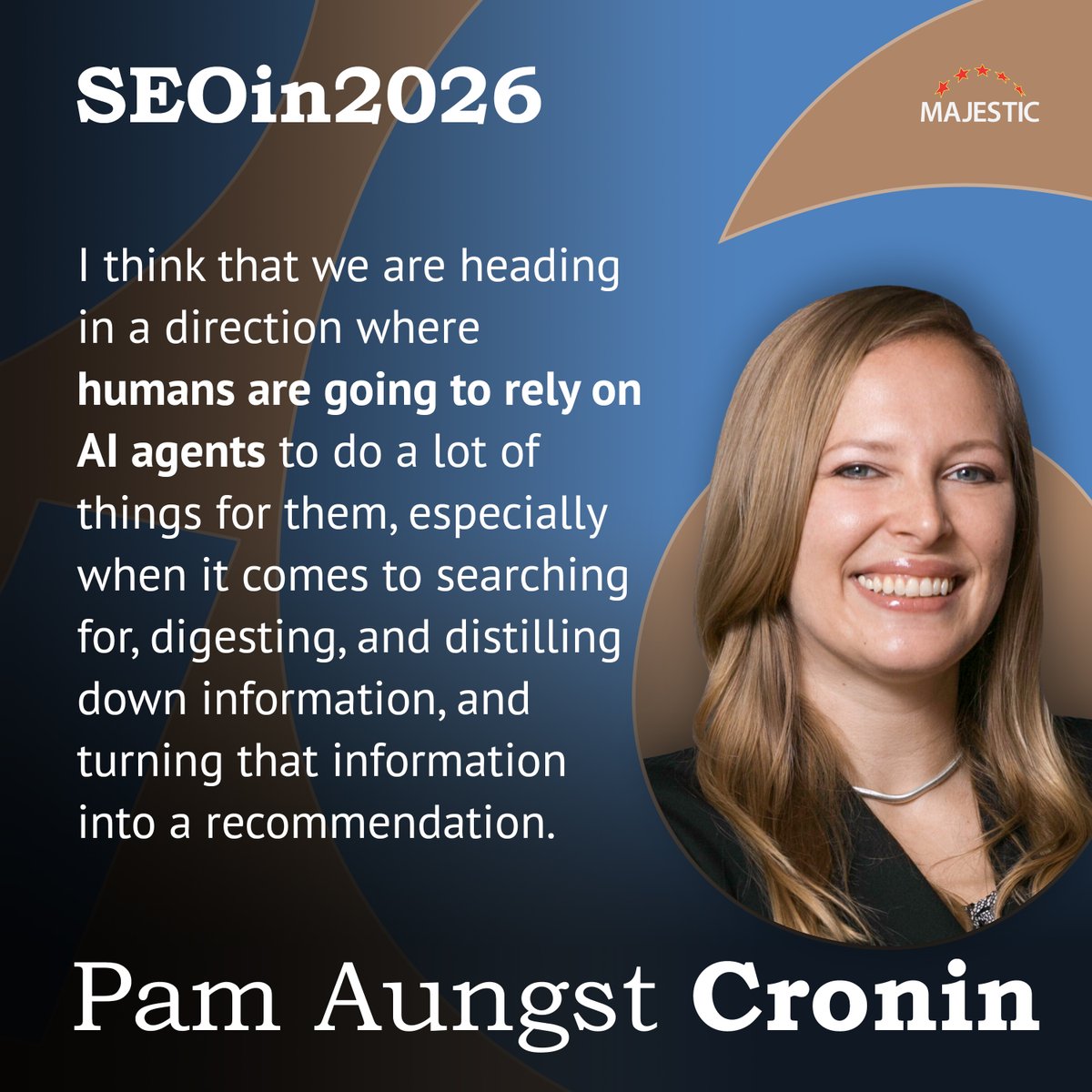
Pam Aungst Cronin believes that humans are going to rely on AI agents to do a lot of things for them, especially when it comes to searching for, digesting, and distilling down information, and turning that information into a recommendation.
https://t.co/HlAjyyGdkO
Pam Aungst Cronin explains that traditional search engines are adding AI chat features, and AI chatbots are adding traditional web search features, but as it stands, AI chatbots are just doing the searching for you on a traditional search engine.
https://t.co/HlAjyyGdkO
Ramona Joita believes that you should move beyond traditional Google-focused SEO strategies and adapt your content to each platform's search behaviour, such as conversational searches on LLMs and informative videos on platforms like YouTube.
https://t.co/Zob7ragoAv
Ramona Joita wants you to prioritise a multi-platform approach encompassing social media and AI platforms to ensure long-term SEO success.
https://t.co/Zob7ragoAv
Ramona Joita wants you to expand beyond traditional SEO with an omnichannel approach by prioritising building a consistent brand presence across all platforms where your audience searches for information, including social media and AI tools.
https://t.co/Zob7ragoAv
Joseph Kahn (@josephskahn) explains that LLMs and search engines prioritise links and mentions from trusted sources, making brand authority and relevance more important than ever.
https://t.co/LXNmLXIlKc
Joseph Kahn (@josephskahn) wants you to focus on establishing your brand as an influencer in relevant spaces, as LLMs prioritise mentions over simple backlinks.
https://t.co/LXNmLXIlKc
Joseph Kahn (@josephskahn) explains that citations and brand mentions on trusted platforms carry more weight with AI and search engines than the quantity of links alone.
https://t.co/LXNmLXIlKc
Romain Leliukh believes that natural mentions are the new backlinks for LLMs, so you should prioritise earning contextual brand mentions on other websites over traditional link building to improve visibility in those LLM-powered search results.
https://t.co/V9JruvQhzF
Roman Leliukh believes that LLM optimisation complements, not conflicts with, SEO, and that enhancing content for LLMs is additive to existing SEO strategies, creating synergy rather than competition.
https://t.co/V9JruvQhzF
Roman Leliukh explains that, with explosive growth in users, LLMs are poised to challenge Google as a primary search source, potentially reshaping SEO faster than Google’s initial rise.
https://t.co/V9JruvQhzF