@TopherNOW@CashionEast Guys what’s the best AI for easily creating concept plans for large master plan developments? Most of the ones I have tried seem to be designed for smaller projects: floor plans or for architects designing a building — not for larger concept plan design.
@shayneaiads Shayne what’s the best AI for concept plans for large master plan developments? Most seem to be designed for floor plans or for architects
@JakehellerAI Jake what’s the best AI for concept plans for large master plan developments? Most seem to be designed for floor plans or for architects — not for larger concept plan design.
The Land JV is the most creative tool in development finance and the hardest sell.
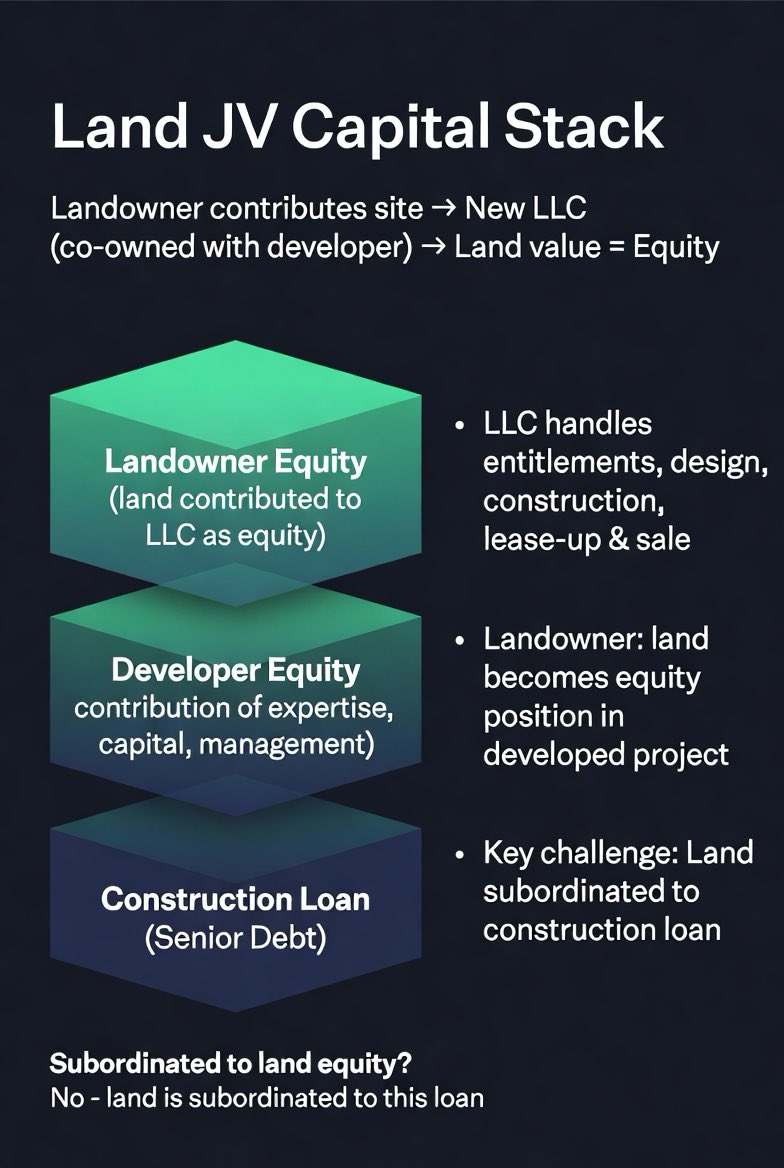
The structure: landowner contributes the site into a new LLC, co-owned with the developer. The land value becomes equity. The LLC completes entitlements, design, capital raise, construction, lease-up, and sale.
Where we lose people: the moment they hear they'll subordinate their land value to the construction loan. Most land sellers aren't developers. The risk profile is foreign to them.
The other key challenge: Must remove existing debt on land to free up 1st position for new construction loan.
But for landowners who understand it? Their land goes from a stagnant or undervalued asset to an equity position in a fully developed project, all while being a tax free move.
That's the upside that makes the conversation worth having.
@BodyRecompExprt@anymanfitness Agree and disagree. Individual chemistry, injection type, ester type, and hormonal levels vary person to person.
Libido spike. New BO. Slightly elevated HR There are plenty of “tells” early on before you hit month 2.
I'm a big "deal structure" nerd because I believe most structures incentivize the wrong things.
We believe a 85/15 or 80/20 straight split, low fee structure offers the best trade-off for compensating GPs well while ensuring the incentives are in the right place.
A straight split, zero pref structure with no asset management fee removes the incentive to simply collect units and raise gobs of capital.
If the GP only gets paid when the deal is actually performing, the incentive is to buy great deals that cash flow for LPs. Period.
But when a GP is taking 2% of gross rents for simply owning the asset?
I worry it's impossible to totally ignore the incentive to buy larger, more expensive deals that inevitably have higher top line revenue (and thus, higher fees).
The asset management fee is justified with a 7% preferred return, which is often packaged with some "LP eats first" marketing...which simply isn't true, given the GP eats 2% off the top line revenue even if the LP isn't getting paid (accruing pref is not cash flow).
Look, GPs need to get paid for good work. Demanding they eat ramen while they work 50 hr. weeks is silly and unreasonable...especially if they are actually operating the assets and are not just fund bros.
It's very difficult to find and fund an actual good deal. It is even harder to operate it. It takes years to master a market, to build a track record, and grow intelligently. Lots of pain to get there.
As such, a high-performing GP should get paid well regardless of structure. I am not saying a preferred return model with AM fee can't result in excellent deals. Of course it can - and often does - provided you have honest, excellent operators.
But incentives do drive behaviors, and that's something to pay attention to when assessing both a sponsor and a given deal.