Four startups led by MIT Sloan alumni were featured as part of a recent MIT Startup Exchange Virtual Demo Day. See what each of these startups is doing to make other firms work better. https://t.co/oWUEtz6aNw
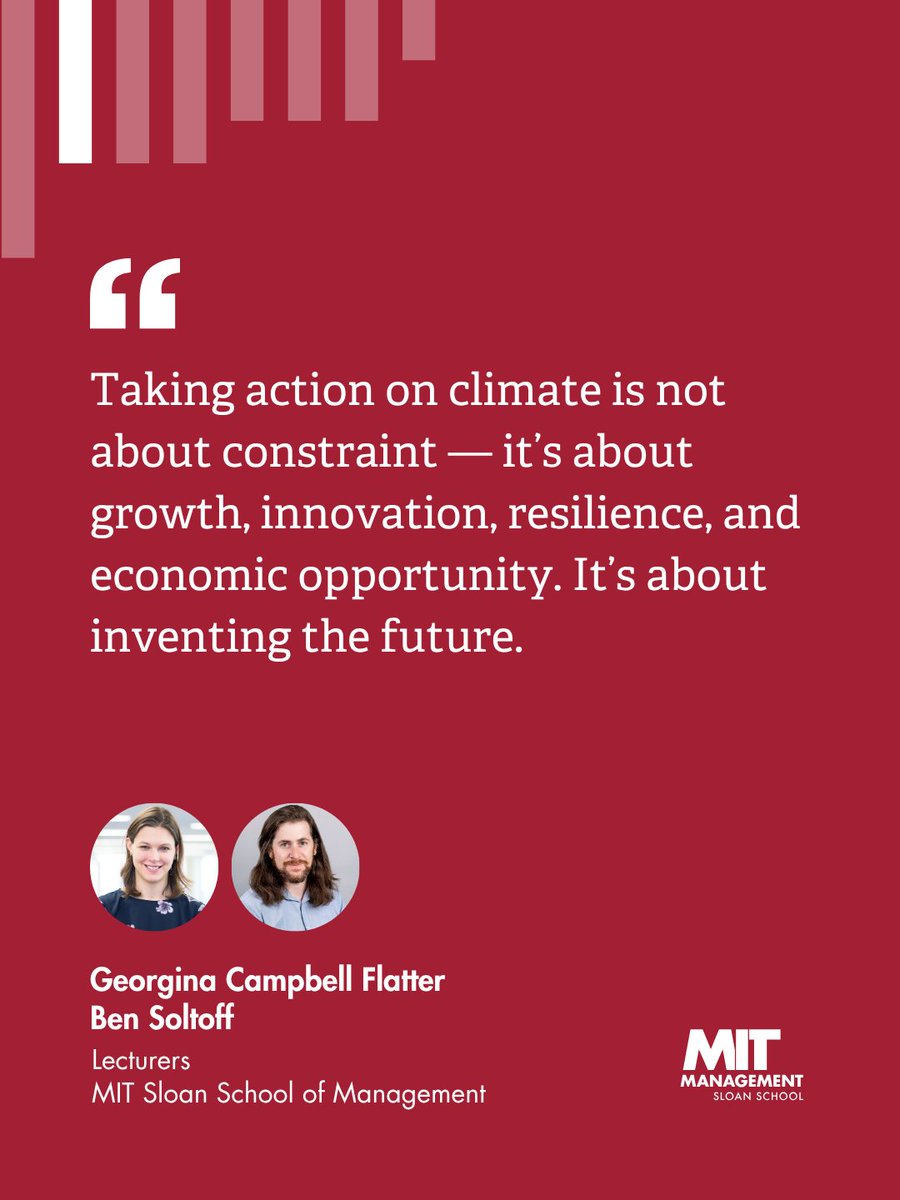
“Taking action on climate is not about constraint — it’s about growth, innovation, resilience, and economic opportunity. It’s about inventing the future.” — Georgina Campbell Flatter and Ben Soltoff, MIT Sloan Lecturers https://t.co/UrmQ0VY7JM
MIT Sloan professor Eric So believes that AI is changing how people’s brains operate and causing users to become overly dependent on the technology. This could eventually undermine individual learning patterns and derail business goals.
Learn what individuals and organizations can to do protect cognitive capital: https://t.co/2gDC1q7RSm
MIT Sloan professor Jared Curhan, who has spent his career studying negotiation, partnered with MIT colleagues to understand what strategies make AI agents negotiate best. https://t.co/f7ewKCCyvL
The new Catalytic Climate Finance Project, co-founded by the MIT Sloan Sustainability Initiative’s Florian Berg and Jason Jay, aims to replicate the solar industry’s success by supporting the development of other green technologies. https://t.co/2m59BAIxFg
Human content creators are protected by copyright law, in part to ensure that they’re fairly compensated for their work. But whether these laws allow AI models to learn from human-created content is up for debate in court and on Capitol Hill. https://t.co/V6icub2foe
Few organizations have parlayed AI experimentation into initiatives that move the needle on critical business metrics. Researchers from @MIT_CISR have identified five common mistakes impeding AI success.
Learn more: https://t.co/MyuHwkoqPt
By providing climate startups with strategic funding from philanthropists and private companies for early-stage and scale-up costs, catalytic climate finance can make climate technologies less risky and more attractive to private investors. https://t.co/2m59BAIxFg
Leaders are facing unpredictable challenges, and AI is part of a “bewildering onslaught of change” that is driving executives to seek learning opportunities. https://t.co/5DCCLZaqT4
A new wave of climate technology is coming, and it spans everything from peel-and-stick solar panels to nuclear reactors that can fit on a truck. https://t.co/BIAACp6fUz
Consumers often express positive views toward environmentally friendly actions, but good intentions don’t always translate into behavior. One possible reason? Consumers find it challenging to gauge their positive environmental impact. https://t.co/IAyNDdh5HO
Pope Leo XIV wrote an encyclical arguing for why AI should serve humanity instead of concentrating power.
A new op-ed from Thomas Kochan (George Maverick Bunker Professor of Management, Emeritus), agrees.
Learn more at the link below.
https://t.co/SEb67qkSaZ
These research-backed titles cover economic strategy, entrepreneurship, talent management, cultural evolution in the age of AI, and more. https://t.co/h09D3xmjkp
AI can now produce work faster than humans can verify it, and closing that gap is becoming the central economic challenge of the transition to artificial general intelligence. @ccatalini https://t.co/cKTOzOlTLV
In a new opinion piece, Greentown Labs’ Georgina Campbell Flatter and Ben Soltoff of the MIT Sloan School of Management argue that climate leadership and economic competitiveness are not opposing priorities — they are increasingly interconnected.
Learn more: https://t.co/0E1eQ3ltxf