🚨 مايكروسوفت تطلق إطار مفتوح المصدر لتشغيل نماذج بمئة مليار معامل على المعالج العادي! 💻🧠
الشركة أطلقت bitnet.cpp، إطار استنتاج لنماذج اللغة ذات البت الواحد (1-bit).
النتيجة المعلنة:
تشغيل نماذج بمئة مليار معامل محلياً على المعالج، من دون بطاقة رسوميات
استنتاج أسرع بـ6.17 مرة
استهلاك طاقة أقل بنسبة 82.2% على المعالجات
والكود مفتوح المصدر 100% على GitHub.
نماذج ضخمة كانت تحتاج خوادم وبطاقات غالية، صارت تعمل على حاسوب عادي. احفظ الأداة الان. 🧵👇
Método alternativo: usa /graphify
Instalación rápida:
uv tool install graphifyy
graphify install
Repo:
https://t.co/acpWcELgeP
Pruébalo en tu próximo proyecto y verás cómo cambia la forma de entender (y explicar) tu código.
Just saw that the LLMs-from-scratch repository passed 100,000 stars on GitHub!
This is super cool and motivating. I am really happy to see that this open-source repo has helped so many people.
Thanks also to everyone who shared ideas and opened PRs with improvements!
Of course, I plan to keep adding new material, including new attention variants and architectures (while bigger projects like RL and Reasoning From Scratch live in their separate repositories).
I am also currently working on a larger applied custom “small” LLM project. It has been keeping me super busy this month, but I will share more on that soon.
If you are new to it, some of the highlights include
1. Of course, the complete code path from tokenization and attention to pretraining, classification, and instruction fine-tuning, etc. All of it FROM SCRATCH, of course! (RL lives in a companion repo.)
2. From-scratch implementations of Llama, Qwen, Gemma, and Olmo (smaller variants that run locally and can be plugged into the training scripts).
3. From-scratch implementations of attention alternatives and other architecture components, such as GQA, MLA, sliding-window attention, Gated DeltaNet, DeepSeek Sparse Attention, cross-layer KV sharing, and mixture-of-experts
4. Materials on KV caching, training performance, memory-efficient weight loading, DPO, evaluation, and LoRA
So, if you don’t have any weekend plans yet, happy tinkering!
"não é isso, é aquilo"
Preguiça demais desses textos de IA. Descobri duas skills que mudaram da água pro vinho a forma que o modelo escreve texto. Se liga:
1. Humanizer (31 mil stars)
A base dela é a página "Signs of AI writing" da Wikipédia, escrita por quem fica corrigindo texto de IA. Mata importância inflada, tom de folder, gerúndio vazio e travessão sobrando, e ainda calibra na sua voz se você colar dois parágrafos seus.
https://t.co/EL96leL9AF
2. stop-slop (14 mil stars)
Em vez de elogiar, ela pontua de 1 a 10 em direção, ritmo, confiança, autenticidade e densidade. Se tiver abaixo de 35 de 50, reescreve.
https://t.co/TGHkJTuS4q
Pelo menos aqui ajudou DEMAIS
I created a playbook to help you learn AI engineering.
It'll give you:
• Core concepts behind AI systems.
• Condensed notes to understand full-stack AI engineering.
• Must know techniques to build, deploy & scale AI apps.
(24 HOURS ONLY!!!)
1 Follow @systemdesignone [MUST]
2 Like & Retweet to get DM
3 Reply "Playbook"
Then I'll DM you the details.
This line from Atomic Habits isn't ready to leave my head:
"It doesn't make sense to continue wanting something if you're not willing to do what it takes to get it. If you don't want to live the lifestyle, then release yourself from the desire. To crave the result but not the process is to guarantee disappointment."
An 82K-star GitHub repo is built around one painfully obvious idea:
Your coding agent should map the codebase once, not grep it forever.
Graphify turns an entire project into a queryable knowledge graph.
Functions, classes, files, SQL schemas, infrastructure, docs, PDFs, images and videos become connected nodes that an agent can traverse instead of repeatedly opening files and reconstructing the architecture.
So instead of:
→ search for authentication
→ open twelve files
→ follow imports manually
→ lose the trail as the context fills up
The agent can ask:
> What connects authentication to the database?
> Trace the path from UserService to DatabasePool.
> Explain RateLimiter.
> Which concepts does everything flow through?
Graphify returns the relevant subgraph and the path connecting the concepts, not another list of keyword matches.
For source code, this is not RAG:
→ No embeddings
→ No vector database
→ No LLM required
→ Code is parsed locally using tree-sitter
→ Calls, imports and inheritance become graph edges
Every relationship is also marked as EXTRACTED, INFERRED, or AMBIGUOUS, so the agent can distinguish what exists explicitly in the source from what Graphify resolved or guessed.
The cleverest part is what happens next.
Graphify can install hooks or persistent instructions for Claude Code, Codex, Cursor, Gemini CLI, Copilot and 20+ other assistants.
Before the agent starts blindly grepping or reading files one by one, it is nudged to query the existing graph first.
The graph can be committed to Git, automatically rebuilt after commits, shared across the team and exposed through MCP.
Long context windows help agents read more code.
A persistent knowledge graph helps them know where to look.
The next improvement in coding agents may not come from stuffing more files into the prompt.
It may come from making them stop rereading the repository.
Here's the GitHub Repo: https://t.co/4ify3X8urp
🚨 ATENCIÓN: esto es gratis y da miedo de verdad.
Un tipo empezó a construir una herramienta en 2012. Hoy, si le metes cualquier correo o dominio, te escupe en minutos todo lo conectado a esa persona: cuentas, contraseñas filtradas, brechas de datos, teléfonos, fotos y hasta perfiles reales.
Se llama SpiderFoot.
No es una página normal. Escribes un solo email y pasa esto:
• Lo cruza contra todas las grandes filtraciones de datos conocidas
• Encuentra una contraseña vieja
• Esa contraseña la sigue hasta usernames repetidos
• Esos usernames los persigue hasta cuentas reales
• Y de repente tienes foto, teléfono, ubicación aproximada y más cuentas vinculadas
Todo automático. Sin abrir otra pestaña. Más de 200 módulos conectados entre sí (Shodan, Have I Been Pwned, VirusTotal y decenas más) que se alimentan solos.
Una pista entra y sale un mapa completo de la vida digital de alguien.
Está instalada por defecto en Kali Linux. Eso ya te dice lo seria que es la herramienta.
¿Quieres ver lo fácil que es exponer a alguien (o a ti mismo) con solo un correo? SpiderFoot está ahí. Gratis. Y sigue creciendo.
Úsala con responsabilidad… porque funciona demasiado bien. 😬
¿Te animas a probarla?
JODER… esto va a romper internet.
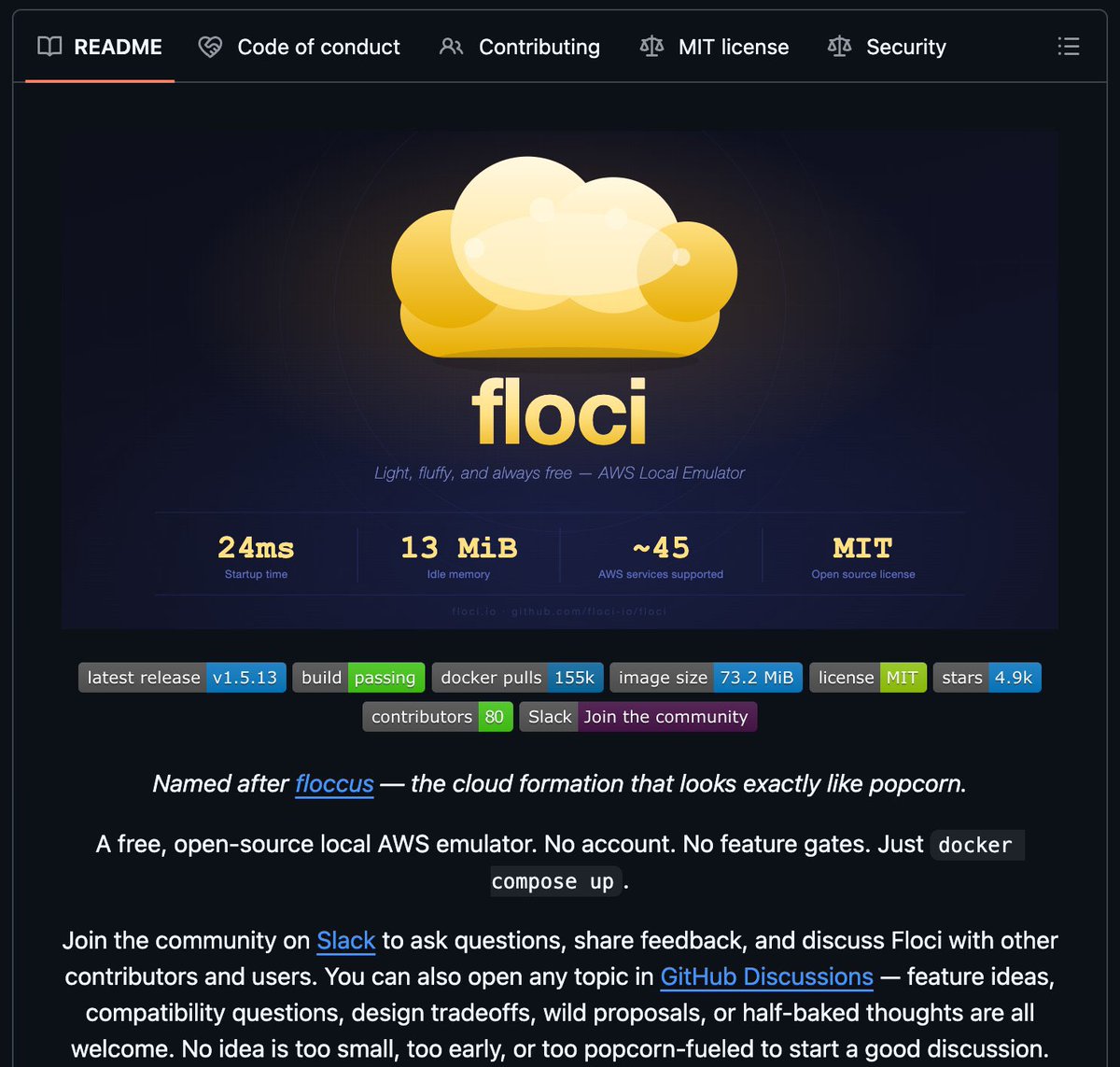
Un equipo acaba de tirar a la basura todo lo que conocíamos de emuladores de AWS. Se llama Floci.
Un solo binario de Go de 13 MiB que levanta 45 servicios de AWS (S3, Lambda, DynamoDB, SQS, SNS, IAM, CloudFormation, Step Functions y más) en menos de 1 segundo. Sin Docker. Sin LocalStack. Sin facturas. Sin 4 GB de RAM robados. Sin esperas de 30 segundos.
Solo descargas el ejecutable, lo lanzas y ya tienes toda la nube de AWS corriendo en tu laptop.
Por qué esto es una puta locura:
• 13 MiB de RAM total. Una pestaña de Chrome consume 200 veces más.
• Arranque en frío en menos de 1 segundo.
• Un solo binario. Cero dependencias.
• Compatible al 100% con AWS SDK y CLI. Apuntas el endpoint a localhost y todo sigue funcionando.
• Binarios para Linux, macOS y Windows. Descargas y ejecutas.
LocalStack Pro de $40/mes → muerto.
Docker Desktop comiéndose tu RAM → muerto.
Entornos de staging caros → muertos.
Y lo mejor: funciona en CI/CD. Levantas todo el entorno en pipelines en menos tiempo del que tardas en escribir el comando.
100% open source
Si eres developer de AWS y esto te ha hecho decir “joder, por fin”… dale like, RT y sígueme. Esto es solo el principio.
El local development con AWS acaba de cambiar para siempre.
Say goodbye to Google Workspace.
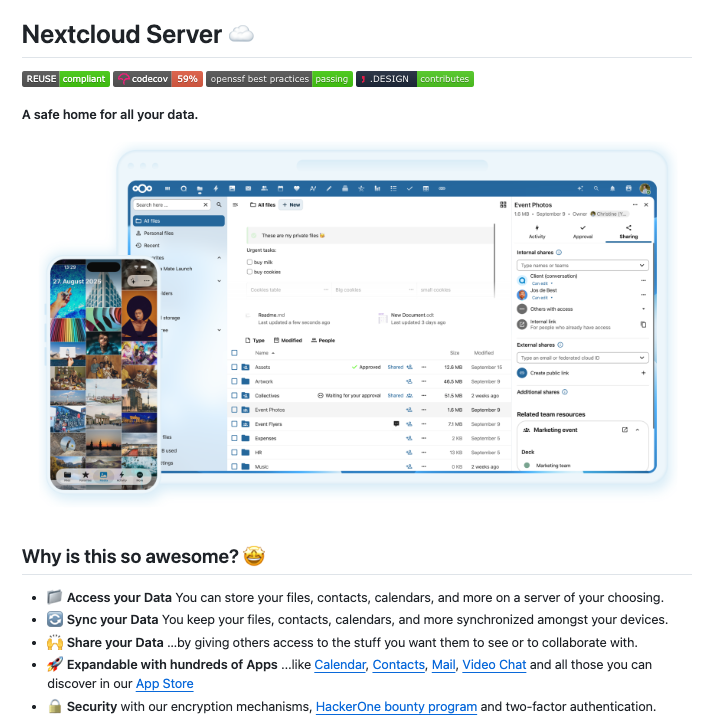
Someone built a complete replacement that runs on your own server, costs nothing, and has 400+ apps.
It's called Nextcloud. 400,000 organizations are already running it. The German federal government switched to it. The French public sector switched to it. The European Parliament uses it.
None of them are doing it to save money.
Here's what one install actually gives you:
→ File sync and sharing that works exactly like Dropbox
→ Live document editing with full Word/Excel compatibility, no internet required
→ Video calls with end-to-end encryption and no vendor in the call with you
→ Photo backup with local AI face grouping, your machine, your data
→ Calendar and contacts synced to every device through open standards
→ 400+ apps including Jira-style project boards, Spotify-style music streaming, and RSS readers
The architecture is the part nobody talks about.
Nextcloud does not route your data through their servers. Ever. Your server talks directly to your devices. No company in the middle. No terms of service that can change overnight. No price increase email you have to swallow.
Google Workspace costs $12/user/month and owns everything you put in it.
Nextcloud costs whatever your VPS costs and owns nothing.
35K stars. 100% Opensource.
https://t.co/mTcnkth10B
https://t.co/YchJXeRmtM