De "Pequeños cuentos filosóficos", la recopilación de Jean-Claude Carrière que será el tema de la conversación del episodio del Salón de Gascón con Ernesto Castro que publicamos mañana.
When I was the Air Force Military Aide to Bill Clinton (and again, that was not a political appointee position, it was a military assignment), I served daily with very young staffers who were appointed because of their efforts in the campaign or who their parents were.
I really enjoyed interacting with most of them. Bright kids from Ivy League school. But their naïveté and lack of experience showed. Dramatically.
One day I was walking across the White House “campus,” the “18 acres,” and I encountered one of the young female staffers. We chatted for a bit, and she asked me, “So, why did you join the military? Were your career options limited or were you forced to by a judge?”
I wanted to throat punch her, but I said, “No, ma’am, I volunteered.”
She asked, “But why? Lack of education? No other options?”
“No, ma’am, I volunteered. Really. Not only do I have a Bachelor’s but also an MBA.”
She asked again, “Then why?”
I shook my head and walked away. They simply can’t understand a higher calling. They are incapable of understanding that another human who would selflessly serve.
Therein lies much of the Democrat vs. military disconnect. They’re missing the patriotism chip.
Mosab Hassan Yousef, son of Hamas founder, triggered absolute hysteria among pro-Palestinian students at Oxford — simply by telling the truth about his father’s terrorist organization.
Even Arab leaders admit it.
Everyone is sharing the Bill Clinton clip where he describes how Yasser Arafat rejected a generous peace offer at Camp David that would have given the Palestinians a state on 96 percent of the West Bank, land swaps, and a capital in East Jerusalem. Clinton says Arafat lied to him and that the Palestinian leadership never actually wanted a two-state solution. They wanted to destroy Israel. It’s a video often shared by people like @VividProwess, and it’s an important one for people to see.
Of course, critics immediately dismiss it. They claim Clinton is biased or he’s pro-Israel. They’ll tell you that you cannot trust the American perspective.
Ok, so let us set that aside.
Now watch this.
In this powerful interview, former Egyptian President Hosni Mubarak, a major Arab leader who was directly involved in negotiations, says exactly the same thing from the Arab side. He talks about the Mena House Conference in Cairo as well as the Camp David negotiations of 1978. All failed because of the Palestinians repeatedly rejecting any offer. The Oslo accords were signed but because Hamas and the Palestinian Islamic Jihad were not involved, they derailed the accords and any chance for peace by initiating 4 years of terrorist suicide attacks in Israel. Then came the second Camp David negotiations in 2000 which Arafat agreed to, then rejected and instead initiated the Second Intifada.
Mubarak explains how the Palestinians refused to even participate in the Mena House conference of 1977. He describes repeated opportunities they were given, including a detailed document that called for Israeli withdrawal from the Samaria, Judea and Gaza, security arrangements during a transitional period, and other major concessions. The Israelis were willing to negotiate on difficult issues like who would control security. The Palestinians, according to Mubarak, kept saying no and wasting chance after chance.
He speaks with clear frustration about how for decades the Palestinian side has rejected peace initiatives and realistic compromises.
The video further shows footage from the PLO representative in 1977, as well as old footage of Egyptian president Sadat who was involved in the Mena House and first Camp David negotiations of 1978.
This perhaps is far more impactful than Clinton’s account because it is not a Western or Israeli voice. It is prominent Arab leaders who lived the negotiations, who represented the broader Arab world, and who had zero incentive to defend Israel.
When leaders from both sides of the table describe the same pattern of Palestinian rejectionism and violence, it becomes much harder to dismiss as bias.
The pattern is clear across decades and across different voices… generous offers, repeated refusals, and continued demands for everything while giving nothing in return.
This is not ancient history. It is the core reason the conflict continues today.
If you value the truth, please share.
Rafa cannot be an inspiration. And I mean that seriously.
Watched the RAFA series on Netflix with my daughters this week. The 9 year old was okay and maybe even excited. The five-year-old had to be - let's say - firmly encouraged to stay seated.
I kept pausing to tell them where I was when some of these matches happened. The 2008 Wimbledon final - Nadal winning his first on grass, at dusk, in what many still call the greatest match ever played. The 2012 epic, which for a lot of people remains the most complete - for me a complete heartbreak. The 2022 comeback - a man who had been told his foot condition might end his career after his first few grand slams, winning not only his 14th Roland Garros but his second AO.
Each of those matches is etched somewhere specific in my memory. The emotions came back watching the documentary like they hadn't gone anywhere.
My daughters of course couldn't relate. They will grow up creating their own moments and their own memories. I hope sport is part of that and maybe even their own matches, who knows.
But I kept coming back to the thought I mentioned at the beginning as I watched the series.
Rafa cannot be an inspiration.
Nobody can look at what he did - the physical punishment, the sheer doggedness, the way he kept coming back when his own body was the opponent - and think: I can do that. He belongs to a handful of people across all of human history, in sport or any other field, who achieved what they achieved.
Holding him up as a template is almost unfair to the rest of us.
But here is what the documentary does show: At the absolute pinnacle of human achievement, he felt self-doubt. He wanted to give up. He lost hope. He questioned himself in ways that will feel familiar to anyone who has ever tried to build something or push through something hard.
And that is the more honest inspiration.
Court Philippe-Chatrier has the words engraved: "Victory belongs to the most tenacious." But the tenacity that matters to most of us isn't the tenacity to win the tournament. It's the tenacity to win your own inner doubts. To show up when everything in you is arguing for staying put.
Showing up isn't just how you succeed. Showing up is the success.
My daughters will figure that out in their own way, in their own time. I just hope they have their own version of those matches to look back on when they need reminding.
Well done Netflix. Made me cry.
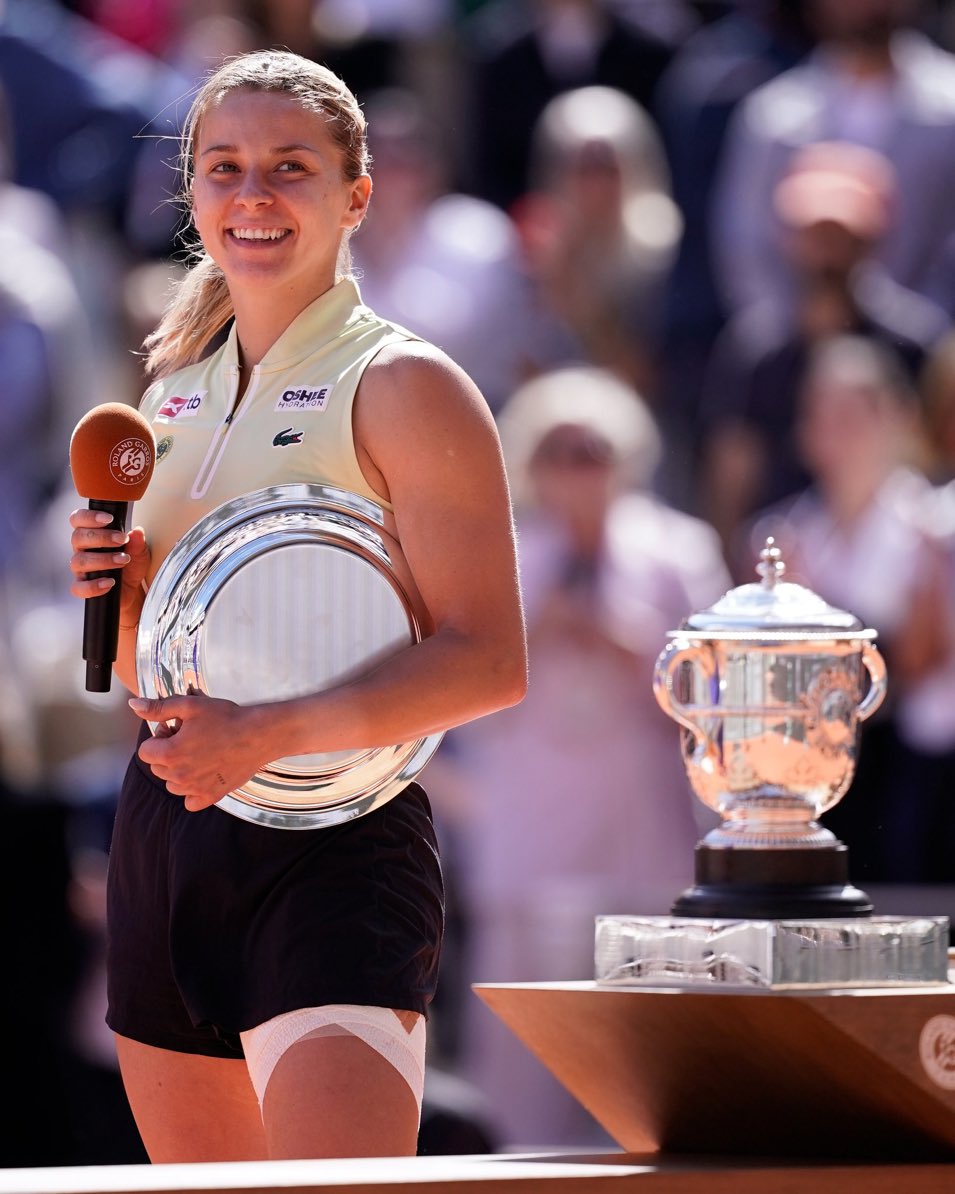
She lost the final, but won the hearts of so many.
Maja Chwalińska entered Roland Garros at world No.114, which wasn’t good enough for an automatic main draw entry. Instead, she started one week earlier than the favourites to win the title, winning three qualifying matches, with the third round played on Court 6. After winning 10 consecutive sets, the streak was finally over against Maria Sakkari in the third round, but Maja didn’t arrive in Paris to make up the numbers. In fact, it was the only set she dropped en route to her first-ever Grand Slam final, becoming the lowest-ranked woman to do so at Roland Garros since the rankings system started in 1975.
Maja was so unknown that she didn’t even have a sponsor, which explained the different outfits each match.
Despite guaranteeing herself a prize money sum of €1.4 million, she was worried about not having enough money to cover her hotel accommodation, until Polish sports drink company Oshee helped cover the remaining costs.
The 24-year-old has risen 93 spots in the WTA rankings to a career-high No.21. That was unthinkable five years ago, given she took a four-month break from tennis to help overcome depression, which is the moral of the story: In the midst of darkness, light persists.
-¿Nos escribes un blurb para esta novela premiada?
-Claro. Toma: "Básicamente es como mi novela, así de buena es. Por ello, no tendré que escribirla yo, esta novela tan buena como mi novela, que es también muy buena."
👇🤷🤣😏💣
Ejemplo de la degradación moral de la democracia española desde 2018 hasta hoy. En julio de aquel año, nada más llegar a presidente, se armó un gran escándalo porque Sánchez usó el Falcon para ir al festival de Benicasim. Anoche se fue al Primavera Sound de Barcelona en el avión oficial y ya casi nos parece normal. Derroche de recursos públicos para que el presidente se lo pase bien el sábado por la noche. El líder de la lucha contra el cambio climático quemando queroseno en vez de dar ejemplo montando en el AVE. Y así todo.
Bajo su apariencia de peluquera de tu pueblo, tras su prosodia de Telecinco, al otro lado de esa mirada bizqueante, está el sanchismo entero. Leire resume ocho años, es el Frankenstein con pedazos del resto. La vulgaridad de Ábalos, el dogmatismo primitivo de Koldo, el cálculo de Cerdán, la arrogancia de María Jesús Montero, la pachorra de ZP, la doblez de Marlaska, el patetismo de Óscar López, la avidez de Begoña, el oportunismo de Rufián, el populismo de Santaolalla, la agresividad de Puente, la superficialidad intelectual de Javier Ruiz, la grisura de Aldama y la asombrosa ausencia de escrúpulos morales del presidente Pedro Sánchez: todo eso encarna Leire Díez, que suma al pack sus propios recursos. Si el PSOE tomase forma humana, saldría Leire.
https://t.co/Yc5HWdEAPq
@FPJ_Loretta El Aria de la Reina de la Noche de la ópera de Mozart La Flauta Mágica. Una de las más difíciles. Excelente. Sin embargo nada supera a Diana Damrau en ese papel. Espectacular y sobrecogedora: https://t.co/idVZuO6Ycd
Gracioso que tanta gente de izquierdas esté tan alarmada con el auge del evangelismo pentecostal, movimiento muy conservador, pero muchos nunca hayan dicho ni mu sobre el auge del islamismo salafista o wahabí...
Marjane Satrapi era una mujer extraordinara.
Extraordinariamente inteligente, divertida y lúcida, una de esas personas capaces de contar una tragedia sin convertirse en una plasta solemne y de reírse del fanatismo sin quitarle ni un gramo de gravedad. Persepolis sigue siendo una obra magnífica porque explica mejor que muchos ensayos cómo una teocracia consigue meterse hasta la cocina de la vida cotidiana y convertir la existencia de millones de personas en una interminable sucesión de prohibiciones, miedos de todo tipo y humillaciones.
Por supuesto, una mujer iraní que había vivido aquello en primera persona acabó siendo acusada de islamófoba por una legión de majaderos occidentales que jamás habían pasado un minuto bajo una teocracia, pero que se sentían perfectamente cualificados para explicarle a ella qué debía pensar sobre los fanáticos que le habían robado el país y la vida.
Hay formas de vanidad moral difíciles de superar.
La acusaron de islamofobia. A ella.
La palabreja ha resultado comodísima. En cuanto alguien menciona el islamismo, la policía religiosa, el velo, la persecución de la homosexualidad o cualquier otra porquería teocrática, los fanáticos siniestros desaparecen y toda la atención se concentra en el insolente que se ha atrevido a describirlos. El debate deja de tratar sobre lo que ocurre y pasa a tratar sobre quién se ha atrevido a contarlo.
Mientras Satrapi describía con claridad todo eso, una parte de la izquierda occidental realizaba el prodigio intelectual de pasar de mofarse de los curas a encontrar fascinantes a los ayatolás, que llegaron rodeados de suficientes estudios poscoloniales y suficiente distancia geográfica.
El resultado ha sido contemplar a supuestos progresistas defendiendo con entusiasmo algunas de las mismas ideas de las que huyeron miles de iraníes como Marjane.
Para ella fue una broma macabra ver a europeos libres, cómodamente instalados en democracias liberales, dedicando su tiempo a blanquear los mismos horrores contra los que ella había escrito y dibujado durante toda su vida.
Nos queda Persepolis, que sigue siendo infinitamente más inteligente, más honesta y más útil para entender el fanatismo religioso que toneladas de artículos, manifiestos y tesis producidos por gente que jamás ha tenido que soportarlo.
Te voy a echar de menos.