Simon O'Connor shares how a New Zealand primary school is actively promoting gender ideology and fluidity, starting with five-year-olds! 😟😡
It's a warning to all parents and grandparents to check carefully what schools are teaching your kids.
#familyfirstnz#education #teaching
Has NZ forgotten this part of its legacy?
“Up Against The Wall Exhibition” - the movement that kept NZ GE FREE.
It’s been 25 years since prominent New Zealanders stood up to protect NZ’s GE FREE status.
Not only did the nationwide movement unify our nation, but it also helped build public awareness, create GE controls, and strengthened New Zealand’s clean, natural image as a global export success story.
Today our country once again sits at this crossroad. Our voices are needed again.
Curators talk by Jon Carapiet. Clip 3. @brandnewzealand
Follow us for updates on:
Gene Tech Bill
HSNO Amendment Bill
KEEP GE IN THE LAB, NOT OUR FOOD. 🇳🇿
#newzealand
#foodie
#photography
#nzpol
Most people missed this in the budget,
National have allocated $30M on developing the U16 social media ban.
Read that again, 30M.. Luxon is the antipodean version of Keir Starmer both are full bozo.
Economist Dr Eric Crampton who has been warning of this digital age authoritarianism condemns the Govt for throwing money into such an Orwellian project.
IMPORTANT UPDATE ‼️
Amendments to HSNO Act Raises Suspicion and Risks for GE Deregulation
GE FREE NZ PRESS RELEASE:
The Hazardous Substances and New Organisms Act (HSNO) amendment Bill had its first reading in Parliament on the 14 May 2026.
It was passed with a majority of votes and is to be sent to the Primary Industries select committee where submissions will be heard. It will be reported back to the House in September.
Most parties supported the HSNO amendments to go to select committee except Te Parti Māori, Green Party and the two independent members. But even MPs who spoke in support of the bill said they were sceptical that there were hidden hooks in the 300 pages of amendments.
Steve Abel of the Green Party, who had taken time to read the Bill was the only MP to call out the creeping, weakening of regulation and unbridled powers given to the Authority to exempt new genetically modified organisms (GMO) from controls.
He reminded MPs of the history of the EPA and its attempt to redefine and exempt new Genet edited organisms as not GMOs, that resulted in a successful legal challenge in the High Court. The absence of any new ethical controls is also concerning because years of cruel GE animal experiments have been allowed to occur under the current HSNO Act.
There is no liability on users of GE new organisms that would protect growers and ratepayers across the regional GE-free zones which the government intends to abolish.
"The scepticism voiced by some MPs at the first reading is justified, “said Claire Bleakley, GE-Free NZ president.
"The removal of vital directions for assessing all hazardous substances and new organisms in the streamlining of the legislation weakens vital protections for New Zealand."
The Bill sets up pathways for release of GMOs without proper consideration of significant risks to the environment, economy, and loss of GE Free farming. Whole segments on how the regulator/EPA is to assess releases of vagrant organisms appears to have been given a fast track for release. Changes to 'definitions' makes it difficult to know what will and won't be regulated under different amendments.
"There is a whole section that has been removed on the GE organisms guidelines the regulator needs to assess," said Claire Bleakley.
The Bill also allows consideration and approval of GMOs released in the US, Canada and Australia to be rubber stamped in New Zealand by fast tracking conditional release and full release approvals. New Zealand's GE Free export premiums and point of difference that consumers seek would be lost.
The HSNO Act amendment Bill is a complex web of changes that threatens to do what the stalled Gene Technology Bill also threatens to do which is deregulation of GE organisms that will destroy our GE-free status.
This Bill cannot be allowed to stand and the Ministries involved have seriously let down the Country by weakening the environmental protections that have made us a high quality, GE free nation.
More to come on this HSNO Amendment Bill.
Submissions close June 15th.
@brandnewzealand@GEFreeNZ
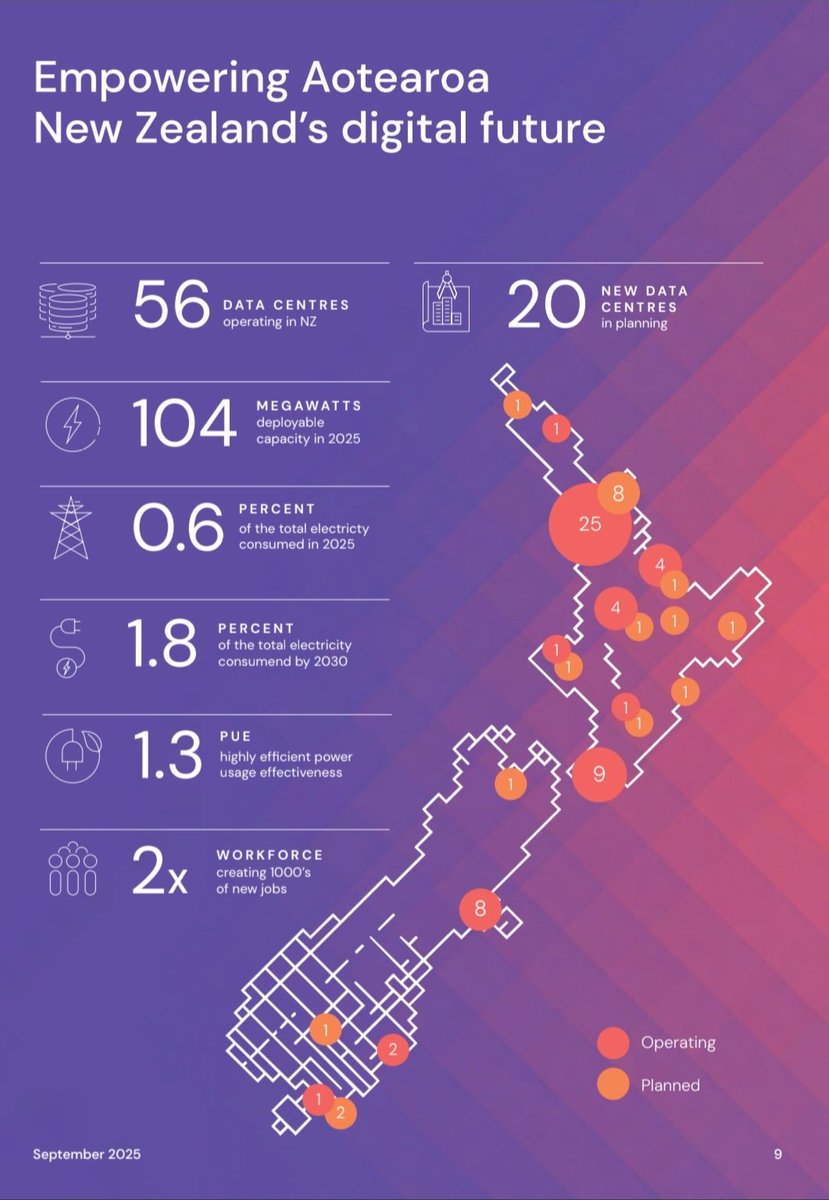
🇳🇿 By 2030 in New Zealand all our data harvesting centres operating are expected to use roughly as much electricity as Dunedin.
With virtually all these centres include massive diesel backup generators when there's a brown out your lights go off thses GPU's keep humming
The H²O used for cooling thses centres is staggering
For years they told you that your diesel generator, your car, your electricity use was destroying the planet. They built a whole control grid around that story - digital money internet age verification police surveillance, carbon credits, ESG scores, social credit tied to energy use. For you. Not for them.
Now watch what happens when the data hoovering center's needs power. Data centers pulling city-scale electricity, 24/7 diesel backup, & suddenly… no problem. No climate lectures. No fines. No shutdowns.
Why? Because the rules only apply to the people outside the system.
That’s the setup for The Great Taking.
Our financial system is being centralized into a control structure. The assets you think you own - securities, bank deposits, even your property through liens and custody chains - are being moved into a system where access is contingent on compliance.
And compliance is determined by the people who control the pipes: energy, data, finance, digital ID.
When they need the power, they turn it on. When you need it, it’s “unsustainable.”
"When they need liquidity, they reuse your assets. When you need it, your account is frozen for 'review.'"
The smoke you see is a signal. It tells you who’s actually inside the perimeter & who’s outside. The Great Taking is about moving everyone else outside, while making it look legal, technical, & inevitable.
So the question isn’t really about the smoke. The question is: where are your assets sitting, & who can turn off the switch?
🔗Empowering Aotearoa New Zealand's Digital Future👇
https://t.co/tA9rrjJHJx
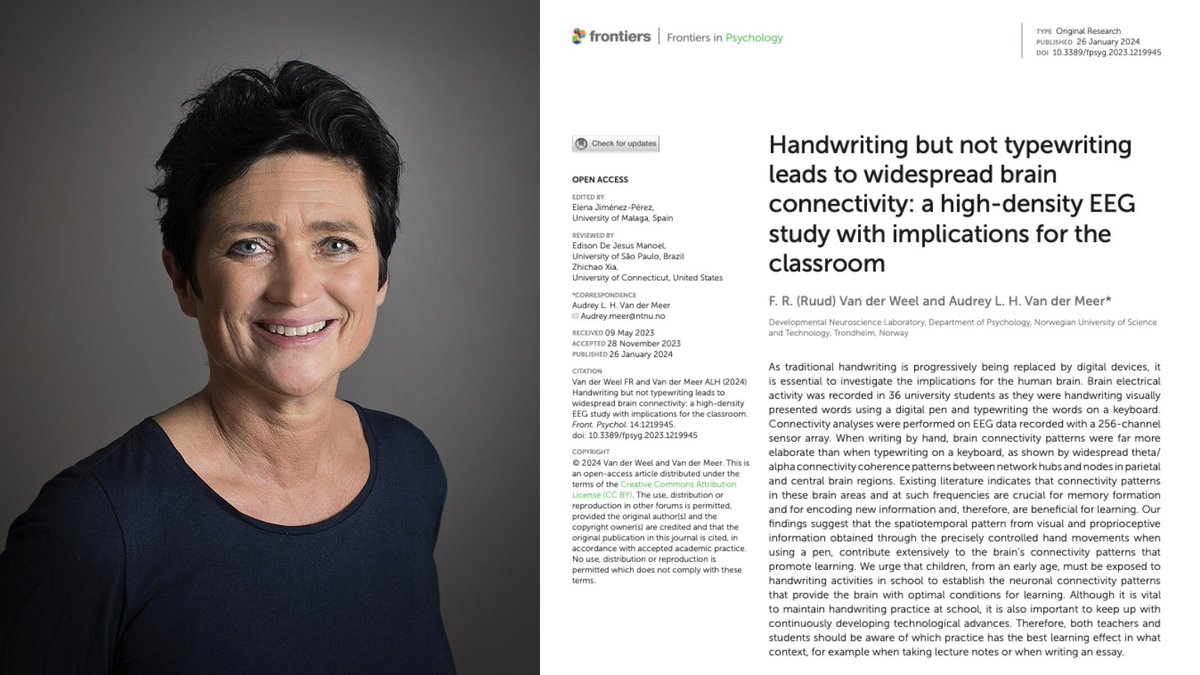
A Norwegian neuroscientist spent 20 years proving that the act of writing by hand changes the human brain in ways typing physically cannot, and almost nobody outside her field has read the paper.
Her name is Audrey van der Meer.
She runs a brain research lab in Trondheim, and the paper that closed the argument was published in 2024 in a journal called Frontiers in Psychology. The finding is brutal enough that it should have changed every classroom on Earth.
The experiment was simple. She recruited 36 university students and put each one in a cap with 256 sensors pressed against their scalp to record brain activity. Words flashed on a screen one at a time.
Sometimes the students wrote the word by hand on a touchscreen using a digital pen, and sometimes they typed the same word on a keyboard. Every neural response was recorded for the full five seconds the word stayed on screen.
Then her team looked at the part of the data most researchers had ignored for years, which is how different parts of the brain were communicating with each other during the task.
When the students wrote by hand, the brain lit up everywhere at once.
The regions responsible for memory, sensory integration, and the encoding of new information were all firing together in a coordinated pattern that spread across the entire cortex. The whole network was awake and connected.
When the same students typed the same word, that pattern collapsed almost completely.
Most of the brain went quiet, and the connections between regions that had been alive seconds earlier were nowhere to be found on the EEG.
Same word, same brain, same person, and two completely different neurological events.
The reason turned out to be something nobody had really paid attention to before her work. Writing by hand is not one motion but a sequence of thousands of tiny micro-movements coordinated with your eyes in real time, where each letter is a different shape that requires the brain to solve a slightly different spatial problem.
Your fingers, wrist, vision, and the parts of your brain that track position in space are all working together to produce one letter, then the next, then the next.
Typing throws all of that away. Every key on a keyboard requires the exact same finger motion regardless of which letter you are pressing, which means the brain has almost nothing to integrate and almost no problem to solve.
Van der Meer said it plainly in her interviews.
Pressing the same key with the same finger over and over does not stimulate the brain in any meaningful way, and she pointed out something that should scare every parent who handed their kid an iPad.
Children who learn to read and write on tablets often cannot tell letters like b and d apart, because they have never physically felt with their bodies what it takes to actually produce those letters on a page.
A decade before her, two researchers at Princeton ran the same fight using a completely different method and ended up at the same answer. Pam Mueller and Daniel Oppenheimer tested 327 students across three experiments, where half took notes on laptops with the internet disabled and half took notes by hand, before testing everyone on what they actually understood from the lectures they had watched.
The handwriting group won by a wide margin on every question that required real understanding rather than surface recall.
The reason was hiding in the transcripts of what the two groups had actually written down.
The laptop students typed almost word for word, capturing more total content but processing almost none of it as they went, while the handwriting students physically could not write fast enough to transcribe a lecture in real time, which forced them to listen carefully, decide what actually mattered, and put it in their own words on the page.
That single act of choosing what to keep was the learning itself, and the keyboard had quietly skipped the choosing and skipped the learning along with it.
Two studies. Two countries. Same answer.
Handwriting makes the brain work. Typing lets it coast.
Every note you have ever typed instead of written went into your brain through a thinner pipe. Every meeting, every book highlight, every idea you captured on your phone instead of on paper was processed at half depth.
You did not forget those things because your memory is bad. You forgot them because typing never woke the part of the brain that would have made them stick.
The fix is the thing your grandmother already knew.
Pick up a pen. Write the thing down. The slower road is the faster one.
Chris Hipkins has said today that “The kiwi dream should not be reserved for the few, it should be delivered for everybody who calls New Zealand home.”
He has just called New Zealanders “the few” and that “everybody” should be delivered what we have built.
The ‘kiwi dream’ belongs to kiwis who have worked hard for our country, invested time, sweat, pride, and belongs to the generations who share in our country’s history. It is not for just anybody around the world who decides to come to our great country that we have built for their convenience.
Politicians like Hipkins use “diversity is a strength” to shut you down, but the choice is in your hands, not in the hands of retail globalists like him.
Why is the Government "affirming" UNDRIP in the India Free Trade Agreement? UNDRIP is a major threat to social cohesion in New Zealand. Todd McClay, Trade Minister, claimed he was unaware of the reference. Who put it in and for what purpose? The reference offers a hostage to fortune to an activist judiciary. It must be removed before the FTA can be ratified @chrisluxonmp@dbseymour@NewZealandMFA
Professor William Happer explains ALL YOU NEED TO KNOW....about CO2 and Climate Change.
I promise you as an engineer and logistician.
I promise you - this is ALL you need to know:
𝐑𝐄𝐕𝐄𝐀𝐋𝐄𝐃: 𝐓𝐚𝐱𝐩𝐚𝐲𝐞𝐫𝐬 𝐌𝐢𝐥𝐤𝐞𝐝 𝐅𝐨𝐫 $𝟏.𝟎𝟕𝐦 𝐂𝐨𝐰𝐬𝐡𝐞𝐝 𝐋𝐨𝐚𝐧 𝐂𝐫𝐞𝐚𝐭𝐢𝐧𝐠 𝐉𝐮𝐬𝐭 𝟏.𝟖 𝐉𝐨𝐛𝐬
The Taxpayers’ Union can reveal that a taxpayer-funded $1.07 million cowshed upgrade in Taranaki is expected to sustain just 1.8 ongoing jobs.
Documents released under the Official Information Act request show the project received $900,000 in loan funding through the Government’s Regional Infrastructure Fund, despite only $120,000 in co-funding from Omuturangi 6E & 7A Ahu Whenua Trust. Large parts of the application, financial analysis, loan terms, risk assessment, and decision-making material of the loan have also been withheld.
Taxpayers’ Union spokesman Rhys Hurley said:
"The Government sold this as a productivity story, yet taxpayers are being used as the bank for a private cowshed upgrade that creates fewer than two ongoing jobs.”
“If this project stacks up commercially, why couldn’t the trust get a loan from a bank like they have before? And if it doesn’t stack up, why are taxpayers being asked to carry the risk?”
“Farmers across Taranaki would love help upgrading their cowsheds, but they are stuck paying rates, taxes, interest, and compliance costs. They don’t get to send the bill to Wellington.”
“The Government needs to explain why this loan was approved, what risks taxpayers are exposed to, and how many more low-value projects are hiding behind blacked-out OIA documents. Otherwise, this simply looks like another case of pork barrel politics.”
@camrynpetebrown@fanboy466@aniobrien We were looked straight in the eye by the single source of truth and lied to. lies that killed and maimed. Lies that impacted on families and destroyed economy.
So the Christchurch City Council will allow "women only" pool times for muslim women but not for New Zealand women? NZ women have repeatedly asked for women only pool times but dirty old trans identifying males have repeatedly had this stopped. What on earth is so special about muslim women that they get to have pool.time without men being permitted?
The NZ$2B BlackRock renewable energy fund: A failed promise for NZ’s green future?
From 2023 to 2025, millions of taxpayer dollars have been lost & the promised jobs have failed to materialise.
In Aug 2023, the Ardern's Labour party (led at the time by PM Hipkins) partnered with BlackRock to launch a $2 billion climate fund, aiming for 100% renewable electricity by 2030 via solar, wind, green hydrogen, & battery storage. Hailed as a world-first, it promised jobs and innovation.
The fund drew on taxpayer money via NZ Green Investment Finance (NZGIF), a Crown entity funded by public resources incl: ACC, KiwiSaver, & the NZ Super Fund. By using NZGIF, the government exposed taxpayers to risks of financial loss if investments failed-& they did.
The first investment was SolarZero- a high-risk company with potential. (With better due diligence, this investment would not have gone forward.)
The company was first acquired by BlackRock in Nov 2022 for approximately $110M. However, BlackRock later injected a further $147.8M into the business, bringing total capital involved to roughly $257.8M. Of this, NZGIF provided a $145M debt facility, & BlackRock contributed $112.8M. SolarZero aimed to scale solar energy in NZ with a pay-over-time model. But on Nov 26, 2024, BlackRock placed it into liquidation after it missed sales targets.
Of the $145M facility, only $115M had been drawn down by the time of collapse. The full $257.8M was not "lost" as a single sum; the total recovery outcome remains uncertain. The collapse left around 160 staff jobless, with $4-5M in unpaid obligations. The loss of at least $115M of taxpayer money — representing roughly 5.75% of the $2B fund ,this was a huge blow to its credibility, leaving taxpayers with little hope of full recovery.
Despite SolarZero’s failure, BlackRock charges fees reported at 1.5% annually on invested capital. While the total $50.57M fee figure is (not verified in public records), it is confirmed that BlackRock charged $4.35M on NZGIF’s $145M commitment, taxpayer money for a failed project. The fund now “seems to have gone nowhere,” with no new major projects announced and roughly $1.69 billion idle.
BlackRock’s Auckland office, opened in July 2023 with around 10 staff, has delivered nothing new, appearing only to manage the fallout while fees continue. MBIE, overseeing NZ’s energy strategy, has offered no public updates. The lack of transparency raises questions about the government’s choice to partner with BlackRock, potentially delaying NZ’s 100% renewable goal.
The financial losses, fees charged on taxpayer money, & lack of outcomes have led to perceptions of a “renewable investment scam,” eroding trust in BlackRock and the government.
January 2026: BlackRock abandoned the $2 billion NZ Climate Infrastructure Fund. The fund is now dead.
With $1.69 billion left, there was potential to salvage the fund, but this remains a sad tale of risks with global asset managers & taxpayer funds.
Claims have also emerged during this time-including allegations of government officials receiving kickbacks from the deal, with a Ardern being named. No evidence has been provided to support these claims.
NZGIF has advanced $314,000 in taxpayer money to fund legal investigations into whether SolarZero hid money from creditors by shifting assets into separate trusts before collapsing. NZGIF's chance of recovery in drawn-down funds hinges entirely on whether the court agrees those payments were improper. If the liquidators win, some money may be clawed back. If not, money is likely gone for good..
2026 BlackRock has abandoned NZ Climate Infrastructure Fund. The fund is now dead.