Overall, Cristopher Sánchez's slider looks like the pitch that has taken him to the next level in 2026.
A new spiked grip, a higher release point, increased movement, and improved location have helped transform the pitch into a true put-away weapon. The improvements in both Whiff% and PutAway% suggest hitters are having a much more difficult time picking up and handling the pitch, making it one of the biggest reasons behind Sánchez's success this season.
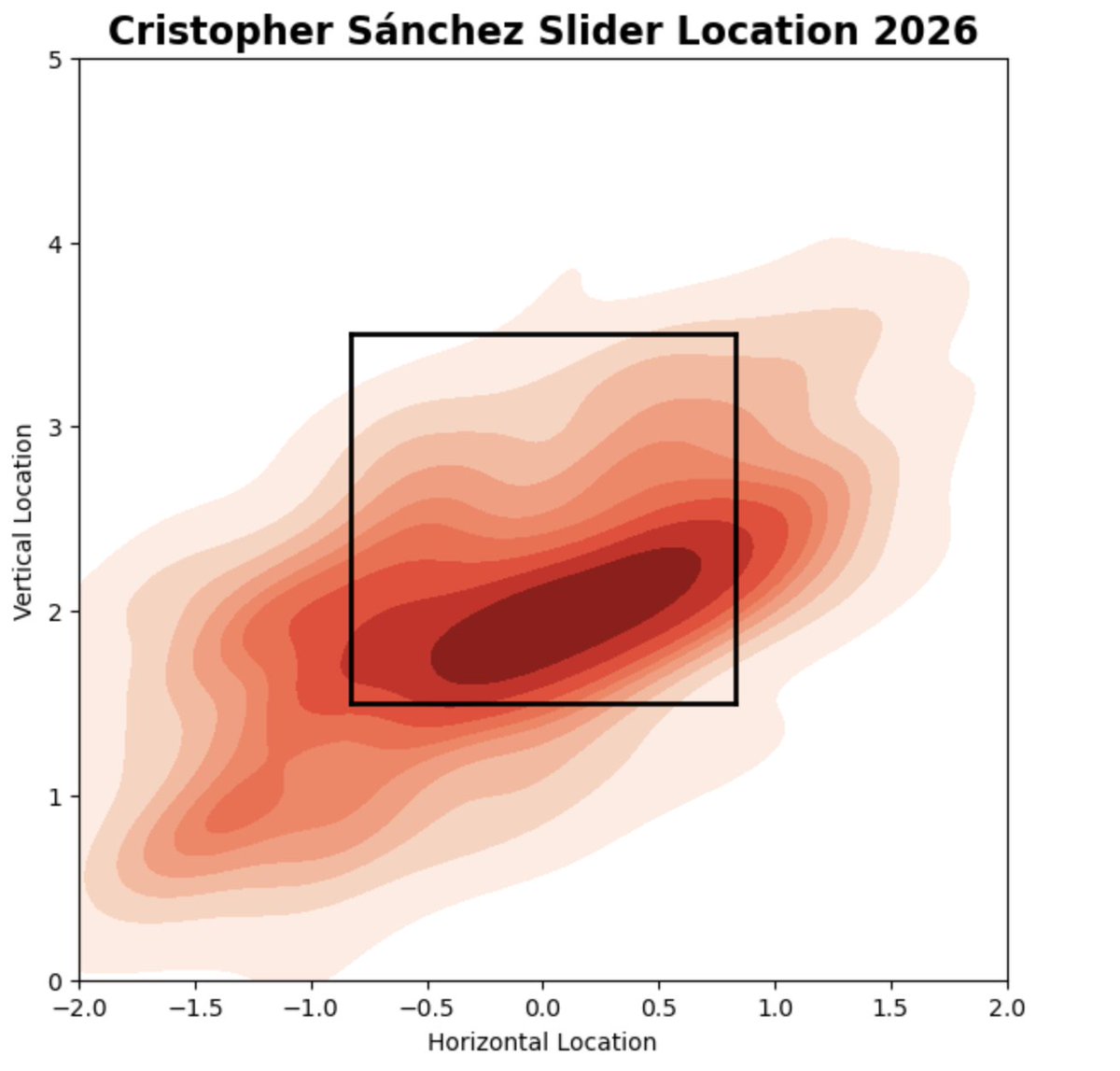
Despite gaining additional movement, Sánchez hasn't simply started burying the slider more often. Instead, he's become more comfortable throwing it around the strike zone, particularly in the lower third, trusting the pitch's improved shape to generate swings and misses.
Cristopher Sánchez's slider has taken a step forward in 2026.
Compared to 2025:
• Whiff%: 33.6% → 39.6% (+6.0%)
• PutAway%: 19.4% → 31.9% (+12.5%)
With Sánchez's slider becoming a much more effective finishing pitch, I wanted to break down some of the changes behind its success. 🧵
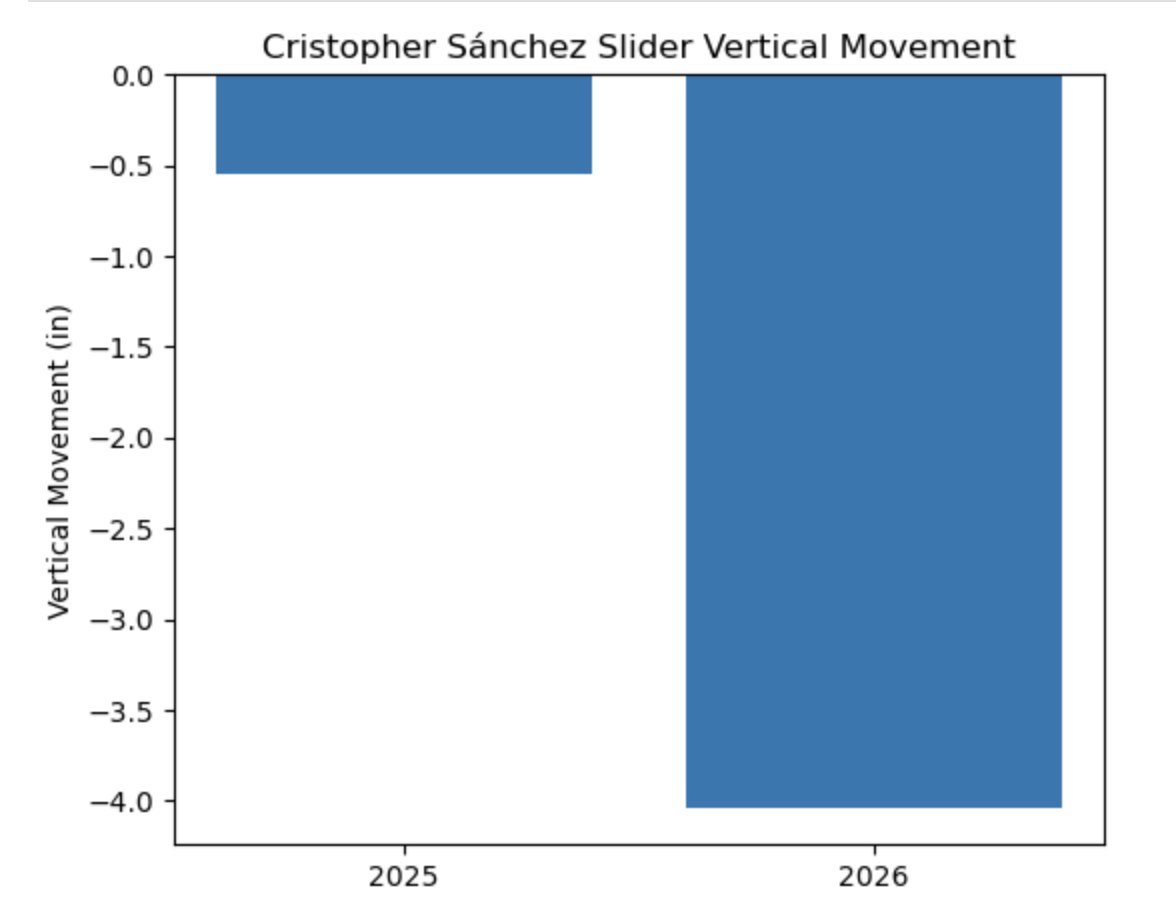
Sánchez's adoption of a spiked slider grip has coincided with noticeable changes in the pitch's movement profile. Compared to 2025, the slider now features more vertical drop and increased arm-side movement, giving it a sharper shape and helping it generate more whiffs and put aways.
One of the biggest changes behind Cristopher Sánchez's improved slider appears to be a new spiked grip.
Instead of applying pressure with the index finger, Sánchez raises (or "spikes") it off the baseball, allowing the middle finger to do more of the work at release.
Pitchers often use this grip to improve feel and consistency while helping create more lateral movement and a cleaner spin profile.
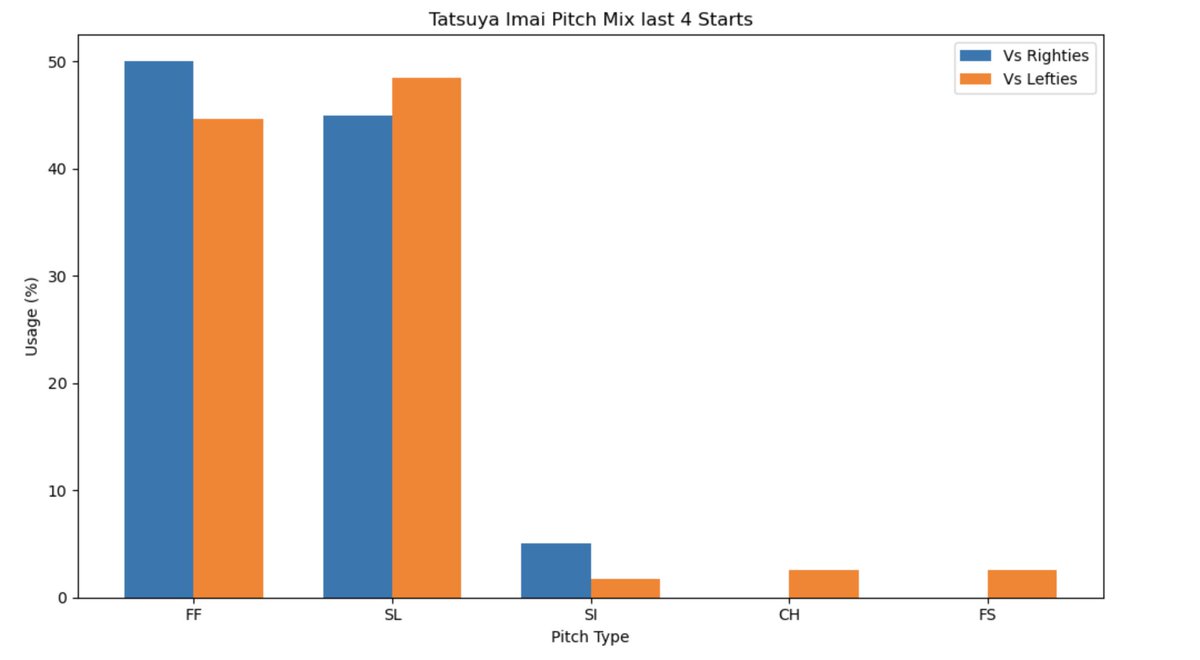
Tatsuya Imai's pitch mix has evolved considerably over his last 4 starts.
Against lefties, sinker usage has fallen from roughly 24% to under 2%, while his four-seam fastball and slider now account for over 90% of his pitches.
Against righties, he's also leaned more heavily on the four-seam while reducing sinker and splitter usage.
What's interesting is that the adjustment has coincided with a drop in hard-hit rate allowed from 53% in his first 4 starts to 44% in his last 4 starts.
Small sample caveat applies, but it appears Imai has simplified his arsenal and is generating weaker contact as a result.
#tatsuyaimai #NPB #ChaseTheFight #pitching #MLB
Quick look at how pitchers adjusted to Munetaka Murakami from April to May.
The biggest change wasn't where they attacked him, it was what they attacked him with.
📉 Fastball usage fell from 46.2% to 42.9%
📈 Breaking ball usage jumped from 35.8% to 42.7%
📉 Offspeed usage dipped from 15.5% to 13.5%
The chase maps tell a similar story. Pitchers continued to target the edges and lower part of the zone while increasingly relying on breaking balls rather than challenging Murakami with fastballs.
Small sample caveat applies, but it appears opponents made a noticeable adjustment in pitch selection throughout May.
#MLB #WhiteSox #MunetakaMurakami #NPB
Fernando Tatis Jr.'s production has taken a massive back in 2026.
I dug into the underlying data to see what changed.
The answer appears to be less about how pitchers are attacking him and more about how he's responding to certain pitch types.
🧵:
Overall, the underlying data paints a more encouraging picture than the traditional numbers alone.
While pitchers have made some minor adjustments to how they're attacking Tatis, the more notable changes have come in his performance. He's producing more whiffs against several breaking-ball types, generating weaker contact on those pitches, and increasing his share of batted balls hit in the Statcast sweet spot range (8°–32°).
It's still early and there are areas that can improve, but the underlying trends suggest there may be more positive regression ahead than his current results indicate.
I looked at Bo Bichette's Statcast data through the same point of the season in 2023, 2025, and 2026.
Two trends stood out:
• Sweet Spot% (balls hit between 8°–32° launch angle) has fallen from ~42% in 2023 to ~34% in 2026.
• His expected wOBA on contact (estimated_woba_using_speedangle) has also declined from roughly .45 to .37.
The data suggests Bo isn't elevating the ball as consistently as he did during his best seasons, and the quality of contact on balls in play has been less productive as a result.
I can see why Blue Jays fans are frustrated with Andrés Giménez.
One of the most aggressive chase maps I've seen in a while. The defense remains elite, but when you're expanding the zone this often it's tough to find offensive consistency.
The contract and glove likely keep him at shortstop long-term, but should Toronto be looking for more infield offense at the deadline?
#bluejays50
Kyle Harrison's pitch shapes have become really interesting in 2026.
His four-seam fastball now combines roughly 15" of vertical break with 13" of arm-side run, giving hitters a fastball that both carries through the zone and moves laterally.
Meanwhile, his slurve moves over 10" glove-side while generating additional drop, creating significant separation from his fastball. Combined with his regained velocity and altered release, hitters are being forced to cover a much wider movement profile than in previous seasons.
No wonder these are his two most used pitches.
This guy is so nasty 😅😅
#thisismycrew