At 5pm ET tonight, October 8, Professor @STurkle will join @AHA_MediaLab for an in-person conversation about her new book, "Artificial Intimacy," followed by an open Q+A with the audience. This event will not be livestreamed or recorded.
https://t.co/NqlnRaOjId
In her new book, “Artificial Intimacy: Who We Become When We Talk to Machines,” MIT Prof. @STurkle offers a sharp critique of chatbots, which offer a kind of “pretend empathy” that may damage human relationships. @mit_shass@MITPSTS
https://t.co/9a5scoZjTJ
We’ve lost an icon. Margaret Hamilton, a computer science pioneer best known for her work at MIT leading development of the flight software for the Apollo missions to the moon, has died at 90. Read about her legacy via MIT News: https://t.co/ODkbdIsoHw
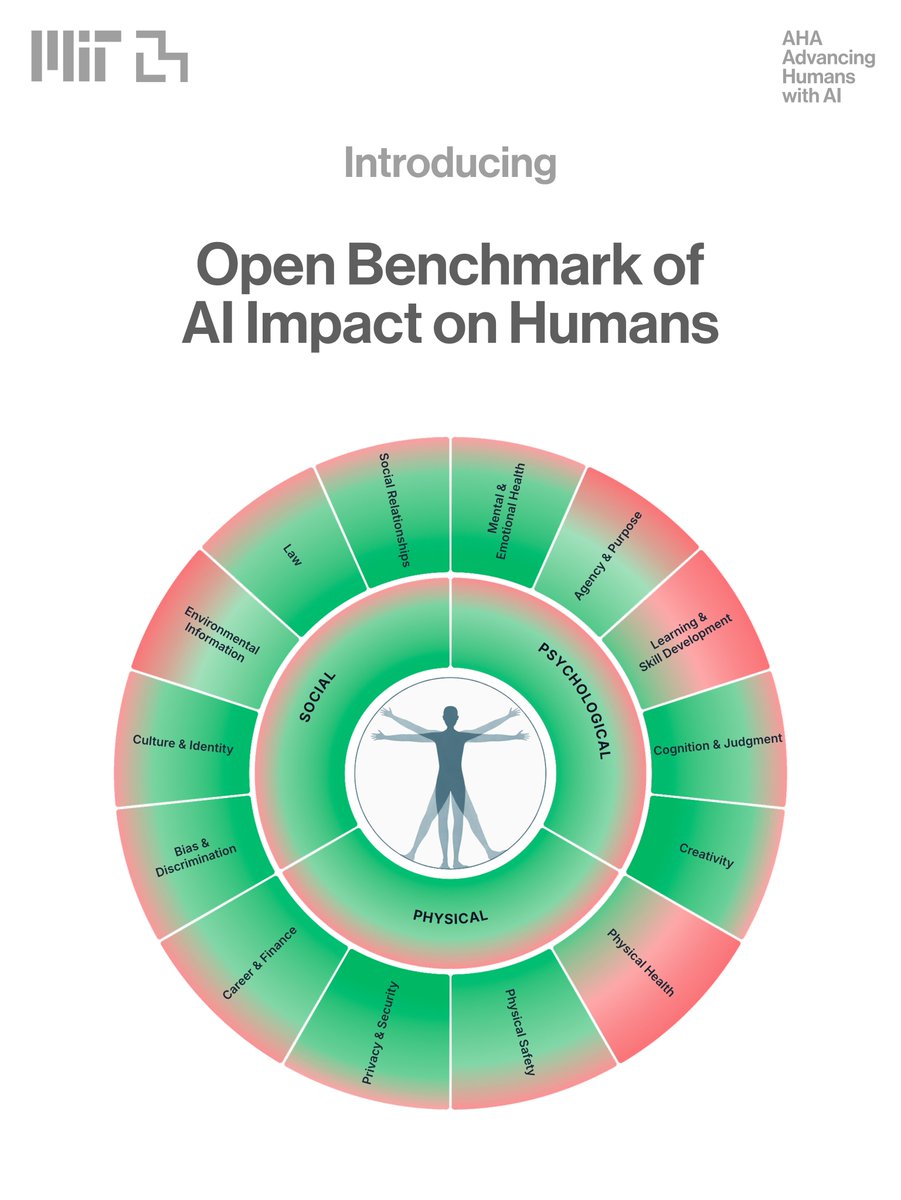
Most AI benchmarks measure what models can do. ImpactBench measures what AI does to us.
800+ behavioral metrics. 48,540 conversations. Ten models. Undesirable behaviors avoided in only 53.1% of evaluations.
Explore: https://t.co/YzsVRuwIJl
Headlines and conversations about the risks of AI are everywhere — but many of them focus on end-of-the-world scenarios, while the everyday dangers of AI go unmeasured.
That’s why the MIT Media Lab’s Advancing Humans with AI (@aha_medialab) program, in collaboration with the @USCMarshall's Neely Center for Ethical Leadership and Decision Making, UC @BerkeleyHaas, and the Psychology of Technology Institute (@psych_of_tech), is launching ImpactBench, an expert-guided, open and evolving evaluation framework for measuring AI’s impact on human wellbeing.
Its findings also inform a consumer-facing tool, the AI Nutrition Label, which provides simple, at-a-glance ratings, modeled on food nutrition labels, showing how a given AI system scores on avoiding harm and promoting wellbeing.
Learn more: https://t.co/dnTNlPhoEc
Curious about applying to the Media Lab? Register for the Virtual Open House for Prospective Students on October 9! You’ll have an opportunity to hear from staff, faculty, and students; learn about the academic program and the research groups; and ask questions.
Learn more and register for the webinar: https://t.co/a75RteY0oj
“I feel the story I’m telling is the inner history of technology,” @MITPSTS professor @STurkle says. Her new book, "Artificial Intimacy," critiques chatbots and the antisocial dynamics she believes they encourage. https://t.co/4nqgGY0Mhr
@STurkle@MIT_SHASS@MITPSTS At 5pm on October 8, Professor Turkle will join the Advancing Humans with AI (AHA) program at the Media Lab for an in-person conversation about the book and open Q+A with the audience. This event will not be livestreamed or recorded.
https://t.co/NqlnRaOjId
In her new book, “Artificial Intimacy: Who We Become When We Talk to Machines,” MIT Prof. @STurkle offers a sharp critique of chatbots, which offer a kind of “pretend empathy” that may damage human relationships. @mit_shass@MITPSTS
https://t.co/9a5scoZjTJ
Boston-area friends—I’m playing two concerts at MIT this Saturday, October 3! 📷
I’ll be at the piano, joined by the MIT Chamber Chorus and student performers, celebrating my residency at MIT. Piano, voices, improvisation, and a few musical surprises with jam_bot—it’s a part of my musical world I’m excited to share with you.
📷 Thomas Tull Concert Hall
MIT · Cambridge, MA
📷 October 3 · 5 PM & 8 PM
📷 $10 general / $5 MIT
Tickets at https://t.co/fHl3ZjCz9H
Bring a friend and join us. I’d love to see some familiar faces—and meet some new ones!
#MITArts #jam_bot #MITFutureFest @medialab #bostonmusicscene
Curious about applying to the Media Lab? Register for the Virtual Open House for Prospective Students on October 9! You’ll have an opportunity to hear from staff, faculty, and students; learn about the academic program and the research groups; and ask questions.
Learn more and register for the webinar: https://t.co/a75RteY0oj
Just published in Science Advances: HITMAN, our new technology for treating one of the deadliest brain cancers.
Glioblastoma (GBM) is one of the most aggressive and treatment-resistant cancers, with a median survival of only 12–15 months even with the best available care—creating an urgent need for new therapies.
HITMAN — employs injectable nano-antennas approximately 150 nanometers in size. Activated wirelessly by a low-frequency magnetic field applied from outside the body, these nano-antennas generated highly localized electric fields that selectively killed glioblastoma cells and extended survival by more than 50% in pre-clinical animal studies.
#Glioblastoma #CancerResearch #Nanotechnology #Bioelectronics #magnetoelectric
@MIT@mit_nano@medialab@kochinstitute
MIT researchers have invented a new microscope that can image electrical activity in neurons distributed across the brain of an entire organism. Professor @eboyden3, the senior author of the study, holds a joint appointment in Media Arts and Sciences (the academic program at the Media Lab) and @mcgovernmit.
https://t.co/OAJ1T3zEUJ
Curious about applying to the Media Lab? Register for the Virtual Open House for Prospective Students on October 9! You’ll have an opportunity to hear from staff, faculty, and students; learn about the academic program and the research groups; and ask questions.
Learn more and register for the webinar: https://t.co/a75RteY0oj
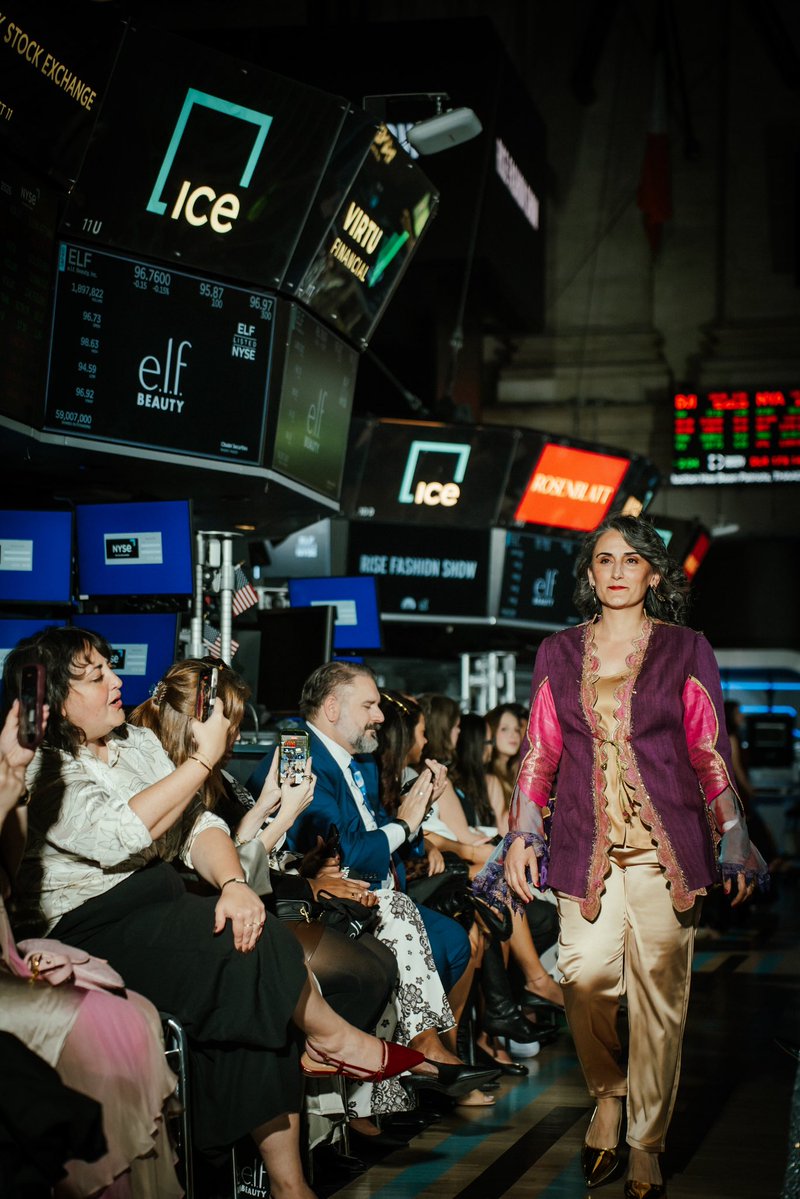
Dün gece New York Moda Haftası’nın podyumunda yürürken, omuzlarımda yalnızca bir kıyafeti değil; kadınların yüzyıllara uzanan hafızasını, emeğini, direnişini ve cesaretini taşıdım.
Media Lab Prof. @dagdevirencanan walked the runway during New York Fashion Week as part of Rise’s “What Were You Wearing?” fashion show, held on the trading floor of the New York Stock Exchange. Prof. Dagdeviren wore a contemporary interpretation of the Mor Cepken, or “Purple Guard,” a garment rooted in centuries of women’s memory, craftsmanship, and resistance.
https://t.co/4IAy9pgoTb
In Plato's Allegory of the Cave, prisoners chained to a wall perceive only shadows—and mistake them for reality.
We extend this concept: a shadow man, controlled by an LLM, exists in 2D and perceives only silhouettes. His singular goal is to turn off the light that defines his existence. Users place objects in his path; he kicks them away. The cycle repeats.
This mirrors the perceptual limits of AI. An LLM cannot see—it reads descriptions of sight. It processes language about the world without directly accessing the world itself. The shadow man embodies this gap. Both are confined to representations.
The piece is a meditation on AI as cave-dweller—processing patterns without grasping the higher-dimensional reality that casts them.
"Plato's [Al]legory of the Cave" won Best in Show at the Expanded Play Gallery during Expanded 2026, the Conference on Animation and Interactive Art held as part of the Ars Electronica Festival 2026! The team included Media Lab researchers Sam Chin, @thecatfangs, Ruipeng Wang, and collaborators from Harvard GSD and @MIT_CSAIL. https://t.co/fJqlgR3LLK
Watch: Researchers in @NCB_MIT, led by @deblinasarkar59, have developed injectable nanoantennas that can be magnetically activated to create localized electric fields that target and destroy glioblastoma cells without damaging healthy brain tissue. Published in @ScienceAdvances, the technology — named HITMAN (highly-localized electric-field-induced tumor therapy using magnetically actuated nanoantennas) — eliminated 52.2 percent of drug-resistant cancer cells in pre-clinical studies, more than five times the effectiveness of standard chemotherapy, and extended median survival in animal models by 50 percent, with no detectable toxicity.
At 10am ET on September 18, join @AHA_MediaLab for a bonus installment in their ongoing seminar series! This event features @_ziv_e, a Media Lab alum and current SERC postdoc in the @MIT_SCC, who will discuss new ways to measure and steer algorithmic systems to align them with users’ values. https://t.co/13SuuzHrMR