Everyone's Chasing REM This Week. Don't.
New study: more REM sleep, lower rates of 83 diseases. Now everyone's checking their REM score.
That's the streetlight. The keys are in the full night of sleep around it.
You can't force REM. You can protect it.https://t.co/Sz2rFZyv5I
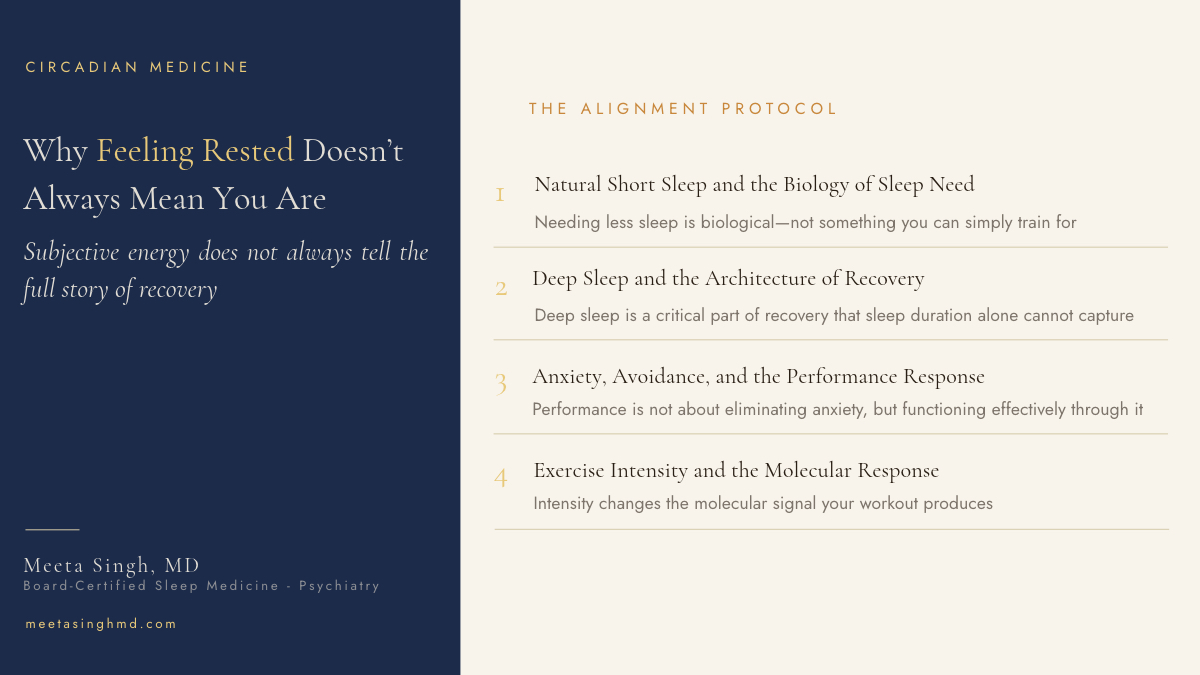
From sleep architecture to exercise intensity, this week’s research highlights a common theme: individual biology matters.
Sleep needs differ. Recovery depends on sleep quality. Anxiety can influence performance. And training can evolve as the body changes.
The goal is not to do more—it is to adapt more intelligently.
Subscribe to The Nocturne at https://t.co/QW8iYKHbry
#PerformanceSleep #CognitivePerformance #SleepScience
How Much Sleep Keeps You Young? Half a Million People Just Answered.
1817: a mill owner guesses eight hours.
1990s: NIH gives people unlimited darkness. They settle at eight.
2026: half a million people. Youngest bodies sleep 6.5 to 8.
https://t.co/cihRLi646y
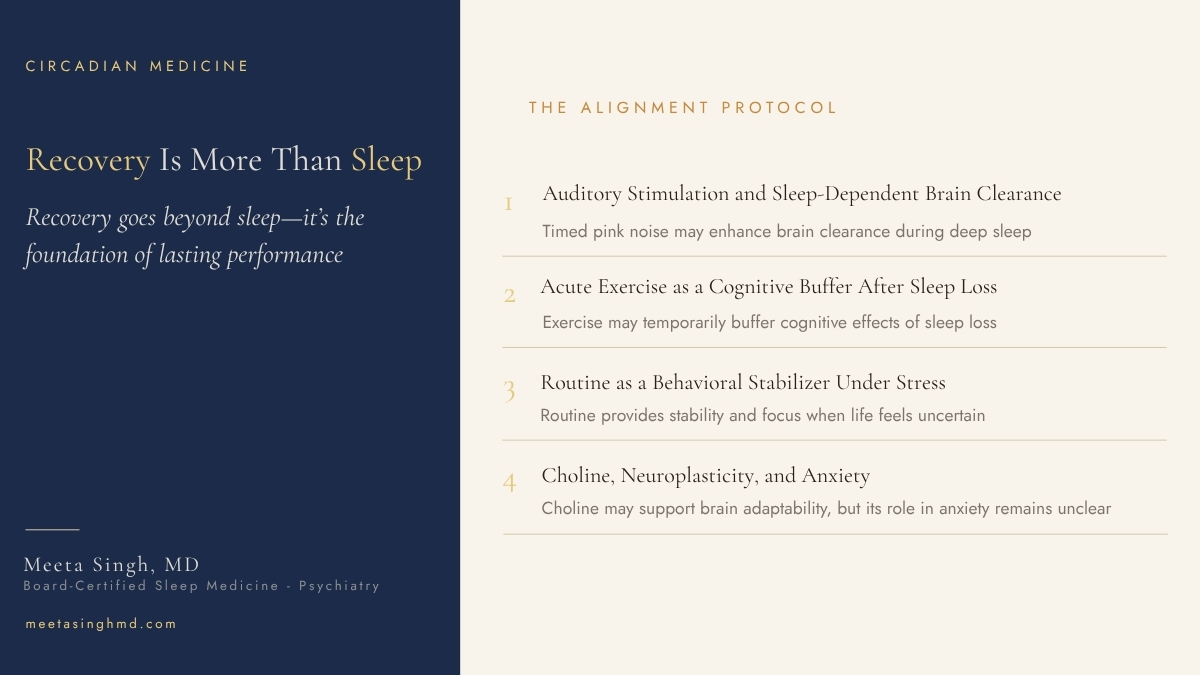
Recovery and performance are built through consistency—how we sleep, when we eat, how we train, and how we challenge the brain all matter.
Subscribe to The Nocturne at https://t.co/5haOGGw1tW
#PerformanceSleep#CognitivePerformance#SleepScience
Brain health is shaped by what we do consistently. Sleep, movement, nutrition, and routine all contribute to resilience and long-term performance.
Subscribe to The Nocturne at https://t.co/5haOGGw1tW
#PerformanceSleep#CognitivePerformance#SleepScience
Hard to say who wins that game. Easier to say what doesn't change: whichever team does the 24-hour turnaround shows up sleep deprived, and sleep deprivation shows up on the field as sloppy football, missed assignments, slower reactions, worse decisions late in games. Swap the strategies and the 49ers inherit that, not the Rams. I won't guess the score. I'll guess the tape looks rough.
Offf sorry for the long response
Both teams are actually home for their next games, so this isn't back-to-back travel — just one round trip each.
The Rams' issue was never jet lag. They stayed on Pacific time the whole trip, so there's nothing to re-adjust on return. What they're carrying is sleep debt and normal game-day wear, from two long flights bracketing a physical game. That kind of fatigue clears faster than a shifted body clock, especially with eleven days at home. The real thing worth watching is illness and minor injury risk — two long-haul flights in one week is a real strain on the immune system, even without a jet lag problem attached.
The 49ers had a full week to adjust to Melbourne time, so coming home is a genuine second jet lag event for them. But it's the easier direction, snapping back to a schedule their bodies already know, and ten days is plenty of room for it.
So: Rams' story next week is fatigue and injury risk, not circadian science. 49ers' story is an easy re-adjustment. Neither is uncharted, exactly. What's actually new is a team doing the fast in-and-out with no travel buffer before the next kickoff — that's the part worth watching Monday night.
The @nflrams didn't lose to jet lag. Not exactly.
The kickoff time argument was sound. 10:35am in Melbourne lines up with early evening on the West Coast body clock, right in the window players usually perform best.
But a 72-hour round trip left almost no time to recover from the travel itself. Travel fatigue and jet lag are not the same problem. One is disrupted sleep, dehydration, and immobility. The other is a misaligned body clock. The consensus statement I co-authored on managing both in athletes is clear: the first three days after long-haul travel are when performance takes the biggest hit, independent of time zones.
This also keeps getting reported as a 17-hour time difference. Circadian rhythms don't work that way. The body shifts in whichever direction is shorter, and here that's a 7-hour delay, not a 17-hour advance. Still hard in three days. Just not as hard as the headlines made it sound.
I said it plainly to Yahoo Sports last week: if you're exhausted or sleep-deprived, your performance slips. That's the worst-case scenario.
Final: @49ers 27, Rams 7.
If the Rams had won, this plan would be called visionary. They didn't, so it's called reckless. Neither reaction is really about the science. Good sleep science doesn't bend to the scoreboard.
Quoted this week in:
Yahoo Sports (Jeff Eisenberg): https://t.co/5YPZpKcise
The Dan Patrick Show / NBC Sports: https://t.co/ml16fjVZFJ
The Washington Post: https://t.co/YcYLYEYtcS
The Atlantic, "The Los Angeles Rams Are Trying to Defeat Time": https://t.co/Hhlt1EJFP0
Also: Fox Sports Australia (https://t.co/r1KKlHHXLB) and Yahoo Sports AM (https://t.co/uhvgX0MttT)
Two theories, one football game.
Circadian timing says your body performs best when your internal clock thinks it's evening, regardless of the actual time on the wall.
Sleep debt says none of that matters if you haven't slept enough to begin with.
The Rams bet on timing. The 49ers protected sleep and managed jet lag
Final: 49ers 27, Rams 7.
One game doesn't settle the science. But it's a clean real-world test of an idea worth taking seriously: for elite performance, hours of sleep may beat hours of sunlight.
@dpshow Five years ago, 26 of us wrote the consensus on how athletes should manage jet lag. This week two NFL teams ran the experiment for us.
https://t.co/bmgsCSvOfK
Kickoff is 10:35am Friday in Melbourne, which works out to 5:35pm Thursday on the Rams' body clocks. That's actually a pretty good hour to play. Reaction time, strength, and coordination all peak in the late afternoon, so an unadjusted team is kicking off close to its natural best. The catch is the night before. Melbourne bedtime is 5 or 6am back home, right in the middle of the circadian night, and they'll be trying to sleep through it after 16 hours on a plane. So the Rams get a great kickoff hour and a lousy night ahead of it. The 49ers have a different problem. Eight days isn't enough to shift 17 time zones, so they're somewhere in the middle of adjusting, and the body doesn't move as one piece. Sleep shifts first, body temperature and hormones drag behind, and digestion is last. You can have a guy sleeping on Melbourne time while his cortisol is still somewhere over the Pacific, and that in-between state is often what feels worst. Even so, I'd rather be half-adjusted with a week of real nights in a bed than not adjusted at all with one bad night on a plane. The Niners' risk is a fog they've been living with for days. The Rams' risk is sharper, and it lands on game day. And whoever wins on Friday will have proven their sleep plan was genius, and science will get asked to explain why the other one was doomed all along.😎
Fair point, and I think that's exactly the bet the Rams are making. Two things I'd push on. First, you can't really stay on home time in a place that's 17 hours off. Daylight, meals, and a game at 10:35am local are all pulling the clock whether you want them to or not, so you end up partly shifted, which can be the worst of both. Second, my bigger worry was never week 2. It's the night before the game, when they're trying to sleep at what feels like 5am after a 16 hour flight. On week 2 I actually agree with you. Ten days is plenty, and coming home westward is the easier direction anyway. So it's a real tradeoff, but I think it's one game of risk versus a smaller one, not two equal ones.
Performance is more than what happens on the scoreboard. It’s the result of quality sleep, proper nutrition, movement, recovery, consistent routines, and strong life skills. Sustainable performance starts with the basics.
Subscribe to The Nocturne at https://t.co/QW8iYKHbry #SleepScience #PerformanceSleep #BrainHealth
Meditation Is a Skill. Sleep Isn't. That's Why It Can Keep You Awake.
For an anxious brain, staying busy isn't avoidance. It's management. Meditation asks you to put it down, and what's left is the raw feed. That's why it wires some people instead of calming them.
Meditation is a skill. Sleep isn't.
The morning paragraph is the one to check against your own clinical experience, since I wrote it from your description rather than from data.
https://t.co/EZRj3KnaXX
"I can't fall asleep without a podcast." Or the TV on a timer. Or the same episode for the fortieth time.
Two-thirds of adults do this. It works.
A familiar voice gives your brain a job besides watching itself not sleep.
Keep it.
https://t.co/4LCJjW5s0b
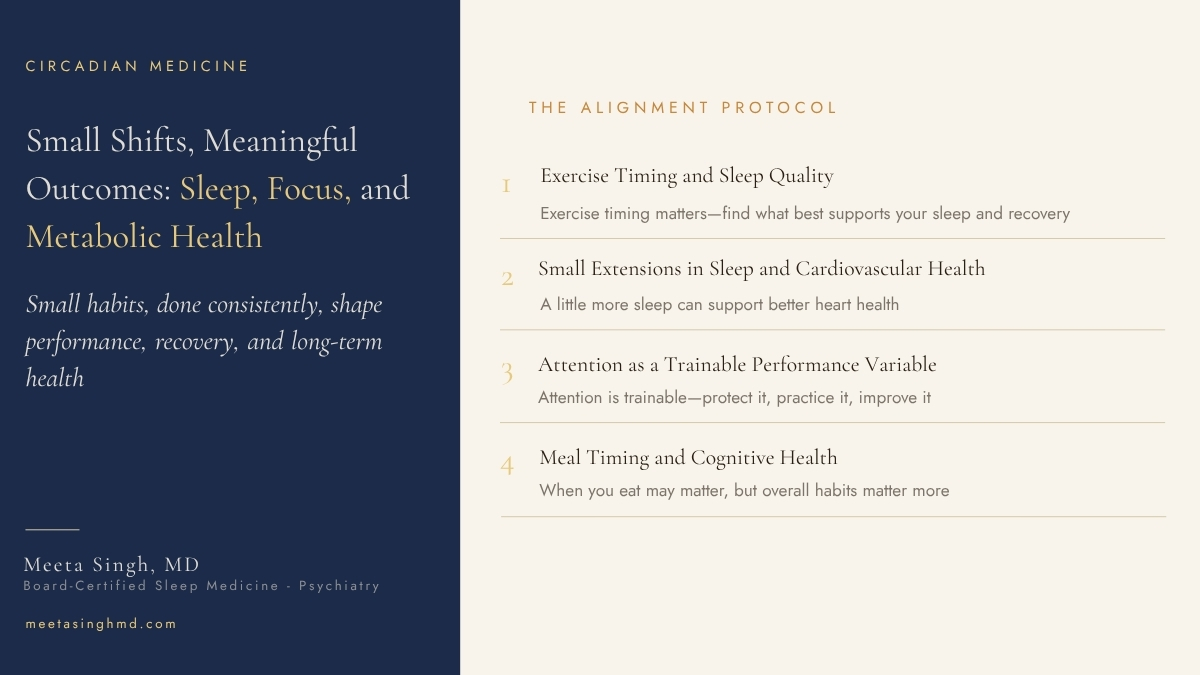
Your brain doesn’t run on one habit—it runs on the whole system.
Sleep, movement, meal timing, metabolic health, and attention all work together to shape how we think, perform, recover, and feel.
The goal isn’t perfection. It’s building daily habits that support your brain for the long run.
Subscribe to The Nocturne at https://t.co/QW8iYKGDC0 #SleepScience #PerformanceSleep #BrainHealth
The Blue Light Theory Finally Got Tested. It Mostly Failed.
722 adults, hour before bed, tested layer by layer.
Device: nothing.
Content: almost nothing.
Habits: tripled the model.
Staying in bed. Not stopping when you meant to. 73% of us don't.
It was never the device.
https://t.co/kRRXv8AVv0
The evidence continues to point toward an integrated model of performance—where sleep, metabolic health, exercise, cognition, and environment influence long-term function.
Subscribe to The Nocturne at https://t.co/5haOGGw1tW #PerformanceSleep#CognitivePerformance#SleepScience
Half of Us Lose the Same Hour Every Night
"I meant to be asleep by eleven. I looked up and it was one."
Two people in that sentence. One made the plan in the afternoon. One was asked to keep it at 10:40.
52% of us struggle here. Not weakness.
Part 1 of 3.https://t.co/BhxW2N0czm