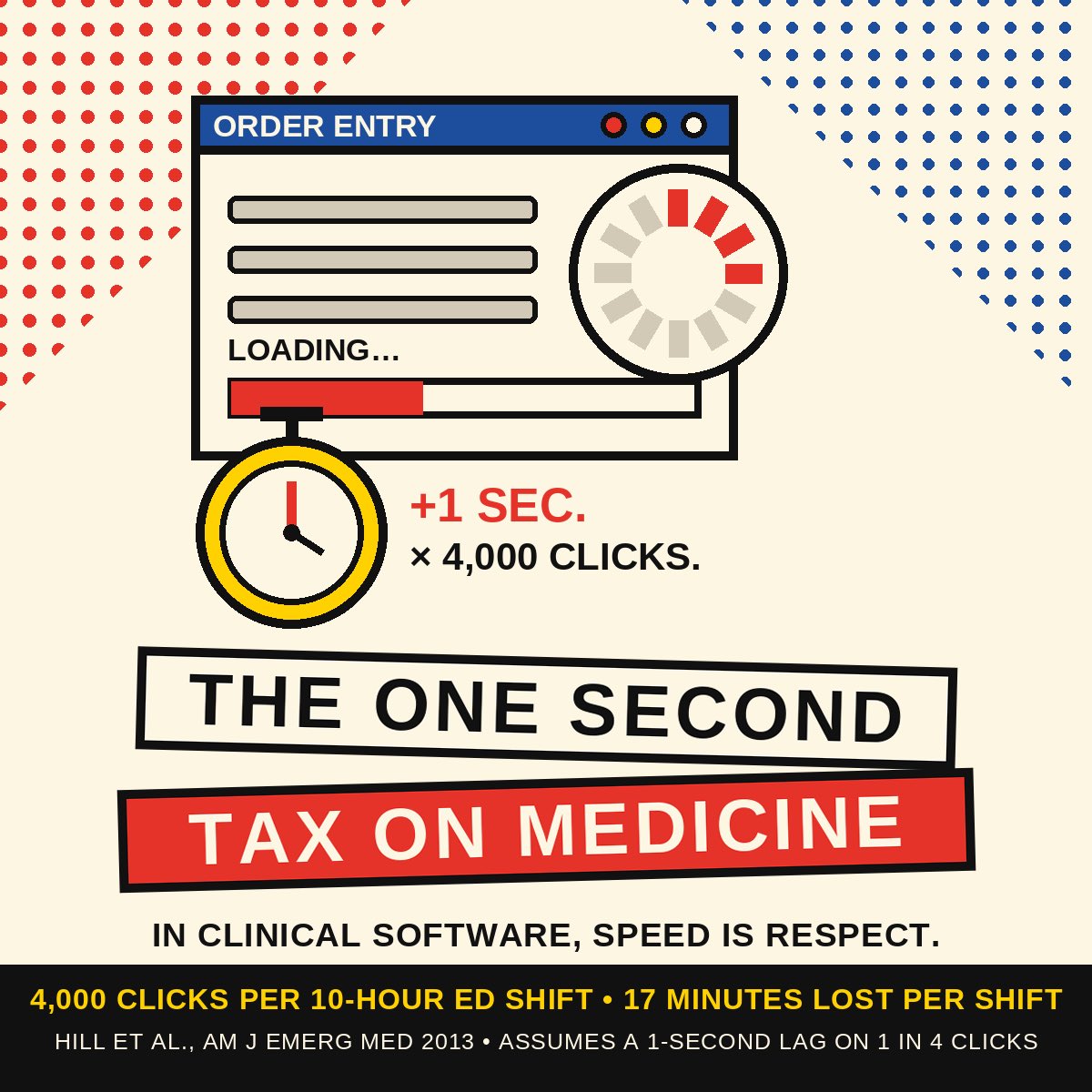
There is a tax on American medicine that appears in no budget. It is one second long.
Click delay.
The pause between a physician’s action and the EHR’s response. Order entry that takes two seconds to open. Pull-down fields that hesitate. And worse: one major EHR I work in daily freezes for five to ten seconds, sometimes longer, when I expand a diagnosis list. Not occasionally. Routinely. No exaggeration.
Do the arithmetic with me, because nobody ever does.
The classic time-motion study of community ED physicians counted roughly 4,000 clicks per 10-hour shift. Now assign a delay to some fraction of those interactions. Suppose only a quarter of them carry a one-second lag, a conservative figure for anyone who has used these systems. That is 1,000 seconds. Seventeen minutes per shift, per physician, spent watching a screen think. Across a five-physician ED, an hour and a half of clinical attention daily. Across a thousand US emergency departments, thousands of physician-hours every day. Millions annually. Paid to no one, for nothing.
And the seconds are the smaller cost. Every freeze is an interruption, and emergency medicine has an entire literature on what interruptions do to clinical reasoning. The delay does not just steal the second. It breaks the thought that was in progress at 2 AM on patient seventeen.
Here is the analogy I keep returning to. Imagine McDonalds ran its kitchens this way: food cooked only after each customer arrives, never prepared for the lunch rush everyone knows is coming. Asked why, they explain that anticipating demand would require both technical skill and an understanding of their customers. We would call that organization broken. Every EHR that generates a summary only when clicked, loads a screen only when opened, and computes nothing in advance is running exactly that kitchen. Anticipation is not exotic. Consumer software has prefetched and prepopulated for decades. Your phone does it a hundred times a day.
The reason this persists is not technical difficulty. A one-second interaction delay is an afternoon of engineering. It persists because the physician’s time is the one resource in the transaction that the vendor does not pay for. Latency is free to everyone except the person practicing medicine and the patient waiting behind them.
Speed is not a convenience feature. In clinical software, speed is respect. And the bill for its absence arrives every single shift, unitemized.
BTS will not submit music for consideration at next year’s Grammy Awards, members of the K-pop supergroup announced, a little over a month after the Recording Academy confirmed that the 2027 ceremony will include an Asian pop music performance category for the first time. https://t.co/XMBE6NjpOi
BTS will not submit music for consideration at next year’s Grammy Awards, members of the K-pop supergroup announced, a little over a month after the Recording Academy confirmed that the 2027 ceremony will include an Asian pop music performance category for the first time. https://t.co/XMBE6NjpOi
I'm a cardiologist. I've spent twenty years inside American healthcare, and I'll say the quiet part first: the system is indefensible.
We spend roughly 18% of GDP on health care — the highest on earth — and have a lower life expectancy than countries spending half as much. Medical bills are a leading cause of bankruptcy. I have patients rationing insulin. I fight prior authorizations for medications that prevent heart attacks and imaging that finds cancer early.
Anyone defending the status quo isn't practicing medicine. They're profiting from it.
So why am I not for #MedicareForAll ?
Because I've watched what government-run health care actually does — from inside the exam room.
Denial doesn't disappear. It changes uniforms. Insurers deny by prior authorization. Single-payer systems deny by waiting list. Canada's median wait from referral to treatment has run over 25 weeks. The UK's NHS backlog has hovered around 7 million. When you eliminate the price signal, you don't eliminate rationing — you just move it from a claims department to a queue, and queues are invisible. Nobody sues a waiting list.
Medicare rates don't cover the cost of care. Hospitals lose money on Medicare and Medicaid and make it back on private insurance. Extend Medicare rates to everyone and that cross-subsidy vanishes overnight. Rural hospitals go first. Independent practices consolidate into hospital systems. The physicians I know would retire early, and the smartest students would go elsewhere. You can legislate coverage. You cannot legislate a doctor into existing.
The fraud problem is already staggering. HHS loses an estimated $100 billion a year. Investigators found a hotel in Los Angeles where every room was a registered hospice with zero patients — just addresses billing Medicaid. If we can't police the programs we have, scaling to the entire country isn't reform. It's a bigger target.
And the innovation math is real. Just this month: the first oral PCSK9 inhibitor approved, five Lp(a) drugs in late-stage trials, engineered immune cells that clear arterial inflammation. Americans overpay for drugs, and that overpayment subsidizes global R&D. Crush prices to European levels and something has to give. I'd rather fix the pricing abuse than gamble the pipeline.
What I'd actually do, and none of it requires a $30 trillion bet:
Real price transparency, enforced — you can't have a market where nobody sees prices.
Break the employer link so insurance is portable and you don't lose coverage with your job.
Expand HSAs and direct primary care — my colleagues doing it spend more time with patients and charge less.
Break the PBM middlemen inflating drug costs.
Site-neutral payments so a hospital can't charge triple for the same test.
AI-driven fraud auditing — flag every provider billing 10 standard deviations above peers and audit them.
Universal catastrophic coverage so nobody goes bankrupt from cancer.
Now the honest counterpoint, because you deserve it: the strongest case for single-payer is administrative. Private insurers run 15-25% overhead. Traditional Medicare runs 2-3%. Most published economic analyses do project net savings. And every peer nation with universal coverage spends dramatically less than we do. Those aren't talking points — they're real findings that my side has to answer.
I just don't believe the answer to a bureaucracy that denies your care is a bigger bureaucracy that can't be sued.
Fix the prices. Fix the fraud. Cover the catastrophes.
Don't hand the whole thing to the same people who couldn't notice 29 hospices in one hotel.
Under Medicare physicians are getting a pay cut on the conversion factor and on EM charges that are done in conjunction with a procedure.
This is done for 2 important reasons:
1. This tells the public that physicians are the drivers of
high healthcare costs and our pay must be docked to
make sure that patients can afford their care.
2. These cuts will force many of the 12-20% of independent physicians to become employed, many by hospitals.
The reality is that physician salaries are 6% of healthcare costs and that hospitals are the largest source of costs and are increasing faster than all other costs.
These actions will lead to higher costs, worse outcomes and more unfounded blame for physicians.
The only answer is for physicians to just say no to Medicare and insurance.
Cash paid physicians are cheaper and provide better care.
This is the only way we get to control the narrative and once again serve our patients.
@kksheld@HeathVeuleman@DutchRojas@SurgeryCenterOK@noahkaufmanmd@AtlasMD@Steelmanmedical@docshanep@DrOzCMS
CMS just dropped the CY 2027 Physician Fee Schedule proposed rule. At 1,592 pages, it is one of the most consequential rulemakings in years for independent physician practices, and almost none of the headlines are capturing what is actually at stake.
The long and short of it is that Congress let the 2.5% conversion factor fix expire, so non-APM physicians are looking at a -1.68% cut on January 1. That alone would hurt. Buried in this rule are structural changes that compound the damage in ways that will outlast any year-end patch.
This week I am walking through what matters most for independent practices:
Tuesday: The conversion factor cut and what Congress has to do about it before year-end.
Wednesday: The proposal to slash payment 50% when you bill an E/M and a procedure on the same day, and why we beat this back in 2019 and can do it again. Plus, the new JAMA data showing how much uncompensated post-op work physicians are already doing that CMS is not counting.
Thursday: The two biggest structural threats buried deeper in the rule. A complete overhaul of how practice expense RVUs are calculated, and a comment solicitation that could let CMS define "employed" vs. "independent" in ways that devastate facility-based independent practices in 2028.
Friday: Fix It Friday. Specific comment asks and legislative actions with real deadlines.
Comment deadline: September 14, 2026. You have eight weeks. Let's make them count.
WATCH: Metro Detroit teens are reportedly making the trip to Grand Rapids for late-night burnout meetups with “Michigan Street Team.”
New videos show late-night takeover-style meetups this past weekend, with drivers performing donuts as crowds ring the vehicles. Similar events across the summer have continued to draw attention from local police, who define street takeovers as illegal gatherings involving burnouts, donuts, and blocked intersections.
What happened to my bank account? Absolutely nothing.
You believed a lie.
You believed a lie that was told to you by your political class, and your news media, to keep you from asking uncomfortable questions about how much you are paying in tax, where that money is going, and what quality of care you actually receive for the portion of it they didn't steal.
Don't believe me? Look at the pictures.
Look.
At.
Them.
That's my wife, @acrobatichobbit. Before and after.
That's a five centimeter mass. Stage 4 metastatic melanoma. The worst kind of cancer, the most vicious form of assassin your own body can betray you with. That bright area? Blood.
Ten years ago, anywhere in the world, the scan on the left is a death sentence... an endless gauntlet of painful surgeries, followed by chemotherapy, hair loss, uncontrolled vomiting, wasting away to nothing, death.
In America, today, it's not.
We have things here. Genetic therapies. Tailored viruses that attack tumor cells. Drugs that highlight cancers for your immune system, drag them kicking and screaming into the spotlight to be killed.
I won't tell you about her exact course of treatment, because that's none of your goddamned business, but I will tell you that it cost American drug companies and medical researchers a fortune to discover.
A fortune that your nation cannot afford because you chose socialism instead of progress. And socialism, however fine-sounding in theory, simply does not work.
Were she and I British, living in Britain, relying on the National Health Service, I would be a widower now.
Did saving her cost a ruinous amount of money?
Yes. This technology was expensive to create, and the people who did so deserve to pay their mortgages and feed their kids. So do the oncologists and surgeons.
Many of the men who cared for her were old men, experienced men, long past retirement age, still working because when your profession is clawing souls back from the void, sitting on a beach with a pina colada instead just doesn't hit the same.
They deserve every cent.
Did saving her cost a ruinous amount of money?
Yes.
Did I pay it?
No.
Because believe it or not, when things are ruinously expensive, but vitally necessary, we here in America come up with ways to deal with that.
Ways that don't involve creating a big pot of money and entrusting it to corrupt slimeballs.
We have insurance. And sometimes insurance isn't cheap, but the bite it takes is a hell of a lot less of what we have than the tax man takes from you.
And insurance companies sometimes have to make hard decisions about which spending choices will save the most people. I know about this in detail, because that is my wife's profession. She creates the mathematical models that pay for all this stuff.
The insurance that saved her is the exact same plan that she provides to others.
And at the end of an awful year and a half of treatment, awful because cancer medicines make you far sicker than the cancer itself...
We were left whole.
Battered and wounded in spirit, but financially whole, at least.
The only loss we took was the blow to my career as a novelist, because it turns out you can't write stories while your wife is dying, and you don't automatically recover that ability afterwards. Not right away.
I wondered every day if she was going to live or die. I wondered every day what the hell I was going to with myself without her.
But I never wondered, not for a moment, how the hell we were going to pay for all this.
Your government doesn't solve the problem. It is the problem.
They lie to you.
Nightly walk through Ann Arbor and a quick visit to the stadium of the University of Michigan. This is the biggest stadium in the US and the third largest in the whole world (107,601 capacity)🤯
Finding your residency buds on Google & leaving them a 5⭐️ review is a pretty great way to make their day. Especially 20+ years out from training. Thanks Leo ❤️
𝗡𝗲𝘄 𝗦𝘂𝗿𝗴𝗲𝗼𝗻 𝗚𝗲𝗻𝗲𝗿𝗮𝗹 𝗡𝗼𝗺𝗶𝗻𝗲𝗲 𝗶𝘀 𝗮𝗻 𝗜𝗠𝗚:
Dr Nicole Saphier has been nominated as the next U.S. Surgeon General, and this marks a return to credentialed, clinically trained medical leadership.
Board-certified radiologist.
Completed U.S. residency and fellowship.
Director of Breast Imaging at Memorial Sloan Kettering Cancer Center.
And yes, she is also an IMG, having graduated from Ross University School of Medicine.
A reminder that IMGs are not “less qualified”, many follow the exact same rigorous U.S. training pathway and go on to lead at top institutions.
Her nomination comes after Casey Means’s bid faced scrutiny over not completing residency and lacking an active medical license, along with controversial public health views.
This isn’t about politics.
This is about credibility.
The Surgeon General is not just a spokesperson, it’s the face of American public health.
Training matters. Experience matters. Accountability matters.
#NicoleSaphier #SurgeonGeneral
Dr. Nicole Saphier is a fantastic choice for Surgeon General! I loved meeting Dr. Koop as a med student, he had such a heart for students & babies!👶 Congratulations @NBSaphierMD
One way Surgery Center of Oklahoma keeps our costs down? Reducing administrative bloat.
Instead of layers of executives and bureaucracy, our founders, Dr. Keith Smith and Dr. Steven Lantier, still work regular shifts in the operating room. That physician-led structure keeps decision-making close to patient care and eliminates many of the overhead costs that drive hospital prices higher.
More focus on medicine. Less spent on administration. Surgery Center of Oklahoma.