Don't let them pull the wool over your eyes.
This is just more borrowing, which means more debt, and more interest payments.
Labour can't be trusted with the economy or the public finances, because they don't understand either.
What else have we learned from the debt data today?
1. Despite a forecast surplus from the @OBR_UK because of self-assessment tax receipts, the government spent £1.8 billion more in July 2026 than it received in taxes and other income.
2. Borrowing is outstripping official government forecasts by £2.3bn in the financial year to July.
3. Borrowing was 68% higher than this time last year, despite an increase in tax receipts as well, because of rising spending on benefits and debt interest.
4. The debt-GDP ratio was last seen at these levels in the 1960s, when we were still unwinding from WW2.
We all knew Labour would borrow more, despite their denials at the election. Their plans involve borrowing £250 billion more than the plans they inherited from the Conservatives, and today’s figures show they’re borrowing even faster than that.
The fact is they do not have control of the public finances, and its families and businesses who are left to pick up the tab.
Only @Conservatives have a radical, credible plan to get spending down by £50bn, and have a Golden Economic Rule to use the majority of those savings to close the deficit and get the debt down.
BREAKING: ONS confirms UK national debt is now almost £3 trillion!
We spend more just on the interest than we do on defence, police, and prisons combined.
But Labour will just keep tapping the nation's credit card, even with the bailiffs at the door.
Banning diesel HGV's will push costs up and the bill will inevitably land in the laps of working people.
The Conservatives would scrap it to ease the cost of living.
Would Labour?
Labour’s ideological plan to ban diesel HGVs will drive up transport costs by 19% for every hauliers
These hauliers are often operating on 1%-2% margins, so the cost will be passed to families at the checkout 🚛🛒
Conservatives will scrap the diesel HGV phase-out, save taxpayers £877 million and back a multi-fuel future for British haulage. Battery where it makes sense, alternative fuel where it makes sense & diesel where it makes sense
Businesses, not Whitehall, should decide what trucks work for them
Via @ClaireEllicott1 & @DailyMailUK
https://t.co/9ePIsVkXZE
We could save families the equivalent of £540 a year on energy bills.
@ClaireCoutinho and @ukonward have done some fantastic analysis on the absurd costs in our energy system - and how we can make electricity cheap.
The cost of living is at the forefront of everyone's minds and many people in the UK open their energy bills with a knot in their stomach. It doesn’t need to be that way.
The Government's answer has been temporary sticking plasters, like taking VAT off bills (worth £4 a month) or moving the cost of renewables off bills and onto the taxpayer for three years.
But the actual electricity doesn’t get any cheaper. You just end up paying some other way through higher taxes
What the new analysis exposes is the hidden costs of renewable energy generation. Take the transmission network for example. We are spending over £150 billion on things like new transmission lines. That's not money spent on electricity but the wires that move it. So over £150bn is being spent on assets that do not generate any power. That cost is ending up on your bill.
Also, because things like wind and solar are intermittent, we have to keep a second, near-idle power system on standby during the winter months. Another cost that ends up on your bill.
Electricity in Britain costs up to 4X the price of gas, which is the widest gap in Europe.
It raises the cost of living, and it undermines growth too.
Factories, data centres and other infrastructure choose where to build based on the price and availability of electricity.
Right now they take one look at Britain and the cost of electricity and go elsewhere.
We don't have to choose between the economy and the environment. At the moment, we are harming both.
Only 10% of our emissions come from the grid whereas 90% come from cars, heating, and industry.
Cutting that 90% means electrifying it - but nobody wants to electrify anything because it costs too much.
We can break out of this cycle. Onward have put the prize at £320billion by 2050. Cheaper power is the green policy and is the only approach that will work in the long term.
Today I'm launching the most detailed energy analysis ever produced in British politics.
It compares the cost of a Net Zero electricity grid to one that prioritises cheap power.
The Cheap Power system saves consumers £320 billion and is still 80% clean.
Price rises are accelerating once again under Labour. We left inflation bang on the 2% target, now it has been above that level for 22 months in a row.
Labour’s mismanagement has left us unprepared for global shocks. It is ordinary people who are left paying the price.
The Consumer Prices Index (CPI) rose by 2.9% in the 12 months to July 2026, up from 2.6% in the 12 months to June 2026.
Read the full article ️➡️ https://t.co/K1ks688Qvn
Businesses are finding it harder and harder to employ young people.
That’s why we Conservatives will cut taxes, slash red tape and end the attacks on our hospitality industry, making it easier to employ young people.
Join our campaign to save the summer job👇
EXC: UK govt to pay KPMG and EY up to £456mn to train civil servants on skills, including AI
Tory shadow chx Mel Stride hit out at Labour’s “empty words” on cutting consultancy spend
@jo3hill said AI skills were Whitehall’s biggest challenge and welcomed investment in “neglected” areas, but warned: “The crucial test is whether they can build expertise in-house to train staff in these areas”
Officials say the contract will serve as a stopgap pending a planned in-house model for a “national school for government” that promises to reduce external spending
via @elleshevakissin and me
https://t.co/x8B3y0QBBt
Job vacancies are at their lowest in over five years, and unemployment remains high. Labour are the party of welfare, not work.
Saturday jobs used to be commonplace, equipping generations for the workplace.
We will bring them back, and create jobs across the economy 👇
Too many young people are not in work.
That’s why the Conservatives will smash pointless barriers to summer jobs.
We’ll give young people flexibility over shifts and breaks, simplify restrictions on evening work, and scrap the red tape that stops businesses from recruiting.
Quite the turnaround from Reform UK. They wanted to increase the benefits bill by scrapping the 2-child cap - now they claim they’ll reduce it by £50bn.
Putting to one side whether the number is credible, the good news is we’ve got a growing consensus that the welfare bill should come down. Time for @andyburnham and Labour to wake up and smell the coffee.
@Conservatives already have a plan to save £23bn and our review of the sickness benefits system is in progress. Grabbing a headline with a big figure is easy - but serious reforms take hard work.
I welcome @reformparty_uk's support on policies they've copied from us - like our plans to reassess PIP claims for milder mental health and neurodiversity, bring back face-to-face assessments, move from cash to practical support, stop benefits for foreign nationals – and reinstate the 2-child cap.
But the rest of their announcement is unravelling in real time. For starters:
1. Yesterday they said they'd scrap PIP, today they've said they'll keep it after all.
2. I said their insurance scheme would cost businesses much more than they’ve forecast. Instead of defending their figures, they’ve already conceded this may be true – in which case they would spend more. There goes the £50bn in savings.
3. They’ve gone big on a workfare programme - popular but expensive. Their figures are based on a tiny programme in Ireland, for a few thousand people. They’ve just multiplied this up for everyone on universal credit over a year. Not credible.
4. They claim their changes to Child DLA will halve spending overall but only apply to new applicants. Doesn't add up. They’ve made some tenuous assumptions about how much money you can take away from adults on disability benefits too.
5. Billions of their savings depend on renegotiating Brexit. Likely to take years – and what will be given up in return? Not the best plan to put your cards on the table for a negotiation like this either.
All in all it’s cobbled-together and they’ve got a lot of questions to answer. But at least they are now part of the conservation. Let’s get on with the serious work to reform Britain’s welfare system.
In the 24 months since Labour came to power, we've seen;
• Employer National Insurance increased from 13.8% to 15%.
• The employer NI threshold cut from £9,100 to £5,000.
• Income Tax and National Insurance thresholds frozen until 2031.
• Capital Gains Tax increased from 10% and 20% to 18% and 24%.
• Business Asset Disposal Relief increased from 10% to 14%, then 18%.
• Investors’ Relief increased and its lifetime allowance cut from £10 million to £1 million.
• Carried interest taxation increased and moved towards the Income Tax regime.
• Dividend tax rates increased by two percentage points.
• Savings-income tax rates increased by two percentage points.
• Property-income tax rates increased by two percentage points.
• Most unused pension funds brought into the Inheritance Tax net.
• Agricultural Property Relief restricted.
• Business Property Relief restricted.
• Inheritance Tax thresholds frozen for longer.
• The non-dom regime replaced with a more extensive residence-based system.
• VAT imposed on private school fees.
• Business-rates relief removed from private schools.
• Stamp Duty increased on second homes and buy-to-let properties.
• The Furnished Holiday Lettings tax regime abolished.
• Pension salary-sacrifice benefits capped at £2,000 before National Insurance applies.
• The Cash ISA allowance cut to £12,000 for most under-65s.
• A 22% charge introduced on interest from cash held inside non-cash ISAs.
• Restrictions introduced on transfers and cash-like holdings within ISAs.
• The Energy Profits Levy increased and extended.
• Investment allowances for oil and gas producers reduced.
• A new Vaping Products Duty introduced.
• Tobacco duties increased above inflation.
• Vehicle Excise Duty increased for many new cars.
• Electric vehicles brought into the Vehicle Excise Duty system.
• A new mileage tax announced for electric and plug-in hybrid cars.
• Air Passenger Duty increased.
• Climate Change Levy rates increased.
• Plastic Packaging Tax increased.
• A new Carbon Border Adjustment Mechanism introduced.
• Making Tax Digital extended to more landlords and self-employed people.
Together they represent one of the biggest transfers of wealth from households and businesses to the Treasury in decades - with no noticeable improvement in public services.
Whether you're a business owner employing staff, a parent paying school fees, a farmer planning succession, an entrepreneur building wealth or simply someone trying to save for retirement...
You keep less of what you earn.
You keep less of what you invest.
You leave less to your family.
Death by a thousand cuts is becoming tax policy.
According to the IPPR think tank £1 in every £5 taken in future tax will need to go on servicing debt interest.
Generation Beta (those born between 2025-2039) are set to take on this burden if we don’t change course. My comment in the Express ⤵️
Tax Freedom Day was 6th June this year. That's the date you stopped working for the taxman and started earning for yourself.
It’s the latest it’s ever been and under Labour it’ll become later still.
Let’s cut welfare spend and get taxes DOWN.
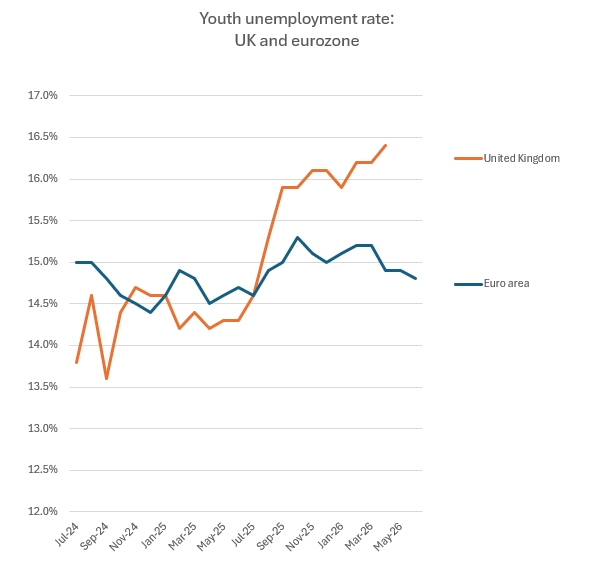
The youth jobless rate has soared as Labour hiked the cost of young workers.
Youth unemployment rose 44% under the last Labour government - then fell substantially under the Conservatives.
It's always the same with Labour. And it's young people who end up paying the price.
Congratulations to everyone getting their results today 🎉
We believe those who work hard for a better life should keep more of what they earn.
That's why the next Conservative government will scrap real interest rates on student loans.