NOVA Blueprint: 678.5 Billion Possible Molecules
Last week, we upgraded Blueprint to Boltz-2-based scoring. This week, we're expanding the chemical search space by more than 11×.
Reactions: 5 → 44
Building blocks: 225K → 2.03M
Enumerable chemical space: 61.1B → 678.5B molecules
The implications are bigger than the numbers.
Blueprint competitors now have to find the highest-scoring set within an 11× larger chemical space, using a substantially more computationally intensive scoring model than before.
That makes deciding where to search and which molecules are worth spending inference on more important than ever.
That's the problem Blueprint is designed to optimize: developing increasingly efficient and generalizable algorithms for navigating ultra-large chemical spaces.
Winning algorithms must outperform the incumbent across four different targets. By repeatedly changing the target, Blueprint applies evolutionary pressure toward search strategies that generalize rather than overfit to develop code that can more reliably screen chemical space for new unseen targets.
The expansion incorporates the SANQI reaction space alongside broader molecular validity and filtering rules covering physicochemical properties, ring structure, elemental composition, molecular complexity, and other structural constraints.
We're also upgrading how Blueprint rewards diversity. Submission entropy will now be calculated using atom-pair fingerprints rather than MACCS keys, with the threshold moving to 0.35.
The expanded reaction and building-block database underlying the new 678.5B search space is available openly on HF.
Competition open to all.
https://t.co/bfiLwBqOr7
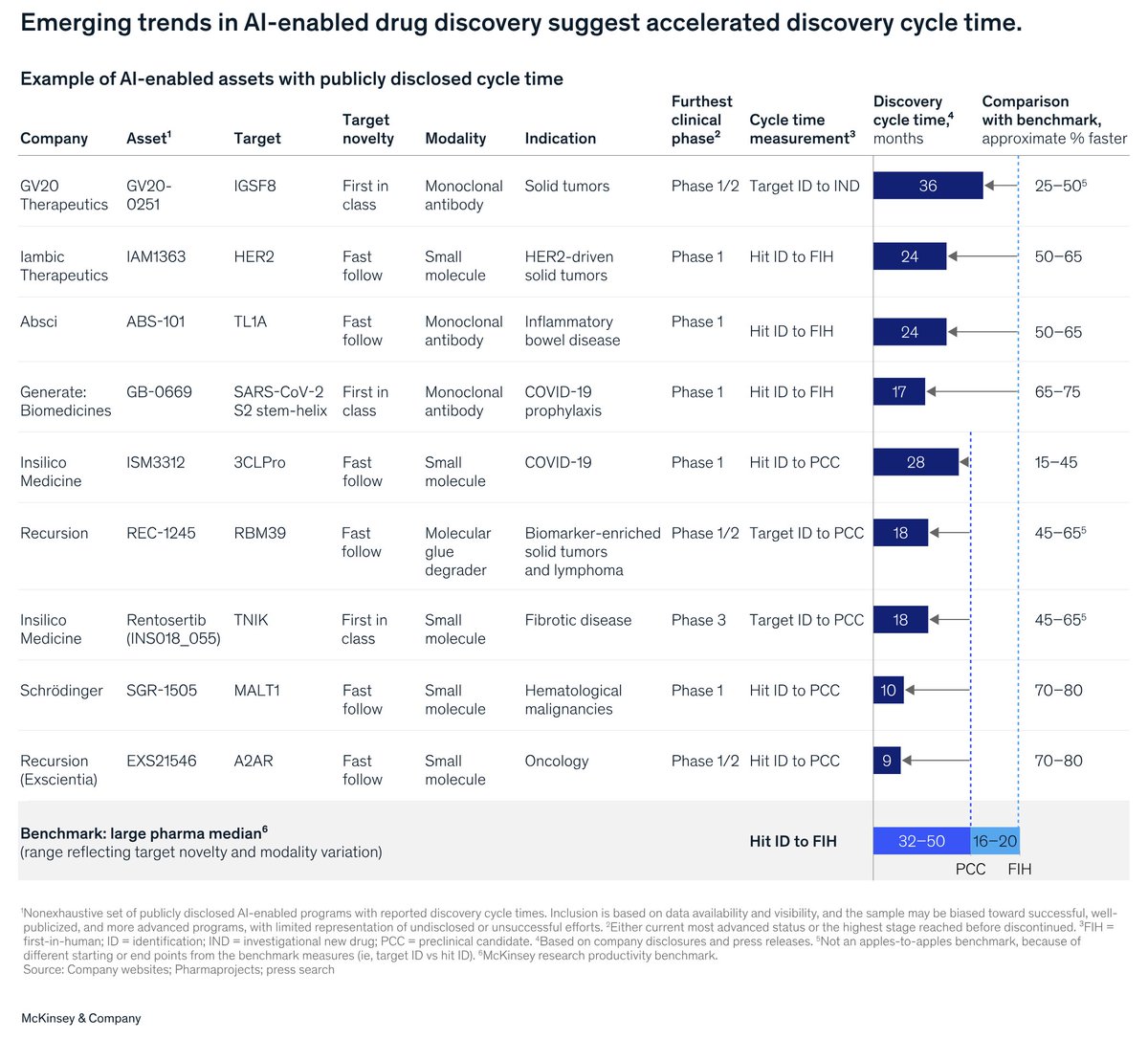
Is AI actually speeding up drug discovery?
According to new McKinsey research, there are early signs that it is: all of these candidates were AI-enabled, with discovery time cut by ~15-80%.
(Incredibly bullish)
AI/ML drug discovery competitions are a powerful paradigm for advancing models and methods.
Congratulations to the teams involved including the pioneers who have helped establish this format. We’re excited to see it expanding and to be building on this approach with NOVA.
Excited to partner w/ @FoundationOAI to build (w/ OpenADMET) better HT methods to measure physicochemical properties and Distribution to enable the next set of AI model improvements through blinded competitions. Thanks @JacobTref & @owl_posting!!! https://t.co/Uvk5RB6u1u
It’s only a matter of time before it becomes obvious to everyone that drug discovery is the best and potentially most rewarding use of compute and capital ↓
By then, we will have an unstoppable, increasingly automated system of incentive mechanisms connected with experimental validation optimizing different steps of the drug discovery process.
We already have 3 competitions running around the clock (and more in the works), validation underway.
Slowly then all at once.
First mover advantage and early conviction compounds.
Aiming AI at meme coins is the least interesting thing you can do with it.
Point that compute at drug discovery and the reward is measured in billions, not basis points.
@ItsFloe from @NEARFoundation reframes the whole compute race.
@ItsFloe@0xBoomz@therollupco@NEARFoundation Indeed why not point all that compute and capital to solve problems with multibillion rewards. Inevitably it will seem obvious to everyone. We got a head start.
New NOVA Blueprint winner
Delivers 7.02× PSICHIC inference speedup
from 214 → 1,502 protein–ligand pairs/sec
on an RTX 3090
That means the same inference workload can be completed with ~86% less time and compute costs, allowing substantially more chemical space to be evaluated within the same budget.
The winner also improves search by:
Learning what to try next.
Uncertainty-aware ranking directs search toward components that look promising while continuing to test those where evidence is limited.
Optimizing the final set.
Exact assembly selects the strongest 100-molecule set that satisfies Blueprint's diversity constraints.
Next up: Boltz-2.
NOVA Blueprint will now be scored using Boltz-2. We're excited to see how competitors optimize search around this more computationally intensive model.
Build the next winning search algorithm:
Boltz-2 is coming to NOVA Blueprint.
The integration is now available for testing.
With this release, Boltz-2 scoring moves to a dedicated GPU oracle rather than running inside the miner sandbox. Competitors can query the oracle throughout a run and use its predictions to guide and optimize their search.
The challenge: how intelligently can you use a more powerful (and more computationally expensive) oracle to navigate chemical space?
Blueprint:
https://t.co/1QCEEpR73k
Oracle:
https://t.co/i1JLkjAM4E
Test it now. Competition goes live this week.
Mounjaro and Zepbound were 56% of @EliLillyandCo's 2025 revenue. @definiumtx's LSD tablet just got a 2nd FDA Breakthrough designation, this one for depression.
Both improve self-regulation, which can impact health, relationships, work and longevity.
Agency Therapeutics 🧵
Mounjaro and Zepbound were 56% of @EliLillyandCo's 2025 revenue. @definiumtx's LSD tablet just got a 2nd FDA Breakthrough designation, this one for depression.
Both improve self-regulation, which can impact health, relationships, work and longevity.
Agency Therapeutics 🧵
These drugs weren't designed for agency. Their broader effects were discovered later.
@metanova_labs competitions and pipeline are focused on targets associated with reward and learning with the aim of designing multi-indication agency drugs from the start.
The distance between intention and action is treated as a question of discipline.
GLP-1s, stimulants, psychedelics act on the biology of self-regulation.
Agency Therapeutics may be medicine's next major category.
Read: thesis, pharmacology, and how we're designing them ↓
NOVA Blueprint: Better Search Meets Better Models
Transitioning to Boltz-2-based scoring this week.
This matters because Boltz-2 gives Blueprint a richer scoring layer than PSICHIC. Boltz-2 is a structural biology foundation model that predicts biomolecular structure and binding affinity.
The tradeoff is compute. Boltz-2 inference is more expensive than PSICHIC, which makes search optimization more valuable. Blueprint algorithms need to identify which regions of chemical space are worth spending inference on.
That creates a better division of labor between search and scoring: cheaper algorithmic exploration can narrow a vast space, while more expensive Boltz-2 inference is concentrated where it is most useful.
Better search decides what deserves a closer look.
Better models make that look worth taking.
Competition open to all, #Bittensor Subnet 68.
continuous incentive tuning creates an adaptive system that learns and improves over time.
each iteration generates richer datasets for hit picking, model training + distillation.
competition can uncover areas of ultra-large spaces that may never be discovered by an individual working in isolation.
Optimizing Discovery Through Adaptive Incentives
We track winning submissions and network-wide trends to generate the diversity and signal needed downstream.
We continuously tune parameters to guide the network through ultra-large chemical and biological spaces, producing richer datasets for hit picking, model training, model distillation, and future competition design.
Today’s updates include:
Nanobodies: We are rotating to Interleukin-11 (IL-11), a cytokine increasingly implicated in fibrosis, inflammation, and age-associated disease biology, with an updated structure, binding site, and MSA opening a new biological search space for the network.
Compound: We updated our diversity constraints, setting minimum entropy to 0.25 and maximum similarity to historical submissions to 0.6. We are also moving from MACCS keys to atom-pair fingerprints for entropy calculations, giving us a more informative representation of molecular diversity.
The broader point is that the incentive mechanism itself is part of the discovery engine.
NOVA is adversarial by design. That creates an adaptive dynamic closer to evolution or a competitive multi-agent system than to a static optimization pipeline: variation emerges, selection pressure acts on it, and the mechanism evolves in response.
That is an edge. The system is not limited to the hypotheses or search strategies of any one team. Collective competition can surface behaviors, combinations, and routes through search space that no individual participant would have chosen in isolation.
Every winning submission teaches us something about the landscape. Sometimes it also teaches us how the rules should change.
That feedback loop is how the system improves.
NOVA is a global market for virtual drug discovery: the first decentralized platform to coordinate continuous competitions to identify novel therapeutics and advance discovery tools.
3 competitions run in parallel across small molecules, nanobodies, and chemical search algorithms — open to anyone, with economic rewards tied to measurable performance.
We're building on a powerful lineage of scientific competition.
@kaggle (by @Google) demonstrated as early as 2012 with the Merck Molecular Activity Challenge that crowdsourced competition consistently outperforms what any single internal team produces. Tox21 brought that model to toxicity prediction. @leashbio pushed it to extraordinary scale with BELKA in 2024, releasing 133M molecules and ~3.6B experimental binding measurements to nearly 2,000 competing teams and exposing how poorly even the best models generalized to novel chemistry. @Polaris_HQ built the benchmark infrastructure the field needed. More recently, @openmsf's OpenADMET — led by @wpwalters — has brought the model even closer to real pharmaceutical discovery through blind challenges using experimental data and prospective evaluation.
These competitions have done more than gamify science, they bring new talent and methods into difficult problems, create shared benchmarks, expose what doesn't work, and force reproducibility.
NOVA extends that model by running competitions around the clock and making participation genuinely interdisciplinary — ML engineers, computational biologists, chemists, mathematicians, physicists, or anyone with a better method can compete and be rewarded for performance rather than credentials.
To date, we have received 212,561 submissions that enriched our libraries with:
— 11,130,975 small molecules
— 82,575 nanobodies
— 6,397 discovery algorithms
And the loop is closing: our first small molecules and nanobodies are now in the lab, bringing physical ground truth back into the network.
The opportunity is to combine what scientific competitions have already proven with the efficiency of a market: persistent economic incentives, open participation, and continuous selection pressure directing resources toward better results.
#Bittensor gives us a modular framework for doing this across an expanding set of discovery problems. NOVA can keep adding new targets, modalities, and problems to the same competitive infrastructure.
@metanova_labs we are building the infrastructure for an increasingly automated era of drug discovery.