My 1st textbook! Thank you Drs. Smith & Plowman for this honor. This is Full of new data, references, examples, & features.
Thx to Joey Munoz & @LRenteria14 -Couldn’t have done this without you.
Click here: https://t.co/RyifGtI0zo
#textbook#exercise#fitness#physiology
After reading PMID: 41366185 + our lab data, the pattern is clear:
Exercise buffers, protects, and offsets the cost of modern life.
Fitness doesn’t make you invincible.
It gives you margin.
Exercise is the biological apology to our modern lifestyle.
Elite ultra-endurance athletes who had been strictly keto for an average of 20 months achieved an average maximal fat oxidation (MFO) of 1.54 g/min.
Some outliers hit 1.7–1.8 g/min, but this is the physiological limit of the human species right now.
Energy Math: 1.54 g of fat × ~9 kcal/g = ~14 kcal/min.
Tour de France attacks and climbs or other high intensity competitive endurance sports require 25+ kcal/min.
There is a 10 kcal/min deficit that must be filled by glycolysis. If you don't have the glucose or have less glucose than your competitors (we all know that even without eating carbs your glycogen stores will be somehow filled but not topped out, and you can't burn fat any faster (because 1.5g is the ceiling), the power output drops.
You physically cannot produce the ATP fast enough to stay in the race. It´s not exactly rocket science.
Not to mention that most lowcarb athletes won´t even get to burning 1.5 g of fat per minute. Which makes the deficit and the need for carb ingestion even bigger.
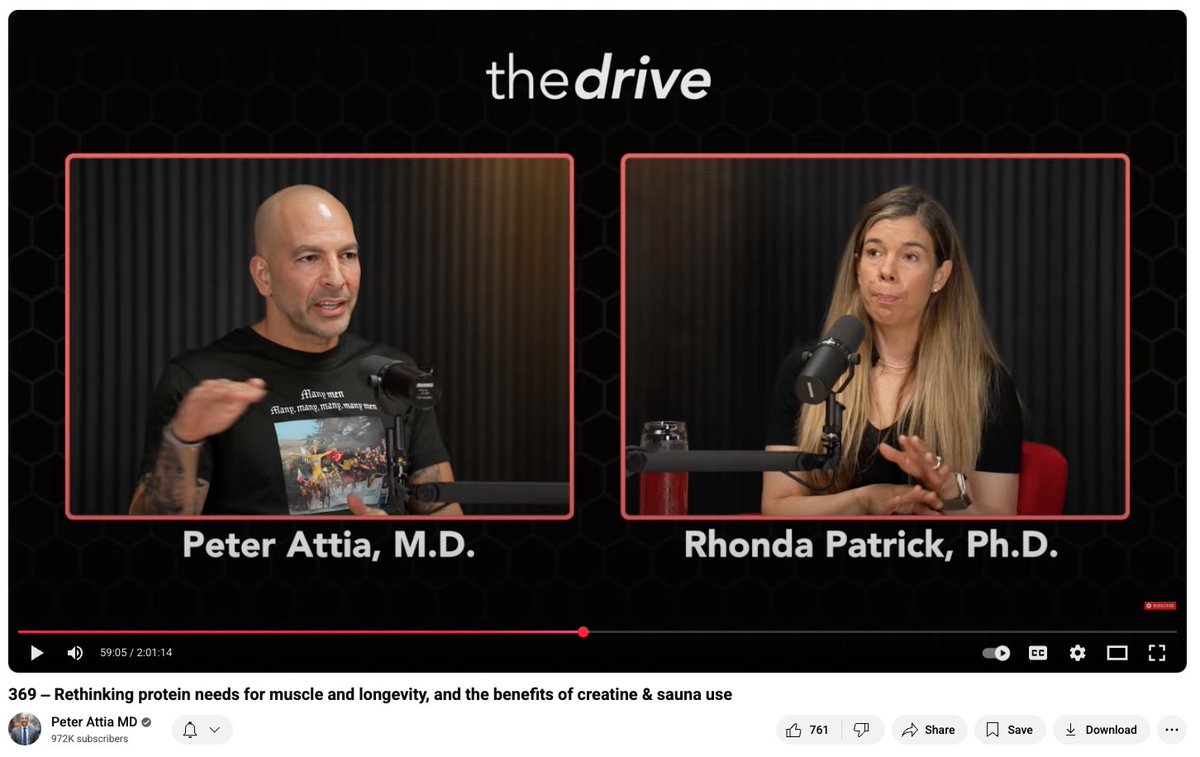
Dr. Rhonda Patrick and Dr. Peter Attia just set the record straight on protein recommendations.
It's the best synopsis of "why you should hedge against more protein versus less" that I've heard.
My recap 🧵👇
Thank you @fsuzeigler (Mark Zeigler) for sharing public speaking insights with our @fsuissm team! Third speaker in our ISSM training series. 🙌 #ISSM#FSU#Leadership
This is an extraordinarily clear presentation of kinda revolutionary findings by @AKoutnik. Do we need carbs for high intensity exercise? Very, very little apparently.
@ProfTimNoakes suggests elsewhere it’s the brain bonking you as a protective measure. https://t.co/VXijcUynNB
Good research takes years, not headlines.
Most studies aren’t “bad,” they’re misinterpreted.
One study ≠ universal truth. Context, populations & variables matter. Real answers take time, but they’re worth it.
#nutritionscience#nutritionresearch#nutrition#nutritionstudy
Florida State University continues to solidify its reputation as a premier public institution, securing the No. 11 spot in Niche’s 2026 Top Public Universities in America rankings.
FSU climbed to No. 7 nationally for Best Student Life, a testament to FSU’s engaging and supportive campus environment. Overall, Florida State was ranked in the Top 11 in 13 different categories by Niche.
Read more ➡️ https://t.co/JJv4yUMxXd
Inspired by a new paper on the history of back squats, here are 3 great examples of 2 major lessons:
1. Bad science communication
2. How unintentional biases shape confusion among 'experts' and thus - the community
3. Plus, some fascinating history of arguably the most maligned exercise in history, and some INSANE feats of strength.
🧘♂️ 1800’s | Squats for Exercise Begin
From Indian baithak traditions to Europe—light squats praised, heavy ones feared.
☠️ 1860’s | Lifting Weights = Deadly
Windship’s death + “muscle-bound” panic push heavy training into exile for nearly 100 years.
💪 1890’s | Rise of Superhumans
Eugene Sandow becomes bodybuilding’s father, while H.P. Hansen squats 277 lbs × 65 reps 🤯.
🏋️♂️ 1902 | Barbells for the Masses
Sandow sells spring-loaded gear; Alan Calvert launches Milo Barbell + America’s first strength mag.
🌍 Early 1900’s | Squat Training is Born
“Deep knee bend” contests spread worldwide—tiptoe squats dominate, Thomas Inch promotes flat-foot stance.
🦵 1920’s | Goodbye Tippy-Toes
Goerner, Morke & Steinborn squat 500+ lbs flat-footed, inventing clever barbell-loading tricks pre-rack era.
🥛 1930’s | Back Squats & Husky Gains
Steinborn sets the standard; Mark Berry’s “Husky Program” = 20-rep squats + a gallon of milk/day. Racks & cambered bars appear.
🏆 1940’s | Modern Back Squat Cemented
Bob Hoffman popularizes safe squat racks; Bob Peoples deadlifts 700 lbs at 181 lbs 🤯.
🧪 1950’s | Scientific Sabotage
Karl Klein falsely claims deep squats ruin knees—later exposed as fraud ❌.
⚡ 1960’s | Squat as a Sport
Bodybuilding, weightlifting & powerlifting split, each developing unique squat styles.
👟 1970’s | Gear + Science
Squat shoes, wraps & suits emerge; Tommy Kono & Boyd Epley prove heavy lifting is safe and powerful.
🎥 1980’s | Bodybuilding Boom
Pumping Iron brings lifting mainstream. Tom Platz (“Quadzilla”) redefines leg training; Nautilus machines spread squats & leg work to every gym.
📚 1990’s | Science Approves
NSCA, ACSM, and more endorse strength training and drop all anti-squat warnings 🚀.
📌 Major Lesson 1
There has never been one “perfect” squat.
Squats are just tools—mix it up: Front, Back, Zercher, Partial, Sissy, Hack, Hindu, Goblet, High bar, Machines, etc. 🏋️♂️
📌 Major Lesson 2
Science communication matters. Poor messaging held lifting back for decades—clear, honest outreach is as important as the science itself. 🧠📣
So why does it feel like so many "experts" disagree? It's often driven by differing perspectives on the outcome goal. Someone looking to maximize muscle growth will simply view things from a different "benefit" lens than someone looking to get the most strength or to use an exercise to increase general athleticism.
I really hope this helps!
Paper: https://t.co/g9fD7QUpWC
Clip from a recent talk I gave to the community. Health is our greatest asset! At some point it is all you will care about.
Enjoy! Full length video is linked in bio.
🚨New Review On Advancing Diabetes Management
💊 Drugs/Tech: 24
🍽 Nutrition: 0
🗣"There is heavy reliance on technology-assisted insulin delivery and glucose monitoring. Yet, people living with type 1 diabetes still face dysglycemia, weight gain, vascular complications, ketoacidosis and severe hypoglycemia, and psychological distress."
...sorry but we are not serious about normalizing the complications of this disease if mention diet ZERO times.
No this isn't DIET TRIBE crap...this is serious evidence-based reality. Carbohydrates have the most potent impact on glucose levels 24/7. Insulin don't match the glucose impact. They are not fast enough. Period. Discussing diet zero time illustrate where STANDARD OF CARE has been and will continue to be.
Every. Single. Patient. Is expected to get atleast one complication and lose 11-18 years off their life on average. Time to have real and uncomfortable conversations.
https://t.co/iHAiXmB9cg
For years, we thought recovery meant chugging protein right after training or losing all your gains. I preached it too. But research shows the “anabolic window” isn’t as small—or critical—as we believed.
#performancenutrition#nutrition#science#fsuissm#protein
Clip of my great conversation with @mikeormsbee on my podcast.
Check out the full episode to hear Dr. Mike talk about the latest research from his lab on topics such as:
Food Timing, Nutrition & Supplements for Fat Loss, Muscle Growth & Recovery - and plenty more.
This episode is available in full on 𝕏, YouTube, and all podcast platforms; just search for "Perform with Dr. Andy Galpin" .
This was episode 9, from Season 2.