These are my favorite ideas from my conversation with @EdwardMehr , CEO and Co-Founder of @MachinaLabs_ .
-> The factory is the product. It doesn't matter if you can build 1 machine. The hard part is building millions of them
-> When fundraising, you need to be able to tell the 20-year story of your company, but have a thread that ties all the way back to what you are doing in the present
-> Don't build it unless customers will pay you for it. Machina's early customers, like NASA, paid Machina not only for the robots, but for the time and effort to develop them
-> Always learning. Ed learns relentlessly from manufacturing leaders like Toyota or SendCutSend, doing site visits and taking principles from the Toyota Production System
-> Teal collar workers. Ed believes the best robotics companies have folks who are comfortable playing in between white collar and blue collar work (white + blue = teal)
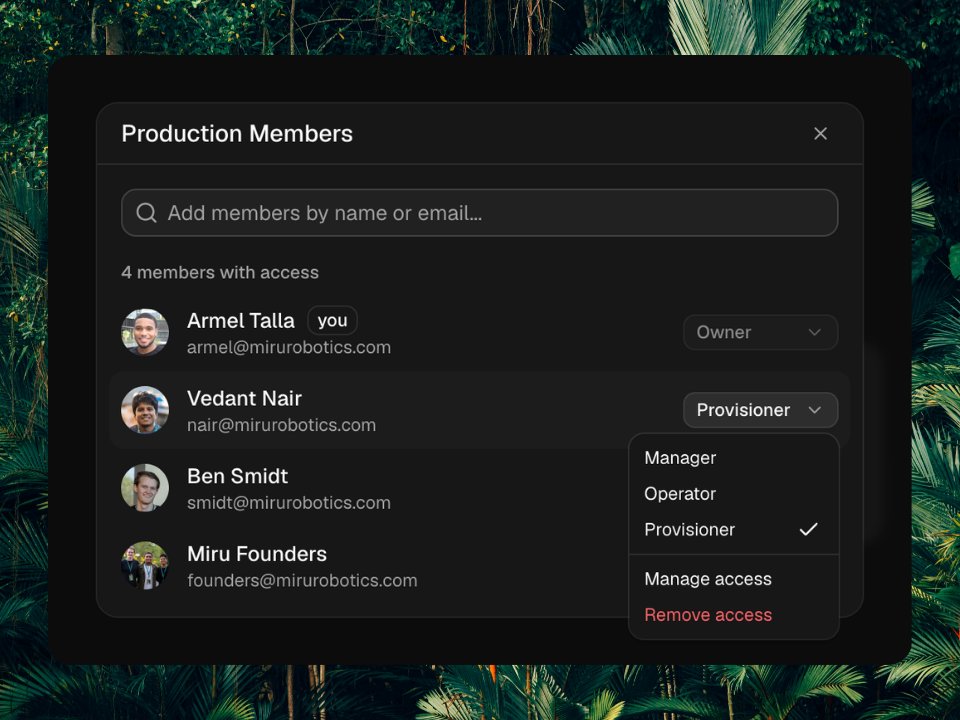
Access Control is now live in @mirurobotics!
Robotics teams need fine-grained control over who can do what across their fleet: who can deploy new configs, to which robots, for which customers.
Every workspace member now has a user type (owner, admin, or member) and roles that grant specific abilities, such as publishing releases, managing deployments, or provisioning devices.
Roles can be scoped to the entire workspace or to a single group of robots.
Since groups can be organized however you run your fleet, a common setup is one group per customer, so a robot operator can manage only one customer's robots.
We hope this makes it easier to implement config management across large fleets and teams.
Let us know what you think!
Building a Generational Manufacturing Company with @EdwardMehr, Founder & CEO of @MachinaLabs_
Timestamps
(00:00:04) – Introduction
(00:03:00) – The Problem Machina Solves
(00:06:15) – Fleet Scale and Factory Buildout
(00:07:51) – Ed's Origin Story
(00:13:10) – Lessons from SpaceX Culture
(00:16:15) – Early Customers and Going to Market
(00:18:56) – Staying Lean and Building with Humans in the Loop
(00:23:20) – Culture: What Not to Copy from SpaceX
(00:27:18) – Scaling: From R&D Shop to Factory Operator
(00:30:49) – Bridging Engineering and the Factory Floor
(00:33:15) – Telling the Story: Fundraising and Vision
(00:36:55) – The Strategic Thread for Machina
(00:42:03) – Operational Excellence: Learning from Toyota and SendCutSend
(00:45:24) – Staying Lean with Resources
(00:48:13) – Lightning Round
(00:51:00) – Why Manufacturing and Robotics
(00:53:22) – How to Help Machina Labs
Robotics founders, do you have a firm grasp of your working capital?
Daniel thinks it's one of the cruelest ways for a robotics company to die.
Say you're at $5M in revenue and you 5x to $25M. That's a home run. Orders are signed, you're scaling, everything looks great. But your inventory has to be 5x too, after all, you're selling hardware.
If you only have $2M in cash, plus payroll and lease considerations, you're facing a multi-million-dollar gap. And to make things worse, if you run a RaaS model, your inventory may not pay you back for 6+ months.
This is why hardware is hard. You don't have the simple SaaS financials with a P&L, churn, and margins. You have to manage all three financial statements, inventory, and debt.
So how do you close the gap?
- Take deposits up front
- Structure contracts with a lower price but faster payments to bring cash forward
- Build relationships with lenders to call on capital quickly
If you don't have familiarity with the capital stack and understand the right levers to pull as you scale, you'll put your company in dire straits
Today, we unpack the finance function in Physical AI with Daniel Kirstein, founder of Holdfast Partners, and former CFO of FarmWise (acquired by Taylor Farms)
If you're a scaling robotics company, check this out!
𝐓𝐈𝐌𝐄𝐒𝐓𝐀𝐌𝐏𝐒
(00:00:04) – Introduction
(00:03:32) – Joining Robotics as a Finance Leader (00:05:26) – Business Models in Robotics
(00:07:40) – Choosing the Right Business Model (00:11:59) – Will RaaS Stick Around as Technology Matures?
(00:16:21) – The Operational Realities of Running RaaS (00:18:37) – Working Capital and Cash Management (00:22:21) – Forecasting and Cash Planning for Early Stage Founders
(00:25:18) – Why Debt Matters for Robotics Companies (00:29:55) – Common Pitfalls with Debt
(00:31:56) – What Equipment Financiers Look For (00:33:54) – Raising Equity for Robotics Companies (00:37:09) – Show, Don't Just Tell
(00:37:48) – What Investors Push Back on Most (00:40:46) – Advice for Founders Scaling Their First Fleet
(00:42:02) – Why Robotics Is Worth It
(00:43:25) – Closing and How to Connect
How do you know the right business model for your scaling fleet of robots?
Daniel, founder of Holdfast Partners, and former CFO of FarmWise (acquired by Taylor Farms), has a three-part framework:
1) Technological Feasibility
2) Market Feasibility
3) Commercial Feasibility
If your technology is immature, you may need someone to babysit the robot at a customer site to ensure uptime and swap out broken parts; in that case, RaaS may be best.
If your customers prefer to own the hardware (like in AgTech), then a hardware purchase model is preferred.
Lastly, examine your capital stack. What are your working capital constraints? What financial levers do you have to scale that up and down for your business?
We loved this conversation with Daniel, where we dove into all things financing at a scaling robotics company.
What were the factors you considered for your startup's business model?
"Sustainment is important because if it's not done well, it can bankrupt you."
Phantom Auto went to market with unreliable hardware and poor sustainment. That led them to a death spiral.
Every time something broke
1. The product team was pulled off R+D and into bugfixing
2. There was no good pipeline to connect issues in the field to their engineering roadmap
The result was that more and more time was spent sustaining the fleet rather than improving the product.
If a sustainment team were in place, they could fix robot issues in the field and document/triage issues early on. If they invested in it early, they would have built a good sustainment muscle and would be a well-oiled machine by the time the fleet was big and expensive.
But they started too late, and by then the cost of each mistake was amplified. To Matthew Lee, it spelled doom for the company.
The lesson here is that even though sustainment costs $ early on, it's a necessary function to support the fleet. You need to invest in teams, tools, and processes before you scale.
How have you thought about building the sustainment function at your company?
How did Aescape build a user experience that's genuinely delightful?
The answer goes far beyond a user just lying down for the robotic massage.
They handle relationships and ops with their customers (luxury hotels and gyms) and separately manage the users who get massages.
They build specialty apparel to unlock a top-of-the-line massage.
And they do all of this while maintaining a clean, unified brand.
Here are a few insights from our conversation with Nick Akiona to help you build robots that people love.
1️⃣ Retention is the most important metric
2️⃣ Spec your hardware one generation at a time
3️⃣ Trust is all about design
4️⃣ The product is much more than the robot
5️⃣ You can't forecast unit economics until you ship
In Episode 10, we speak with Matthew Lee, who has spent the last decade running field operations and sustainment at three autonomy companies: Aurora (on-road autonomous trucks), Phantom Auto (teleoperated forklifts), and most recently Scythe Robotics (autonomous commercial lawnmowers, deployed across 20+ states).
Before robotics, he spent two decades in automotive repair, working his way up from technician to service manager.
I believe that field engineering is the most criminally underrated function in running and scaling a fleet of robots. Matthew has spent his whole career on that side of the problem, and has watched companies live or die (like Phantom Auto) based on how seriously they took it.
We get into why sustainment is the function most robotics startups underinvest in, and how Phantom Auto's failure to iterate on hardware in the field helped sink the company. Why field ops works on a totally different timescale than engineering. And how to build a real support stack from tier one all the way up to your developers, including who you should hire for each tier and what data you need to surface when a customer calls in.
There are also a few tidbits on how to run your software deployments and canary releases. Enjoy this one, it's a top to bottom analysis of how to run field ops from someone who's experienced the struggle first hand.
𝐓𝐈𝐌𝐄𝐒𝐓𝐀𝐌𝐏𝐒
(00:00:04) – Introduction
(00:01:09) – Overview of Autonomy Use Cases
(00:03:50) – What Is Field Ops in a Robotics Company
(00:05:52) – Why Sustainment Is Critical
(00:07:59) – Building a Support System from First Call to Resolution
(00:14:05) – Tier Two Support and Escalation
(00:20:11) – The Tier Two Agent Profile
(00:24:52) – Feeding Field Data Back to Product and Engineering
(00:30:49) – Canary Releases and Software Rollouts
(00:34:22) – Networking Challenges in Field Deployments
(00:38:41) – The John Henry Problem: Operator Adoption
(00:42:49) – Advice for Scaling Your First Fleet
(00:45:23) – Closing and Where to Find Matthew
In Episode 9, we speak with Nick Akiona, Principal Engineer and Architect at @aescape . Aescape builds robotic massage tables deployed at luxury hotels, gyms, and spas, with around 150 systems in the field and nearly 100,000 sessions delivered to date.
At Aescape, Nick previously served as Director of Product and Head of Robotics. Before Aescape, he worked on surgical robotics and warehouse automation as Robotics Lead at Accenture, and was a researcher at the Stanford Robotics Lab, where he also earned his BS and Master's. His experience wearing many hats and building for different use cases gives him a uniquely holistic perspective on how to build world-class robotics products.
Most deployed robots are nestled into the back of a warehouse. Aescape's are front and center with a face-down customer while two robot arms work on their back. This changes almost everything about how you think about building product.
We get into how Nick decides what to fix in hardware versus software when changing the hardware can take months. Why he's already thinking three to five years ahead about the next generation of the table, and why trying to put every feature into the first version is a trap.
Plus, why his most important metric is retention.
There are also some tidbits on building a B2B2C business and on why designing specialized clothing for massage was both the best and worst decision Aescape has ever made. Enjoy!
Timestamps
(00:00:04) – Introduction
(00:02:42) – Defining Product in Robotics
(00:05:58) – Deciding Where to Solve Problems in the Stack
(00:09:47) – Planning Hardware Generations
(00:11:48) – Managing Multiple Stakeholders
(00:15:39) – Prioritizing Stakeholder Needs and Reducing Churn
(00:20:39) – Building a Unified Experience Beyond the Robot
(00:23:04) – Brand Language and Positioning
(00:27:09) – Designing for Comfort, Safety, and Trust
(00:31:43) – Measuring a Great Session
(00:34:46) – The Specialized Clothing Decision
(00:41:07) – Scaling From R&D to Production
(00:43:35) – Operations and Serviceability
(00:45:11) – Unit Economics and Cost Optimization
(00:48:17) – Hiring Product People for Robotics
(00:51:09) – Lightning Round
Scaling Robotics Episode 8:
The Software Playbook for a 2,000 Robot Fleet with Cem Ersoz, Director of Robotics Software @simberobotics
--
Timestamps
(0:04) Introduction
(1:32) Fleet Scale and Deployment
(3:57) Lessons from Operating Alongside Humans
(6:56) Building Software for Thousands of Robots
(10:55) Testing, Deployment, and Reliability
(13:58) A/B Testing in Robotics vs. SaaS
(17:06) Supporting Legacy Hardware
(22:20) AI Coding Tools in Robotics
(25:28) Staged Rollouts and Canary Deployments
(29:30) The Hundred Megabit Cable Story
(34:10) Building Workarounds into Everything
(36:11) Hardest Moments in Scaling
(39:49) What Makes a Great Robotics Engineer
(43:21) Closing
--
This Episode
In Episode 8, we speak with Cem Ersoz, Director of Robotics Software at Simbe Robotics. Simbe builds Tally, an autonomous retail robot that scans millions of shelves per week, giving retailers real-time visibility into product availability, out-of-stocks, and shelf accuracy. With thousands of Tallys deployed across major retailers in more than 10 countries, operating daily alongside untrained store employees across grocery, club, farm supply, and home improvement, Simbe runs one of the largest commercial Physical AI fleets in the world.
We discuss what actually changes when your fleet crosses key thresholds. At a certain scale, you can no longer SSH into a robot to fix it, and that forces a complete rethink of how you build. We get into the difference between 95% autonomous and truly autonomous, why improving 9s of reliability is so hard, and how Simbe ships software to thousands of robots they can never directly touch.
Plus, why A/B testing a robot fleet isn't like optimizing a SaaS funnel. There are things that no dashboards can capture, such as whether people actually feel comfortable around a robot moving faster through the store. We also get into what a truly representative canary rollout looks like at this scale, and what Cem learned when hardware he had trusted for years finally failed on robot number 2,000.