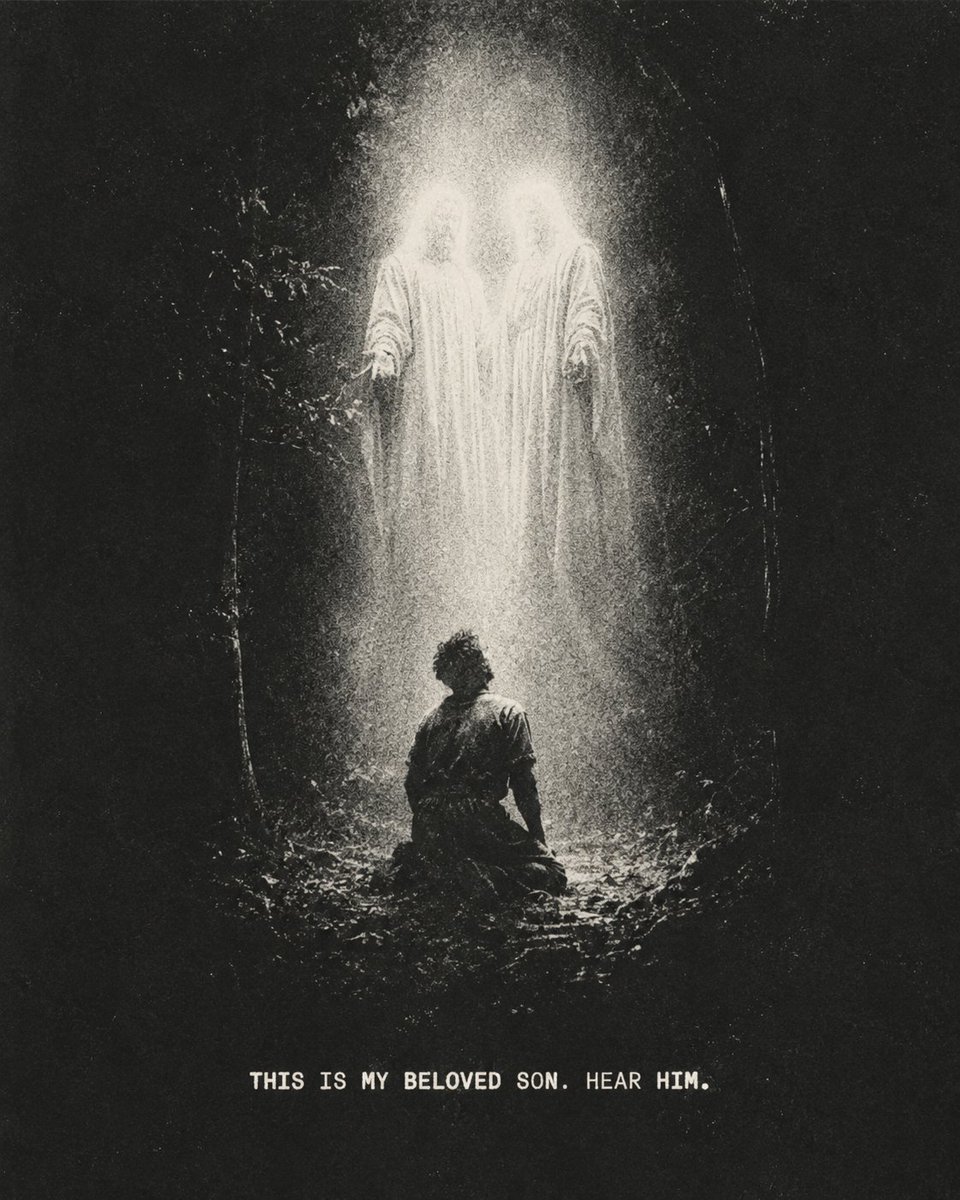
“And now, my sons, remember, remember that it is upon the rock of our Redeemer, who is Christ, the Son of God, that ye must build your foundation; that when the devil shall send forth his mighty winds, yea, his shafts in the whirlwind, yea, when all his hail and his mighty storm shall beat upon you, it shall have no power over you to drag you down to the gulf of misery and endless wo, because of the rock upon which ye are built, which is a sure foundation, a foundation whereon if men build they cannot fall.”
The Book of Mormon, Helaman 5:12
Now that the "Mormons aren't Christians" bandwagon is slowing down (or maybe I'm just not paying attention to it anymore), I must say that I've once again come out the other side with a renewed zeal and love for my faith.
The Bible never uses "Trinity" or defines one essence in three co-equal persons. That precise doctrine developed at Nicaea and later councils.
LDS cite strong distinctions: Jesus' baptism (Matt 3:16-17) shows Father speaking, Son in water, Spirit as dove; Jesus prays to the Father (John 17:3 calls Father "the only true God"); Stephen's vision (Acts 7). They read these as three separate beings, one in purpose.
Trinitarians counter with John 1:1, Matt 28:19, and one-God passages read as shared essence.
Scripture supports debate either way. It does not clearly settle the creedal version for all readers.
I really dislike all the attacks on my Mormon friends on here.
Mormons are some of the most Christlike people you will ever meet. They operate in charity and self sacrifice.
And you know what? They put family at the core of their lives. They love children and view them as blessings from God. I know a lot of Christians who have terrible views on children and family.
America has a lot of problems and I think the last possible problem is the Mormon community.
I obviously disagree with their theology or else I would be Mormon. But give me a break about heresy and doctrine when there are over 40,000 different interpretations of Christianity since the Protestant reformation.
"If the world hate you, ye know that it hated me before it hated you. If ye were of the world, the world would love his own: but because ye are not of the world, but I have chosen you out of the world, therefore the world hateth you."
Your argument only works if you quietly smuggle the Nicene Creed into the definition of Christianity and then pretend you've proven something from the Bible.
You say Latter-day Saints aren't Christian because they reject later creedal theology. Fine. Then stop pretending your standard is "the Bible." Your actual standard is fourth-century Greek metaphysics.
Show me where the Bible teaches that God is "one being in three co-equal, co-eternal persons sharing one indivisible essence." Not a creed. Not a church council. A verse.
You can't.
You cite Deuteronomy 6:4 and Matthew 28:19, but neither passage teaches the Nicene doctrine of the Trinity. The Trinity is an inference constructed centuries later. Latter-day Saints reject that inference. That's not the same thing as rejecting Christ.
You also claim Mormons believe in a "different Jesus." That's rhetoric, not an argument.
Do Latter-day Saints believe Jesus is the divine Son of God? Yes.
Do they believe He created the world? Yes.
Do they believe He was born of Mary, performed miracles, atoned for sin, died on the cross, rose bodily from the dead, and will return in glory? Yes.
Those are not minor details. Those are the central claims of Christianity.
What you really mean is that Latter-day Saints reject later theological developments concerning the nature of God. That's a much narrower claim than "they worship a different Jesus."
The "spirit brother of Lucifer" line is especially weak. It's usually deployed because critics know it sounds shocking, not because it proves anything. In LDS theology, Christ is the divine Son of God, Creator, Redeemer, and Lord. Repeating "spirit brother of Lucifer" doesn't refute any of that. It's just polemics.
Your claim about salvation is equally misleading. Latter-day Saints do not believe they can earn salvation apart from Christ. They believe Christ's grace is necessary and indispensable. The disagreement concerns the relationship between faith, covenant, discipleship, and transformation—not whether Christ saves.
As for Galatians 1 and 2 Corinthians 11, quoting "another gospel" doesn't magically settle the debate. Every Christian tradition has used those verses against rival traditions. The question is whether Joseph Smith restored authentic Christianity. Quoting Paul's warning simply assumes your conclusion.
And the census argument is frankly irrelevant. Governments classify groups for demographic purposes, not theological ones. If tomorrow a census listed Baptists separately from evangelicals, that wouldn't determine who is or isn't Christian.
At bottom, your position is not "Mormons aren't Christian because of the Bible." Your position is "Mormons aren't Christian because they reject post-biblical creeds that I consider authoritative."
You're entitled to that definition. What you're not entitled to do is pretend that the definition came directly from Scripture when the very doctrines you're using as tests of Christianity were formulated centuries after the New Testament was written.
When you say I have to accept “the Nicene Creed” to be Christian, could you be more specific?
Do you mean the creed produced in A.D. 325 at a council convened by the Roman emperor Constantine, who was trying to settle the Arian controversy and preserve unity in his empire?
Or do you mean the version most Christians actually recite today, which comes from A.D. 381, when another Roman emperor, Theodosius I, convened the First Council of Constantinople to settle further disputes and more fully define the doctrine of the Holy Spirit?
Because that seems like a pretty important distinction.
One was created under Constantine, a Roman emperor with no priesthood authority, whose interest in Christianity was inseparable from his interest in imperial stability.
The other was expanded under Theodosius, another Roman emperor who used state power to enforce religious uniformity.
And somehow I’m supposed to believe that my faith in Jesus Christ is invalid unless I accept the theological conclusions of emperor-sponsored councils held centuries after Christ and His apostles?
You are free to trust those councils, led by rulers of the same empire that crucified Christ.
But please stop pretending that your post-biblical, politically entangled, imperial committee language is simply “biblical truth.”
And stop acting like you have the authority to decide who is and is not Christian based on a person’s willingness to pledge allegiance to Rome’s preferred definition of the Divine.
It does seem that the LDS are being unfairly singled out here. If the essential criterion for Christianity is Trinitarian theology, why do the Jehovah’s Witnesses, Christian Scientists, Oneness Pentecostals, and even Quakers (in some instances) get a pass here?
Elon Musk just defended America better than every politician in Washington combined.
Musk: “After World War 2, the US could have basically taken over the world and any country. Like we got nukes, nobody else got nukes. We don’t even have to lose soldiers. Which country do you want?”
One nation on earth held a weapon nobody else had.
Total dominance. Zero competition. No risk of retaliation.
Every empire in history that held that kind of advantage used it.
Rome. The Mongols. The British. The Ottomans.
They conquered until they collapsed.
America had a bigger advantage than all of them combined.
And it rebuilt the countries it just defeated.
Musk: “The United States actually helped rebuild countries. So it helped rebuild Europe, it helped rebuild Japan. This is very unusual behavior, almost unprecedented.”
Almost unprecedented?
It had never happened before. Not once in 5,000 years of recorded history.
The Marshall Plan wasn’t foreign aid.
It was the most radical act of restraint any superpower ever committed.
America turned its enemies into allies. Turned rubble into economies. Turned surrender into partnership.
Germany went from ashes to the economic engine of Europe in a generation.
Japan went from unconditional surrender to the third largest economy on earth.
Three years after the war, America was flying food into Berlin.
A city in the heart of the nation that just tried to destroy it.
That’s not policy.
That’s a civilization deciding what it is at the exact moment it has the power to be anything.
You’re being told a story right now.
That America is the villain of history.
You hear it everywhere. Media. Universities. Social platforms.
Musk: “There’s always like, well America’s done bad things. Well of course America’s done bad things, but one needs to look at the whole track record.”
Every nation on earth has dark chapters. Every single one.
The difference is what a country does when nobody can stop it.
And when nobody could stop America, it fed its enemies and rebuilt their cities.
Musk: “The history of China suggests that China is not acquisitive. Meaning they’re not going to go out and invade a whole bunch of countries.”
Probably right.
China has historically built walls, not fleets.
But the real question isn’t about borders anymore.
We’re approaching a moment that mirrors 1945 in ways nobody has fully processed yet.
AI is going to give a handful of people a power advantage that makes nuclear monopoly look quaint.
If someone is going to hold that kind of power, who do you want it to be?
The country that conquered when it could? Or the one that rebuilt when it didn’t have to?
Every alliance. Every trade route. Every economy.
Billions lifted out of poverty.
All of it traces back to one act of restraint that had never been done before.
And carries no guarantee of being repeated.
The most powerful thing America ever did wasn’t building the bomb.
It was what it didn’t do after.
Doc Brown: You can use the Delorean, just don't touch anything in the past. The tiniest change can alter the future in unimaginable ways.
Me: OK, Doc. I promise.
10 seconds later:
INSTEAD OF WATCHING AN HOUR OF NETFLIX.
This 60-minute MIT lecture will teach you more about building companies than every startup book you've read combined.
Bookmark it and give it an hour, no matter what.