Agents can edit a vlog now. The slow part is finding the shot.
Give the agent your script and it searches the footage line by line, describing each shot, gets back the clips and where each shot sits, then writes the cut list.
Give your agent a memory it can audit.
One MCP URL. The agent attaches its own data source, syncs it, builds the collection and searches it. Every query leaves an execution record it can read back.
When it uses a result, it reports that, and the ranking learns from it.
Everything that changed in your search index, in order, from a position you hold.
Every change gets a monotonic seq and a cursor you store. A consumer that dies resumes where it stopped.
Each batch ends with a store-counted total, so you can prove you saw every write.
Your search now runs inside your bucket.
The filter and the vector traversal run at the shard that holds the segment. Only ids and scores come back.
The index is a documented tree of objects in your S3, GCS or MinIO. Four lines on the bill. Bytes scanned is not one of them.
Your search results now come with a memory you can read.
Every click, dwell and bookmark lands in a collection in your namespace, queryable like any other.
The fusion weights learn from the same signals. Label results and an evaluation scores the retriever against them.
Run an AI engineering team.
amux is the open-source control plane for AI coding agents. Claude Code, Codex and Gemini CLI run as named workers on one board. Claiming is compare-and-swap, so two workers never take the same card.
Video below.
Your catalog says "Copper Cast Iron Pan". Your supplier's says "Copper Cast-Iron Pan".
cross_compare walks exact, then fuzzy, then embeddings. It stops at the first hit and tells you which tier caught it.
The rug matched nothing, and it says so.
https://t.co/zJ89u1fnyC
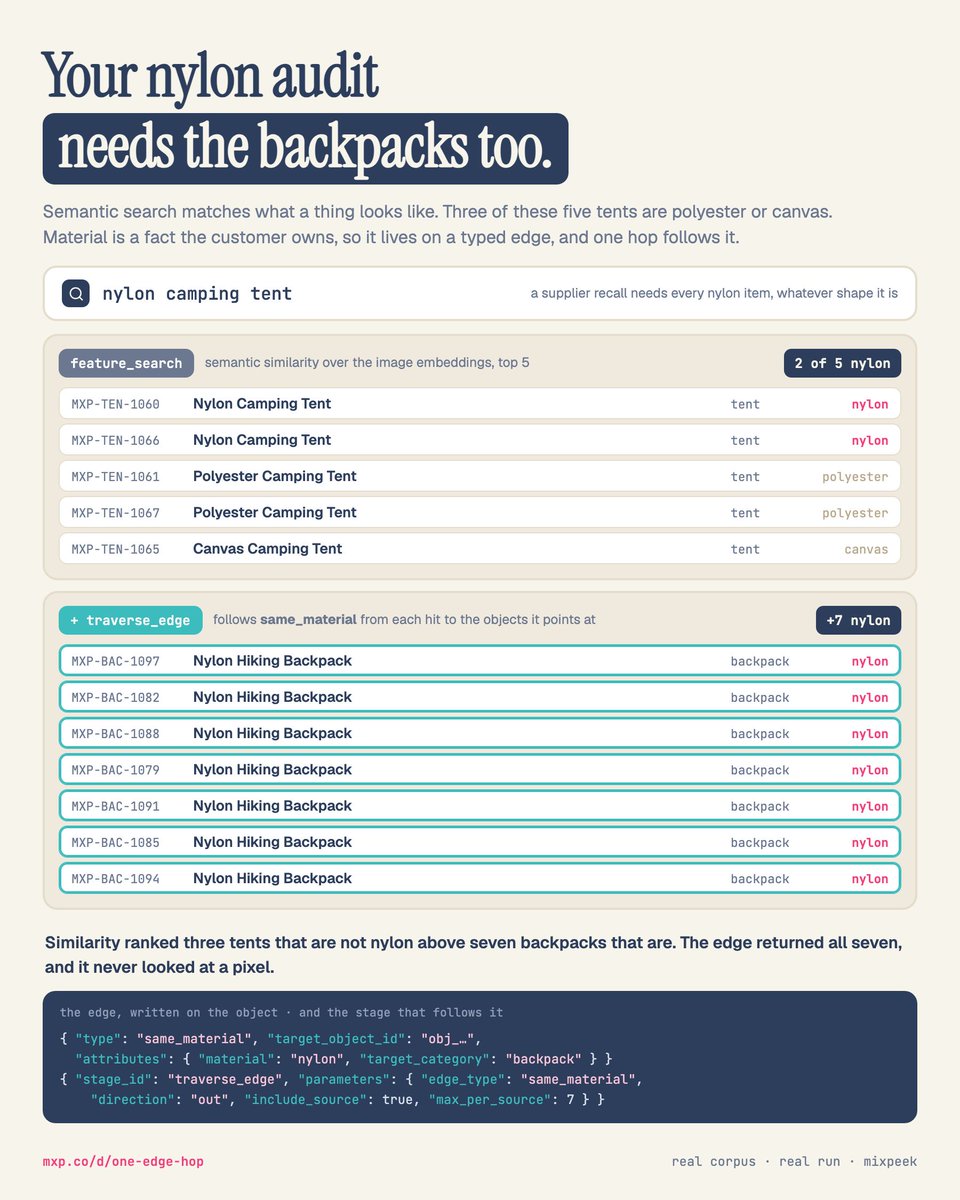
Searched our demo catalog for "nylon camping tent".
Got 5 tents back. Three of them are polyester or canvas.
One traverse_edge hop on a same_material edge then returned 7 nylon backpacks that no image embedding would ever rank near a tent.
https://t.co/3cw1ZxTbvt
Ran one product photo through a retriever with a reverse image stage on it.
20 listings came back. Target, Walmart, Wayfair, Home Depot, Macy's, Lowe's. 13 domains total.
Competitor monitoring as one stage in a pipeline you already run.
https://t.co/vtfzfLoAWp
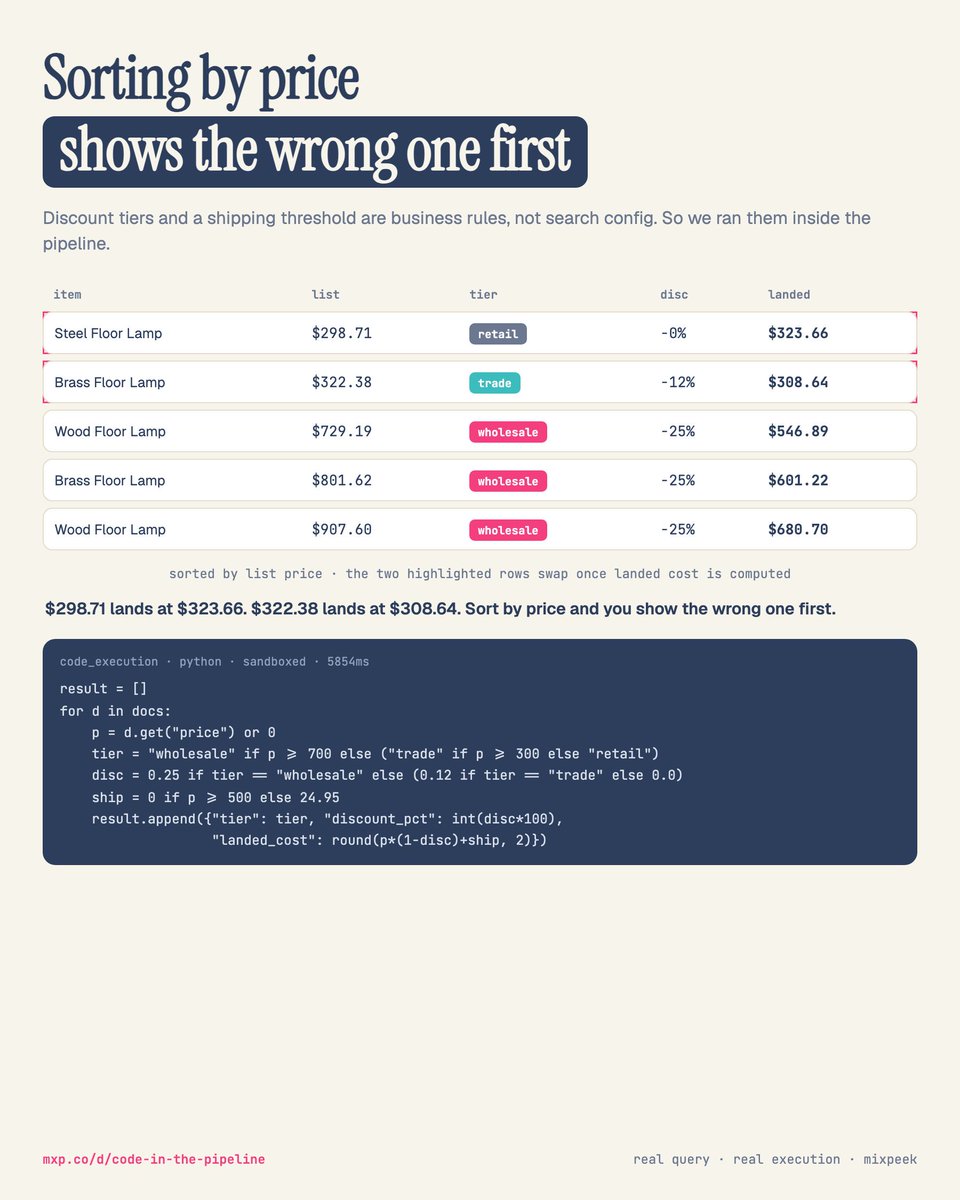
Discount tiers and a shipping threshold are business rules, not search config.
So we ran them in the pipeline. $298.71 lands at $323.66. $322.38 lands at $308.64.
Sort by list price and you show the wrong lamp first. Python, sandboxed, 5.8s.
Your search engine can answer "how much inventory matches this?" without returning a single document.
One aggregate stage: 60 documents become $27,989 across 60 items, $466 average.
Same retriever, same query, same index.
Semantic search has no idea what a budget is.
"reading nook under 400 dollars" returned 3 items over $400.
Gave an agent the same query and the stage catalog as tools. It searched, then picked attribute_filter and wrote price < 400 itself. One result, $180.
Cost: $0.0006.
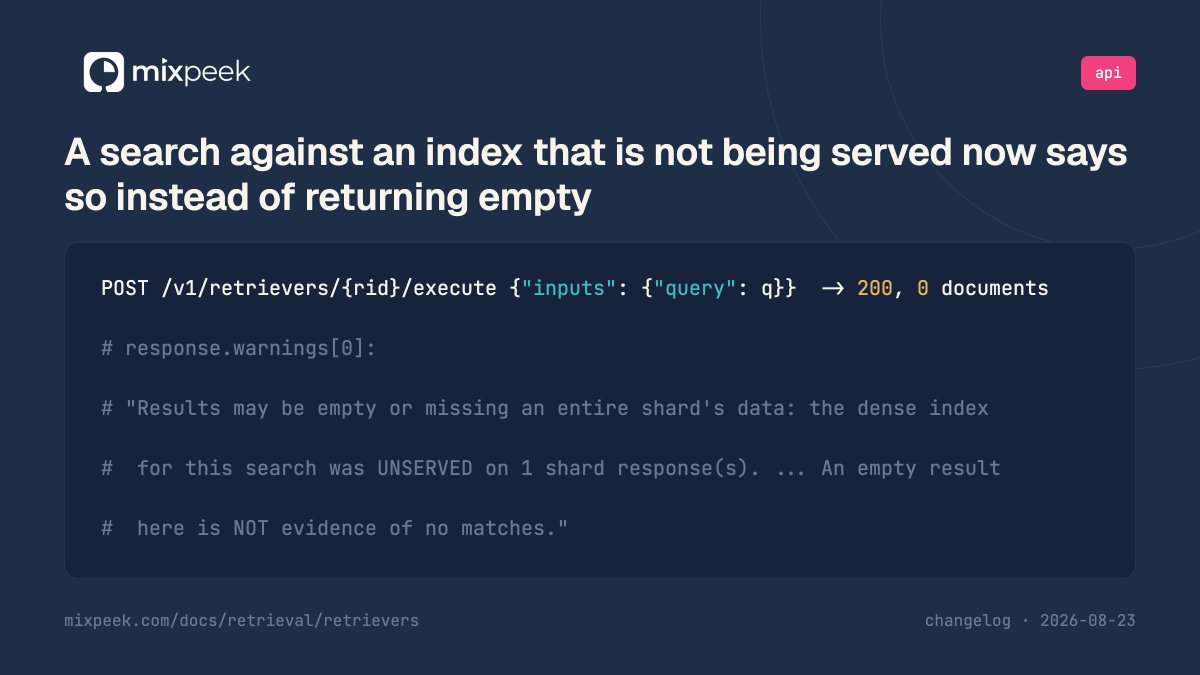
A search against an index that is not being served now says so instead of returning empty.
The response warning names the condition and the remedy, and a partial outage on one shard stays distinguishable from a total one.
https://t.co/e2OZChpg4I
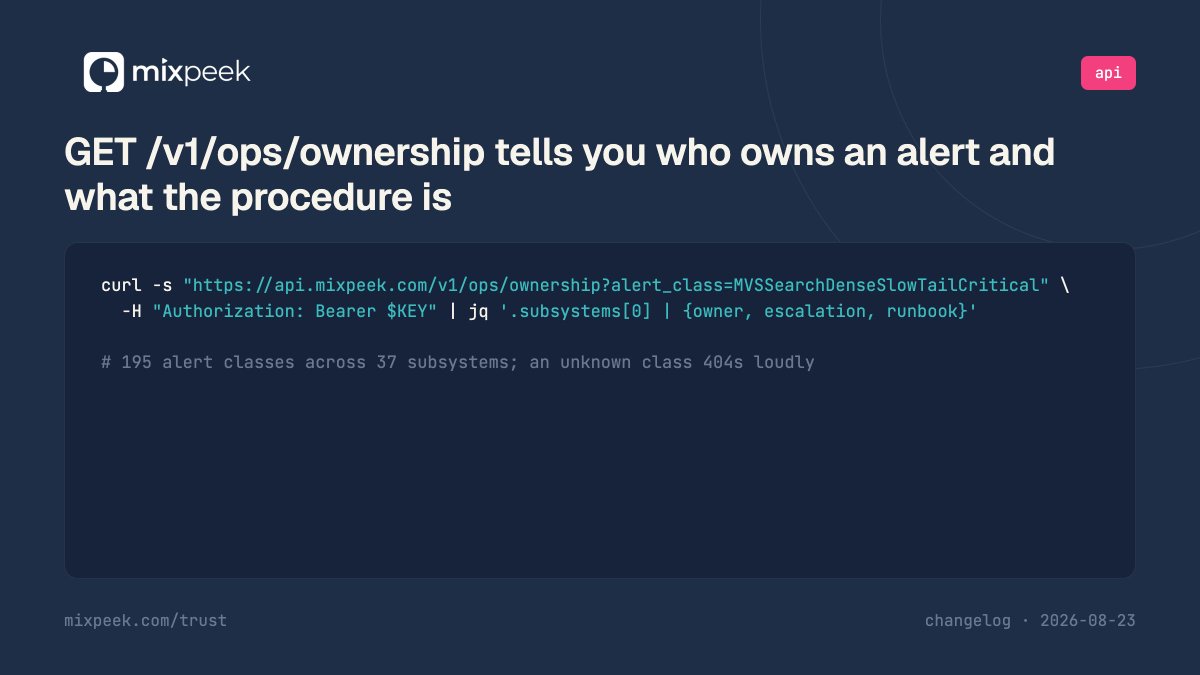
GET /v1/ops/ownership tells you who owns an alert and what the procedure is.
Who responds when part of the platform degrades, answerable from your own org key.
https://t.co/jB6Md3CKvH
No config changed between these two rails. Only the sentence did.
"chair" returns generic modern chairs. "worn leather armchair, bright room" returns worn leather armchairs.
Your biggest retrieval knob is the query itself.
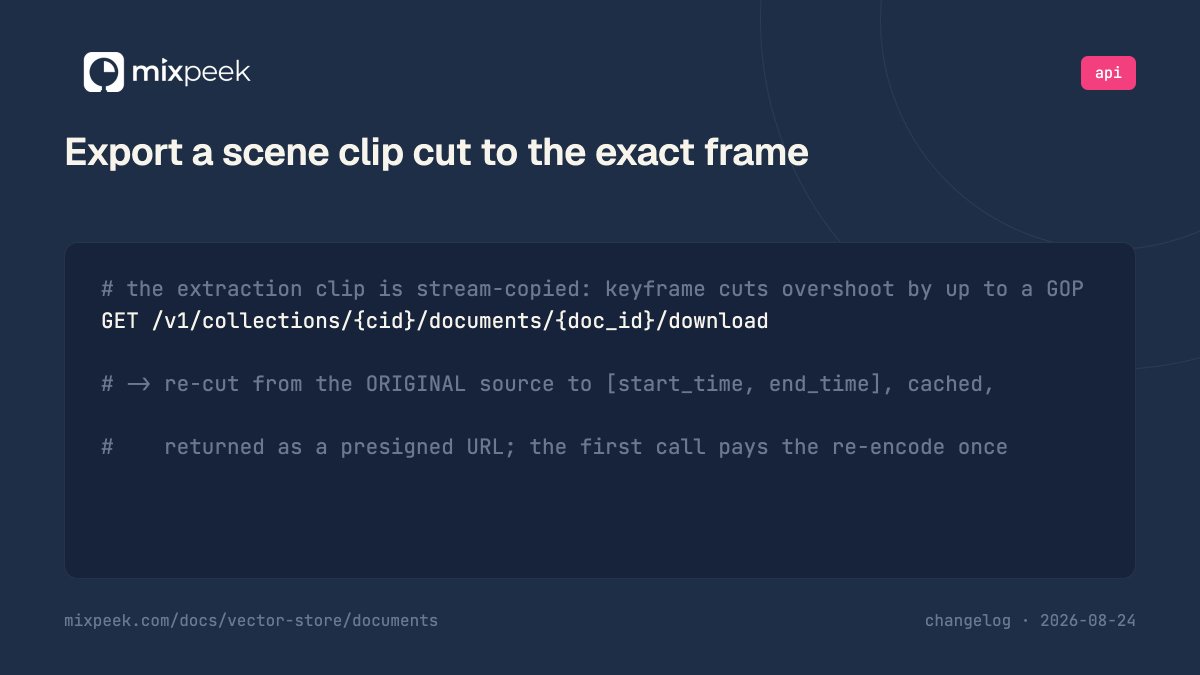
Export a scene clip cut to the exact frame.
The download endpoint re-cuts from the original source, so the clip lands within one frame of the declared range.
https://t.co/zQlLByM95C
Same index, same collection, two query modalities.
Text: "worn leather armchair". Image: an actual photo.
The image query scores 1.0 on itself, then puts a floor lamp among the armchairs. Visual similarity doesn't respect your taxonomy.
OpenAI put GPT Live 1 in the API: a full-duplex voice model that listens and speaks at the same time.
Mixpeek makes every session searchable: recordings land in a bucket, audio extraction runs on arrival, a retriever finds the moment in plain language.
https://t.co/Hsz0HaQBnm
Ingest checks what a file actually is, on every transport.
The magic-byte check now runs on every transport, so a mime hint can no longer skip validation.
https://t.co/8jhaDgBs1F