Presenter, performer & writer bringing history, books & creative learning to life ⚔️📚 Workshops, streams, films & Jump Through History Rep: @EmilyKTalbot
OUT NOW! 🎧⚡
Episode 1 of Jump Through History has launched!
We’re starting with one of England’s greatest royal mysteries:
The Princes in the Tower - What Really Happened?
Listen on Spotify, Apple, Amazon.
Watch on YouTube: https://t.co/aTXqeqaK8C
#schools#teachers
Schools! Teachers! Come and join us for this gloriously summery, celebratory, interactive, ice-cream flavoured FREE online author event! Tuesday 23rd June at 11am! 📚🌞
BOOK NOW via @mrdillypresents or use this link! 📚🌞 https://t.co/WFtGy7YuaA
🏛️⚖️ For a thousand years, the British people governed themselves without the state.
This is how they did it.
A thousand years ago in England, there were no police. There were no prisons. There was no central state strong enough to reach every village.
And yet, somehow, England worked.
The reason was something the Anglo-Saxons had built into the foundations of their society.
They called it frankpledge.
Every man in every village belonged to a group of ten. They were called a tithing. ⚖️
And each man, by law, was responsible for the conduct of every other man in his tithing.
If one man committed a crime, his nine neighbours were responsible for bringing him to justice. If they failed, they paid the fine themselves.
The whole tithing answered for the crime of one man.
📜 The system was given the force of law by King Canute, the Anglo-Danish king who united England in peace. Between 1016 and 1035, Canute decreed that every man over the age of 12 must belong to a tithing.
When the Normans came in 1066, they could have abolished it.
They did the opposite.
William the Conqueror kept the Anglo-Saxon system. And he made it stronger.
⚔️ Twice every year, the Sheriff would arrive in the village. He would call the tithings together. He would check that every man was accounted for.
This was called the View of Frankpledge.
The system held England together for 300 years.
And when the king's courts eventually grew to replace it, two pieces of frankpledge stayed behind.
🔥 The first became the jury.
Twelve neighbours, called to judge another. The same idea, transplanted from the village to the courtroom.
The second became the constable.
The man chosen from among neighbours to keep the peace. Not imposed from above. Chosen from below.
Modern British policing began here. The jury system began here.
The principle that ordinary British people are responsible for ordinary British people began in an Anglo-Saxon village a thousand years ago.
✍️ For a thousand years, we have been responsible for each other.
We do not need the state to teach us how to belong.
━━━━━━━━━━━━━━
This channel has no ads. No sponsors. No state funding.
It is built the same way the tithing was built. By the people who choose to stand in it.
Be part of us 🇬🇧👉 https://t.co/rih7iKwnvf 👈🇬🇧
Be Proud Of Us. 🙏🇬🇧
If you’re doing anything D-Day related next term, there are a lot of free films (from Normandy) and other resources on here. Please feel free to use. Thanks.
https://t.co/4NAnBBqk0e
🇬🇧 Every British river. 🌊🇬🇧
Has a name older than English. Older than Rome. You still say it.
The Thames. The Romans wrote it as Tamesis. But the name they wrote was already old when they arrived.
A pre-Celtic name passed to the Celts, passed to Rome, passed to us. The name has changed only in the shape of the sound.
The Severn. The Welsh called her Sabrina. A river goddess in the Brittonic tongue. And the Severn still carries her name today.
🏞️ The Trent. The Celts called it Trisanton. A name meaning the trespasser. The river that bursts its banks. And it still bursts its banks.
The Avon. The word means river. The Britons called every river the Avon. The English kept the name.
The Tyne. A Brittonic name meaning the flowing one. The Dee. A name meaning the goddess, the holy one. The Britons named her sacred and the English left her sacred.
The Anglo-Saxons came. They renamed villages. They renamed hills. They renamed almost everything they could. But they did not rename the rivers.
The rivers were too holy. The names were too rooted.
And so the Brittonic words stayed in English mouths.
The Britons did not vanish. Their words did not vanish. Their descendants became the British. And the British still name the river the same way. Every time.
🇬🇧 British people speak a language older than English. Every day. Without noticing. The Britons named the water. The British still call it the same.
━━━━━━━━━━━━━━
The river names are not relics.
The villages changed names. The rivers kept theirs.
Help us pass our history downstream. 👇🙏
👉 https://t.co/rih7iKwnvf 👈
Be part of us. ☝️🇬🇧
Be Proud Of Us. 🙏🇬🇧
Taking a tour through the universe with @isabelwriting! "The big questions children ask really matter... asking questions is the beginning of science" Frog gives children and adults the opportunity to explore some of these questions together. That's the power of #InformationBooks
I'm hosting a virtual England #WorldCup quiz on 11th June with @uksla. Kick off day. The idea is to promote reading for pleasure through the game. It is free to members and non-members. Please join us.
(Oh... and this is my brand new England book.)
https://t.co/WQAYqkiSKz
In 600 AD, an English king wrote the first law in our language.
He priced your thumb at 20 shillings and your finger at just 9. 🤯
He gave women the right to own property. 🇬🇧
He bound himself, the king, by the very first judgement.
Six hundred years before Magna Carta.
Three hundred years before England was a nation.
His name was Aethelberht. King of Kent.
He wrote it in English. Not Latin. Not the language of the Church.
Around 90 judgements. From the hair on the head to the nail on the toe — every injury had a price.
Knocking off a man's hat cost 6 shillings. Twice the price of a punch on the nose. 🎩
And then it did something extraordinary. ✨
A widow could keep half her husband's estate.
She could leave with her children.
She could choose.
In the year 600.
The original was lost. ⚖️
But one English monk at Rochester saved it in 1120.
UNESCO calls it the birth of English as a language of the page.
The English have been writing their own laws ever since. 🙏
If you want to preserve the past and help write the next chapter 👇
👉 https://t.co/rih7iKwnvf 👈
Be part of us. ☝️🇬🇧
Be Proud Of Us. 🙏🇬🇧
Great to host the Author Panel & Quiz for the National Reading Champions Quiz 2026 Final 📚with @Literacy_Trust & @ALCS_UK - see the fab @BooksandChokers again & meet, after several Mr Dilly Meets appearances, the equally brilliant @edgechristopher 👏 Fantastic day🥳
Announcement 🧭
Excited to launch Jump Through History – a fun, story‑driven #history podcast for curious kids, families, #teachers & home educators.
🎥Episode 1 lands 1 June
Watch / subscribe on YouTube: https://t.co/GkErALVlBY
#PrimaryHistory#SecondaryHistory#Schools
Our Reading Champions were delighted to receive their prizes recently for achieving 1st place in our regional heat of the Senior National Reading Champions Quiz 2026! Thank you to @literacy_trust and @alcs_uk! We are so excited for the grand final in London next week! 📚❤️🥳
🌿🇬🇧 Every spring, in some corners of 🏴England🏴, a strange thing still happens.
A priest walks through the streets in robes.
Behind him, a group of children carry long willow wands taller than themselves.
They stop at certain stones, certain trees, certain spots on the pavement.
And they beat them.
🌳 This is a ceremony called Beating the Bounds. It is at least a thousand years old.
A thousand years ago, there were no maps. The land was learned by foot.
Anglo-Saxon villages walked their boundaries every spring to remember where their parish ended and their neighbour's began.
A boundary that you had walked, you could remember. A boundary that you had beaten with a stick, you could remember even better.
⚖️ The ceremony had legal weight. If a parish boundary was disputed in court, men who had walked it as boys could give evidence.
One man's seventy-year-old memory was enough to settle a parish lawsuit.
🔥 In 1645, Oliver Cromwell banned it. The Puritans thought the procession too Catholic.
The Restoration brought it back.
📜 In most of England, the ceremony faded with the coming of accurate maps.
But in certain places, it never stopped.
At St Michael at the North Gate in Oxford. At All Hallows by the Tower in London. At Helston in Cornwall. At the Tower of London itself.
In some parishes, the ceremony has been walked for over 600 years without interruption.
The same parishes. The same boundary stones. The same willow wands. The same simple act of remembering where you are.
✍️ We did not need a state to teach us our land.
We taught ourselves.
🇬🇧 The British write their own history. 🏴🏴🏴🍀
━━━━━━━━━━━━━━
Help us remember who we are.👇🙏
👉 https://t.co/rih7iKwnvf 👈
Be part of us. ☝️🇬🇧
Be Proud Of Us. 🙏🇬🇧
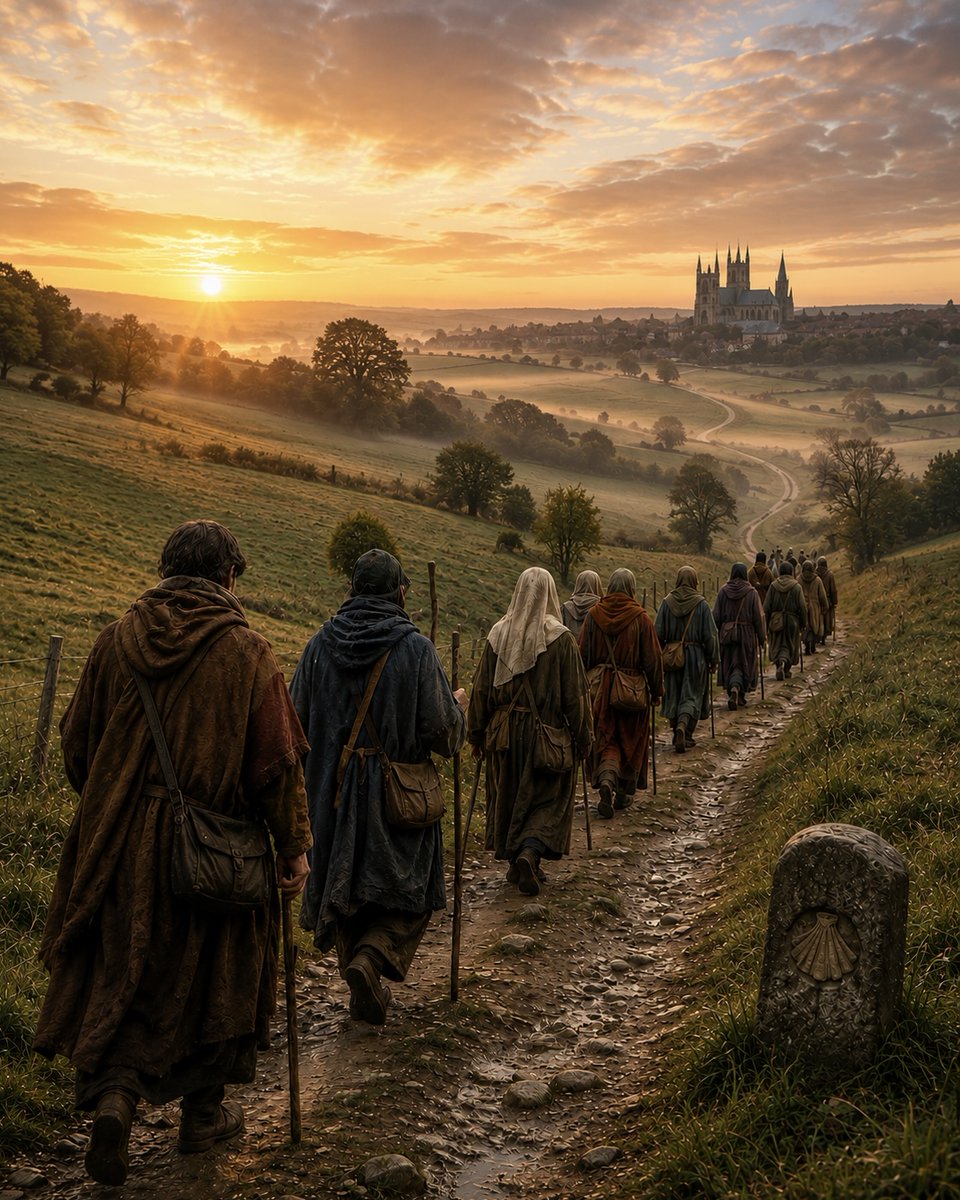
The Pilgrims’ Way stretches for roughly 130 miles across southern England.
Some parts of the route have been walked for over 4,000 years.
Older than the English language itself.
The route links Winchester Cathedral with the shrine of Thomas Becket at Canterbury Cathedral.
After Becket’s murder in 1170, generations of pilgrims crossed these chalk hills and ancient ridgeways on their long journey east towards Canterbury.
Some walked for weeks.
Some crossed entire kingdoms.
In places, the path is still worn deep into the earth by countless footsteps across hundreds of years.
The route passes through ancient woodland, old churches and chalk downs that medieval pilgrims would still recognise.
England’s oldest roads were not engineered. They emerged slowly through centuries of human movement.
Have you ever walked part of the Pilgrims’ Way?
Follow @oaksandlions for more posts about English history.
#England #EnglishHistory #EnglishHeritage #Countryside #PilgrimsWay
We're proud to be part of the Libraries Alliance – a partnership of organisations working to strengthen and champion libraries of all kinds. We have a shared vision of 'Libraries Through Life,' illustrated in this short film. Read more: https://t.co/wW68JJZWC8
School Library Association CEO, Victoria Dilly will give evidence to the Education Select Committee today, as a part of their inquiry into the decline in children reading for pleasure. This a significant moment for #schoollibraries. Watch live online: https://t.co/uI4XLgP0g7 #RfP
🇬🇧 Most British schoolchildren are taught about Magna Carta.
They are taught it was sealed in twelve fifteen at Runnymede.
They are taught it is the foundation of English liberty.
They are taught it is one of the most important documents in human history.
They are not taught what came next.
They are not taught about the eighty years between twelve fifteen and twelve ninety-five when ordinary Englishmen forced three successive kings to write down, for the first time in any kingdom in medieval Europe, what English law was, what English liberty was, and how an English king must govern.
They are not taught about the Charter of the Forest, which restored the right to graze, gather firewood, and live on common land, and which remained in force for seven hundred and fifty-four years.
They are not taught about the Provisions of Oxford in twelve fifty-eight, often called England's first written constitution, which placed the king under a council of fifteen and required Parliament to meet three times a year.
They are not taught about the Provisions of Westminster in twelve fifty-nine, which subjected the barons themselves to the same law they had forced upon the king.
They are not taught about Simon de Montfort, an earl born in France who died for England, who summoned the first Parliament in English history to include ordinary commoners alongside the great lords.
They are not taught about the Statute of Marlborough in twelve sixty-seven, which is the oldest piece of statute law in the United Kingdom still in force today. ⚖️
Seven hundred and fifty-nine years old.
If you've ever taken a debt to court in England, you've used it. 🏠 If you've ever rented a home, you've been protected by it. 👑 If a creditor can't lawfully drag your possessions into the street to settle what you owe, that's because of a law signed seven hundred and fifty-nine years ago.
They are not taught about the Model Parliament of twelve ninety-five, summoned by Edward the First, which became the shape of every English Parliament since.
Eighty years. Three successive kings. The first written constitution in any kingdom in medieval Europe.
It was not given to them. It was not handed down from God or king or Pope.
✍️ It was written. By Englishmen. For England.
🇬🇧 The British write their own history. They always have.
This one needed more than a thread. The full story is in our video, watch it below 👇
Help us remember who we are. Help us remember every British achievement. 👇🙏
👉 https://t.co/rih7iKwnvf 👈
Be part of us. ☝️🇬🇧
Be Proud Of Us. 🙏🇬🇧