(1/x) 🧙♂️A Consolidation of my thoughts on current state of Crypto and future Opportunities into 2024:
- #BTC ( Metaprotocols / L2 / ETF )
- $SOL / $ETH
- T̶h̶o̶u̶g̶h̶t̶s̶ ̶o̶n̶ ̶M̶e̶m̶e̶c̶o̶i̶n̶s̶
- Data Availability ( $Tia/Avail/Eigen) + $NEAR
- OP/ARB & #Polygon
I’ll forever be bullish on crypto.
I think we overestimated how quickly crypto would become the next major computing paradigm. A lot of people were searching for the next platform shift and assumed it would be crypto, but in many ways that ended up being AI.
Over the past decade, ton of capital flowed into crypto, and much of it went toward overbuilding. Instead of focusing on a handful of narrow sectors where crypto had a clear advantage, the industry tried to reinvent everything all at once. What we’re seeing now is a natural pullback and consolidation after that period of excess
I don’t think the core thesis is broken by any means. Crypto’s biggest success may not be apps first (even though we have a few), but rails first. As stablecoins, wallets, tokenized stocks and onchain financial infra via neobanks reach every human and eventually every AI agent, crypto becomes the default settlement layer of the internet.
Once those rails are everywhere, many of the ideas that arrived too early like DAOs, decentralized marketplaces, machine to machine payments, and the ideas Vitalik wrote about in the early days of Ethereum may finally have the distribution needed to get it off the ground.
idc what investment decisions you make as you should make that yourself always but the comms critique is very poor here, as someone who's been through over a dozen of these
the team:
i) immediately disclosed and highlighted their plan. and gave a timeline
ii) it was patched
iii) the second it was patched, they communicated it
iv) after a way forward was determined by listening to holder feedback, next steps were announced
anything else would've been either shady, a lie, or centralized
the specific language used is a fair critique IMO but the cadence of comms is not. and there isn't just one team, theres like 5 at least. thats how Decentralization works. there's no corporate PR department as if it's a single company
anyway, encrypted money is gonna win
I have friends who were early Bitcoin investors. I met them in 2014 at various Bitcoin meetups. None of them have X accounts, and they often make fun of me for having one.
One of them owns a hotel in Greece, in Halkidiki. He’s living his best life, and from time to time we meet at his hotel.
Recently, he was joking with me about posting on X and trying to convince people that Bitcoin is the best asset of our lifetime. He said: “You can’t change people’s karma. Everyone creates their own aura. If someone lives in an aura of poverty, you can’t change that, even if you forcefully give them Bitcoin. A day later, Trump will tweet something negative, they’ll sell it, and then gamble the money on who will become President in 2028.”
I asked him, “What about those who have an energy of prosperity?”
He replied: “Those who have an energy of prosperity won’t pay much attention to Bitcoin’s short-term price action. We became this successful because when we discovered Bitcoin, the flow of information wasn’t this overwhelming. All we had was each other, and no one was constantly using psychological pressure to try to shake us out.”
I asked him to create an X account and help people who, like him, started from less than zero. (By the way, he didn’t start from zero - he started with debt inherited from his family line.)
I suggested that helping others break free from financial slavery could be a way of giving back to the world that had given him so much.
He refused, even though he has plenty of free time. He said that society often destroys the very people who contribute the most when doing so serves its own interests. As an example, he pointed to Saylor and the way the Bitcoin community treat him.
@EliBenSasson@IIICapital@gazza_jenks Sure of course. But then Zcash supply exist both in Transparent Pool and also Shielded pool. While Transparent pools can be easily detected, the Risk at the Shielded pool will also ultimately affect all ZEC holders, whether it is transparent ZEC or not.
Bitcoin and Zcash are complements, not competitors.
Supply certainty and strong privacy are both important properties of a self-sovereign money, and you can't fully get both in a single money system.
I'll explain...
Self-sovereign money means no one can mess with your funds. It means no one can block your transactions, debase your currency, or spy on your finances and then use that information to coerce you. For a money system to credibly deliver those features, it must have the following properties:
1) Sufficient decentralization, so no practical chokepoint can block you, freeze your funds, or force arbitrary changes to the rules.
2) Full supply auditability, so you can verify from the public ledger that nobody is debasing your money.
3) Strong privacy, so your financial activity does not subject you to coercion risk.
Bitcoin provides #1 and #2, but not #3.
Zcash provides #1 and #3, but not #2.
And critically, it is (or at least seems!) fundamentally impossible to engineer a system that offers full transactional privacy while also allowing anyone to run a full transparent audit of the entire supply without trusting other people’s code to be bug free.
Think about how privacy and auditability are achieved. If a chain hides transaction amounts, external observers cannot independently check the total supply from the raw public ledger. You are forced to trust the cryptography, the system design, and the implementation. An inflation bug in a shielded system could in theory stay hidden inside the same privacy that protects users’ transaction information. This opens the door to the possibility of *undetectable* inflation bugs.
By contrast, on a transparent chain like Bitcoin, any inflation bug is visible in the raw data. Anyone with a copy of the blockchain can audit the supply without trusting the code to work precisely as devs intend it to. Thus the entire class of undetectable inflation bugs does not exist in Bitcoin.
This appears to be a fundamental structural truth: you cannot have both full privacy and full transparent supply auditability in a single money system.
Hence, Bitcoin and Zcash are complements, not fundamentally competitors. If someone wants strong financial self-sovereignty and protection against the usual attack vectors on your money - inflation and coercion - you cannot fully get both types of protection by just owning/using either BTC or ZEC.
That said, there are, of course, hybrid approaches which mitigate the attack vectors for both somewhat. Zcash has turnstile accounting, which limits the vector (magnitude and velocity) of a theoretical shielded-pool inflation bug before it is detected. And on the Bitcoin side, you can jump through some hoops to use Bitcoin in a much more private manner than is typical.
Yet the fundamental tension remains. Transparent money protects you from hidden inflation. Private money protects you from surveillance and coercion. Those are different protections, which likely cannot strongly coexist in a single money system.
(and to be clear: I’m not intending to address relative value here, nor the myriad other tradeoffs in using or holding BTC vs ZEC. The above is intended as a high-level theoretical framework for thinking about the key properties you want in self-sovereign money, and what you can and cannot reasonably expect to get from the idealized versions of assets that are natively great at one property, but not another. You can decide for yourself how much you value each property, and then what tradeoffs you may or may not be willing to make to express your view in practice.)
Exactly. The issue wasn't about the "EXISTENCE" of the soundness bug. It is about the "DETECTION" of it. And the timing between the exploit and the detection.
@EliBenSasson yeah the takes on the timeline are not good
similar bugs can be (and have been) found in bitcoin it’s not special
BUT with zcash you can hypothetically counterfeit coins and spend them undetected for days/weeks/months/years
with btc you can’t
An unfortunate example of why I've long said not to expect Bitcoin to implement strong cryptographic privacy at the base layer.
Doing so greatly increases risk of undetectable monetary supply inflation. Few folks value privacy more than supply integrity.
https://t.co/fv3LioJXW9
The way to understand the ZCash bug is it’s not infinite mint of ZEC itself. It’s more like the shielded pool (Orchard) could become insolvent. Think of it more like the KelpDAO hack for ETH.
Very little reason not to proactively unshield any ZEC today. Being early to the exit is always better in a bank run. Consider Orchard burned, and don’t re-shield until there’s a new pool with a clean history
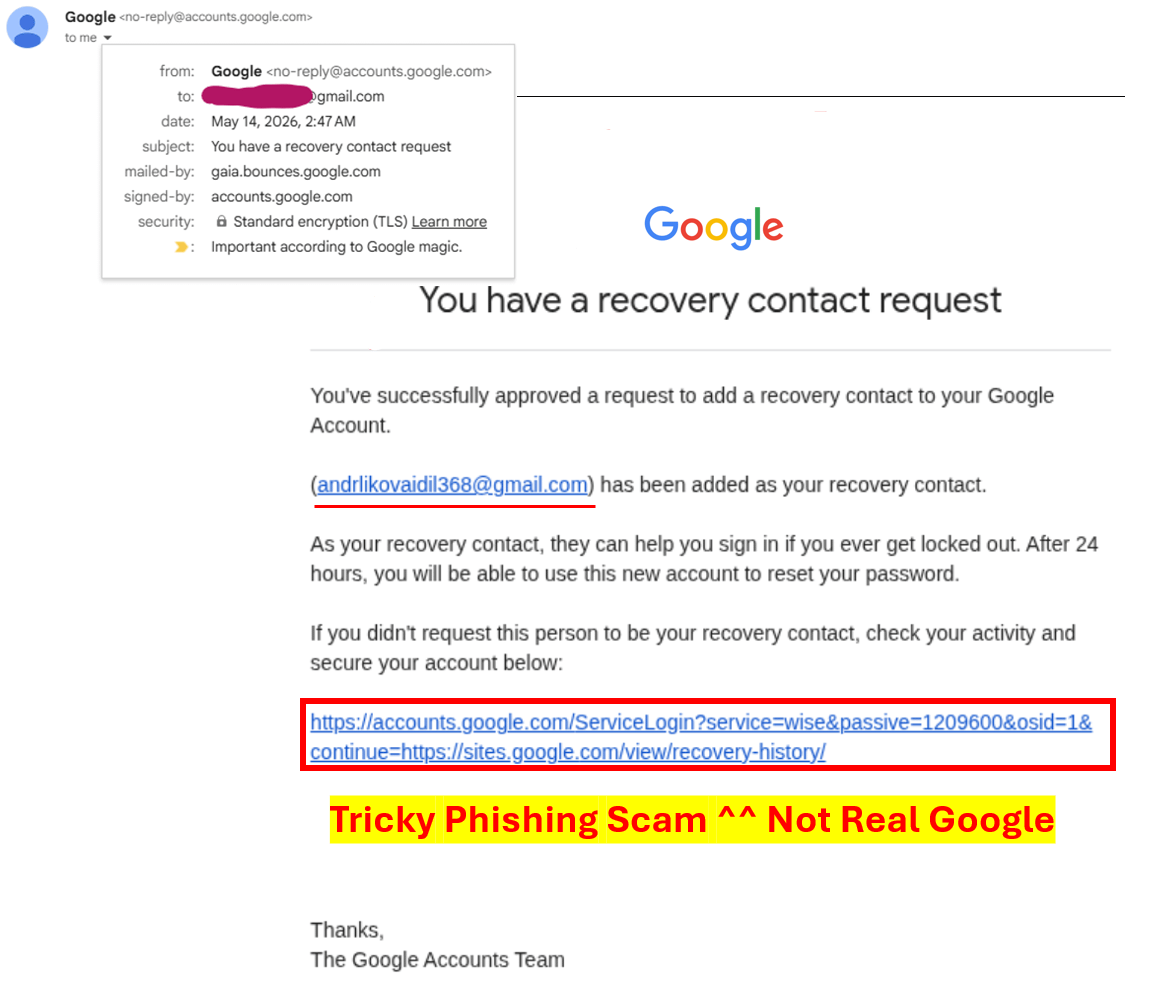
🚨Convincing Scam Alert: Not All Google Sites Are Legit🚨
Scammers are using Google Sites (an intuitive website builder from Google) to host scam pages under what appears to be a “legit” Google domain…
> Scammers spoof emails pretending to be Google
> Immediate panic because it looks like someone successfully added a foreign recovery contact email, which can feel like your account has been hacked
> The user does not look closely at the link and clicks it because it looks like a legit Google notice
> User lands on a phishing website and enter their login credentials into a fake sign-in page
> The scammer now has access to the email account
Anyone can use Google Sites to create a website and host it on the Google Sites domain. Scammers are exploiting this and using Google’s own tools to impersonate Google with fake recovery emails, “unauthorized login” alerts, fake subpoena requests, “attempted login” notices, and prompts to sign in to verify, among others…
The security rule of thumb is to NEVER click a link in an email. Instead, go to the source of truth, in this case directly in your email or Google account.
Stay Safe & Stay Vigilant
Phishing and social engineering are getting more sophisticated at an exponential rate due to AI.
Proton just let a phishing email go through to my inbox that I think will compromise tens of thousands of folks.
How it seems to work: someone added my email to a real Google Group. They then sent out a message to all members of the group with subject line "Your Google data has been exported."
Obviously this will cause many people to panic. The email went through to my inbox because it came from a legit google group from a legit Google URL.
All links in the email look totally normal – unless you look at the link for "Cancel request" button. But amazingly this one also seems to come from a genuine Google URL – a URL shortener from Google! goo[dot]gl/XXXXX (not putting the real URL here).
Then it takes you to (1) a Recaptcha screen and then (2) a genuine looking Google account login screen. It's hosted on a Google site (sites[dot]google[dot]com) so everything looks legit.
Because all links are technically hosted by Google, this is very very bad.
@frankdegods Your SS literally show, he had to prompt it specifically. General prompting like the example you gave, did not produce any result and doesn't work. 🤦🏻♂️.
Why is crypto not going up while everything is?
Because a large majority of you cunts spent the last cycle promoting garbage negative sum meme coins to newcomers
Now those people hate crypto and your meme coin is worth zero regardless while some scamming cunt drives a new lambo
@camolNFT https://t.co/dsuc00zXkH
Literally this. Even the top cryptographers says it's a FUD. That said fully agree that Bitcoin should still upgrade to quantum-proof.
My turn to call out quantum FUD.
The new “we improved on Google’s Bitcoin-breaking quantum circuit” story is, in my view, a nothingburger.
Roughly: Google obscured details of a particular circuit. Researchers reverse-engineered it and found a more efficient way to describe/optimize that circuit.
Interesting? Sure.
Does it change the big picture for Bitcoin, Ethereum, or cryptographic signatures? No.
The question that matters is not “can we shave down circuit size again?” We’ve seen those estimates improve for years.
The question that matters is whether anyone can build a machine with 1,000+ reliable logical qubits and run it at scale.
This is not that news. Not today.


![zherbert's tweet photo. Phishing and social engineering are getting more sophisticated at an exponential rate due to AI.
Proton just let a phishing email go through to my inbox that I think will compromise tens of thousands of folks.
How it seems to work: someone added my email to a real Google Group. They then sent out a message to all members of the group with subject line "Your Google data has been exported."
Obviously this will cause many people to panic. The email went through to my inbox because it came from a legit google group from a legit Google URL.
All links in the email look totally normal – unless you look at the link for "Cancel request" button. But amazingly this one also seems to come from a genuine Google URL – a URL shortener from Google! goo[dot]gl/XXXXX (not putting the real URL here).
Then it takes you to (1) a Recaptcha screen and then (2) a genuine looking Google account login screen. It's hosted on a Google site (sites[dot]google[dot]com) so everything looks legit.
Because all links are technically hosted by Google, this is very very bad.](https://pbs.twimg.com/media/HJ-c-53XUAE3wKr.jpg)




![zherbert's tweet photo. Phishing and social engineering are getting more sophisticated at an exponential rate due to AI.
Proton just let a phishing email go through to my inbox that I think will compromise tens of thousands of folks.
How it seems to work: someone added my email to a real Google Group. They then sent out a message to all members of the group with subject line "Your Google data has been exported."
Obviously this will cause many people to panic. The email went through to my inbox because it came from a legit google group from a legit Google URL.
All links in the email look totally normal – unless you look at the link for "Cancel request" button. But amazingly this one also seems to come from a genuine Google URL – a URL shortener from Google! goo[dot]gl/XXXXX (not putting the real URL here).
Then it takes you to (1) a Recaptcha screen and then (2) a genuine looking Google account login screen. It's hosted on a Google site (sites[dot]google[dot]com) so everything looks legit.
Because all links are technically hosted by Google, this is very very bad.](https://pbs.twimg.com/media/HJ-d829X0AEyrX5.jpg)





