One of the most interesting parts of Ethereum’s post-quantum roadmap isn’t the specific PQ signature schemes it’s researching.
It’s crypto-agility.
Today, ordinary Ethereum accounts are tied to ECDSA/secp256k1. Ethereum’s proposed Frame Transactions (EIP-8141) would change that by making authentication programmable at the account level.
In simple terms, Ethereum would stop mandating a single signature scheme for ordinary accounts and instead let accounts define their own verification logic.
With Frame Transactions, a user could migrate from ECDSA to a post-quantum signature scheme, and later from that scheme to another one, without Ethereum needing a hard fork every time the cryptography changes.
This is what crypto-agility is all about, and what we’ve been raving about for some time now. If a PQ scheme is weakened, broken, or simply superseded, you want to be able to replace it without redesigning the protocol.
What Ethereum is trying to introduce at the account layer is conceptually very similar to something CKB already gets from its architecture.
On CKB, ownership isn’t hardcoded to one signature algorithm. Instead, Cells are protected by Lock Scripts: verification programs executed by the RISC-V-based CKB-VM.
A Lock Script can verify secp256k1 or SPHINCS+/SLH-DSA today, or some entirely different signature scheme introduced in the future.
The base layer doesn’t need to be redesigned around each new scheme. It simply executes the verification program.
It’s very cool to see a leading chain like Ethereum converging on the same conclusion CKB arrived at seven years ago:
Blockchains shouldn’t be built around the assumption that today’s cryptography will still be tomorrow’s cryptography.
[1/7] 👀 Tracking #Nervos CKB Community Fund DAO proposals shouldn’t mean jumping between forum threads, voting pages & update posts.
So I built a dashboard, with #AI turning my requirements into a working product.
Explore it 👇
https://t.co/F39rgcZGSs
In 7 years of being in crypto I don’t think I’ve seen so many active builders on nervos network, glad to see devs are paying attention to a tech that’s been ahead of its time. $ckb bitcoin:native
⚠️ Notice for UTXOSwap Liquidity Providers: Withdraw Before 10 October 2026, 16:00 UTC
UTXOSwap has announced that its service will shut down on 10 October 2026 at 16:00 UTC.
If you have liquidity in UTXOSwap pools, remove all of it before this deadline. Please act well in advance.
CKBA does not operate UTXOSwap and is not managing its shutdown. We are sharing UTXOSwap’s notice to raise awareness and help liquidity providers act in time.
Read the original notice on the UTXOSwap website 👉 https://t.co/0DZdvqnN4u
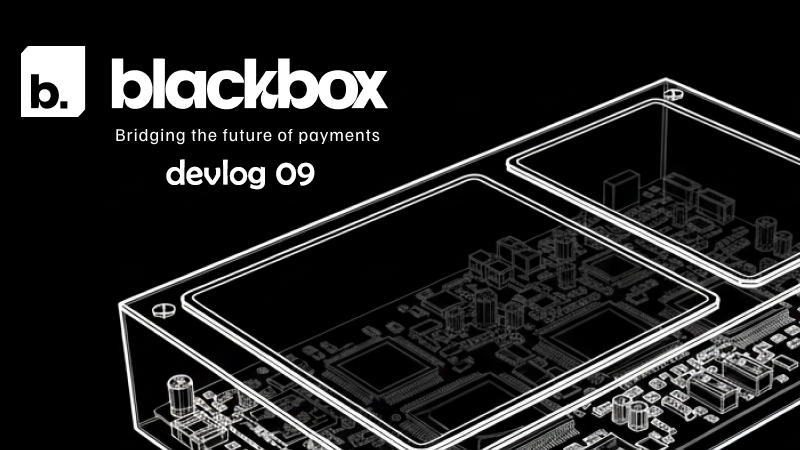
Blackbox Devlog #9: Bitcoin support added! Plus, a purpose-built PCB
Three developments this fortnight at three different distances from a shipping product: the new board is running, #Bitcoin is in as a new payment rail, and for the first time Blackbox has a custom-designed circuit board.
Bitcoin payment support:
- Receive-only, with no private key on the device; the merchant scans their Bitcoin wallet's public key and each sale derives a fresh receive address
- Two distinct settlement states: SEEN means unconfirmed on the network; VERIFIED means the terminal has validated a cryptographic proof against block headers it audited itself, from a firmware checkpoint upward through proof of work and consensus rules. A connected server can help locate a payment; it cannot fabricate one
- Sixteen test suites run against real mainnet and signet vectors
- Disabled by default; running on signet until the hardware checkpoint passes
First purpose-built PCB:
- A circuit board designed around Blackbox's own requirements rather than repurposed from a development board
- ESP32-S3, 5-inch 800x480 display, 4 layers, single 3.3V rail, printer, scanner, NFC, and microSD; 193 footprints, 125 nets, ERC clean and routed
- Design generated from a source model: schematic, PCB, BOM, placement file, pinout doc, and firmware pin header all produced from two Python files, with automated checks re-validating pin assignments on every build
- Errors caught before copper include a level translator wrong on all five signals, a shorted eFuse footprint, a printer inrush of 200A resolved with a Miller capacitor ramping it to 1.4A over 6.6ms, and over-voltage protection set to the printer's 9V limit
- Not yet sent for fabrication; six blockers remain
The new board is running:
- The VIEWE S3 boots, renders, takes touch, and talks to the testnet indexer
- First real action: resolved a merchant address to its funding block, verified against a prediction rather than accepted at face value
- Printer confirmed working via its own self-test print before any firmware interaction
- Scanner driver reworked: a non-responsive handshake no longer marks the scanner absent; the driver falls back to listen-only mode and reads decoded barcodes as plain text
Light client sync start:
- A light client needs to know where on the blockchain to begin; too low wastes hours, too high silently misses incoming funds while reporting healthy
- Start height now has explicit provenance: pulled from the provisioning bundle if present, otherwise a one-time setup screen offers a live indexer lookup or manual entry
- Manual entry validated asymmetrically: above the chain tip is refused, just under it warns; a failed lookup sets nothing rather than defaulting to zero
Next: re-run light client bootstrap checks through a real scanner, complete the Phase 1 hardware checkpoint, take the first Bitcoin payment on the device over signet, and measure a panel for the PCB.
Full devlog: https://t.co/6KKOMVDEI5
Some ideas got tested in the real world. Some moved onto testnet. Some took a different turn entirely. 👀
Dular wrapped up its pilot after testing Fiber payments with 30 users in Kenya, FiberNuts (by @Code3ks) opened its Fiber + Cashu community market demo, and @LusoCryptoLabs tried using `.cell` names as human-readable Fiber payment endpoints.
There are also new experiments around P2P trading, payment + service delivery, and node recovery tools.
⚡ Catch up on what Fiber builders have been working on: https://t.co/1OXQPjiAz7
And thus we observe the return to verification-centric architectures (realized and idealized by UTXO chains like @NervosNetwork and Bitcoin).
Whether by means of cryptography or other forms of succinct verification, the concept is the same: don’t replicate globally what need not be replicated globally.
🔄 DAO Proposal Sync (Discussion Phase)
Project: Kaze × CKB UniTour - Kenya Stage 2
reached 35 likes within the 7-day discussion window and is now eligible to proceed to the Metaforo voting stage.
Proposal link: https://t.co/DuExrggynk
1/4
Building in the open on @NervosNetwork is thrilling.
So the team here @_Lucentlabs joined the @NervosNetwork community to explore building DeFi on the Nervos Blockchain. We thought a native Nervos DEx is a great start, and guess WHAT, we gave it a try by spinning up PoC.
Most payment networks are islands. Fiber is being built to reach the biggest one next door.
Fiber and Lightning share the same basic machinery, payment channels and multi-hop routing, so a Cross-Chain Hub can sit between them and link a payment on one network to a payment on the other.
Say Alice holds assets on Fiber and wants to pay Bob, who only takes BTC over Lightning.
The hub accepts her Fiber-side payment and makes the matching Lightning payment to Bob, and the two are tied together by the same cryptographic secret, so revealing it to settle one side is what settles the other.
The hub provides liquidity and connectivity, not custody.
It cannot claim the incoming payment without making the outgoing one, because if the condition is not met in time, both sides unwind.
See what's being built on Fiber 👉 https://t.co/iknGMeffMh
People ask why we'd build a Fiber SDK that helps projects beyond our own wallet. 🌱 Because we're not just building on Nervos, we're building for it. Bitcoin and Nervos are both first-class here, and shared tooling makes the whole ecosystem stronger. @NervosNetwork
$CKB’s token does two jobs at once.
It’s money. It’s space and the rent system is properly clever.
Here’s a clever bit of how CKB works. Its token basically does two jobs, and behind that sits one of the smartest economic designs in crypto.
If you saw my storage video, you’ll remember the $CKB token isn’t just money, it’s also space. You lock CKB to store data on the chain, one token roughly equals one byte. So it’s gas and it’s storage, in one.
Here’s where it gets interesting. CKB has two kinds of new supply. The first is just like Bitcoin, capped, halving over time, paid to miners. The second is a small, steady inflation, and it does a genuinely clever job. It works like rent. If you’re hogging loads of storage on the chain, that inflation charges you for it over time. You pay for the space you use.
But if you’re just a long-term holder not using storage, you don’t want to be diluted by that. So there’s a shelter called the Nervos DAO. Lock your idle coins in it, and you earn back exactly what the inflation would’ve taken.
So you’re not diluted.
So the same token is Bitcoin-like and deflationary for holders, but charges rent to the people using space. Pretty clever
Paying for something with crypto shouldn’t have to mean publishing every purchase to a permanent public ledger.
With payment channels, individual payments happen through signed balance updates exchanged off-chain. Thousands of payments can take place without creating thousands of public blockchain transactions.
That offers a privacy benefit, though it isn’t perfect anonymity: routing nodes can still observe some information, and timing or network activity can reveal more.
Our guide explains how payment channels reduce what gets published, and how the blockchain still protects the funds 👇
https://t.co/hy9UgJRNCk
⚠️ Notice for UTXOSwap Liquidity Providers: Withdraw Before 10 October 2026, 16:00 UTC
UTXOSwap has announced that its service will shut down on 10 October 2026 at 16:00 UTC.
If you have liquidity in UTXOSwap pools, remove all of it before this deadline. Please act well in advance.
CKBA does not operate UTXOSwap and is not managing its shutdown. We are sharing UTXOSwap’s notice to raise awareness and help liquidity providers act in time.
Read the original notice on the UTXOSwap website 👉 https://t.co/eeDz6d2iKz
A Fiber node can now run entirely inside a Chrome extension, with no separate app or server behind it.
Chrome normally puts an extension’s background worker to sleep when it’s idle, which is a problem for a node handling payments.
Fiber gets around this by running in a Chrome Offscreen Document: a hidden browser page that keeps the node active even when you close the extension’s popup.
Under the hood, this setup requires SharedArrayBuffer access, cross-origin isolation, and a content security policy that permits WebAssembly and worker threads.
For now, it’s limited to Chrome-based browsers. Firefox and Safari don’t yet support the same extension setup.
Check the full build walkthrough👇
https://t.co/6F8iIJjdLH
The basic logic behind payment channel networks like Lightning or Fiber is based on a simple question: why involve the whole network?
If two parties want to make 10,000 micro payments to each other, does the entire blockchain need to process all 10,000?
With scaling solutions like Lightning and Fiber, it doesn’t.
The parties commit funds onchain, then exchange signed updates to their balances directly. The blockchain remains available to settle the channel and enforce those balances if cooperation breaks down.
This allows crypto to move quickly and inexpensively while preserving a non-custodial setup.
Although not with without trade-offs, it’s arguably the best solution we have for permissionless micro and streaming payments—payment modalities that the machine economy will be built on.
Dive deeper into the ins and outs of offchain payments with our latest guide 👇
https://t.co/hy9UgJRfMM
Rollups and payment channels both move activity off the base layer, but they optimize for different jobs.
A rollup executes transactions in a separate environment, batches them, and submits data and proofs or state commitments to the base chain for verification or challenge.
That makes rollups a good fit for applications where many users interact with shared state, such as decentralized exchanges, lending markets, and games.
Payment channels take a more specialized approach.
Two parties lock funds in an on-chain contract, then exchange signed balance updates directly. The blockchain steps in to open or close the channel, or enforce a valid balance if needed.
If the goal is scaling a shared application, a rollup is a natural fit.
If the goal is moving value between parties frequently, quickly, and inexpensively, payment channels are built for the job.
Fiber brings that channel model to CKB. Try it yourself 👇
https://t.co/yfSHXyhSQl
$CKB’s builder scene is busier than you think.
Dozens of open-source projects live on the CKBuilders tracker. Right now.
The CKBuilders tracker just updated and there are dozens of projects on there. All open source, all being built on $CKB right now, and honestly, some of them are properly cool. There’s a top-down survivor game running on Fiber, actual gaming on a Bitcoin-secured payment layer. There’s a football prediction market where you can bet on matches. There’s a jobs marketplace, and a brand new orderbook exchange being built.
That’s just scratching the surface. You’ve got inheritance vaults that lock funds on a timer, identity tools, proof-of-participation systems. Games, finance, identity, the lot.
Now, to be fair, a lot of these are early, MVPs and proof-of-concepts, not finished mass-market apps. That’s not the point. The point is the builders are actually here, building.
That’s what’s making CKB stronger.


![JackyLHH's tweet photo. [1/7] 👀 Tracking #Nervos CKB Community Fund DAO proposals shouldn’t mean jumping between forum threads, voting pages & update posts.
So I built a dashboard, with #AI turning my requirements into a working product.
Explore it 👇
https://t.co/F39rgcZGSs https://t.co/TspubzsPIn](https://pbs.twimg.com/media/HTSnf0haIAAScPR.jpg)