The hardest part of a proactive agent is deciding what deserves attention.
When should it act on its own? When should it ask for approval? When should it stay quiet?
I like that DeepSeek is treating these as core design questions. The next step is measuring how well those decisions work.
I’d love to see more agent demos show the decisions behind the action.
When did the model act? When did it ask for confirmation? When did it correctly stay silent?
That’s where agent judgment becomes measurable.
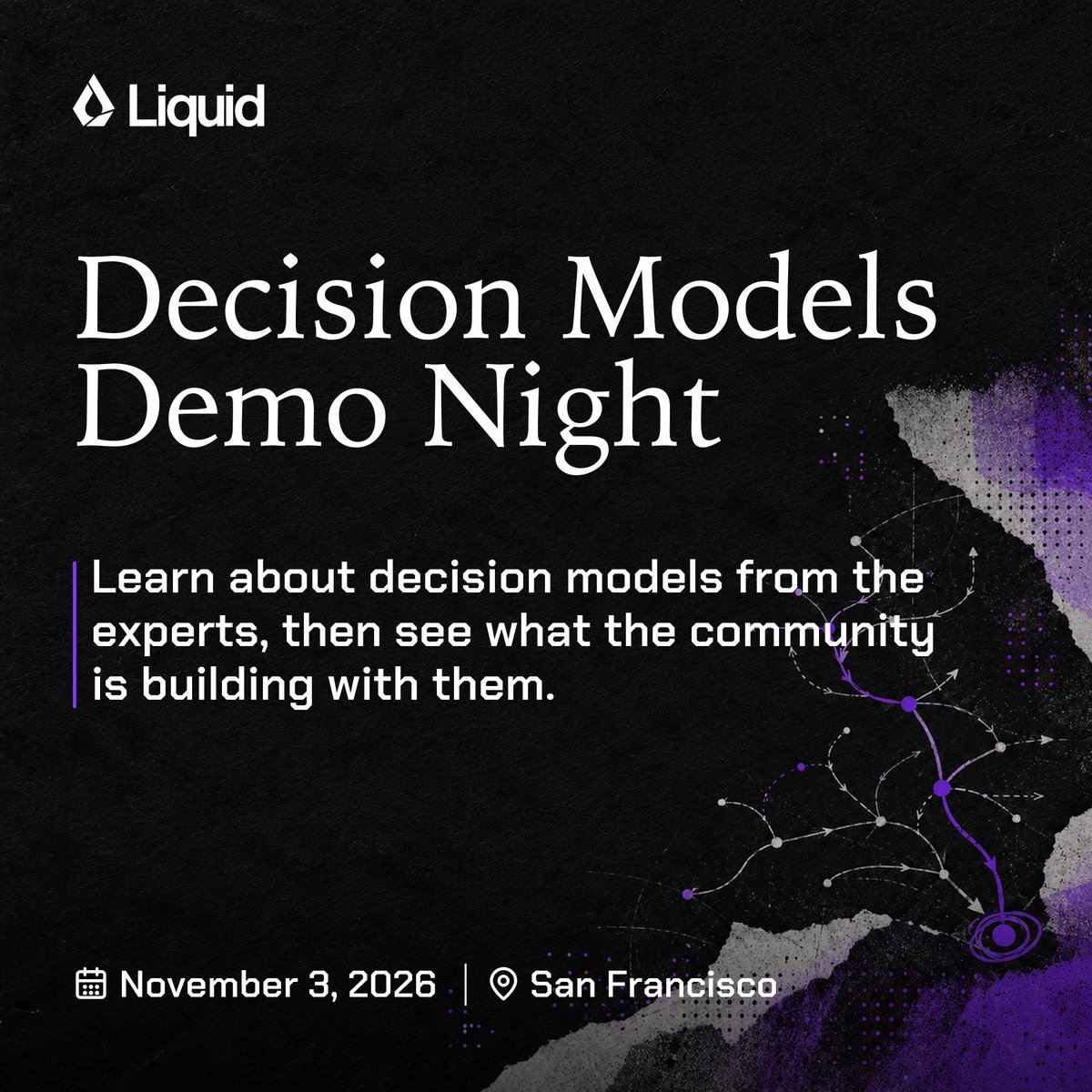
SF builders! 🚨 Last few demo spots for Decision Models Night (Nov 3)!
@maximelabonne will share how we trained our decision models + how to use them.
Built something? Come show it off! Just 5 mins, scrappy prototypes welcome 🙌
👉 Apply here: https://t.co/HhNM1J9GS6
The economics of local AI get interesting when agents run continuously in the background.
A personal agent that understands context, learns preferences, and makes decisions throughout the day has very different requirements from a chatbot responding to questions.
What excites me about LFM3 is what smaller, capable models make possible on everyday devices.
Imagine personal agents that understand what’s happening around you, remember what matters, and know when to help.
Proud of the Liquid AI team! 💧
Introducing 𝙻𝙵𝙼𝟹: our new generation of Liquid Foundation Models. With a new tri-hybrid architecture and new multimodal encoders, the LFM3 family is the ideal model suite for specialized intelligence.
> 6 model instances, across text, audio, vision, and omni modalities, generative and decision models.
> 𝙻𝙵𝙼𝟹-𝟷.𝟽𝙱: text, 256k context window.
> 𝙻𝙵𝙼𝟹-𝚅𝙻-𝟸𝙱: vision-language model with video-input support for spatial understanding
> 𝙻𝙵𝙼𝟹-𝙰𝚞𝚍𝚒𝚘-𝟸𝙱: tool calls, voice chat, reasoning in 18 languages.
> 𝙻𝙵𝙼𝟹-𝙾𝚖𝚗𝚒-𝟸𝙱: an omni model combines vision, audio, and language.
> 𝚍𝟷-𝟸𝙱 and 𝚍𝟷-𝙾𝚖𝚗𝚒-𝟸𝙱: decision models with typed outputs and calibrated probabilities in a single pass. Omni adds audio input.
> fine-tune on 1 GPU.
> a new tri-hybrid architecture
> architecture optimized for 14 processor classes across GPUs, CPUs, and NPUs.
> 𝙻𝙵𝙼𝟹-𝚅𝙻-𝟸𝙱 is a beast. It performs competitively with Gemma 4 12B (6x larger), and Gemini 3.5 Flash Lite, and GPT-5.6 Luna, with 1.9B parameters.
> 𝙻𝙵𝙼𝟹-𝟷.𝟽𝙱 is #1 on the Pareto frontier of device intelligence 𝚙𝚒𝚙𝚎𝚝𝚝𝚎.𝚕𝚒𝚚𝚞𝚒𝚍.𝚊𝚒
Every modality for specialized intelligence. Pick the one that fits your use case, customize it, and run it on-device.
1/ 🧵
Introducing 𝙻𝙵𝙼𝟹: our new generation of Liquid Foundation Models. With a new tri-hybrid architecture and new multimodal encoders, the LFM3 family is the ideal model suite for specialized intelligence.
> 6 model instances, across text, audio, vision, and omni modalities, generative and decision models.
> 𝙻𝙵𝙼𝟹-𝟷.𝟽𝙱: text, 256k context window.
> 𝙻𝙵𝙼𝟹-𝚅𝙻-𝟸𝙱: vision-language model with video-input support for spatial understanding
> 𝙻𝙵𝙼𝟹-𝙰𝚞𝚍𝚒𝚘-𝟸𝙱: tool calls, voice chat, reasoning in 18 languages.
> 𝙻𝙵𝙼𝟹-𝙾𝚖𝚗𝚒-𝟸𝙱: an omni model combines vision, audio, and language.
> 𝚍𝟷-𝟸𝙱 and 𝚍𝟷-𝙾𝚖𝚗𝚒-𝟸𝙱: decision models with typed outputs and calibrated probabilities in a single pass. Omni adds audio input.
> fine-tune on 1 GPU.
> a new tri-hybrid architecture
> architecture optimized for 14 processor classes across GPUs, CPUs, and NPUs.
> 𝙻𝙵𝙼𝟹-𝚅𝙻-𝟸𝙱 is a beast. It performs competitively with Gemma 4 12B (6x larger), and Gemini 3.5 Flash Lite, and GPT-5.6 Luna, with 1.9B parameters.
> 𝙻𝙵𝙼𝟹-𝟷.𝟽𝙱 is #1 on the Pareto frontier of device intelligence 𝚙𝚒𝚙𝚎𝚝𝚝𝚎.𝚕𝚒𝚚𝚞𝚒𝚍.𝚊𝚒
Every modality for specialized intelligence. Pick the one that fits your use case, customize it, and run it on-device.
1/ 🧵
@nvidia Good to see agent security moving into the runtime.
The next challenge is making permissions understandable to users.
What did I authorize? For how long? Can I revoke it midtask?
Security becomes a product experience when people can actually control it.
@Letta_AI@OpenAI@AnthropicAI@claudeai The metric matters more than the leaderboard.
What matters isn’t whether an agent remembers a fact. It’s whether that memory improves its next decision.
For personal agents, I’d add one more test: does it learn when NOT to interrupt?
@AirCanada We bought United tickets but received Air Canada service and the difference was stark. If you share the same mileage program, customers should be able to expect the same standard of service. This experience was deeply disappointing. Shame on you.
@AirCanada Your SFO check-in experience needs serious improvement. The process is confusing, and the staff were unhelpful and unfriendly. I won’t be choosing Air Canada again, and I can’t recommend it to others.
@springjapan0801 Their policies are inflexible and unreasonable. We were simply trying to bring a viola on board and were willing to pay for an extra seat. However, the airline showed zero willingness to accommodate and instead we have to carry the instrument by hand. Do not fly
@potterybarn Stanford has been a complete disaster. Ordered 3 items in Aug and the delivery date keeps jumping around — at one point all the way to February. Now, days before December, we still can’t get a straight answer. The store manager won’t help. Don't buy from them!
Pearl enables reinforcement learning researchers and practitioners to develop AI agents that are tailored to problems involving limited observability, sparse feedback, safety-critical scenarios and many more.
2/8