Yesterday, every one of our 50 states hit average gas prices above $4/gallon, and the national average now exceeds $4.56/gal.
To be fair, Trump warned us on May 12th: “I don't think about Americans' financial situation. I don't think about anybody.”
https://t.co/SlLHrE3yLs
“I walked away from the NFL. The NFL didn’t walk away from me.”
At 25, @EmmanuelAcho made the bold choice to leave football behind and start a new chapter.
Watch the full episode of The Deal on the Bloomberg app or listen wherever you get your podcasts https://t.co/MIoB6bW9xk
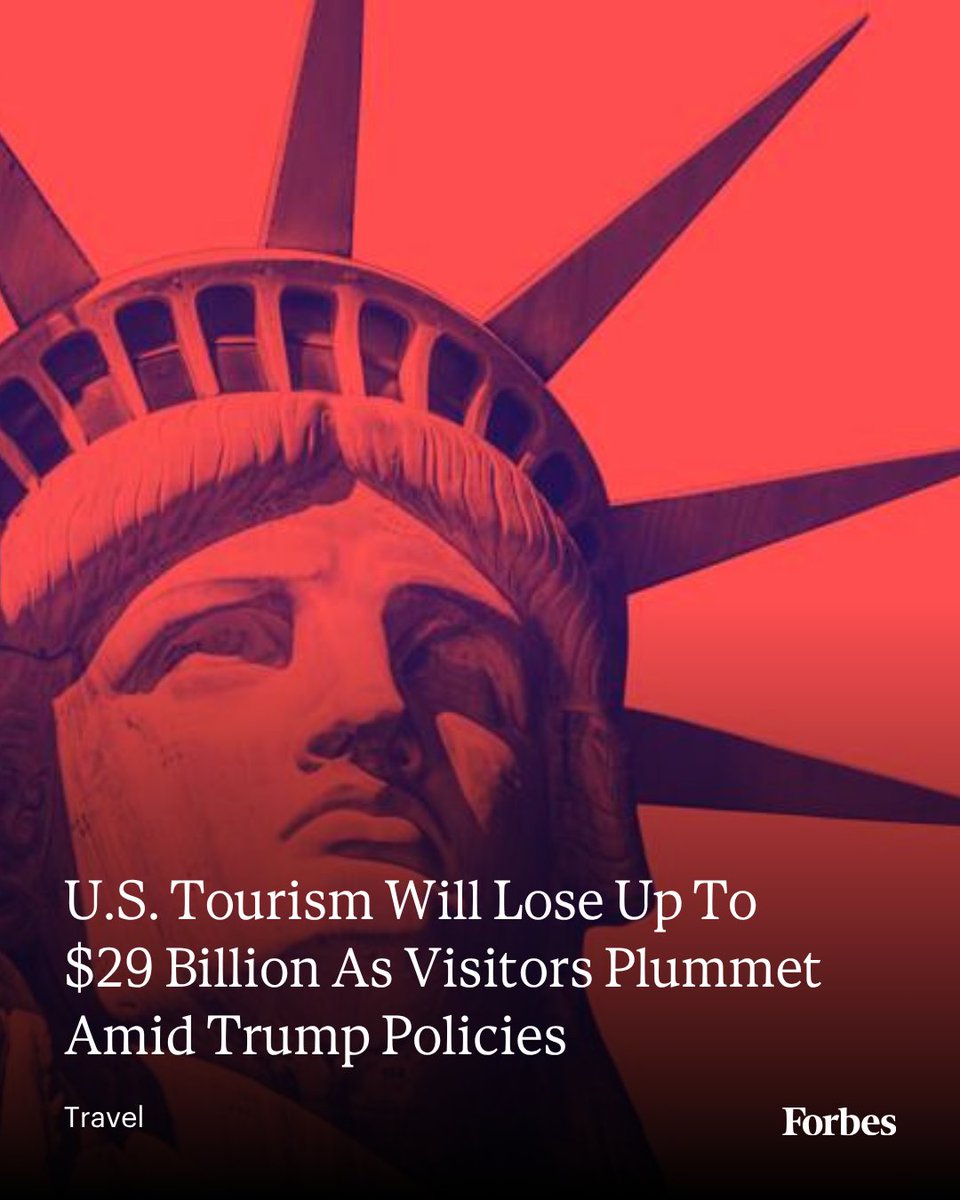
While tourism is booming across the rest of the world, the U.S. is a notable loser this year as tens of millions of international visitors are choosing to travel elsewhere—costing the economy up to $29 billion. https://t.co/d6jQOgTSnf (Photo: Getty Images)
"The Overton Window is a concept used to understand the range of ideas that are considered acceptable within a society or political discourse. It's essentially the spectrum of policies that politicians can propose and expect to gain traction with the public." Thr public hates this policy and it is a fallacy to call it such.
America's Biggest Mistake?
A portion of every American's paycheck is deposited into the Social Security trust fund (OASI), which is then invested to create returns that aim to support long-term retirement payments.
Since 1941, OASI has ONLY invested in US treasuries, averaging an annual return of just 4.8%. Meanwhile the S&P500 has been compounding returns at 10.5% per year.
If instead of buying treasuries, OASI bought the S&P500 index starting in 1971 (the year the US went off the gold standard), it would have a $15.1T balance today and Americans would all share ownership of ~1/3 of America's best companies, likely supporting increased retirement benefits, lowering taxes, and reducing Federal debt levels while being the world's largest sovereign wealth fund.
Instead, OASI has a $2.7T balance today and is projected to go bankrupt in 2032, as retirement benefits swell while annual returns on US treasuries held by OASI have shrunk to <3% per year recently.
Many economic inequities in America can be traced back to this structural mistake. By not investing OASI in equities, only privileged Americans with private pensions, 401(k)s, IRAs, and other investment retirement accounts have benefited from the marvel of American capitalism, leaving behind the tens of millions of Americans who had no choice but to rely on Social Security and were left reliant on low-yielding US treasuries.
It is not too late to change. Social Security can still pivot to an equity-driven investment model, driving future balance sheet growth, providing investment capital to American businesses, reducing the dependence on Federal taxes and money-printing, and giving all Americans ownership in America's best businesses.
Rather than create a new sovereign wealth fund, while ignoring the imminent failure of Social Security, legislators can restructure Social Security. By adding ~$500B directly to OASI, investing the entire balance in the S&P 500, and assuming future annual returns of ~10.5%, OASI will grow while also meeting all future retirement obligations, rather than shrink away into insolvency.
The longer we wait to fix Social Security, the more expensive it will become... shifting to an equity-driven investment model now could ensure its long-term viability, address economic inequities across the US, create the world's largest sovereign wealth fund, and give every American ownership and participation in the rewards of American capitalism.
Over the last few weeks, @lyft has significantly been less expensive than @Uber... a $50 ride on Uber is $35 on Lyft. This is consistent throughout many cities I travel in CA. This could cut into marketshare of Uber and make them less profitable (they are financial cash positive)
We’re painting our way through San Jose! With the help of our TogetherSJ program and @CalVolunteers, we’ve covered up graffiti and blight with vibrant murals and community art projects across 8 different neighborhoods in just 2 months. Want to be part of the solution? Join us this Saturday at Meadowfair Park: https://t.co/gf0rsk3RcA
Deep Dive: Understanding Federal Agencies
When Elon, RFK Jr., and Vivek talk about an overgrown and ineffective federal bureaucracy, they are referring to the 400+ federal agencies that form the operational backbone of the U.S. federal government.
Why have federal agencies become a lightning rod for criticism?
First, federal agencies are the largest employer in the U.S., employing more civil servants than both Walmart and Amazon.