We have a contrarian view on maritime defense:
The future isn’t low-cost attritable.
It’s LOW-COST PERSISTENT.
Attrition is the game our adversaries are playing. We should play a different one. We need to out-innovate them.
Most maritime missions are about presence and deterrence. If your vessel can stay on station 5× longer, cover more area, and operate at a fraction of the cost, who wins?
The common argument is that efficient hulls are expensive.
True—if you build exquisite, one-off vessels.
But when a platform is long-range, reliable, scalable, and low-cost, every mission wants it.
Commercial or defense.
—> Scale drives reliability.
—>Reliability drives lower costs.
—>Lower costs drive more scale.
That’s the flywheel.
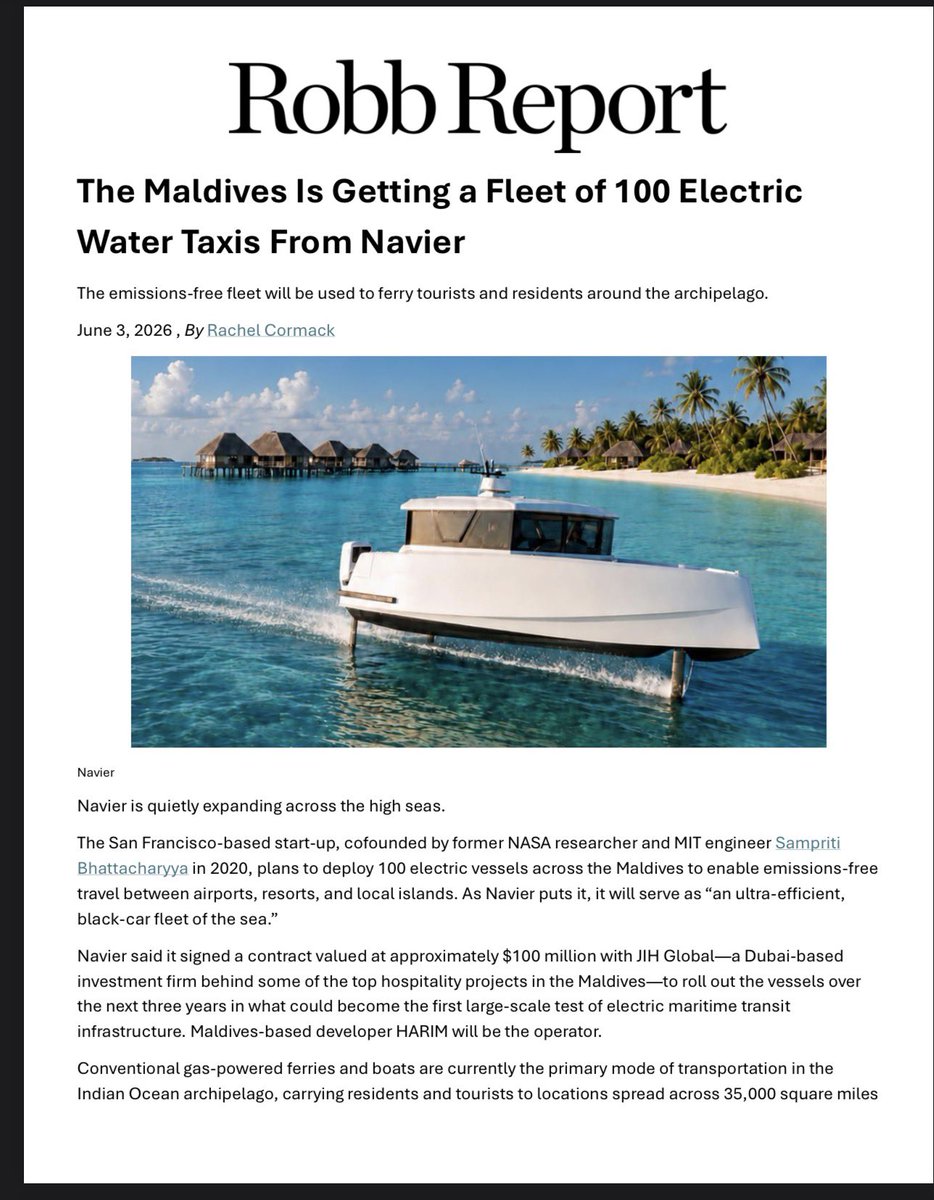
“The Maldives has always been at the frontier of luxury tourism, but as an island nation on the front lines of climate change, we also have an opportunity to help define what the future of waterborne transportation looks like” -Mohamed Ali Janah, Chairman of JIH Global Investment.
BREAKING: Navier, the new-age hydrofoil boat startup, has secured a $100M deal with the Maldives to deliver 100 boats, enabling connections between islands, airports, and resorts.
100 electric hydrofoil boats.
A ~$100M contract.
We are building a first-of-its-kind water transit network to transform how people move across the Maldives.
To scale this, we are partnering with Dubai-based JIH and its Maldives affiliate HARIM, led by Mohamed Ali Janah — a team with a 40-year track record of building the region’s premier resorts and launching the newly licensed Maldives Premier Bank.
Deployment of the first fleet starts later this year.
Yeah, that’s the same N30 platform!
Whether it is transporting passengers, cargo, or defense payloads, the core requirements for most vessels don't change: to carry a unit of payload, per unit mile, at the lowest possible cost, fastest possible speed, and longest possible range, reliably in rough waters.
When we build autonomous boats at scale, we need them to do all of these: stay on mission for long durations, be reliable in various sea states, and be scalable in terms of cost.
Traditional hulls hit a mathematical wall here- the intersection of these requirements is physically impossible.
Foiling isn’t just a cool tech; it’s a practical solution guided by physics. By lifting the hull out of the water, you get rid of the huge hydrodynamic drag. Unlike a standard hull, you actually become MORE efficient at higher speeds.
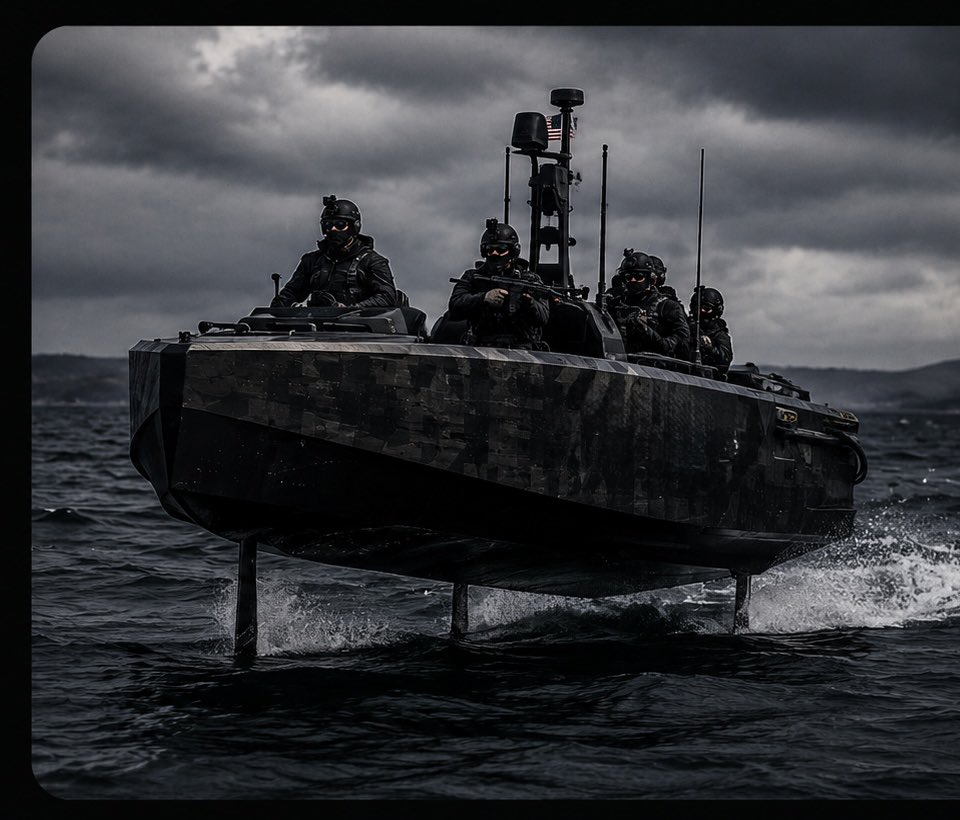
The cherry on top is that active foiling also makes the boat incredibly stable (eliminating motion sickness for passengers and providing a steady platform for various defense. payloads) and it can be quiet stealthy, with low signature (small submerged foils, no wake and low noise).
People often get distracted by the camo wraps or the fancy colors on the premium boats, but underneath, it is just same hardcore first principles driven engineering :)
Today, we honor and remember the brave men and women who gave their lives in service to our country. At Navier, we are grateful for their sacrifice and inspired by their legacy of courage, service, and dedication. Wishing everyone a meaningful Memorial Day.
Our Founder & CEO, @sampritibh, will be speaking at TEDxBoston : Innovating Defense and Security in an Age of AI, taking place at @MIT Laboratory for Information and Decision Systems (LIDS) on May 26, 2026.
Sampriti will discuss how maritime systems must be designed from first principles, why autonomy alone cannot overcome flawed physical systems, and what it takes to build a formidable future for ocean security and mobility.
2016: MIT PhD student.
Throughout my life, I keep finding myself drawn to overlooked problems with world-changing potential. It’s fun to solve hard problems.
Here, I was working on stealth underwater drones for anti-submarine warfare and MCM in the b2b SAAS era.
Before defense tech was cool on X, our CEO @sampriti_bh was building underwater drone swarms at @MIT.
Her path: physics, aerospace, nuclear engineering, robotics.
@navierboat wasn’t started to chase a trend.
It was started to reinvent legacy maritime—starting with physics.
Thank you, SOF community. What a week in Tampa.
We are energized by the conversations with USSOCOM operators, innovators, and leaders at SOF Week 2026. The consensus is clear: the era of wave-slamming and range limitations is over.
We’re heading back to HQ to prepare for the Quanta Sea Trials this summer.
Missed the docks? Follow us here for trial updates, or visit our website to schedule a deep dive for your command. Email us at [email protected].
The maritime revolution is in flight.
The Quanta-D. 2,000+ nmi range at 20 kts, 875 nmi at 35kts, 200 kW exportable power, 2,200 lb payload. Diesel-electric powertrain. Manned or unmanned.
Catch the @AeonIndustrial mounted on the N30 at SOF Week. <1 °pitch and roll. Altitude control to 2 cm. For operators who know what a bad firing platform costs downrange, the numbers matter.
Find us at TCC Slip 16.
SOF Week Tampa.
Our operators deserve better than wave-slamming RHIBs.
Low-signature. Breakthrough-range. Stable at speed. Built for the most demanding missions.