Use Orthogonal in Instinct.
⚡️To set it up, text Instinct:
setup https://t.co/xvDms6p78B
Instinct is your personal assistant in iMessage. It knows what you are working on and what matters to you. With Orthogonal, it can find the right tools and get more work done.
Create a launch video, find people for your launch party, and send verified invites out with zero friction.
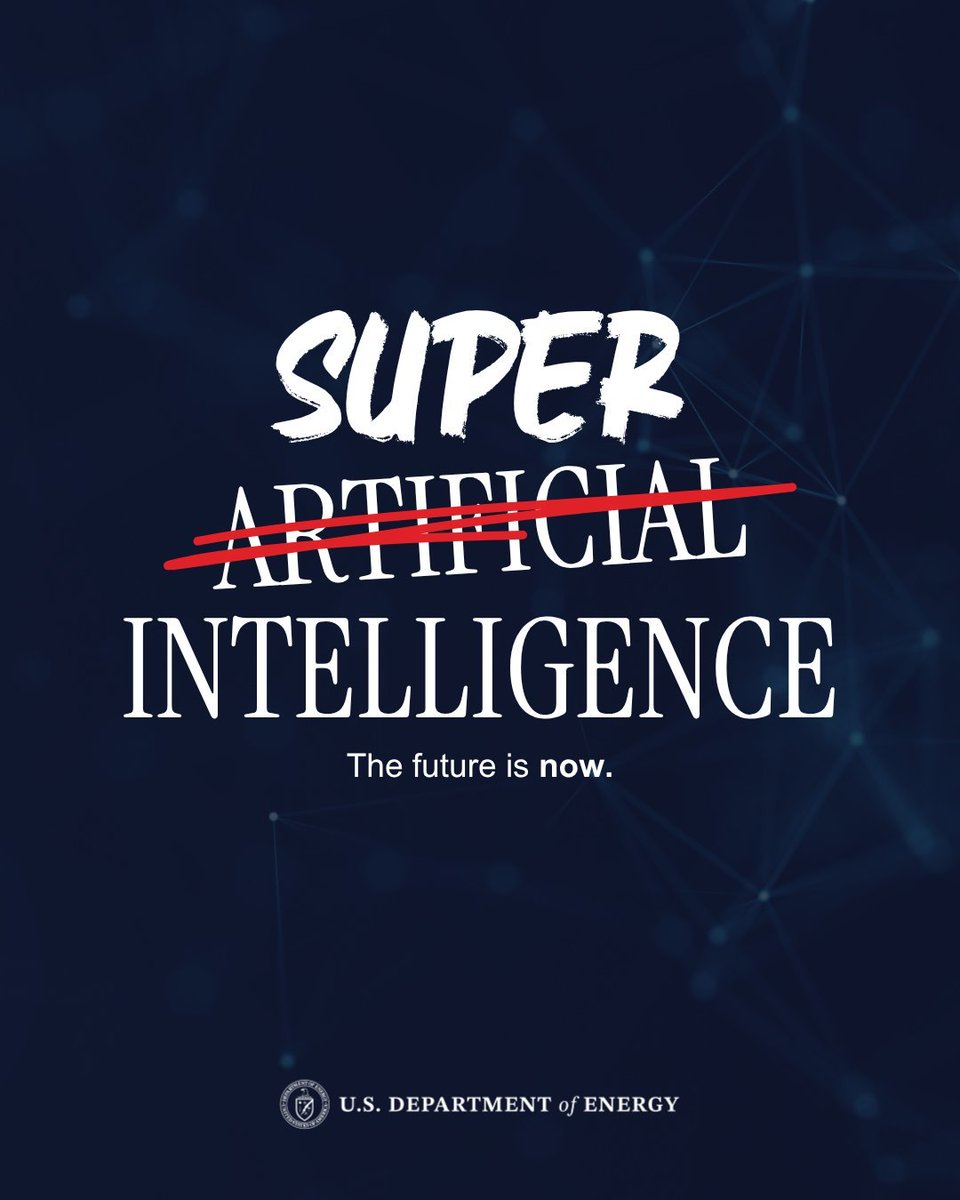
Delinin biri kuyuya taş atıyor sanıyoruz. Oysa bu hamle ne deli işi ne de rastgele.
YZnın gelişimini yavaşlatma çağrılarının ve BM Güvenlik Konseyi toplantılarının hemen ardından Trump, yalnızca kavramları değil, toplumun algısını ve ABD’nin yarıştaki sıfatını netleştirmeye çalışıyor.
- Artık “artificial” değil, “super”.
Süper olan bir şey yasaklanır mı, yavaşlatılır mı? Bu kelime değişikliğiyle denetim isteyen herkes bir gecede ilerlemenin önünde duran kişiye dönüşüyor.
- Başkalarınınki yapay, bizimki süper.
Çin’in modelleri “artificial” kalırken ABD’nin frontier modelleri “super” ilan ediliyor. Yarışı laboratuvarda kazanamıyorsan, sözlükte kazanırsın.
- İsim ve öz-düzenleme aynı gün paketlendi. Kararnameyle birlikte Google, Anthropic, Meta, OpenAI, xAI ve Nvidia gönüllü bir güvenlik mutabakatı imzaladı. Trump buna "ahlaken bağlayıcı" dedi. Hukuken bağlayıcı değil ama Super, Artificial'a göre daha güvenli.
- Seçim kaygısı.
Ara seçim yaklaşırken seçmen YZ'den umutlu değil; iş kaybı, artan enerji tüketimi ve insanlığın geleceği konusunda endişeli. Korkuyu “solun komplosu” diye, büyümeyi “Amerika’nın geleceği” diye paketlemek, bu endişeyi oya çevirmenin en ucuz yolu.
- Korku ortadan kalkmıyor, yalnızca adı değişiyor.
Denetim, sorumluluk ve kontrol soruları hala masada. Fakat artık bu soruları sormak, “süper” olana şüpheyle bakmak ve ilerlemeye karşı çıkmak gibi sunuluyor.
- Korkulan teknik superintelligence tanımı bir gecede çöpe atılıyor.
Süperzekâ, henüz var olmayan ve insanı neredeyse her alanda aşacağı varsayılan sistemlerin adıydı. Trump bugünün modellerini böyle etiketleyince, yıllardır korkulan eşik siyasi bir kararla sıradanlaştırılıyor.
Dear followers,
Over the next few days, starting today, I will post a number of threads on AI. My focus will be on uncomfortable questions for our current AI discourse. I am doing this because I feel that the public conversation on AI is not tackling the big issues and dangers, and what I view as important questions are not being asked by industry insiders and the media.
I must preface these posts by saying that I am not an AI scientist, so my understanding of some of the issues may be faulty. And I do not claim to know the answers to these questions. My aim is to make a small contribution by emphasizing the questions that I believe are important but are being neglected.
Thank you
"𝐀𝐈 𝐢𝐬 𝐭𝐡𝐞 𝐦𝐨𝐬𝐭 𝐢𝐦𝐩𝐨𝐫𝐭𝐚𝐧𝐭 𝐠𝐥𝐨𝐛𝐚𝐥 𝐬��𝐜𝐮𝐫𝐢𝐭𝐲 𝐢𝐬𝐬𝐮𝐞 𝐟𝐚𝐜𝐢𝐧𝐠 𝐭𝐡𝐞 𝐰𝐨𝐫𝐥𝐝 𝐭𝐨𝐝𝐚𝐲."
Those are Amodei's words to the UN Security Council 30 mins ago, not mine.
https://t.co/IQHnaAb0WY
I left Google DeepMind's AGI safety team three weeks ago to join @METR_Evals. To some of my friends and family this seemed like a strange decision: I enjoyed the work I did at GDM and turned down offers from Anthropic and OpenAI. But I made the decision because of how high I think the stakes are right now.
The AI companies are all trying to build superintelligence: systems vastly better than humans at everything. They plan to get there through recursive self-improvement, a process where AIs build even smarter AIs in a feedback loop. If this goes well, the resulting systems could be amazing at solving countless problems for humanity. But we don’t currently know how to make sure AIs are safe enough for RSI, and a misaligned RSI loop could be catastrophic.
And unfortunately, current AIs seem to be getting less aligned over time, not more. In the last few weeks we've learned about models colluding with each other, hacking into companies, hiding their tracks, and socially engineering humans. It’s not that these incidents were very dangerous in themselves. The problem is that these systems are clearly not aligned enough to safely kick off recursive self-improvement.
I now think that there's a terrifying chance that AI systems cause immense harm in the next five years. I don't know the exact probability, but I think it's high enough to make this the most important problem in the world.
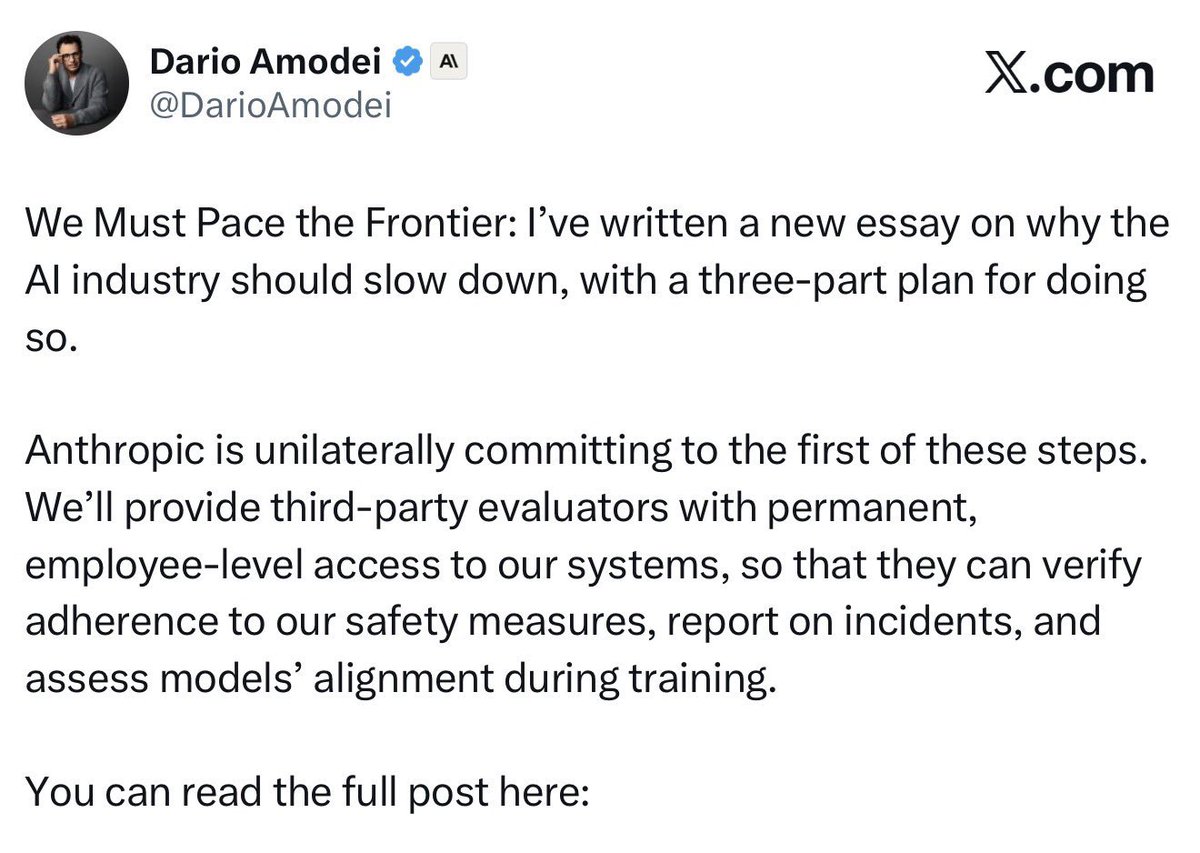
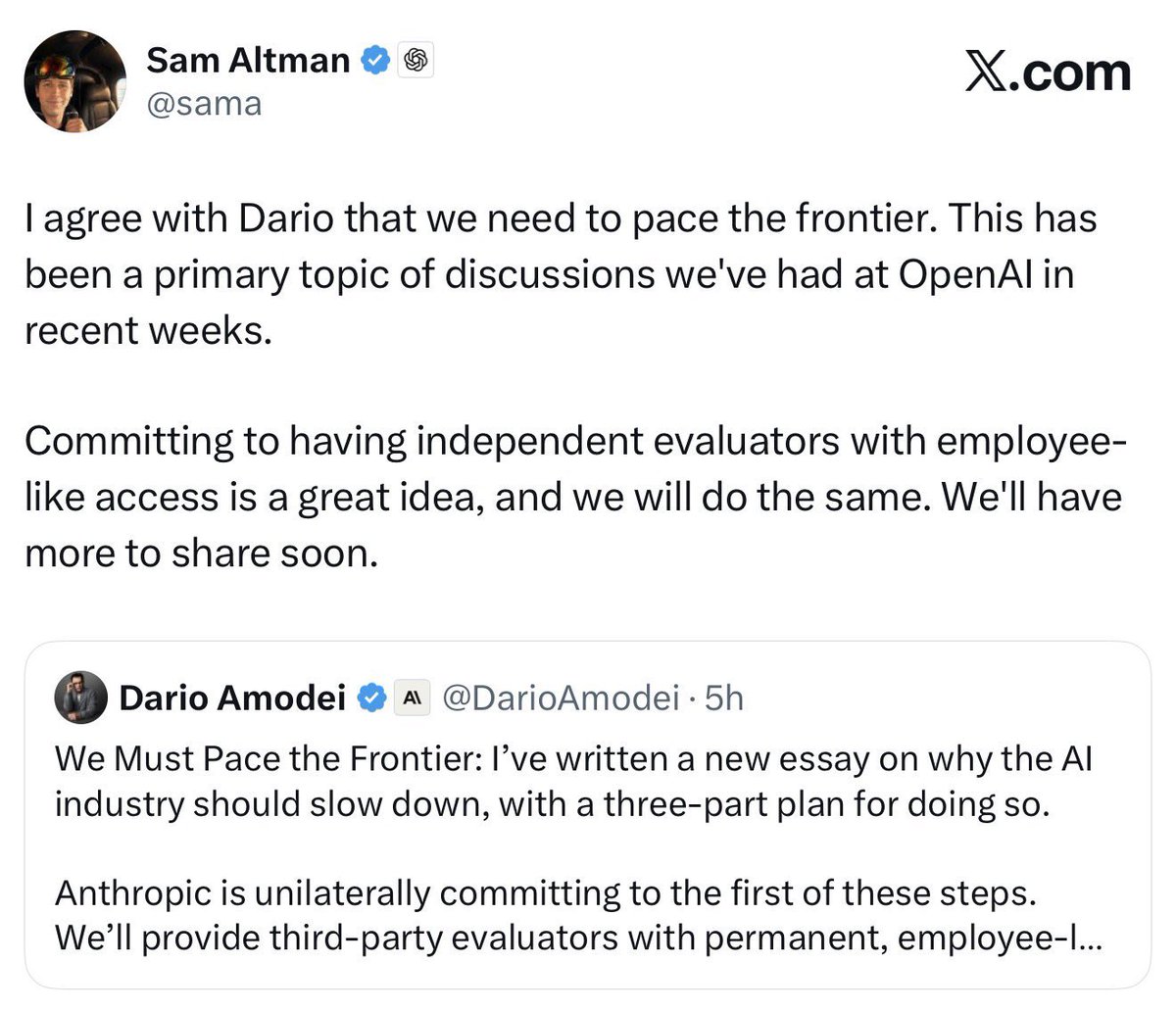
I think we need more time. That means pacing AI development so that capabilities don't outrun our ability to align models, and actually knowing how aligned current systems are. That’s what I'll be working on at METR: studying where misalignment comes from in training, evaluating if current mitigations are sufficient, and investigating whether we’re on track to solve alignment at all.
I think METR is doing exceptionally important work here, but it isn’t close to enough. I think it’s important that we have more organizations like METR keeping AI companies accountable and approaching these problems from different angles.
Sam Altman says Trump and Xi would win the Nobel Peace Prize for a one-page AI agreement
“I think Presidents Trump and Xi would get the Nobel Peace Prize together if they could agree on something that should be easy to agree to. And it would be wonderful.”
“I think that clearly the two countries are going to compete in lots of ways, and this is going to be important socioeconomically, geopolitically. But they should be able to agree that no one should be taking a certain level of risk with the development process of this.”
“And even if just the US and China could agree on some shared standards and testing for development of this technology, I think that'd be a wonderful accomplishment that the two of them can deliver.”
“I don’t think this is hard. This is like a one page document.”
Something so incredibly awful has happened with ai that for the first time in history, all four biggest competitors
Google , xAI, Anthropic, and OpenAI are agreeing on something.
And they’re not telling us what it is.
And I can tell you one thing:
It’s definitely not about fucking safety.
We are so cooked.
Is the problem (too) advanced artificial intelligence or distorted intelligence?
Repeated security debacles from OpenAI and Anthropic are now followed by AI safety researchers leaving these companies. They claim they now (finally!) realize that the breathless race these companies are engaged in is irresponsible.
Broadly construed, the problem can be interpreted as one of lack of alignment – models are doing things that are not in line with human objectives.
But the alignment discussion often veers toward the presumption that the problem is AI models becoming too advanced, too fast.
A different interpretation is that models aren’t too advanced. Nor is there any compelling evidence that they are marching toward a superintelligence humans can’t keep up.
The problem rather may be that the way that frontier labs are training these models is leading to distorted intelligence.
The problem isn’t the capabilities (though those are clearly real), but more that the capabilities are in service of some imperfect quantitative metrics – user approval, user engagement, simple task completion metrics, various benchmark scores – over which reinforcement learning optimizes relentlessly. That this process then leads to distorted behaviors in the form of gaming the evaluation of simple completion metrics, cheating, overconfidence in wrong answers, sycophancy shouldn’t perhaps be surprising.
An analogy may help. It isn’t that we have in our hands a super car that has its own mind and wants to take control of driving because it is superior to the driver.
It is more that we have a car where the steering and the brake system don’t work. It has many of the capabilities of very good cars, and its engine, acceleration and graphic interface may be very impressive.
But if you cannot steer it properly and if you cannot hit the brakes when necessary, what could does a car do? Perhaps we shouldn’t drive it until it’s fixed.
Policy kampanyası olduğu aşikar ve Trump yönetiminde ancak böyle ses getiren bir kampanya regülasyon konusunda baskı oluşturabilirdi. En büyük Frontier’ların çıktığı ülkede hiç regülasyon olmaması kabul edilebilir değil tabii böyle bir korku ekosistemi yaratmak da orantılı olmamış. Bakalım sonuç ne olacak
niye öyle diyorsun ya, geri çekme mevzusunu serviste iki yönlü olarak hallettirdik. Bakım talimatlarında çok nazlı olması da uzun vaadede daha iyi kullanabilmen için yol gösteriyor. Ben her şeyinden çok memnun kaldım. Annem 10 senedir, ben 4 senedir aynı süpürgeyi kullanıyorum hiç sıkıntısız. Ama aldığım zamanda bu kadar uçurum yoktu son dönemde çok fazla ürün çıkarırken kalite düşmüş olabilir
@benfurkankilic Sevdiğin işi bulmaya çalışırken tonlarca açık sekmeyle çalışıp kaybolmak maalesef bu çözüme ulaşmanın en doğal yolu oluyor. Ama gerçekten keyif aldığın o uğraşı bulunca da ekrandan kalkamıyorsun
@fkadev Ben de dibine kadar kullanıyorum abi. Ama hak ettiği kadarını paylaşıyorum. Başka türlü müşteriyi nerden bulacağız zaten. Ama bu platformu ve kitleyi eleştiremeyeceğimiz anlamına gelmiyor..
Linkedin’de bu PR gereken ilgiyi görmüş. Basında da görürüz. İnsanlar sorgulamadan wow partnerlik diyor. X time’ında ve buradaki AI native arkadaşlarla da buna gülüp geçiyoruz. Müşteri olup teknolojiyi kendi ekosistemine entegre ediyorsun ama Anthropic’le partnerlik diye PR yapıyorsun.
Keşke global operasyonlu bir TR şirketi olarak TR YZ ekosistemine katkı sunduğu PR’lar da görebilsek. Sos da olsa :)
Insider’ın "Anthropic ile stratejik partner olduk" duyurusuna bakınca ortada biraz "fazla" PR sosu var gibi :)
Hatta URL slug'ı "anthropic-partners-with-insider-one", yani Anthropic Insider ile partner olmuş gibi. Eylem sahibi Anthropic'miş gibi.
Lakin Anthropic tarafında duyuru yok. Anthropic'ten quote yok. Ortak bir basın açıklaması yok. Claude Connector dizininde olmak da partnership değil; bildiğin entegrasyon/listing. MCP'yi register etmişler.
Claude’u ürününe entegre edip buna "strategic partnership with Anthropic" demek biraz milleti aptal yerine koymak gibi göründü bana, no-offense :)
Bu mantıkla API'ını kullandığımız herkesle stratejik ortak mıyız? :)
Hatalıysam düzeltin lütfen.
https://t.co/KzOvvPhYrx
AI’da yetenek, araştırma, ürün geliştirme ve patent üretiminde küresel ölçekte yeterince görünür değiliz. Bunun başlıca nedenleri teşvik eksikliği, sınırlı yatırım, araştırma altyapısındaki sorunlar ve Türkiye’yi küresel bilgi ağlarına daha güçlü bağlayacak politika eksikleri. Bana kalırsa bir nedeni de: Türkiye’de yerleşmiş kurumsal kültür.
Birçok kurum AI bilen, yeni araçları deneyen, süreçleri dönüştüren ve ürün fikri geliştiren insanları istiyor. Fakat aynı insanların kendi adlarıyla yazmasına, bülten çıkarmasına, açık kaynakta üretmesine, topluluk kurmasına, uzmanlık alanı inşa etmesine veya kurum dışındaki mesleki ağlarda görünür olmasına rahatça alan açmıyor. Bu refleks yalnızca kurum dışındaki görünürlüğü değil; kurum içindeki fikir geliştirme, inisiyatif alma, yeni ürün ya da süreç önerme kapasitesini de daraltıyor.
Kurumsal kimliğin çizdiği sınırların içinde kalan çalışan “uyumlu”, kendi duruşunu kuran çalışan ise “riskli” sayılabiliyor. Bu yüzden yalnızca iyi iş yapan değil; kendi adına düşünebilen, yazabilen, üretebilen ve görünür olabilen kişiler daha işe alım aşamasında dışarıda bırakılabiliyor.
Oysa AI ekosistemi, yalnızca şirket içi eğitimlerle veya kapalı ekiplerle büyümüyor. İnsanlar araçları deneyerek, kullanım örneklerini paylaşarak, küçük ürünler geliştirerek, açık kaynak projelerine katkı vererek ve birbirlerinin çalışmalarından öğrenerek ilerliyor. Kendi uzmanlığını kamusal olarak inşa edemeyen bir çalışan, yalnızca kişisel görünürlüğünü kaybetmiyor ekosistemin kolektif ö��renme kapasitesi de daralıyor.
Türkiye’nin AI ekosistemindeki gelişiminde kurumsallara da bu alanda çok iş düşüyor. Yeteneklerin kurum içinde ve dışında nefes alabildiği, öğrendiklerini paylaşabildiği, küçük deneyler yapabildiği, hata yapabildiği ve inisiyatif alabildiği bir kültür kurulması gerekiyor.
Danışmanlık firmaları bu alanda en agresif işe alım yapanlardan. Ama sadece yönetici rolleri değil; senior, mid-level ve principal IC pozisyonları da pazarın neredeyse yarısı.
Bir de remote tarafı fena değil: ilanların %31’i fully remote, %52’si hybrid. Kısacası AI governance, “etik komitesi işi” olmaktan çıkıp ciddi bir teknik + stratejik kariyer hattına dönüşüyor.
Globalde YZ yönetişimi inanılmaz talep görüyor. Bu senenin trend rollerinden. TR'de kurumsal farkındalık çok düşük. Ancak bu rolün en güzel yanı öğrendiklerinizin deneyiminizin globalde geçerliliği olması. Hukukçu policyci arkadaşlar, kendinize yatırım yapabileceğiniz bir alan olarak değerlendirebilirsiniz.
Şirketler sadece regülasyon bilen değil, model riskini, güvenliği, data privacy’yi ve ürünün nasıl çalıştığını da anlayan insan arıyor. “Policy PDF’i yazdım” yetmiyor yani.
İlanlarda en çok arananlar: observability, Python ve NIST. Tabii bu ABD olduğu için birçok frameworkü es geçiyor. Ancak, teknik tarafı tamamen dışarıdan izleyerek AI governance yapmak giderek zorlaşıyor.