A wallet associated with Ethereum co-founder Joseph Lubin moved 110K $ETH (~$170M) on June 6 after three years of inactivity - depositing into three Sky vaults that together borrow $259M in $DAI against WETH collateral.
The deposits reduced liquidation risk after $ETH slid below $1600; vault liquidation levels sit between $899–$1056 per ETH.
Onchain data confirms a defensive collateral top-up rather than any sale pressure behind the transfers.
💙 $TOSHI has done a 30x before
💙 The market forgot about it
💙 Now it's 93% off ATH
💙 Base just upgraded
💙 Accumulation building on-chain
💙 History doesn't repeat
💙 But it rhymes 🐱
Good Morning
$HYPE just logged a record tenth consecutive session of spot ETF inflows, defying the broader crypto market sell-off.
While $BTC and $ETH ETFs bled billions, the newly launched US spot HYPE fund has added cash every single day since May 12 - pushing cumulative net assets past $122M by Friday.
The token is up over 18% for the week to ~$73 as Hyperliquid continues eating into centralized exchange perps volume.
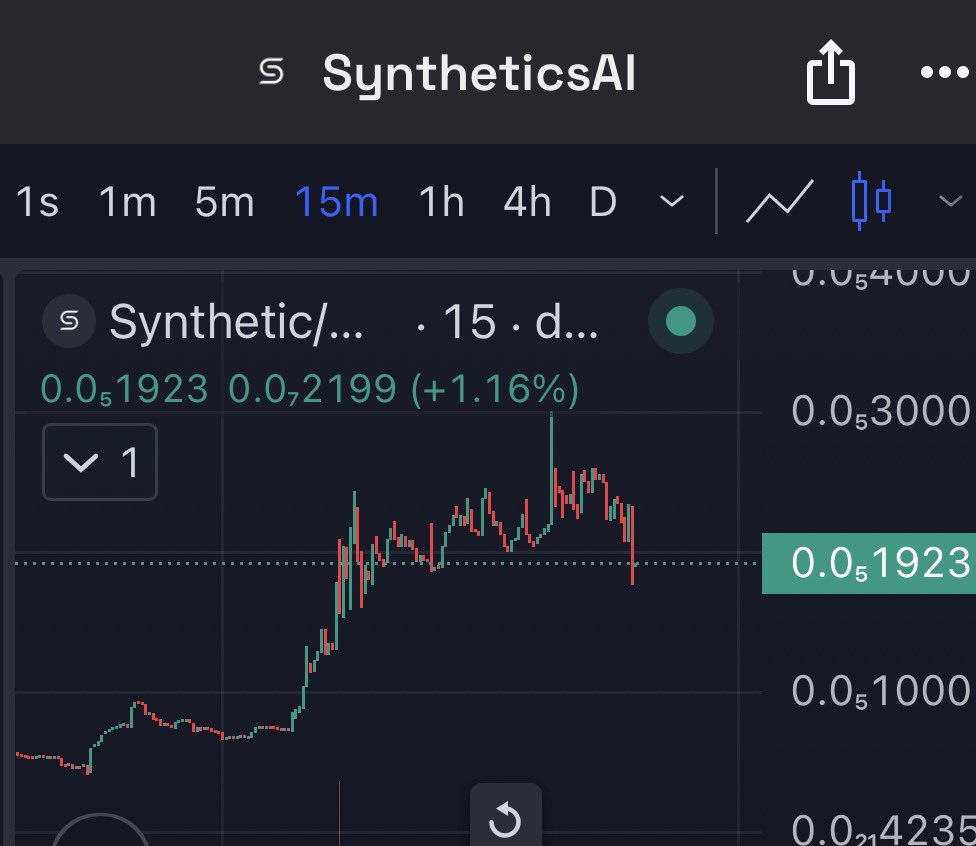
Bought some $synthetic, @SyntheticsAI_. Self launched, aeon, bankr etc seems to like it as well
Seen some interesting @base wallets loading throughout the day as well
0xfE848a4e279e762AD409A84d4e164324b8d26ba3
Also, a v interesting partnership is in talks - if that one goes through I’ll raise my targets even further
Babylon's $BABY token ripped 52.7% higher after South Korea's largest exchange Upbit listed it with a Korean won pair, opening the floodgates to enthusiastic retail traders.
Volume surged to between $100M and $250M within 24 hours, pushing the Bitcoin staking token's market cap to $50M-$55M - still a fraction of its $2B+ total value locked during earlier staking phases.
The rally comes alongside fresh catalysts, including a $15M a16z investment in January and a May testnet launch for trustless BTC vaults, with a proposal to integrate native $BTC as collateral on Aave's V4 platform now in play.
Bybit has launched IPO Express, a tokenized IPO access feature that lets retail users subscribe to primary market offerings directly from the platform. The first listing is SpaceX, trading under the ticker $SPCX, with subscriptions open now through June 11.
Each $SPCX token is backed 1:1 by real shares held in regulated custody, giving crypto-native investors exposure to pre-IPO equity without a brokerage. Tokenized SpaceX shares begin trading on Bybit Spot on June 12.
Bybit’s IPO Express is now live, offering tokenized SpaceX shares under the ticker $SPCX.
The subscription window runs from June 7 to June 11, with pro-rata allocation and spot trading starting June 12.
Each $SPCX token is backed 1:1 by real equity held in regulated broker-dealer custody, giving retail users direct primary market access without a traditional brokerage.
This move pushes tokenized real-world assets further into the mainstream, bridging traditional IPOs with crypto-native infrastructure.
💎Token : $WORLDS
📈Entry: $49k
📊Peak: $136k
🚀Gain: 2.8x Profit
No hype- just early calls , sharp entries, serious profits and great insiders info
Dm for my Invite link to My Alpha telegram Channel now
⛓️ #solana#memecoin#cryptoTrading
The first-ever conventional, Fannie Mae-backed mortgage secured by $BTC has closed, Coinbase announced - a Michigan couple used Bitcoin as collateral for their down payment without selling a single sat.
Better, the mortgage lender, structured the deal with two liens: a standard Fannie Mae loan and a second lien pledging crypto, so price swings don’t trigger liquidations and homeowners avoid capital gains taxes.
A buyer can cover a $100,000 down payment by pledging $250,000 in $BTC, unlocking homeownership while keeping full upside exposure to their stack.
Coinbase plans a nationwide rollout later this year, with $USDC support on deck - a direct bridge between crypto wealth and the $7 trillion U.S. mortgage market that federal housing regulators are now actively pushing forward.
The first-ever conventional, Fannie Mae-backed mortgage secured by $BTC has closed, Coinbase announced - a Michigan couple used Bitcoin as collateral for their down payment without selling a single sat.
Better, the mortgage lender, structured the deal with two liens: a standard Fannie Mae loan and a second lien pledging crypto, so price swings don’t trigger liquidations and homeowners avoid capital gains taxes.
A buyer can cover a $100,000 down payment by pledging $250,000 in $BTC, unlocking homeownership while keeping full upside exposure to their stack.
Coinbase plans a nationwide rollout later this year, with $USDC support on deck - a direct bridge between crypto wealth and the $7 trillion U.S. mortgage market that federal housing regulators are now actively pushing forward.
Coinbase just closed the first-ever government-backed mortgage secured by $BTC.
A Michigan couple pledged Bitcoin as collateral for their down payment, sidestepping capital gains taxes and keeping full upside exposure.
The loan splits into a standard Fannie Mae note and a second lien backed by crypto.
Better requires $250K in $BTC to cover a $100K down payment, with liquidation only after 60 days of delinquency - price swings don’t trigger margin calls.
Rolling out nationwide soon, the product will also support $USDC initially, turning crypto wealth into homeownership without selling a single sat.
Vitalik just proposed rebuilding DeFi on options instead of collateralized debt - aiming to eliminate forced liquidations entirely.
The Ethereum co-founder’s design splits 1 $ETH into two paired assets, P and N, that always sum back to 1 ETH. At maturity, an oracle resolves a price index, and the payoffs distribute accordingly without ever triggering a liquidation cascade. He argues this fixes DeFi’s long-standing dependence on real-time oracles and bot-driven auctions.
The catch is drift: holders don’t get a clean dollar peg but rather quadratic deviation from their target exposure, estimated around ~1–4% per year. Rebalancing costs pose the largest competitive risk in Vitalik’s view. For now it remains research-grade with no protocol committed to building yet - but the idea targets the structural failure mode behind MakerDAO’s $6M+ shortfall in March 2020.
$BABY, the token of Bitcoin staking protocol Babylon, ripped 52.7% higher after Upbit listed it with a KRW trading pair on June 5.
24h volume exploded to over $100M, briefly pushing its market cap to $55M - still tiny relative to Babylon’s previous $2B+ TVL.
The surge follows a $15M a16z investment in January and a public testnet for trustless $BTC vaults in May.
A proposal to integrate native BTC as collateral on $AAVE V4 adds further momentum to Babylon’s DeFi ambitions.
https://t.co/AKv0YvJwcV ($ETHFI) has partnered with Plume Network ($PLUME) to launch a yield-bearing real-world asset vault, backed by a $100M exclusive allocation from https://t.co/AiaYIK0WHO’s liquidity. The vault bundles institutional-grade strategies - overcollateralized credit pools, AAA CLOs, and bond ETFs - into a single product, accessible directly within the https://t.co/AiaYIK0WHO app.
This marks a significant push into tokenized RWAs, tapping into rising demand from funds, family offices, and HNWIs for structured, lower-DeFi-risk earn products. https://t.co/AKv0YvJwcV already manages ~$300M across liquid $ETH, $USD, and $BTC vaults, and this move extends its yield offering into traditional finance assets.
With Plume handling sourcing and due diligence, the vault is non-custodial and built with compliance controls under its Bermuda license, signaling how on-chain yield is maturing beyond pure crypto-native strategies.
https://t.co/5qCNDW8CWZ ($ETHFI) just committed $100M to a new yield-bearing real-world asset vault built by Plume, giving users direct access to tokenized institutional credit pools, CLOs, and bond ETFs.
The allocation comes from https://t.co/5qCNDW8CWZ’s liquid vault base - covering $ETH, $BTC, and $USD strategies - which collectively holds roughly $300M in TVL. It signals growing demand for earn products with institutional-grade risk, far from typical DeFi complexity.
Plume spent months tailoring the vault to https://t.co/5qCNDW8CWZ’s needs, bundling multiple asset strategies into a single non-custodial structure. For $ETHFI holders and depositors, this marks a concrete step toward merging traditional fixed-income yields with on-chain simplicity.