We’re happy to announce our investment in @NLnetLabs's domain project, expanding this comprehensive, memory-safe library for building privacy and security-conscious DNS applications. This is another step towards a safer and more resilient internet:
https://t.co/jpnp2WVnAJ
Leading up to a major announcement, Alex and Benno want to set the stage by laying out our vision for #DNS and our #OpenSource product strategy for the next five years. #rust#rustlang#MemorySafety https://t.co/oBYcyPwTII
They crew is pleased to announce the latest release of our #RPKI validator Routinator, version 0.13.0 ‘Should Have Started This in a Screen.’ It features lots of smaller changes and updated #ASPA support. https://t.co/eZEHru7hO1
We're working on an #IETF document that aims to establish a common, well-defined baseline for #DNS zone files that all implementations can understand. Everyone is welcome to contribute! #IETF117 https://t.co/whrdGW5NKU
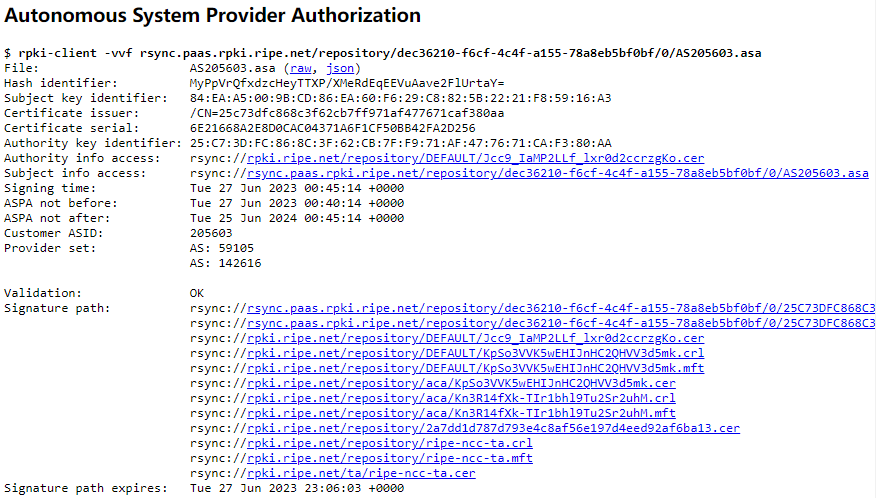
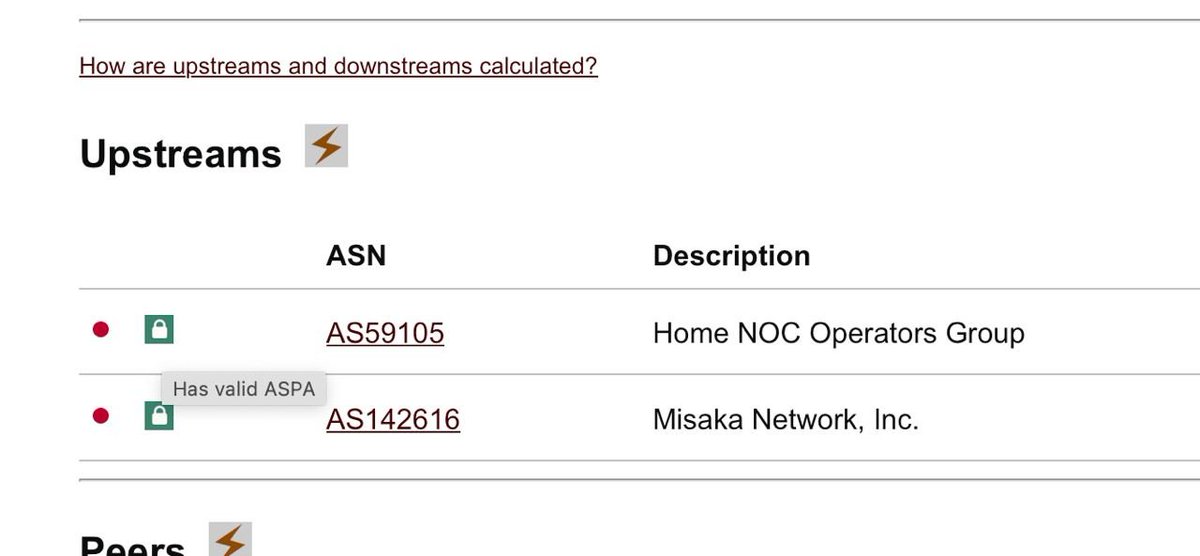
In the latest commits to Routinator, we’ve updated #ASPA validation to conform to the latest changes in the #IETF draft. This means there is now one (1) valid object left in the wild instead of ~50. We should return to previous levels once the new Krill #RPKI CA release is out.
Parsing time stamps faster with SIMD instructions
In software, it is common to represent time as a time-stamp string. It is usually specified by a time format string. Some standards use the format
%Y%m%d%H%M%S meaning that we print the year, the month, the day, the hours, the minutes and the seconds (e.g., 20230701205436). It is convenient because it is short, easy to read and if you sort the strings lexicographically, you also sort them chronologically.
You can generate time stamps using any programming language.
We are interested in the problem of parsing these strings. In practice, this means that we want to convert them to an integer presenting the number of seconds since the Unix epoch.
The way you typically solve this problem is to use something like the C function strptime. Can we do better? Yes. We can go much faster. Find out how at:
https://t.co/nbsPF7dfP8
cc @NLnetLabs
@trustywolf@ripencc Please note that #ASPA is still being discussed in the #IETF, with changes to the profile being made. We’re reflecting this in our #RPKI code. https://t.co/A2XbQKZu7L and https://t.co/yRnD0LRpUG
@trustywolf@ripencc Please note that #ASPA is still being discussed in the #IETF, with changes to the profile being made. We’re reflecting this in our #RPKI code. https://t.co/A2XbQKZu7L and https://t.co/yRnD0LRpUG
📢 Just in! OpenDNSSEC 2.1.13 is out now! 🚀🔐 Update your systems today and enjoy the bug fixes and enhancements in this release. Check out the announcement at: https://t.co/2SCMNMdve7 #OpenDNSSEC#SoftwareUpdate
Parsing IP addresses crazily fast
Most of us are familiar with IP addresses: they are strings of the form “ddd.ddd.ddd.ddd” where ddd is a decimal number of up to three digits in the range 0 to 255. For example, 127.0.0.1 or 192.168.0.2.
Each of the four number is a byte value, and the address is n IPv4 network address that fits in 32 bits. There is a more recent extension (IPv6) that spans 128 bits, but the conventional IPv4 addresses are common. They can be part of URLs (e.g., http://127.0.0.1/home).
For our fast URL parsing library, I also wrote the counterpart, where we go from the string to the 32-bit value. However, I did not optimize it particularly well because there are many other challenges in efficient URL parsing.
Recently, Jeroen Koekkoek from @NLnetLabs brought to my attention that my friend @pshufb has a recent article on the parsing of IP addresses. As usual, it is brillant. Koekkoek is working on accelerating DNS record parsing in his simdzone project and we expect to parse a lot of IP addresses.
Wojciech’s results are slightly depressing, however. He suggests that you can beat a standard approach by a factor of 2 or 2.5 in speed, which is excellent, but at the cost of relatively large tables. After revisiting his work, I produce an optimized function which six times faster than the standard one routine in my tests. My source code is available.
Read more at https://t.co/jkvbRYpgGC
cc @yagiznizipli
We released version 4.7.0 of the authoritative #DNS nameserver NSD. This release adds a script for bash autocompletion for nsd-control. The dnstap log service can be contacted over TCP, with the `dnstap-ip: ip` option. It is also possible to use TLS. https://t.co/fxSBSpoxkG
Greetings from Montréal at #FIRSTCON23 - should you be interested in talking about email security, RPKI, DNS, or something else entirely, feel free to approach me.
Back from #RIPE86 and straight into building High Availability with multiple active nodes for our #OpenSource#RPKI CA software Krill. https://t.co/3kKdu315Je