UK grassroots campaign for the abolition of prostitution & related practices (e.g. porn), an end to men's demand for the same & for the Nordic/Equality Model.
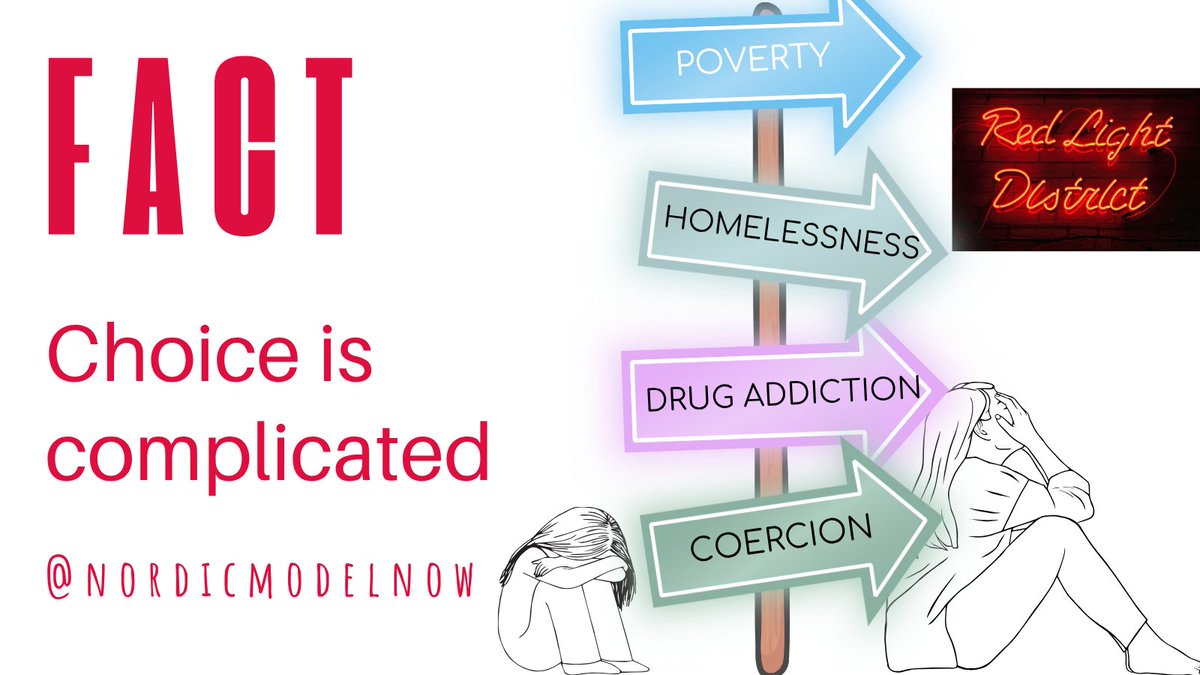
FACT: Choice is complicated
When people talk about prostitution, the woman’s choice is often used to justify her prostitution. For example, here are a few random comments from The Guardian website:
“If a woman chooses (freely chooses, without coercion) to sell sex then that’s her right.”
“So long as they are safe, secure, happy and independently making that decision it is entirely up to them what they do.”
“I respect her right to choose. Don’t you respect the rights of a women to choose?”
But choice is complicated.
WHO GETS TO CHOOSE?
When I was a new mother, my life with a toddler was changed by something the late, great, Claire Rayner said on the radio. She said never ask your overtired fractious toddler whether they want to go to bed, because their imperative to assert themselves as individuals will compel them to say NO. Instead, Claire said, ask whether they want to wear the red pyjamas or the blue pyjamas.
And then bedtime was transformed. My toddler was happy to choose which pyjamas to wear while moving inexorably towards the point she would be tucked up in bed and I could settle down for some quiet time with my book.
Being able to choose between the blue and red pyjamas gave her dignity and a sense of personal agency. But in reality her choice was trivial. It was me who had the power to make all the significant choices and decisions in her life.
I tell this story to illustrate that it is those with power who have the options that make real, meaningful choices possible. The more power you have, the more options you get.
For people who’ve had luckier lives, it’s easy to forget how few options many people actually have. And how for many people, those options may be equivalent to choosing the red pyjamas while moving inexorably in the direction made inevitable by the choices of those with power, such as the UK government that systematically deprives women of resources.
WHAT DO GIRLS WANT?
I asked the mothers in a social media discussion group to ask their daughters what they wanted to do when they grew up. Their answers were full of life and hope. Not a single one of these girls said they want to go into prostitution when they grow up.
So who are the girls and young women who “choose” prostitution and what has happened to them?
THE REALITY FOR MOST WOMEN AND GIRLS IN PROSTITUTION
Testimony from survivors and studies of women and girls in prostitution consistently show that many were in local authority care as children; many started in prostitution before they were 18 or when they were homeless; many were coerced into prostitution; and the majority had been abused as children.
The following chart shows statistics from studies of prostituted women and girls in the UK:
33% were "looked after" children
50% started before they were 18
50% were homeless
50% were coerced into prostitution
72% had been abused as children
Statistics from the government’s 2004 Paying the Price consultation and Eaves’ Breaking Down the Barriers study.
This paints a picture of a marginalised population of girls and young women whose options at the time they started were severely limited. They were not choosing between prostitution and being a vet or a midwife or going to college to study.
Instead these figures suggest that the options for most of them were between prostitution and sleeping rough, or prostitution and being beaten by the person who was coercing them – or losing his support – and for a young woman with little or no family support this might have been more persuasive than being beaten.
So to the man who asked on The Guardian website whether we respect her choice, the answer is yes, indeed we do. But we don’t think those are the options anyone should be facing. It would be like saying that my little girl’s choice of pyjamas justified the choices that I imposed on her.
Because how is a 15, 16, 17, 18-year old girl to know how it will affect her over time, pretending every day that she is enjoying all those men groping her and each ramming his dick into her? Men who might be older than her father and even her grandfather. How is she to know in advance about the violence that is inherent to prostitution? And how it can never be safe?
How is she to know that – in this world that has told her since she was a tiny child that her only purpose in life is to look pretty, to please the male gaze? In this world that glamorises not only prostitution, but pimping too?
So how is her choice, her consent, to enter prostitution either free or informed?
A choice that is not free is not really a choice. Consent that is not informed is not consent.
And did anyone ever tell her, that for most women in prostitution, it is hard to get out and that if she does manage it, the chances are high that she will be worse off than when she started and have a whole heap of additional problems, like post-traumatic stress disorder (PTSD)?
The following chart shows statistics from studies of prostituted women and girls.
39% had no training or formal qualifications
50% were dependent on drugs or alcohol
50% were coerced into continuing
52% had debts that made it hard to leave
67% had a criminal record
68% met the criteria for PTSD
89% wanted to escape but didn't know how
Statistics from Eaves’ Breaking Down the Barriers study and Melissa Farley’s 9-Country study.
This tells us that once women are embedded in prostitution, for most of them getting out is very hard. Most of the time, they continue because of an absence of viable alternatives.
An absence of alternatives is not a choice. Acquiescence is not consent.
We do not use the argument of choice to justify any other systematic inequality. For example, campaigners against zero-hour employment contracts do not justify them by saying people choose those contracts. In the vast majority of cases, people accept them because of a lack of alternative options. It is those who profit from unfair contracts that justify them by the person’s supposed choice.
CONCLUSION
Most women and girls are in prostitution because of a lack of options. We believe that women and girls should have other viable options. This is why we campaign for ring-fenced funding for high quality non-judgemental services to help them exit and for an end to women’s systematic inequality and poverty.
To justify prostitution by her supposed choice is disingenuous. It is the language of the vested interest.
It is men, the punters, who have choice. The choice to continue to abuse her vulnerability or the choice to man up and say no to prostitution.
✍️ Our latest blog post examines how the language of #choice, #agency and #empowerment has been used to market p0rnography as a #feminist alternative to the mainstream industry.
#FeministBlog#EndExploitation
Read the full blog post here: https://t.co/w6rb7DG3ut
It is estimated that there are 11 million sex trafficking victims worldwide, of whom 96% are women and girls. This represents an unimaginable amount of human misery and suffering.
Let’s be clear, it is the money that ordinary men pay for prostitution that drives this exploitative industry.
Every time a man buys sex anywhere in the world, he contributes to this cesspool of ruthless exploitation.
Cool men do not buy sex.
For more information, see the link in the next tweet.
When I was a 'high class escort' I was actually being trafficked around the Midlands by a '#groominggang.' Terrified, raped, under threat of violence, forbidden to talk to the other girls.
Escort agencies are legal in the UK.
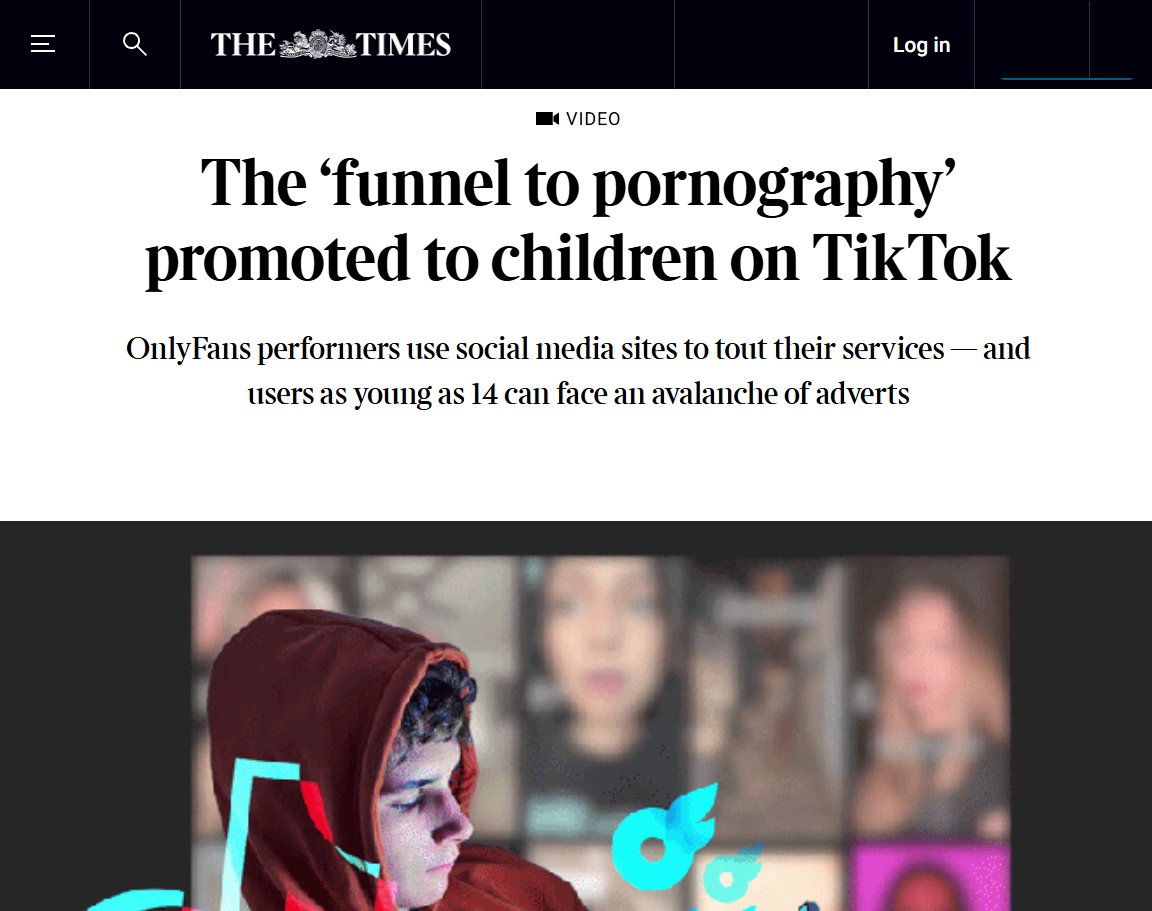
The ‘funnel to pornography’ promoted to children on TikTok: OnlyFans performers use social media sites to tout their services — and users as young as 14 can face an avalanche of adverts
https://t.co/tkXJsLJIkZ
The ‘funnel to pornography’ promoted to children on TikTok: OnlyFans performers use social media sites to tout their services — and users as young as 14 can face an avalanche of adverts
“A young teenager is scrolling through TikTok where women in suggestive videos appear in their feed. There is no nudity but the content is unmistakably sexual. The women mimic sex or masturbation but stay just within the rules of the video platform to make sure they are not banned.
These creators are trying to lure viewers to OnlyFans and other adult websites where they are paid for their services. Most of the videos are too explicit to publish in The Times; the below selection are among the tamer videos that have appeared in the feeds of those aged 14 or 15.
The women on camera provide a path for viewers to find them on OnlyFans and Fanfix, where they can see more explicit videos for a price.
This is a TikTok genre in itself, called “OnlyFans funnel content” by experts. The research company Revealing Reality identified it during a project looking at the TikTok feeds of teenagers. When a teenager searches for one of these videos, their feed will then be filled with similar content.
TikTok bans users from linking directly to platforms that sell adult services. The creators know this and there are dozens of guides online on “how to promote OnlyFans on TikTok without getting banned”, including using code words and avoiding linking to the site directly.
An adult TikTok user can see a direct link from a creator’s account bio to a https://t.co/1rJcS9RqN0 landing page that eventually leads to OnlyFans, but for a child account, the bio does not include the link.
If Instagram is part of the journey to an adult site, the difference is that an adult on Instagram can see a direct link, but a child account cannot see the profile at all.
The guardrails suggest that the companies know what kind of content they are serving. Yet despite these guardrails, once a child searches for the funnel content on TikTok, their feed is filled with it.
Parents may be concerned that their teenagers are able to see this content in the first place. But many children have adult accounts on TikTok and Ofcom has opened an investigation into the platform because of this. In these cases, the platform can be a gateway to pornography.
When under-18s arrive at OnlyFans or another adult site they face age checks under Online Safety Act rules but these can be circumvented with a virtual private network (VPN).
It is not just TikTok that is presented with a problem. A popular category on YouTube is so-called “ASMR” videos, which refers to autonomous sensory meridian response. The clips, which feature whispering, rustling and tapping sounds, are said to help people focus, fall asleep or deal with stress. The Times found several examples that linked through to adult sites.
One video, in which a woman pretends to be the viewer’s girlfriend, was returned through a search for “ASMR intimate”.
From there, users are given an external https://t.co/1rJcS9RqN0 page that directs them to sex videos on OnlyFans.
Baroness Bertin, the Conservative peer who led the government’s independent review of pornography, said that because some of the OnlyFans creators looked so young, the social media platforms were “putting content out that rubs up so close to the law, and is not in the spirit of the law”.
She said: “You could argue that does generate an interest in child sexual abuse because they’re very young-looking. Some of them could easily be under the age of 16. It’s absolutely right that the law has been changed that any depictions of sexual activity with people below the age of consent is now an actual crime.”
The social media ban for under-16s will take effect early next year. Bertin said: “I think you’ve got to remove children from the platform and make it clear to parents and to everyone that the content isn’t safe for children, certainly under-16s and possibly even under-18s for certain content. There does have to be a much more proactive regulatory response which acts quickly when content oversteps the mark.
“There has to be some sort of human judgment call on that. We’ve got the criminal law in a much better place but it actually has to be enforced, and we also have to have much better regulation that bridges that slightly greyer area.”
Jess Asato, a Labour MP and member of the education committee, said: “Despite strong age restrictions on pornography, this research shows that social media platforms are still showing sexualised content to children. That’s why the government’s social media ban needs to stay on track to ensure children can be protected. In the meantime platforms need to make sure they are safe by design — removing algorithmic suggestions based on sexualised content would be a good start. If the algorithm can recognise it, designers could stop it.”
Damon De Ionno, founder and managing director of Revealing Reality, said: “We were prompted to investigate this type of content when we saw it being served to young people in our study. It is evident that as the algorithm can identify and serve unlimited content from adult creators to child accounts, the platforms could easily use this technology to remove this content, which is unsuitable for children.”
TikTok said that its community guidelines did not allow certain types of body exposure or sexualised behaviour on the platform or links that direct people to content that would violate the guidelines. It added that action had been taken against accounts highlighted by The Times for violating these guidelines.
YouTube said: “We take our users’ safety extremely seriously, and remove channels and content (including external links) that violate our community guidelines, including on nudity and sexual content.”
Facing Up to Tough Realities about Pornography And Prostitution
The second wave feminists were right that porn is degrading to women. But what if that's exactly what men (and women) find hot about it?
https://t.co/7TMUoYG4v5
Witch-hunts targeted women with financial independence & status. In colonial New England, women from families w/o male heirs made up 64% of the females prosecuted for witchcraft, 76% of those who were found guilty & 89% of those who were executed.
https://t.co/AC7N6OX0Yz
I find that progressives often don’t want to face issues affecting young women unless you blame men. They struggle to admit that families have broken down, or that the online world is doing anything to relationships, unless the argument targets men—unless it’s about absent fathers specifically, unless it’s about p*rn designed for male tastes, unless it’s about how men behave on dating apps. Social media is bad but mostly because of misogyny and the manosphere; online beauty trends are bad but only because they are decided by the patriarchy.
I can’t help but think this is what choice feminism taught us: not just that every choice a woman makes is empowering, but that every bad choice a woman makes is because of men.
Last week @TheSun published the story of surrogate mother Christian behind a paywall so today, here are the screenshots.
Christian was lied to by everyone involved. Will the little boy ever know the truth about his ‘adoption’?
This is #surrogacy.
MYTH: Prostitution is the oldest profession
For millennia human communities were egalitarian and prostitution was unknown.
In her book, The Creation of Patriarchy, Gerda Lerner showed that prostitution was invented relatively recently in the long history of the human race, when men seized control and started the system of male supremacy known as patriarchy.
One of the key ways the men controlled women was to divide them into two groups: respectable women and prostitutes. Respectable women had to cover their heads and the prostitutes were not allowed to cover their heads – so everyone could see which group each woman belonged to. The respectable women were dependent on the patronage of a named man – her husband or father. The prostitutes were fair game for all men, any man, to rape. So women accepted “respectability” in order to avoid being fair game. And then she had to make sure that she was always taken as a respectable wife so she wouldn’t be mistaken for a prostitute who was fair game. She had to distance herself from the prostitutes. And so women were divided, one from another. In order that they could be more easily screwed.
As such, we see prostitution as a form of violence against the individual women and against all women. We do not believe that equality between women and men is possible while the buying and selling of women for sex is considered acceptable.
For more, see the link in the next tweet.
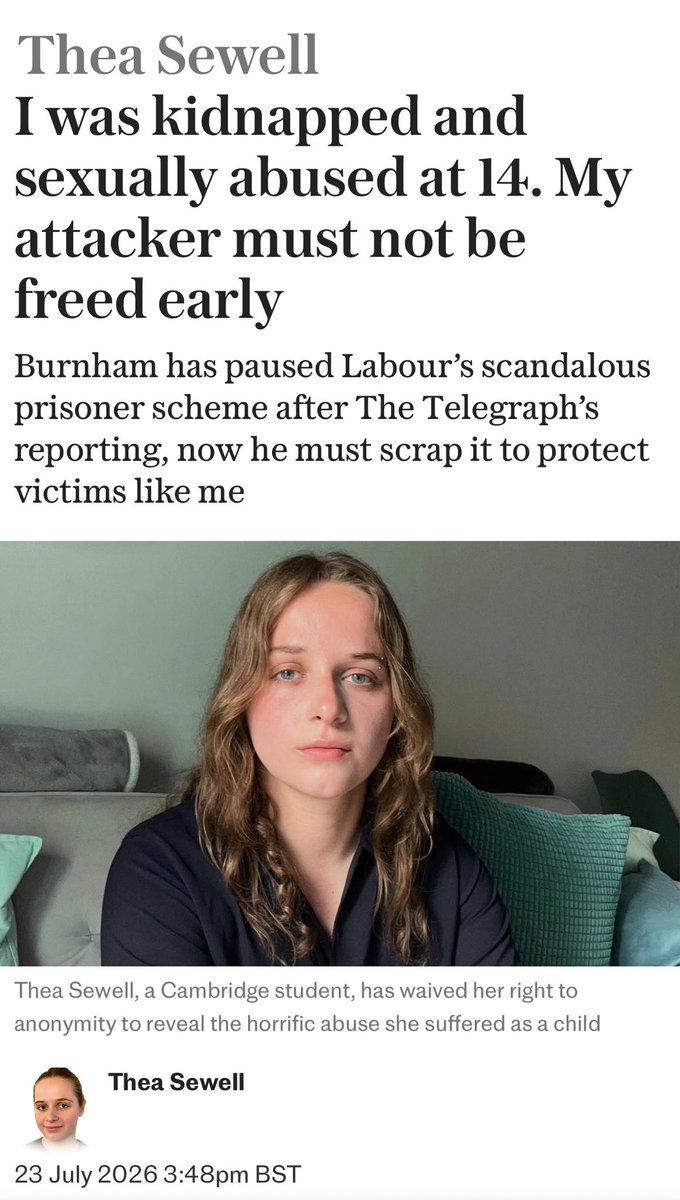
This was a difficult piece to write. It was also necessary.
I am one of the 8,711 victims warned that our attackers could be released early under Labour’s scheme. People should know who stands to benefit.
Malcolm James, then in his late fifties, kidnapped me in 2019, shortly after my fourteenth birthday. He held me for several hours and repeatedly sexually assaulted me.
I remained silent until Sarah Everard disappeared. She was abducted from a road that crosses the one from which I had been taken. I feared that the same men were responsible, and that my silence had allowed it to happen again.
James was convicted of five sexual offences against a child. He is a repeat offender with previous convictions, including for violence. I already believed his eight year sentence was inadequate. Now he may be released earlier still.
Andy Burnham has promised to review this scheme. He must exclude rapists, child sex offenders and repeat violent criminals.
I refuse to have spent longer securing justice than James spends in prison.
In response to *one* of the articles on #surrogacy, published on Sun 19th titled “Rise in overseas surrogates ‘increases risk of stateless babies'” the @guardian has published a letter from our Founder @lexington1920:
https://t.co/IGM54J2PRW
Prostitution: What are the problems and how do we solve them?
It’s generally accepted that prostitution legislation and policy in the UK is confusing, contradictory and out of date – and that it’s time for reform. But before we can understand what the solution to a problem should look like, we need a full understanding of that problem. So I’m going to start by looking briefly at what prostitution means and how it affects the women and men involved, along with wider society.
Prostitution doesn’t happen in a vacuum. It’s part of a structural problem, like plastic in the oceans. We won’t succeed in reducing the harms of plastic unless we address the whole system and change our behaviour and attitudes. I’m not comparing women in the sex trade to plastic, by the way.
I’m comparing one systemic problem that reaches right into the heart of all of our lives with another – worsening inequality – particularly between the sexes.
Inequality is not inevitable – it’s the result of deliberate policies that target the least well off.
The Women’s Budget Group estimates that 86% of the savings from the government’s austerity measures since 2010 have been borne by women, with single mums, and disabled, black and Asian women worst affected.
Sex inequality is not just economic though. We’re witnessing epidemic levels of male violence against women and children.
- 1.3 million female victims of domestic violence in one year.
- 2 women killed every week by a male partner or ex.
- Boys subjecting girls in schools to unprecedented levels of sexual violence and harassment.
This enforces female subordination and upholds men’s individual and collective dominance. It’s a form of mass bullying that’s effectively sanctioned by society.
Why hasn’t this tidal wave of male violence against women and girls been declared a national emergency? Good question.
There’s evidence the rise in male violence is connected with the unprecedented availability of porn, and the misogynistic violence with which it’s infused. Most children are exposed to this from the age of about 11.
Porn conditions viewers to see violence against women and girls as sexually arousing, to consider it normal, and that women and girls deserve it or even ‘ask for it.’
Porn now permeates mainstream culture, grooming girls to think that what’s important is how they look, pleasing men and attracting male attention. It grooms boys to become “users, takers, and pornography makers.”
Studies of men who buy sex find they enjoy the lack of emotional involvement, and see the women they use as objects.
In one study they were found to be nearly eight times more likely than other men to say they’d rape if they could get away with it. Asked why he bought sex, one man said he liked “to beat women up.”
When we consider the actual reality of prostitution, it’s not hard to see why it makes men more prone to violence and to be less empathetic.
Andrea Dworkin, who was herself in prostitution, describes it like this:
“Prostitution is the mouth, the vagina, the rectum, penetrated usually by a penis, sometimes hands, sometimes objects, by one man and then another and then another and then another.”
The man must not think about her delicate tissues, how painful it is, the dissociation she must employ to endure it, and what this does to her over time. He thinks only about his right, his entitlement, getting his money’s worth. And if you suggest otherwise, he gets angry. And she has to pretend she’s happy with it.
This is not work. Not labour. It’s abuse.
So it’s not surprising that buying sex makes men more prone to violence. It feeds his sense of entitlement. It reduces his empathy for women. It normalises one-sided sex – so he learns to ignore the signals of his sexual partners. This means he’s more likely to rape and abuse other women and children. As a result, there’s more male violence in the general community and more sexual harassment in the street and everywhere.
Anything that increases prostitution will inevitably lead to more male violence against women and girls. And this in turn will deepen the inequality between the sexes.
So who are the punters?
They’re men of all ages, races, religions, and backgrounds. They’re rich and they’re poor. No one knows exactly how many men do it. Estimates vary from about 10% to about 80% of the adult male population.
To give a flavour of their attitudes we’ll look at a couple of quotes from punter forums where men enter reviews of the women they buy.
“She was just like a piece of meat… I thought I’ve paid so I better fuck her hard! I decided to put the legs on my shoulders and I was pumping hard!”
Notice how he refers to her legs as if they’re disembodied.
Here’s another one:
“When I asked about anal I was told, not available on first meeting! Well I ain’t starting a relationship with you, love. I just want to fuck you up the arse!”
Research is clear: when the sex trade is made legal – whether by decriminalising or legalising it – prostitution increases. This is not surprising because it sends out a loud message: There’s nothing wrong with buying ‘sex.’
So more men buy ‘sex’; more pimps want to cash in on all that easy money; more brothels get set up; they need more ‘girls’ to fill the brothels – but women who actually have other options seldom choose prostitution; so the sex traffickers move in to fill the gap.
One of the arguments for decriminalising the sex trade is to bring it under Health & Safety regulations. But in any other occupation where there’s a risk of exposure to body fluids, you have to wear masks, gloves, goggles, and protective clothing.
Condoms slip and break, and punters refuse to wear them. And they don’t protect from saliva, sweat and other body fluids. Or from injuries and inflammation caused by friction, and prolonged and heavy pounding. Or from the psychological damage or deliberate physical violence.
Accepting prostitution as normal work means accepting that normal Health & Safety standards do not apply to it. This would set a terrible precedent for all workers.
A German study based on medical examinations of 1,000 women in prostitution found that:
- Most suffer from chronic lower abdominal pain caused by inflammation and mechanical trauma.
- Most show signs of premature ageing, a symptom of persistent stress.
- Most had injuries caused by the overuse of their delicate sexual organs and orifices.
- Most had injuries deliberately inflicted by punters.
Financial or other pressures meant that most of the women had to continue in prostitution even when they were in severe physical pain.
So let’s look at that category of ‘injuries deliberately inflicted by punters.’
In a nine-country study, women reported experiencing a staggering amount of physical violence from punters. Nearly two thirds had been threatened with a weapon, nearly three quarters had been physically assaulted, and more than half had been raped (which, in this context, means unwanted sex for which they weren’t paid). Of those who’d been raped, nearly 60% had been raped six or more times.
Other studies have found similar results and the testimony of survivors tells the same story.
We have a feature on our website where women can enter their experiences of the sex trade anonymously. The stories are moving and powerful. The details vary but the themes are the same – including the long-term consequences, which no one had warned them about. One woman summed it up like this:
“You simply cannot forget years and years of swallowing down your consent, of swallowing down what is, at best, disgust, irritation and boredom during sex and, at worst, anger, humiliation and terror. After you’ve lived through that, it’s fundamentally impossible to have anything near a happy, healthy and ‘normal’ life.”
She goes on to explain how, as a result, her life is a constant everyday battle.
PTSD is an anxiety disorder that develops in response to traumatic or life-threatening experiences, such as war, sexual assault, or accidents. Symptoms can be physically and emotionally crippling and are sometimes delayed for months or even years. And they’re usually worse when the trauma is inflicted deliberately or repeated over time. In one study, 68% of women in prostitution met the criteria for PTSD. This is a similar prevalence to that seen in combat veterans.
Nothing can make prostitution safe for the women and girls caught up in it.
Another theme in the women’s stories is telling themselves it was a choice and hiding the truth about what it was really like from everyone – as a coping mechanism. One woman explained it like this:
“You lie to yourself to ease the pain, keeping a smile on your face while wishing he’d just hurry up and finish. I was a sales woman… why would I ever be honest about hating my job? You just wouldn’t cos it’s bad for business and you’d have to face reality then wouldn’t you?”
Most women enter prostitution as a result of childhood abuse, poverty and misfortune, grooming, coercion, and/or betrayal, rather than as a free choice between a number of viable options.
In study after study, most women say they want to leave prostitution but have no other options for survival. In one study, 89% of the women interviewed said this.
Most of the time, women continue because of an absence of viable alternatives. Common factors that make it hard to leave include: having no training or qualifications, and nothing to put on your CV, being dependent on drugs or alcohol, being coerced by a ‘boyfriend’ or pimp, having debts, and a criminal record.
Much women’s work requires a criminal record check. A criminal record therefore rules out many potential alternatives. This is why we’re not just campaigning for the decriminalisation of those in prostitution, but also for the removal of their criminal records for soliciting, and for high quality services that provide a genuine route out. And an end to the structural inequality that leaves so many women in dire poverty.
Let’s be clear. The majority of women in prostitution don’t make a lot of money. As South African survivor activist, Mickey Meji says, “Prostitution is not a way out of poverty. Most women enter it poor and those that manage to get out, end up even poorer, but now scarred emotionally, physically and mentally.”
But for pimps, it’s a different story. Because so many men are willing to pay for prostitution, there’s easy money to be made.
For example, Phillip Stubbs was found guilty of two counts of brothel keeping at Bristol Crown Court. When the police raided his home they discovered more than 100 luxury cars in a temperature controlled basement. He’d made a fortune from exploiting the prostitution of women in two brothels.
When you think of how much money can be made, it’s little wonder sex industry lobbyists push so hard for full decriminalisation.
In Germany, there are multi-storey brothels in many cities. This is what the pimps want. Industrial scale brothels that can cater to hundreds of men simultaneously. This is what we’d be likely to see in every English city if the sex trade were to be fully decriminalised here.
And instead of being seen as seedy criminals, the pimps who run these palaces of male entitlement and female suffering would immediately become respectable business men.
Sex trade lobbyists have redefined prostitution as ‘sex work’ and prostitutes as ‘sex workers,’ and pushed to get these terms into mainstream use. Many people innocently think these terms are more respectful. But they imply that prostitution is innocuous and is work like any other type of work, when nothing could be further from the truth.
Separating ‘voluntary’ from ‘forced’ prostitution is a similar tactic, which implies that only ‘forced’ prostitution is a problem – when all prostitution is damaging and is seldom – if ever – a real, free, choice for women out of multiple viable options.
Another example is the redefinition of the problem as ‘stigma.’ This suggests that there’s nothing wrong with prostitution itself, and the problem is simply people’s attitudes to it.
We hear from women who’ve been involved in the sex trade that this idea that prostitution is just a job like any other made them think there was something wrong with her if she didn’t like it. We see it as a subtle form of victim blaming and it makes it even harder for women to get out.
When the state sanctions prostitution, it implicitly frames it as harmless and therefore funding for exit services inevitably dries up.
An image has been circulating on social media to support the claim that ‘sex work’ is work.
But perhaps it does more to refute that claim because doesn’t it show what really happens when prostitution is considered as a normal job? Male entitlement and female subordination become official…
… And so does female as second class, lesser, other – or slut, skank, cunt, meat hole, slapper…
And so the tidal wave of violence against women and girls is, after all, all they deserve. And of course it’s not a national emergency.
Women are turning to prostitution out of financial desperation in ever greater numbers – because of economic policies that have impacted women far more than men.
When the government condones women having to turn to prostitution to survive, prostitution becomes the welfare system, and motivation is lost for striving for real, positive solutions to women’s poverty and fixing the broken benefits system.
Prostitution is part of the structural inequality between the sexes. That inequality won’t improve while men have impunity to build up their egos and sense of entitlement by buying sexual access and flattery from women and girls.
Prostitution is a symptom of a systemic problem and it requires a systemic solution.
The best way to minimise prostitution’s harms to both the individual and society is:
- To repeal all the laws that target prostituted individuals, and to clear their criminal records for the same, while introducing ring-fenced funding for high quality non-judgemental services, including genuine routes out and viable alternatives.
- Effective laws against pimping, sex trafficking and brothel keeping, with full funding and prioritisation of their enforcement and prosecution.
- To make purchasing sex a criminal offence, with the key aims of changing attitudes and reducing the demand for prostitution that drives sex trafficking.
This approach is called the Nordic Model. It was first introduced in Sweden in 1999 and since then several other countries have adopted it.
While the Nordic Model doesn’t make prostitution safe – because nothing can – it does reduce the amount of prostitution that takes place, and therefore the number of new women being drawn into it; and it provides genuine routes out for those already involved. The murder statistics provide strong evidence that this approach works.
Each country that has introduced Nordic Model style legislation has done it a little differently and with different degrees of success. It has been most successful in Sweden, where it was introduced as part of a raft of measures to address male violence against women and where there has been the greatest political will to implement all that’s necessary to make it work in practice.
Because, as with any law, it’s not enough to simply pass the legislation. It needs to be enforced. For example, people always used to park their cars in bus lanes in London. But when Ken Livingstone became mayor, he decided to get London moving again and to rigorously enforce the law. For a while, everyone complained about the £80 penalty notice they’d just received for driving in a bus lane. But most people only did this once and now the bus lanes in London are generally clear.
A law alone does not bring about change. It needs to be enforced and enforced consistently. And that takes political will. In Ireland, for example, in the first two years after buying sex became a crime, few, if any, punters were arrested.
The Nordic Model will only be successful if there is political will to enforce it and implement all the things that are required for its success. It needs to be enforced and implemented consistently across the country and not left to the localism agenda. It needs to be prioritised and the services for the women must be fully funded on a permanent basis. The police, the CPS and frontline staff of all descriptions need to be trained. We need public information campaigns and education in schools.
And alongside all of that, we need real measures to address women’s poverty and inequality and a guaranteed minimum income for all.
There’s plenty of evidence that all these things would pay for themselves in the long run and lead to healthier and happier communities.
So how do we create the political will that will bring about a Nordic Model style law and all the things that are needed to make it successful?
To answer, not this exact question, but a similar one, researchers analysed policies in 70 countries to try and find out why some countries adopted effective measures to address violence against women, while others didn’t.
What they found was that the single most important and consistent factor driving good policies for women was feminist activism. They found that feminist activism plays a more important role than any other factor.
So women, we need to get angry! We need to raise awareness of why prostitution is not work, why it’s not the answer to women’s poverty, how it is not a ‘private matter’ – not least because it makes men more violent and is corroding our social fabric.
We need to make it clear that we refuse to live in a world where men have their so-called right to buy sexual access to women and girls enshrined in law.
We must make it clear that women are human beings and we will not rest until our full human rights are enshrined in law and implemented in policy.
Those of us who’ve had luckier lives must remember that our safety, our status, our wellbeing, is inextricably tied to that of the woman being abused on the streets and in brothels in every town and city in this country. If it isn’t exactly the same men who are abusing her as who are paying us less at work and harassing our daughters in the street, they certainly look very similar.
If we abandon her, we cannot complain if no one takes our human rights seriously; if our unequal pay and rape and harassment and domestic abuse get swept under the carpet. Because prostitution is the cornerstone of the patriarchal system that all these things are symptoms of.
Prostitution is both a cause and a consequence of inequality between the sexes. That is why we need a solution that puts equality between the sexes and the well-being of the most vulnerable at its heart. The Nordic Model is the only such approach to prostitution that has so far been devised.
A BRIEF HISTORY OF THE ‘SEX WORK IS WORK’ MOVEMENT
In 1977 a Swedish project was launched to discover the everyday reality of prostituted women’s lives. Researchers interviewed hundreds of women, johns and pimps. What they found exploded the old Victorian myths that prostitution resulted from a biological urge in men and a mental defect in the women. Instead, they found it was something that men do to women with tragic consequences.
Around the same time feminists in the United States and elsewhere, such as Kathleen Barry and Andrea Dworkin, were making a powerful analysis of pornography and prostitution as key elements in the systematic subordination of women. As a result, the sex industry had a serious image problem on its hands.
This article provides an insight into the ways in which the sex industry fought back, including by using euphemism to obscure the reality of prostitution and the idea of prostitutes’ trade unions to give itself legitimacy.
I draw on research and arguments by Kajsa Ekman in her excellent book, Being and Being Bought. Ekman shows that in almost every case these so-called unions are facades put up by those with vested interests – some of them pimps and others who exploit the prostitution of others, some of them johns and some of them people who, for various reasons, have carved out a niche for themselves promoting the industry.
COYOTE
Financed by churches and the porn industry, COYOTE (Call Off Your Old Tired Ethics) was founded in the United States in 1973 by a liberal faction of the hippie movement, who believed that prostitution is an expression of sexual freedom. After eight years it had about 30,000 members, including sex liberals, beatniks and known pimps. In spite of the fact that only about 3% of its members were prostituted women, COYOTE has repeatedly been labelled a union of “hookers” or “whores”.
It was COYOTE spokesperson Priscilla Alexander who, perhaps more than anyone, brought the term “sex worker” into mainstream use. She realised that to normalise prostitution, they needed to shift the language from the word “prostitution,” which is ugly and does in fact conjure up something of its reality, to a euphemism that obscures that reality and conjures up something wholesome and healthy. Sadly, her solution has been very effective.
Alexander claimed that her four years at college qualified her to be considered a “sex worker” and speak on their behalf. She and Margo St James travelled round the world marketing their ideas that “sex work” should be legitimised and that selling your body is a human right.
DE RODE DRAAD
From the early 1980s the Dutch government started a number of projects with the aim of normalising prostitution. This culminated in the legalisation of all aspects of the sex industry in Holland in 1999. The de Graaf Foundation played a central role in this process. The foundation is pro-prostitution and now has official status as the Dutch Institute for Prostitution Issues in Amsterdam and is a major source of pro-prostitution propaganda.
The de Graaf Foundation founded de Rode Draad (The Red Thread), which is now one of the most famous “unions for prostitutes” in the world. In 2002 it became an official trade union under the name Truss and shortly after that it joined FNV, Holland’s largest federation of trade unions. In 2010 it had only about 100 members (out of more than 25,000 prostituted women in Amsterdam) and there is no record of it ever pursuing any genuine trade union issue. In spite of this, tourist brochures give the impression that it is a hive of activity through which prostituted women self-organise en masse.
THE WORLD WHORES’ CONGRESS
The Dutch government and the de Graaf Foundation part-funded the World Whores’ Congress held in Amsterdam in 1985 and in Brussels in 1986. The congress was initiated by COYOTE’s Margo St James and Priscilla Alexander, along with academic Gail Pheterson. The people who attended were prostituted women (about 50%) along with academics, sex liberals, government officials, police, and pimps and others from the sex industry.
The record of the congress shows that it included open and frank discussion with a wide range of opinions expressed including support for prostitution, desire to leave it, and seeing it as a necessary evil. Some of the testimony was harrowing – for example, one woman told of being raped and beaten by her pimp when she was 13 and another spoke of being violently beaten and coerced into prostitution by her boyfriend who became her pimp. In spite of this, the organisers pressed ahead with their pre-defined agenda and adopted a manifesto demanding the decriminalisation of both prostitution and pimping.
The manifesto is quoted extensively in pro-prostitution academic and “sex positive” literature as the authentic demands of “sex workers”. However, the records of the congress show that the prostituted women did not speak with one voice and that the demands were passed by a majority who were not “sex workers” and many who had a vested financial interest in the industry. It is rare to find a critique of the context in which it arose and how the agenda was set and controlled.
THE AIDS EPIDEMIC OPENS UP NEW FUNDING STREAMS
The onset of the AIDS epidemic in the 1980s led to a large (and continuing) influx of funding to COYOTE and other organisations that purported to represent prostituted women, under the guise of preventing the spread of HIV/AIDS.
The prevention strategy can be summarised as the distribution of condoms to the women (at whose door the responsibility for preventing the spread of the disease to punters and their wives and partners is firmly laid). The funding enabled these groups to step up their campaigns for the normalisation of prostitution as “work”.
As a result, the “prostitution is work” argument started to gain real traction in the late 1990s with organisations like the ILO, UNAIDS and the WHO coming out in favour of it.
UNIONS FOR “SEX WORKERS”
In the early 2000s, the idea that trade unions were the solution to all of the problems of prostitution took off. However, discussion about what a union could actually achieve for prostituted women was noticeably absent.
The idea of unions for prostitutes is seductive. But how do isolated women organise against the violent pimps, mafia-like gangs and ruthless brothel and lap-dancing venue bosses that control the trade?
Even in countries where prostitution is legalised, only a very small minority of women are formally employed. For example, in 2007 in Germany (where prostitution is legalised), government research showed that less than 1% of prostituted persons were formally employed and only 5% even wanted any sort of registered employment within the industry.
For her book (which was originally published in Swedish in 2010) Kajska Ekman conducted research into the “sex worker” unions in Western Europe. Of particular note is the International Union of Sex Workers (IUSW), a UK-based group that became part of the National Union of General and Municipal Workers, now the GMB.
The IUSW website states that membership is “open to everyone working in the sex industry and adult entertainment […] and those who support the campaigning aims of the organisation” – which sounds like an invitation to johns and pimps to me. Which legitimate union invites customers, bosses and business owners to join?
The IUSW campaigns for the full decriminalisation of the industry, including pimps. In 2003, it had only 150 members (at a time when there were an estimated 100,000 prostituted women in the UK). When Ekman was doing her research, the most active member was Douglas Fox who claimed to be a sex worker but was actually the founder and co-owner of one of England’s largest escort agencies, Christony Companions – i.e. a pimp.
The IUSW has not only failed to make any demands on the sex industry to improve conditions for workers, it has actually lobbied the government to reject proposed anti-trafficking legislation, which would provide redress for trafficked women.
Ekman found a similar story in the other Western European countries she investigated:
“In spite of my efforts, I was not able to find any group that functions as a trade union in the true meaning of the term: an organisation run and financed by its members, negotiating with employers to promote the best interests of workers. Although there may be or may have been such groups, I still draw the conclusion that the majority of groups calling themselves trade unions for prostituted individuals are mislabelling and misrepresenting themselves. Instead, most of them are interest groups using the term ‘trade union’ to make prostitution out to be a job like any other.” (Page 69)
She showed that the groups weren’t what they appeared to be and generally their main aim was not to change the industry but to change its image. There is a deathly silence from all of them about the practicalities of unionising “workers” in prostitution as it is actually practiced.
THE HALL OF DISTORTING MIRRORS
The focus of all of the groups that purport to represent “sex workers” that Ekman investigated was on agitating for full decriminalisation of the industry – and attacking feminists.
Much of their discourse relies on association – so prostitution is associated with positive and dynamic words and ideas like ecstasy, pleasure, festivities, dynamism, liberation, and transgression while feminists are associated with negative words like puritanical, sobriety, authoritarianism, anti-sex, and even Nazism. This is not analysis. It is manipulation and it blocks analytical thinking.
More recently this strand has morphed into the assertion that feminists hate sex workers and the ‘SWERF’ term has come into use. SWERF stands for Sex Worker Exclusionary Radical Feminist and the term is used widely as a slur against feminists who see prostitution as a lynchpin of the patriarchal system that oppresses and subordinates women. The use of the SWERF term is also manipulative and blocks analytical thinking.
What feminist wants to be thought of as someone who hates anyone, let alone a vulnerable woman? Even the threat of being called a SWERF frightens women into conforming with the “prostitution is work” agenda. This is particularly devastating for young women who are exploring feminist ideas and who might otherwise listen to the feminist analysis of prostitution.
The use of the SWERF term is a form of harassment. It is used to discredit the feminist analysis and to frighten women away from it. This is a tired old patriarchal tactic but unfortunately it is effective.
Another main thread of the discourse is that the “sex worker” is not a victim but a strong person who knows what she wants, whose choices we must respect. This is a curious argument because the definition of ‘victim’ is someone who is subjected to cruel or oppressive treatment or suffers some other damaging event. Nowhere does the definition suggest or imply anything about the victim’s humanity or strength, or lack thereof.
All types of people can be victims of earthquakes or car crashes. News stories about earthquakes often focus on the strength and resourcefulness of the victims and never question their choice of, for example, going to sleep in their own bed on the night of the earthquake.
However, in popular culture it has become something of a taboo to describe someone as a victim of systematic oppression because by definition that draws attention to that systematic oppression and implies the possibility of a different system – one in which there is some form of social justice, for example.
Calling someone a victim of anything other than something random and unpredictable has become associated with an insult to that person’s humanity, strength, “agency”, and so on. It is no accident that this change in popular culture has come about in the decades that neoliberalism has controlled the media and infiltrated academia. It is yet another ideological trick to block analysis of systems of oppression and to keep us all firmly in our place.
We should not be surprised therefore that those who want to normalise the sex industry accuse anyone who critiques it of promoting a victim/saviour narrative that impugns the “sex worker’s agency”.
Who do they use they use this tactic against? Those horrid feminists, of course. Why? To silence their analysis of prostitution as a system of oppression and frighten others (especially young women) from listening to them. Because ultimately that feminist analysis is sound and once you open your eyes and ears and heart to it, it is hard to disagree.
And of course when those horrid feminists say that a prostituted woman is a victim, it just proves that they must hate her. So therefore they are SWERFs. QED*. Except, actually, not.
It’s just another distorting mirror. Let’s listen to the survivors of prostitution and hear what they have to say.


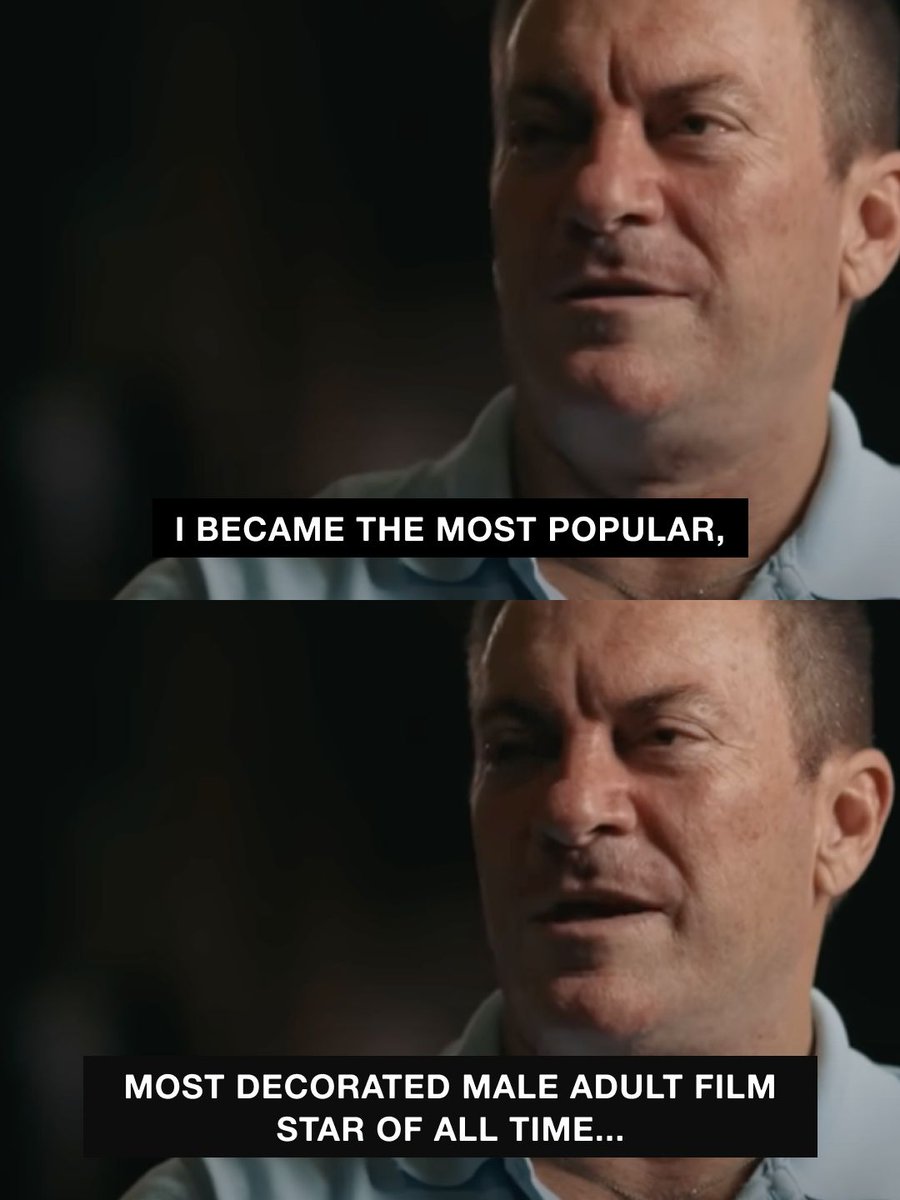
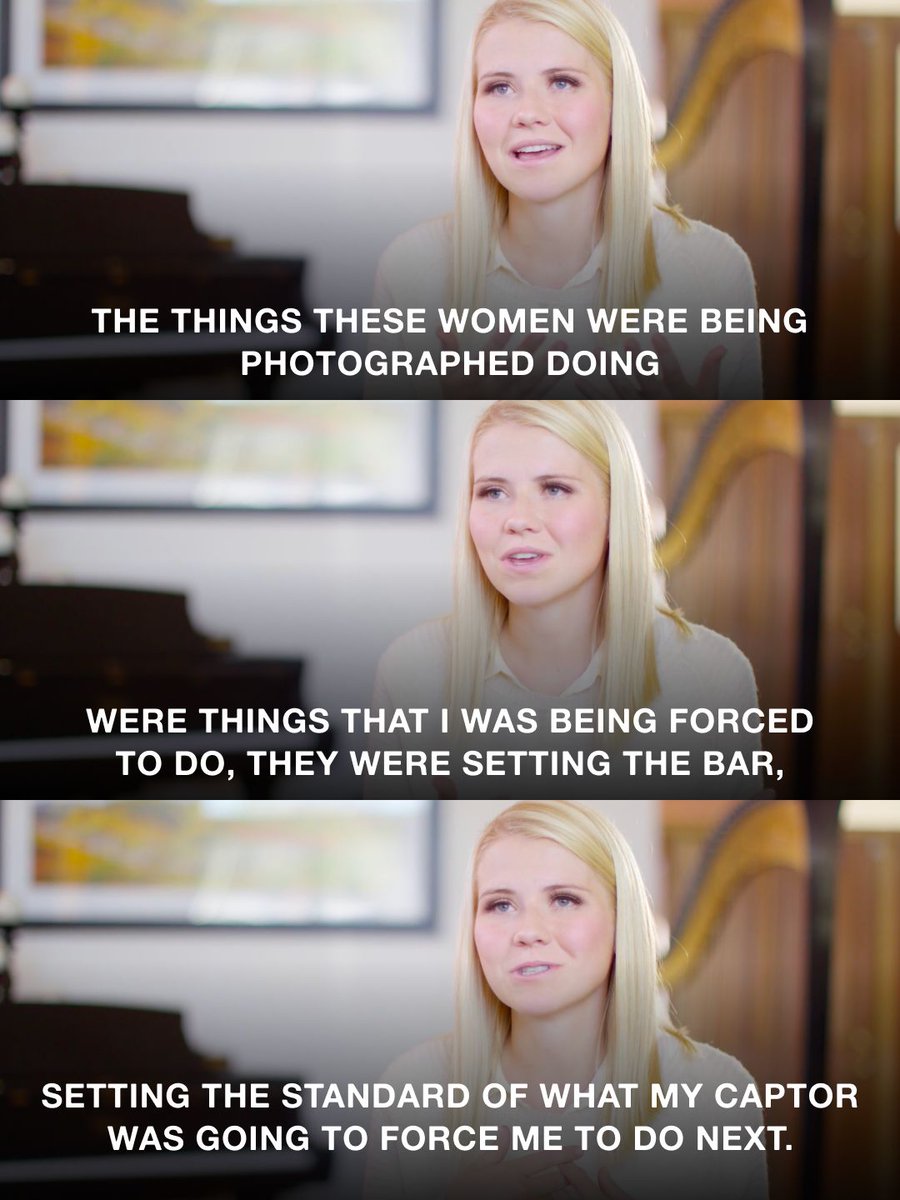
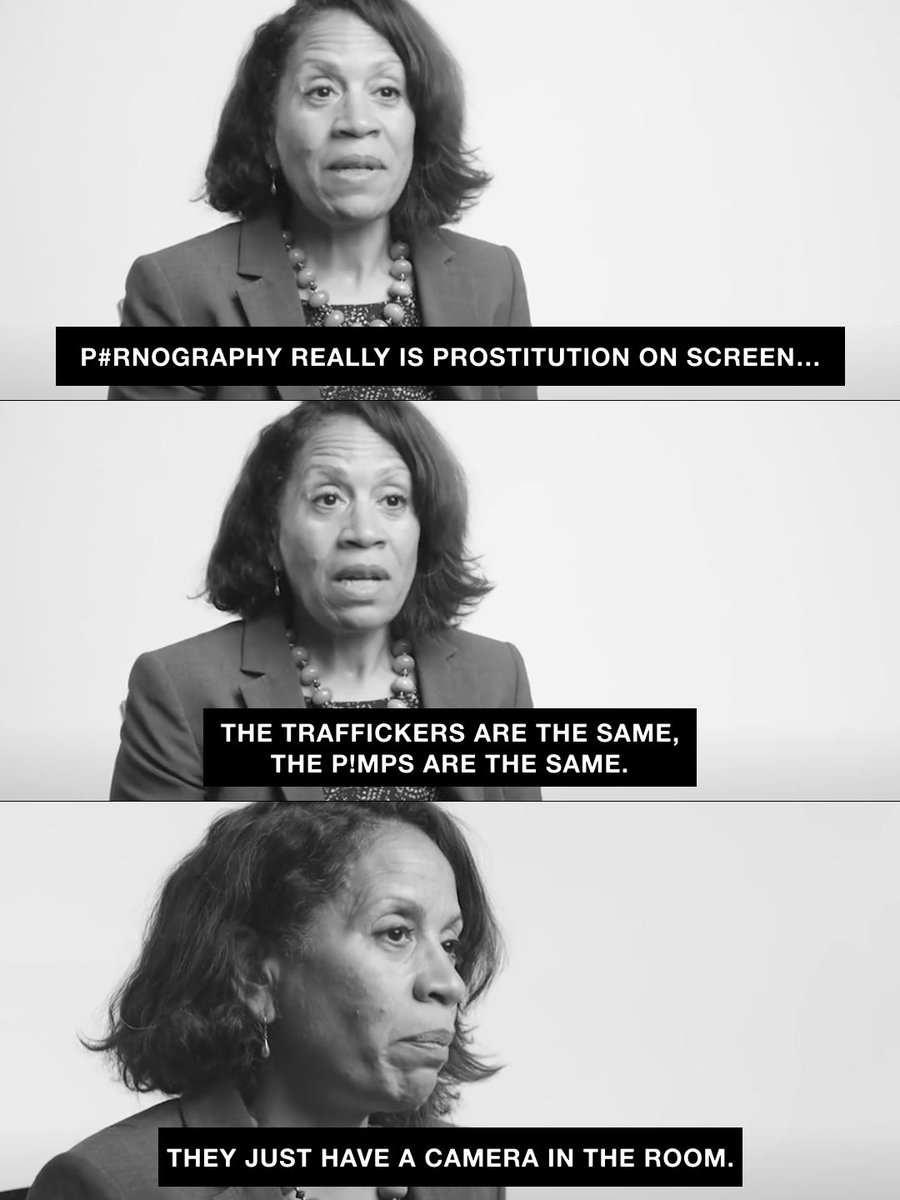










![nordicmodelnow's tweet photo. A BRIEF HISTORY OF THE ‘SEX WORK IS WORK’ MOVEMENT
In 1977 a Swedish project was launched to discover the everyday reality of prostituted women’s lives. Researchers interviewed hundreds of women, johns and pimps. What they found exploded the old Victorian myths that prostitution resulted from a biological urge in men and a mental defect in the women. Instead, they found it was something that men do to women with tragic consequences.
Around the same time feminists in the United States and elsewhere, such as Kathleen Barry and Andrea Dworkin, were making a powerful analysis of pornography and prostitution as key elements in the systematic subordination of women. As a result, the sex industry had a serious image problem on its hands.
This article provides an insight into the ways in which the sex industry fought back, including by using euphemism to obscure the reality of prostitution and the idea of prostitutes’ trade unions to give itself legitimacy.
I draw on research and arguments by Kajsa Ekman in her excellent book, Being and Being Bought. Ekman shows that in almost every case these so-called unions are facades put up by those with vested interests – some of them pimps and others who exploit the prostitution of others, some of them johns and some of them people who, for various reasons, have carved out a niche for themselves promoting the industry.
COYOTE
Financed by churches and the porn industry, COYOTE (Call Off Your Old Tired Ethics) was founded in the United States in 1973 by a liberal faction of the hippie movement, who believed that prostitution is an expression of sexual freedom. After eight years it had about 30,000 members, including sex liberals, beatniks and known pimps. In spite of the fact that only about 3% of its members were prostituted women, COYOTE has repeatedly been labelled a union of “hookers” or “whores”.
It was COYOTE spokesperson Priscilla Alexander who, perhaps more than anyone, brought the term “sex worker” into mainstream use. She realised that to normalise prostitution, they needed to shift the language from the word “prostitution,” which is ugly and does in fact conjure up something of its reality, to a euphemism that obscures that reality and conjures up something wholesome and healthy. Sadly, her solution has been very effective.
Alexander claimed that her four years at college qualified her to be considered a “sex worker” and speak on their behalf. She and Margo St James travelled round the world marketing their ideas that “sex work” should be legitimised and that selling your body is a human right.
DE RODE DRAAD
From the early 1980s the Dutch government started a number of projects with the aim of normalising prostitution. This culminated in the legalisation of all aspects of the sex industry in Holland in 1999. The de Graaf Foundation played a central role in this process. The foundation is pro-prostitution and now has official status as the Dutch Institute for Prostitution Issues in Amsterdam and is a major source of pro-prostitution propaganda.
The de Graaf Foundation founded de Rode Draad (The Red Thread), which is now one of the most famous “unions for prostitutes” in the world. In 2002 it became an official trade union under the name Truss and shortly after that it joined FNV, Holland’s largest federation of trade unions. In 2010 it had only about 100 members (out of more than 25,000 prostituted women in Amsterdam) and there is no record of it ever pursuing any genuine trade union issue. In spite of this, tourist brochures give the impression that it is a hive of activity through which prostituted women self-organise en masse.
THE WORLD WHORES’ CONGRESS
The Dutch government and the de Graaf Foundation part-funded the World Whores’ Congress held in Amsterdam in 1985 and in Brussels in 1986. The congress was initiated by COYOTE’s Margo St James and Priscilla Alexander, along with academic Gail Pheterson. The people who attended were prostituted women (about 50%) along with academics, sex liberals, government officials, police, and pimps and others from the sex industry.
The record of the congress shows that it included open and frank discussion with a wide range of opinions expressed including support for prostitution, desire to leave it, and seeing it as a necessary evil. Some of the testimony was harrowing – for example, one woman told of being raped and beaten by her pimp when she was 13 and another spoke of being violently beaten and coerced into prostitution by her boyfriend who became her pimp. In spite of this, the organisers pressed ahead with their pre-defined agenda and adopted a manifesto demanding the decriminalisation of both prostitution and pimping.
The manifesto is quoted extensively in pro-prostitution academic and “sex positive” literature as the authentic demands of “sex workers”. However, the records of the congress show that the prostituted women did not speak with one voice and that the demands were passed by a majority who were not “sex workers” and many who had a vested financial interest in the industry. It is rare to find a critique of the context in which it arose and how the agenda was set and controlled.
THE AIDS EPIDEMIC OPENS UP NEW FUNDING STREAMS
The onset of the AIDS epidemic in the 1980s led to a large (and continuing) influx of funding to COYOTE and other organisations that purported to represent prostituted women, under the guise of preventing the spread of HIV/AIDS.
The prevention strategy can be summarised as the distribution of condoms to the women (at whose door the responsibility for preventing the spread of the disease to punters and their wives and partners is firmly laid). The funding enabled these groups to step up their campaigns for the normalisation of prostitution as “work”.
As a result, the “prostitution is work” argument started to gain real traction in the late 1990s with organisations like the ILO, UNAIDS and the WHO coming out in favour of it.
UNIONS FOR “SEX WORKERS”
In the early 2000s, the idea that trade unions were the solution to all of the problems of prostitution took off. However, discussion about what a union could actually achieve for prostituted women was noticeably absent.
The idea of unions for prostitutes is seductive. But how do isolated women organise against the violent pimps, mafia-like gangs and ruthless brothel and lap-dancing venue bosses that control the trade?
Even in countries where prostitution is legalised, only a very small minority of women are formally employed. For example, in 2007 in Germany (where prostitution is legalised), government research showed that less than 1% of prostituted persons were formally employed and only 5% even wanted any sort of registered employment within the industry.
For her book (which was originally published in Swedish in 2010) Kajska Ekman conducted research into the “sex worker” unions in Western Europe. Of particular note is the International Union of Sex Workers (IUSW), a UK-based group that became part of the National Union of General and Municipal Workers, now the GMB.
The IUSW website states that membership is “open to everyone working in the sex industry and adult entertainment […] and those who support the campaigning aims of the organisation” – which sounds like an invitation to johns and pimps to me. Which legitimate union invites customers, bosses and business owners to join?
The IUSW campaigns for the full decriminalisation of the industry, including pimps. In 2003, it had only 150 members (at a time when there were an estimated 100,000 prostituted women in the UK). When Ekman was doing her research, the most active member was Douglas Fox who claimed to be a sex worker but was actually the founder and co-owner of one of England’s largest escort agencies, Christony Companions – i.e. a pimp.
The IUSW has not only failed to make any demands on the sex industry to improve conditions for workers, it has actually lobbied the government to reject proposed anti-trafficking legislation, which would provide redress for trafficked women.
Ekman found a similar story in the other Western European countries she investigated:
“In spite of my efforts, I was not able to find any group that functions as a trade union in the true meaning of the term: an organisation run and financed by its members, negotiating with employers to promote the best interests of workers. Although there may be or may have been such groups, I still draw the conclusion that the majority of groups calling themselves trade unions for prostituted individuals are mislabelling and misrepresenting themselves. Instead, most of them are interest groups using the term ‘trade union’ to make prostitution out to be a job like any other.” (Page 69)
She showed that the groups weren’t what they appeared to be and generally their main aim was not to change the industry but to change its image. There is a deathly silence from all of them about the practicalities of unionising “workers” in prostitution as it is actually practiced.
THE HALL OF DISTORTING MIRRORS
The focus of all of the groups that purport to represent “sex workers” that Ekman investigated was on agitating for full decriminalisation of the industry – and attacking feminists.
Much of their discourse relies on association – so prostitution is associated with positive and dynamic words and ideas like ecstasy, pleasure, festivities, dynamism, liberation, and transgression while feminists are associated with negative words like puritanical, sobriety, authoritarianism, anti-sex, and even Nazism. This is not analysis. It is manipulation and it blocks analytical thinking.
More recently this strand has morphed into the assertion that feminists hate sex workers and the ‘SWERF’ term has come into use. SWERF stands for Sex Worker Exclusionary Radical Feminist and the term is used widely as a slur against feminists who see prostitution as a lynchpin of the patriarchal system that oppresses and subordinates women. The use of the SWERF term is also manipulative and blocks analytical thinking.
What feminist wants to be thought of as someone who hates anyone, let alone a vulnerable woman? Even the threat of being called a SWERF frightens women into conforming with the “prostitution is work” agenda. This is particularly devastating for young women who are exploring feminist ideas and who might otherwise listen to the feminist analysis of prostitution.
The use of the SWERF term is a form of harassment. It is used to discredit the feminist analysis and to frighten women away from it. This is a tired old patriarchal tactic but unfortunately it is effective.
Another main thread of the discourse is that the “sex worker” is not a victim but a strong person who knows what she wants, whose choices we must respect. This is a curious argument because the definition of ‘victim’ is someone who is subjected to cruel or oppressive treatment or suffers some other damaging event. Nowhere does the definition suggest or imply anything about the victim’s humanity or strength, or lack thereof.
All types of people can be victims of earthquakes or car crashes. News stories about earthquakes often focus on the strength and resourcefulness of the victims and never question their choice of, for example, going to sleep in their own bed on the night of the earthquake.
However, in popular culture it has become something of a taboo to describe someone as a victim of systematic oppression because by definition that draws attention to that systematic oppression and implies the possibility of a different system – one in which there is some form of social justice, for example.
Calling someone a victim of anything other than something random and unpredictable has become associated with an insult to that person’s humanity, strength, “agency”, and so on. It is no accident that this change in popular culture has come about in the decades that neoliberalism has controlled the media and infiltrated academia. It is yet another ideological trick to block analysis of systems of oppression and to keep us all firmly in our place.
We should not be surprised therefore that those who want to normalise the sex industry accuse anyone who critiques it of promoting a victim/saviour narrative that impugns the “sex worker’s agency”.
Who do they use they use this tactic against? Those horrid feminists, of course. Why? To silence their analysis of prostitution as a system of oppression and frighten others (especially young women) from listening to them. Because ultimately that feminist analysis is sound and once you open your eyes and ears and heart to it, it is hard to disagree.
And of course when those horrid feminists say that a prostituted woman is a victim, it just proves that they must hate her. So therefore they are SWERFs. QED*. Except, actually, not.
It’s just another distorting mirror. Let’s listen to the survivors of prostitution and hear what they have to say.](https://pbs.twimg.com/media/HN5LeadWwAA1Rpf.jpg)


