@Isaac_A_Arthur The connection to the Fermi paradox as a side implication then becomes obvious if the theory is correct. Thus, it is also not a “late filter” theory for the Fermi paradox. It is more a premise. What comes to mind is Scotty saying, “We cannot break the laws of physics, captain!”
@Isaac_A_Arthur What the paper reasons from the science is that if any type of life evolves in its own unique conditions anywhere in the universe, that life would be limited in sustainability based upon the unique conditions of its evolution, basis world, basis star, etc.
The Second Law of Thermodynamics: is it truly universal? Another way of wording this… Heat Death - will it happen, or will the universe avoid it by some currently unknown process, such as creating new high quality energy at the fringes beyond our current ability to sense?
@DrPhiltill Interesting thoughts. I invite you to look at latest paper @Astroeco_Morgan and I published. Everything is material organized by conservative forces into non-equilibrium networks of heat engines, aka dissipative structures. Ref ecological thermodynamics.
https://t.co/lnHKv39prZ
@Andrew_Akbashev@calippoebbira If a proposal does not get accepted or funded, then get a patent, publish a paper, or simply call it a conceptual development white paper. There is always a way to spin it as a positive rather than a negative.
I worked gov agency contracts my entire career with papers limited from public distribution. At age 55, I started my own lab. At ages 56 & 58, I published my first indy papers to broad reading & publicity, challenging established physics & popular opinion. Now working 5 more.
Your academic CV is NOT linked to your ability to make big discoveries.
▫️
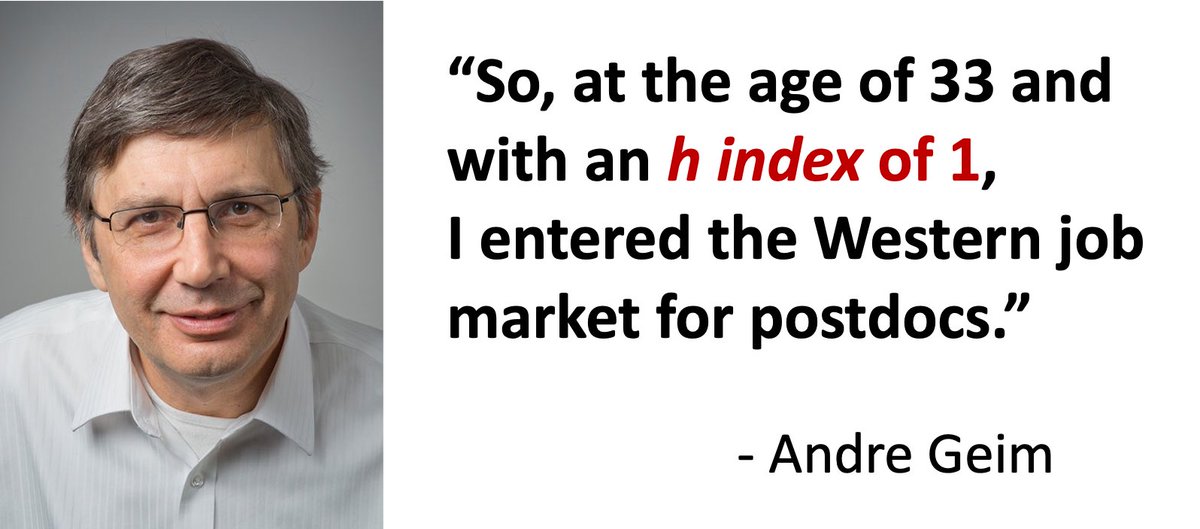
1. Andre Geim, a co-discoverer of graphene, wrote in his Nobel Lecture article:
- “So, at the age of 33 and with an h index of 1 (latest papers not yet published), I entered the Western job market for postdocs.”
2. Albert Einstein searched for a teaching position for two years. He had to accept a position at a Patent Office, where in a single year he wrote the four papers that completely revolutionized #science (the photoelectric effect, Brownian motion, special relativity, and E=mc2).
- Only few years later, he finally secured his first academic position as lecturer at the University of Bern.
▫️
Other examples include Peter Ratcliffe and Frances Arnold, who won Nobel Prizes for the discoveries they made as young PIs in newly established labs. And many others.
▫️
So, let us all keep in mind that:
1. Big discoveries are often unforeseen. They emerge from random and risky research (e.g. graphene was a tiny side project!). Make sure you have such projects in your lab.
2. Most truly impactful discoveries did not require high h-indices, excessive funding or a high-IF journal.
3. Rejection of your proposal does NOT mean it proposes bad science. Such rejections represent the opinion of one person who has a rather subjective idea of what ‘good science’ means.
4. For younger people, it’s easier to do risky research. Locking them to unnecessarily complex tenure requirements makes such discoveries unlikely.
▫️
A strong scientist is not defined by high “academic metrics”.
It is the ONE who proposes risky endeavors outside the conventional boundaries.
Who sees risk as an opportunity to make discoveries.
And who is constantly seeking out these risks in the lab.
#AcademicTwitter #AcademicChatter
@Andrew_Akbashev I worked gov agency contracts my entire career with papers limited from public distribution. At age 55, I started my own lab. At ages 56 & 58, I published my first indy papers to broad reading & publicity, challenging established physics & popular opinion. Now working 5 more.
@EdKrassen Theory suggests it would very difficult if not impossible for any life form to travel too far from its home planet. Even if one alien civilization manages it, the chance of multiple alien civilizations visiting at same time…
https://t.co/lnHKv39prZ
@paulg The way efficiency is achieved is a determining factor. Efficiency by limiting sources to reduce costs by volume definitely results in brittleness. Efficiency by aggradation of networks (circularizing/recycling) or by minimizing/utilizing waste tends to build robustness.
@paulg Rearranging resources implies becoming more efficient. Efficiency usually is accompanied by brittleness, as seen in global supply chains upon commencement of the COVID 19 pandemic. Brittleness leads to instability under heavy internal loads/demands or external disruptions.