@WesternFault@RonStoeferle@ctindale@LukeGromen@kevinmuir ot only do US markets not understand this 6-week shipping gap, they don't understand how slow things will be to normalize. And they don't understand this will reflect in WTI and hugely - in future CPI.
They cannot risk restarting the wells early. https://t.co/uRWQM9P0k5
Economic Destruction in Iran (Targeted Strikes by US/Israel)
South Pars natural gas field / Asaluyeh complex (world’s largest gas field, source of ~90% of Iran’s domestic gas supply): Israeli drone strikes on March 18 damaged four key gas treatment plants, causing long-term disruption to Iran’s natural gas processing and associated electricity generation from gas-fired plants (estimated 20-25% loss in effective domestic gas-to-power capacity due to treatment bottlenecks).
Oil storage facilities in Tehran: Israeli strikes on March 8 ignited large fires and destroyed major storage tanks, disrupting ~10-15% of Iran’s inland oil distribution and export buffering capacity (global impact: negligible direct, <0.5% of world oil storage, but contributed to regional price volatility).
Mobarakeh Steel complex (Isfahan): Israeli strikes on March 27 damaged storage silos and power infrastructure at Iran’s largest steel producer (7.1 million tonnes annual crude steel capacity); ~40% of the plant’s quarterly output (roughly 1.8 million tonnes) halted short-term, representing ~25% of Iran’s total steel capacity lost (global impact: <0.5% of world steel supply, as Iran is a minor global exporter).
Khuzestan Steel complex (Ahvaz): Simultaneous strikes on March 27 hit storage and power infrastructure at Iran’s second-largest steelmaker (4.2 million tonnes annual capacity); 35% of quarterly output affected (roughly 1.0 million tonnes), combining with Mobarakeh for ~11.3 million tonnes total annual capacity impacted (35% of Iran’s overall steel capacity lost; global impact: minimal at <0.5% of world crude steel production).
Associated power infrastructure tied to steel and gas facilities: Widespread electricity generation shortfalls estimated at 15-20% of national grid capacity due to gas supply cuts and direct power plant damage (global impact: none direct).
Economic Facilities Destroyed in Countries Attacked by Iran (Retaliatory Missile/Drone Strikes)
Qatar (Ras Laffan LNG complex, world’s largest LNG export hub): Iranian missile strikes March 18-19 caused extensive damage, wiping out 17% of Qatar’s LNG export capacity (repairs projected 3-5 years); the facility produces ~20% of global LNG supply, so ~17% of world LNG capacity lost long-term (global impact: 3-4% of total world LNG supply offline).
Qatar (Pearl GTL gas-to-liquids plant at Ras Laffan): Co-located damage from same strikes disrupted gas-to-liquids processing (global impact: minor on fuels but tied to downstream petrochemicals).
Saudi Arabia (Shaybah oil field and associated refineries): Iranian drone/missile strikes damaged oil production and refining infrastructure, contributing to ~2-3 million bpd regional Gulf production drop (global impact: part of overall 20% world oil flows disrupted via Strait of Hormuz closure).
Kuwait (multiple oil refineries): Iranian strikes caused direct damage to refining capacity, part of the 6.7-10 million bpd collective drop across Kuwait/Iraq/Saudi/UAE (global impact: amplified the 20% global crude oil supply suspension through Hormuz).
UAE (Shah gas field southwest of Abu Dhabi and Fujairah oil facilities): Iranian strikes damaged gas processing and oil export hubs, shutting gas facilities and contributing to regional energy output losses (global impact: part of 20% world LNG and oil transit halt).
Bahrain and other Gulf states (desalination and power plants): Iranian threats and strikes targeted facilities providing 99% of drinking water in Kuwait/Qatar and significant electricity; specific damage to desalination reduced water output by up to 20-30% in affected states (global impact: none direct, but regional economic paralysis).
Strait of Hormuz Closure (Iran-Imposed Blockade from Early March 2026, Affecting All Regional Exports)
20% of global crude oil (20 million bpd pre-war, net shortage 14.5-16.5 million bpd after limited bypass pipelines) and ~20% of global LNG suspended; additional commodities bottled up include ~35% of world urea fertilizer exports, ~25-33% of global helium supply, ~8-9% of world aluminum production/exports, and ~20-30% of global fertilizer exports overall.
Estimated 2nd and 3rd Order Effects
Prescription medication production in India: Shipping and air-cargo routes through the Gulf (Strait of Hormuz and Gulf air hubs) disrupted 79-90%, delaying ~20-30% of India’s pharma exports (active ingredients and finished drugs transiting the region); global shortages risk for generics and specialty meds in Africa/Asia/US markets within 4-8 weeks.
Chip and semiconductor production in Asia: Helium shortage (one-third of world supply offline from Qatar Ras Laffan damage) halted cooling processes in fabrication; ~10-15% reduction in global chip output capacity within months, hitting electronics, autos, and defense (Qatar supplies ~40% pre-war helium).
Plastic and polymer production in Asia: Petrochemical feedstock disruptions ($20-25 billion annual value through Hormuz) drove polypropylene/polyethylene prices to 4-year highs; ~15-20% cost increase for Asian plastics manufacturers, cascading to packaging, autos, consumer goods, and construction (Asia most exposed).
Fertilizer shortages (Gulf supplies 33% urea / 25% ammonia): Urea prices surged 40% in Southeast Asia/India; global food production yields drop 5-10% in fertilizer-dependent regions (esp. Asia/Africa), raising food prices 10-20% and risking shortages by Q3 2026.
Aluminum supply chain (Gulf ~8-9% global output idled/shuttered): Prices hit record highs; 5-10% higher costs for solar panels, autos, aerospace, and cans, delaying renewable energy projects and adding 2-5% to construction/inflation globally.
Sulfur and critical minerals: ~25% world sulfur (ME refining byproduct) and seaborne trade halved; extraction of cobalt/copper (key for batteries/semiconductors) slowed 10-15%, raising costs for EVs and electronics.
Broader energy-driven deindustrialization: Europe/UK chemical and steel sectors imposed 30% surcharges; potential permanent plant closures and 1%+ GDP drag in heavy industry.
Expected US CPI Impact with $150 Crude and Associated Energy Increases
A sustained $150/barrel crude (from pre-war levels) would drive jet fuel, diesel, and gasoline prices up 40-60%, directly boosting the CPI basket’s energy component by 15-25% annualized. Pass-through effects would add 2-4 percentage points to core CPI via higher shipping/import costs for goods (plastics, aluminum, fertilizers inflating food/manufactured items 5-10%) and services (transport/logistics up 8-12%). Auto fuel alone (gasoline ~3-4% of CPI weight) could contribute 0.5-1 point directly as households face $1-2/gallon increases, compounding with broader energy pass-through to push overall US CPI inflation 3-5 points higher for 2026, with peak effects in Q2-Q3 before any SPR releases or alternative routing mitigate.
@MRefaat_Formal Yeah, ya know? Maybe at some point it's time to consider that this war is about the US dollar, something the BRICS crowd has been saying for years. Chinese state media made a cartoon to help you understand.
https://t.co/96k3Hsz83L
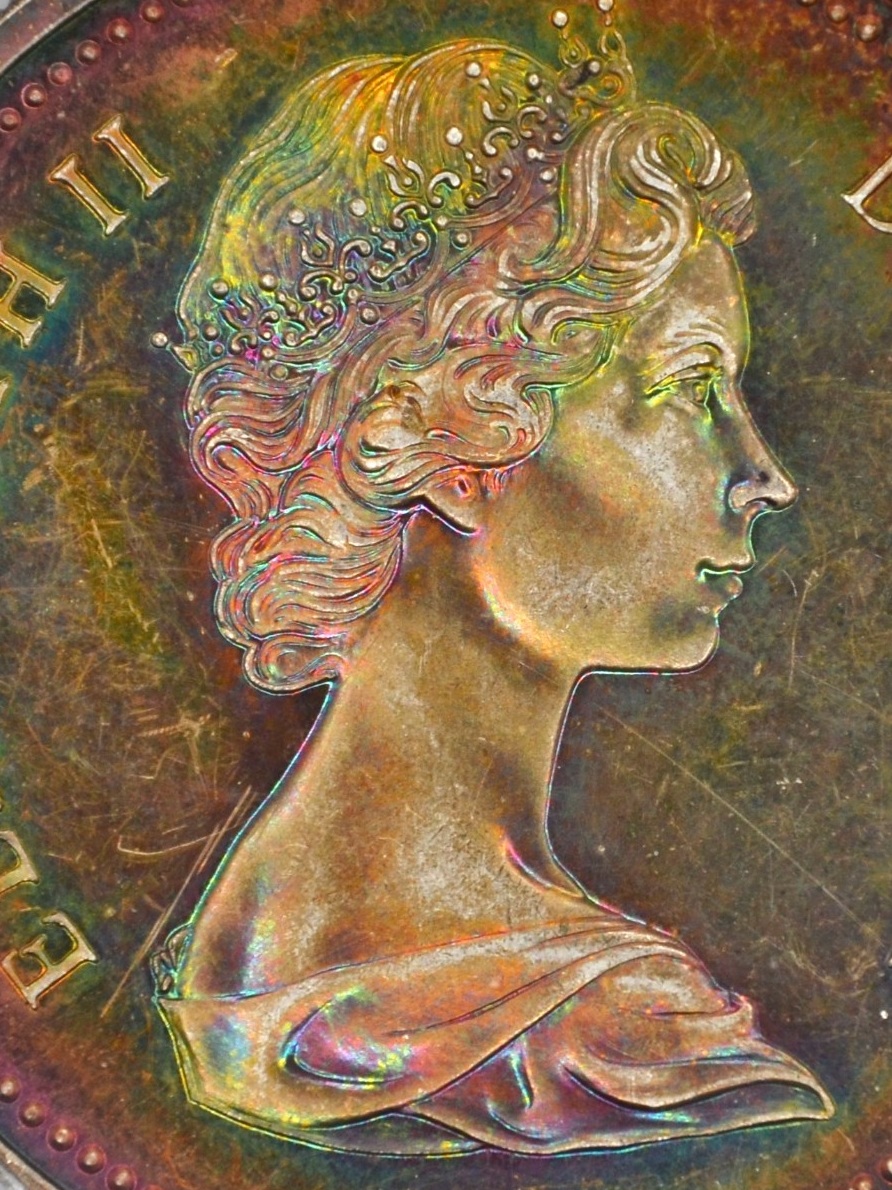
I've got hundreds of toned Morgan dollars, I've been buying them for years - I don't know anything about coins other than I have hundreds of them.
I've never seen anything like this SP62 Canadian Dollar that I just got. My goodness.
I try to buy one of every type of coin I see (if I like how it looks) without caring about the grade or rarity.
Morgans are pretty much the only one that I have hundreds of, I couldn't tell you what they are worth other than how much I think they are worth because of the toning.
I've a lot of "monster" Morgans, but a lot of the $400 range I like better than the actual monsters.
This coin pictured above, while not a monster, is something special. If a Morgan had this type of toning it would be a hundred thousand dollar coin (in my eyes)
@SciTechera I've been getting ready to digitize my possessions and have become a bit of a minimalist in preparation for a Ready Player One existence and just to have less physical strings holding me down from traveling and being flexible.
TBH, this is some of the tech I'm most excited for on a personal level. These glasses will obviously be as lightweight as existing eyeglasses.
The ability to play "GTA 8" using a "PS9" that is 1/2 as big as your current cellphone while being driven around Europe in an autonomous vehicle is literally heaven on Earth.
Even just autonomous travel is insane. Imagine when you go to sleep tonight, if you could wake up in Rome - traveling while you sleep.
These AR glasses inside museums and with instant translation? I'm just speechless about how great this future is looking. Robots, cheap goods, and all the time in the world with free access to information and travel.
I dunno. It is weird that Scott Bessent was part of the George Soros and Stanely Druckenmiller team that shorted the British Pound and broke the banks of England.
Some say Bessent noticed the weakness and was a major architect of that trade.
I have a hard time reconciling that level of knowledge and skill with the idea he doesn't know what's going on.
https://t.co/HgdCH3XxQW
@DA_Stockman Another Orange Swan event. Everyone's been looking at this Orange Swan outside the window for quite awhile, not taking it seriously. Not a Grey Swan, not a Black Swan - literally everyone can see the Orange Swan.
Hard to miss it bobbing around outside your window for so long now
@GoldFishCharts I can't believe how many stops this bus has made, and how many opportunities everyone's had to sidestep this whole mess.
It's been 3-4 years since we passed the Rubicon and these next few weeks are still going to smack these people in the face.
I see this too - them trying to set up Kharg as an operations base to both maintain security in the SoH and to run limited land operations with increased close air support.
This is inline with Trump's latest tweet - he thinks that once the threat of Iran is gone, he can dip out and let the GCC secure the SoH. I do think they try to take the island, to control the sale and flow of oil and to use it as an operation base.
I don't think there's a chance in Hormuz this works.
Thus, it looks like we will have an Orange Swan event. Everyone saw the swan out there window (and I mean everyone) but because the swan moved slow and hadn't broken things before, they disregarded it. Everyone is pretty much boiled frog at this point, about to get covered in swan shit.