At @thestablecon EMEA, @PelleB on the "open-face stablecoin sandwich" where one side of the transaction has already gone native.
Strongest stablecoin PMF? Markets where a USD stablecoin is preferred over fiat in a bank account. One conversion instead of two.
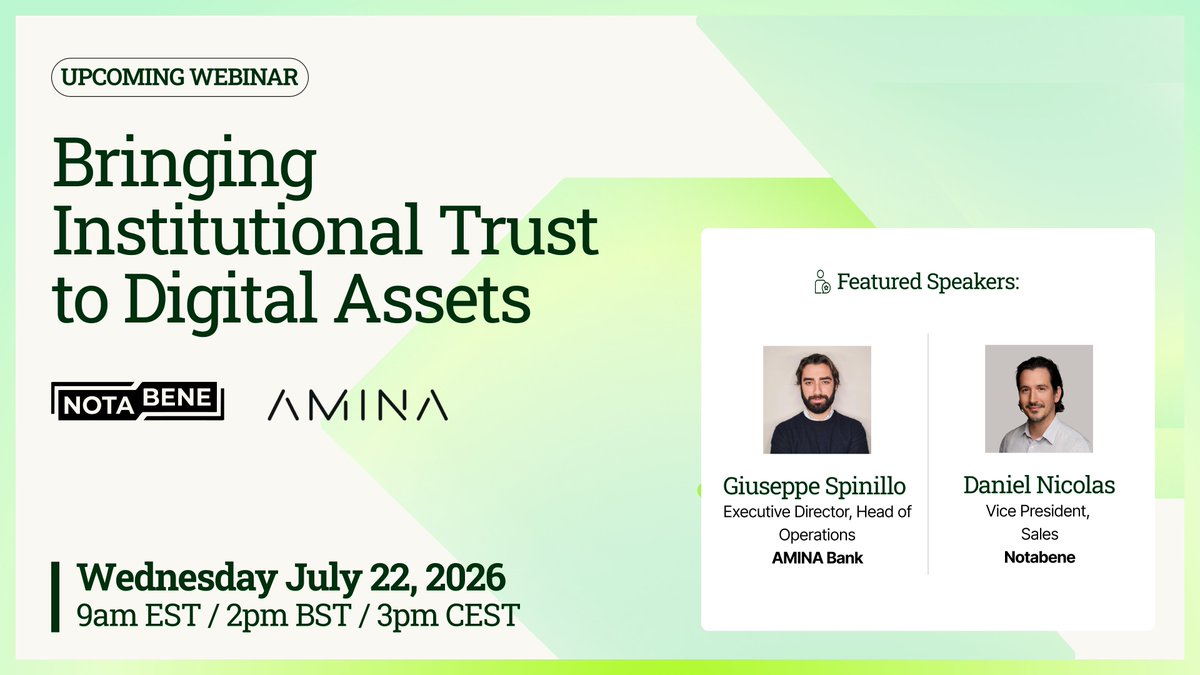
⏰️ 𝗧𝗼𝗺𝗼𝗿𝗿𝗼𝘄: Join @AMINABankGlobal and @notabene for a live discussion on what it takes to build digital asset services for regulated institutions.
𝗪𝗲'𝗹𝗹 𝗰𝗼𝘃𝗲𝗿:
🔐 Counterparty trust
⚡ Pre-transaction authorisation
🌍 MiCA, FINMA, FSRA & SFC
💵 Stablecoins
🔭 What's next
📅 22 July
🕘 9 AM EST | 2 PM BST | 3 PM CEST
Register: https://t.co/lYW5PiifKK
𝗪𝗵𝗮𝘁 𝗱𝗼𝗲𝘀 𝗶𝗻𝘀𝘁𝗶𝘁𝘂𝘁𝗶𝗼𝗻𝗮𝗹 𝘁𝗿𝘂𝘀𝘁 𝗶𝗻 𝗱𝗶𝗴𝗶𝘁𝗮𝗹 𝗮𝘀𝘀𝗲𝘁𝘀 𝗹𝗼𝗼𝗸 𝗹𝗶𝗸𝗲 𝗶𝗻 𝗽𝗿𝗮𝗰𝘁𝗶𝗰𝗲?
Join Notabene and @AMINABankGlobal for a discussion on counterparty confidence, pre-transaction controls, evolving expectations, and the infrastructure needed to operate at scale.
📅 22 July 2026
🕧️ 9am EST / 2pm BST / 3pm CEST
💻 Live webinar
🔗 Save your space today 👉️ https://t.co/0FBQ5Uz8iq
"You don't sell Wells Fargo dollars to buy Bank of America dollars."
@SamBroner (@bettermoney_co) on why stablecoin payments shouldn't require a trade — and what changes with clearinghouse infrastructure 👇
With all the chatter about stablecoin competition this week, one question keeps coming up: is there real demand beyond USDC and USDT?
@SamBroner from @bettermoney_co makes the case that there is, once infrastructure providers realize they can issue their own without losing interoperability. Yield, compliance, reserves — all in their control. A clearinghouse settles the rest.
140 companies backing an open stablecoin validates the thesis: open standards create network effects proprietary systems can't match. same logic applies to the trust and authorization layer. open money needs open infrastructure.
https://t.co/7Mx9OxDHsf
We’ve launched a new way to turn any invoice into a stablecoin payment link via Notabene Flow 🚀
No integration required. Just upload a PDF invoice, generate a payment link, and let your customer pay with stablecoins — settled instantly to the asset of your choice.
We invite you to watch the demo video below to see how it works, then try it out for yourself at https://t.co/CMwjO4BpgZ 👇
The crypto industry assumed transaction reversals were impossible. It turns out they're not — if the institutions on both sides already verify each other through the Travel Rule, you can build return-of-funds flows the same way traditional payments have for decades.
@PelleB explains in this clip from a recent podcast with our friends at @utila_io
you can invoice $789.87 in stablecoins, but market slippage means you won't receive exactly that. a clearinghouse settling at par fixes it. @SamBroner and I get into it on the latest Stack Chats
Let's say your customer wants to pay in USDC, but your treasury wants to hold RLUSD — @bettermoney_co's clearinghouse service will be able to handle that conversion at par directly within #NotabeneFlow. Any stablecoin, any chain, settled based on your preference at the exact amount invoiced.
Much more to come on what we're building together with The Better Money Company and Notabene Flow 🤝
@PelleB and @SamBroner explain how it works on the latest Stack Chats ↓
Stablecoins solved settlement. What SWIFT spent decades building was the coordination layer — counterparty trust, pre-authorization, business context that lets finance teams close the books. That's the gap the $120T B2B payments market needs closed before it moves to stablecoin rails, and that's exactly what #NotabeneFlow is built to do.
Have you downloaded our playbook for payment providers navigating the GENIUS Act?
We've mapped out the nine layers of infrastructure required for compliant B2B stablecoin payments and where PSPs, custodians, on/off ramps, and orchestrators each might have gaps.
tl;dr - the bottom of the stack (custody, settlement, routing) is commoditizing fast. The top of the stack (trust, compliance, authorization, reconciliation) is where the differentiation and true enterprise value lives.